Automatic Brick Making Machine Maintenance Checklist: Preventing Downtime in High-Humidity Climates
Why Humidity Demands a Different Maintenance Rhythm—Not Just More Frequent Checks
In high-humidity climates—think Southeast Asia, coastal India, southern China, or tropical Latin America—automatic brick making machine downtime isn’t usually caused by operator error, material inconsistency, or even mechanical wear. It’s triggered by moisture infiltration where it shouldn’t be: inside hydraulic reservoirs, behind control panel gaskets, beneath motor windings, and deep in the vibration table’s bearing housings. For maintenance technicians, this isn’t about doing the same checklist faster. It’s about reordering priorities, adjusting intervals, and accepting that “dry environment” assumptions built into most OEM manuals no longer apply.
The core insight isn’t new—but it’s routinely overlooked: humidity doesn’t just accelerate corrosion. It changes failure modes. A rusted solenoid valve may fail open instead of closed. Condensation on a PLC input terminal can cause intermittent false signals—not full lockout—making faults appear “intermittent” when they’re actually systematic and seasonal. And when ambient RH consistently exceeds 80%, even sealed hydraulic systems begin to breathe moisture through imperfect seals and thermal cycling. That means your standard quarterly oil analysis may miss water contamination until after emulsion forms and pump wear spikes.
What Actually Fails First—and Why Standard Intervals Mislead
Based on field service data from over 120 installations across humid zones (including Guangxi and Hainan), the top three failure points aren’t what most maintenance logs highlight:
- Hydraulic oil degradation: Not due to heat or particulate load—but because water content exceeds 200 ppm *before* visible cloudiness appears. At that level, additive depletion accelerates, and micro-droplets erode servo valve spools.
- Control cabinet insulation breakdown: Especially at terminal blocks and relay bases. Moisture + dust + voltage creates conductive paths that don’t trip breakers but cause erratic actuator sequencing—e.g., feeder gate opening mid-compaction.
- Vibration table bearing grease separation: High-humidity environments promote hydrolysis of lithium-based greases. The oil bleeds out, leaving dry, abrasive thickeners that accelerate cage wear—often misdiagnosed as “misalignment.”
Standard maintenance schedules—whether from OEM documentation or generic industry templates—assume relative humidity stays below 65% for >80% of operating hours. In reality, many sites operate above 75% RH year-round. That shifts the effective lifespan of critical components by 30–50%. For example, a hydraulic pump rated for 15,000 operating hours in a dry climate may show measurable internal wear after 8,000 hours in sustained humidity—*even with oil changed on schedule*.
A Climate-Specific Checklist: What to Do, When, and Why It Differs
This isn’t a longer list—it’s a reordered, condition-driven one. Focus shifts from “what’s worn” to “what’s wet,” and from scheduled replacement to moisture-state verification.
Daily: The Humidity Gate Check
Before startup, verify three things—not with a multimeter, but with direct observation and simple tools:
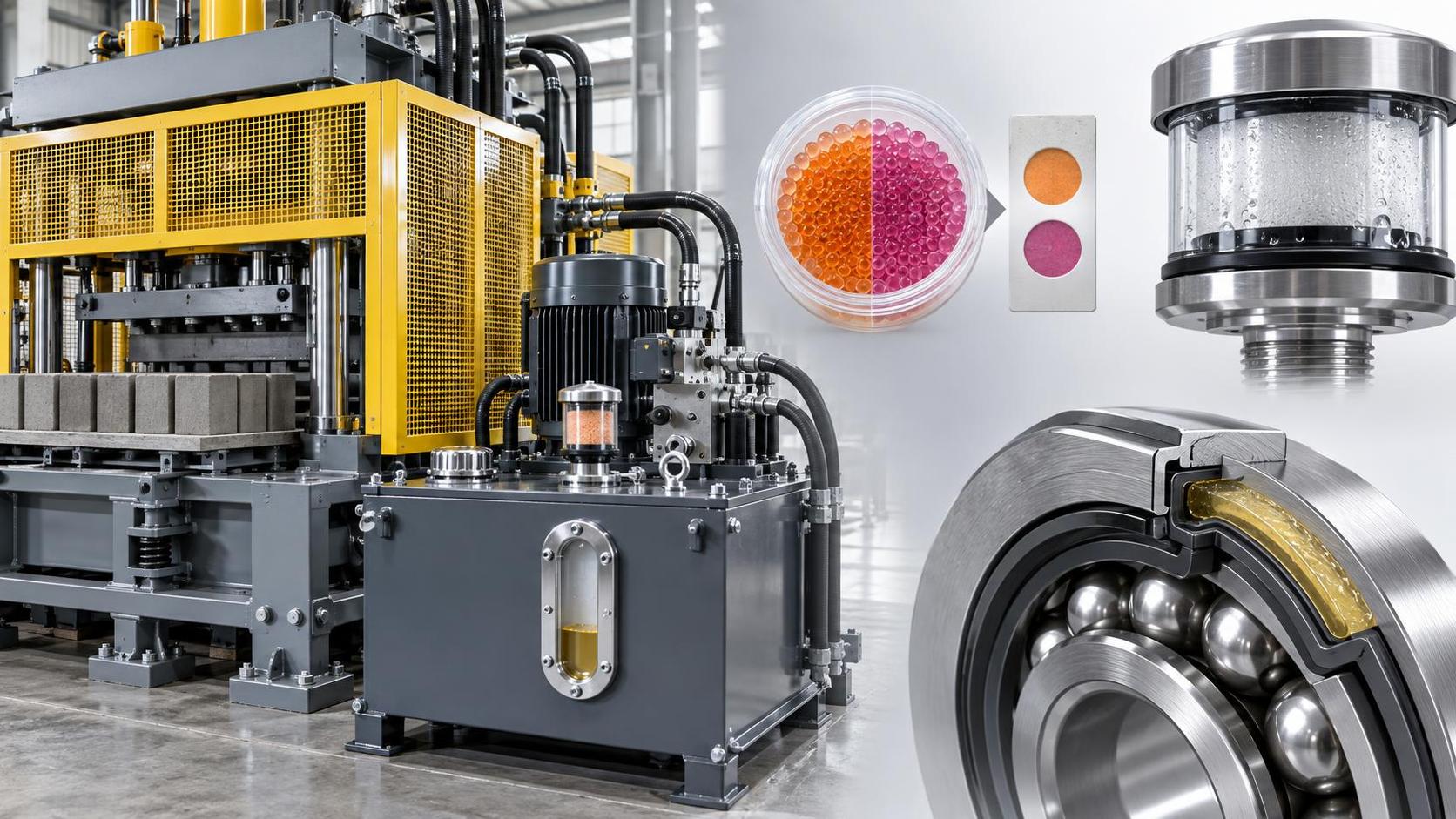
- Cabinet desiccant status: Replace silica gel cartridges if color indicator shows >50% saturation—even if not yet fully pink. Don’t wait for full change; partial saturation still allows moisture ingress during night cooldown.
- Hydraulic reservoir breather cap function: Remove and inspect the membrane. If it’s stiff, discolored, or shows white crystalline residue (salt deposits), replace immediately. A compromised breather lets humid air in during every thermal contraction cycle.
- Vibration table base plate drainage: Clear any standing water or debris from the perimeter channels. Water pooling here wicks upward into mounting bolts and bearing housings—especially after rain or high-dew-point nights.
Weekly: Targeted Moisture Detection, Not Just Cleaning
Go beyond wiping down panels. Use a calibrated handheld moisture meter (capacitance type, 0–100% RH range) on these surfaces:
- Inside control cabinet walls—especially near bottom edges where condensation pools;
- Motor frame surfaces near terminal boxes (not just the box itself);
- Hydraulic manifold mounting surfaces—moisture trapped between steel and painted housing accelerates pitting under vibration.
If readings exceed 70% RH *on the surface*, treat it as an early warning: inspect gasket integrity, verify cabinet door seal compression, and check for nearby steam or mist sources (e.g., curing chambers without proper venting).
Monthly: Proactive Fluid & Seal Intervention
This is where most programs fall short. Don’t just sample oil—test for water *first*, using field-test kits calibrated for 50–500 ppm range. If water exceeds 150 ppm:
- Drain and flush the entire hydraulic circuit—not just the reservoir—with ISO VG 46 anti-wear fluid containing hydrolytic-stable additives;
- Replace all O-rings on hydraulic cylinders and valves—even if visually intact. Standard nitrile degrades 3× faster at 85% RH than at 50% RH;
- Apply dielectric grease to *all* control cabinet terminal screws—not just connections, but screw threads and washers—to block moisture migration along metal surfaces.
When “Sealed” Isn’t Sealed Enough—And What to Upgrade Instead
Many automatic brick making machines ship with IP54-rated cabinets and standard industrial bearings. In humid climates, that’s functionally equivalent to “weather-resistant”—not “humidity-proof.” Upgrading isn’t about cost—it’s about avoiding cascading failures.
Key upgrades with proven ROI in humid operations:
- IP65-rated control cabinets with active ventilation: Passive vents equal moisture traps. Active systems with heated, filtered intake and timed exhaust prevent overnight condensation buildup.
- Bearings with polymer cages and calcium-sulfonate grease: These resist hydrolysis better than lithium-complex greases and handle thermal cycling without oil bleed.
- Hydraulic reservoirs with coalescing breathers and sight-glass water indicators: Not just “better filters”—they separate water vapor before it dissolves into oil.
Note: Retrofitting these isn’t always necessary—but delaying action until first failure *is* costly. One unscheduled shutdown due to hydraulic pump seizure typically exceeds the cost of a full breather system upgrade.
Final Note: Humidity Maintenance Is About Predictability, Not Perfection
No checklist eliminates all risk in high-humidity operation. But shifting focus from time-based to moisture-state-based maintenance restores predictability. You won’t stop dew formation—but you can stop it from becoming corrosion. You won’t eliminate condensation—but you can ensure it drains, not pools. And you won’t make electronics immune—but you can keep conductivity paths outside the circuit board.
That predictability is what separates reactive firefighting from true operational control. It’s why experienced technicians in humid regions don’t ask “How often should I check?” They ask “What moisture state tells me this component is entering its risk window?”—and structure their work around that threshold.