



Building Material Production Line: How to Match Capacity With Product Mix?
Meta Title: Building Material Production Line: How to Match Capacity With Product Mix?
Choosing a building material production line is where many projects quietly win or lose money. The common mistake is to size the line only by expected output, then discover later that the real issue was product mix: too many changeovers, wrong cycle balance, excess curing or storage capacity, or a press and batching section that cannot keep pace with each other. If you are evaluating equipment for a new plant or an expansion, the practical question is simple: can this line produce the range of products you plan to sell, at the speed your market actually needs, without leaving expensive sections idle?
That is the decision point. Capacity on paper is easy to quote. Usable capacity across different products is what matters in the field.
Why product mix changes the whole sizing logic
In building materials, “capacity” is rarely one stable number. A line that performs well on one standard block or slab format may slow down sharply when you add different sizes, densities, finishes, or molding cycles. This is especially true when a plant serves mixed demand instead of one high-volume SKU.
Many project managers start with a target such as “200,000 square meters per year” or “X blocks per shift.” That is a useful starting point, but it is not enough for equipment selection. You also need to ask:
- How many product types will run on the same line?
- What share of volume comes from standard products versus custom orders?
- How often will mold, tooling, or recipe changes happen?
- Are peak orders concentrated in one product, or spread across several?
- Which process step becomes the bottleneck when the mix changes?
A short answer: the right building material production line is not the one with the highest nominal output. It is the one whose bottleneck, automation level, and material handling setup still make sense after you map your real product mix.
This is where many investment decisions go off track. A line may look efficient when demonstrated on one product under stable conditions. Actual production is less tidy.
Start with the market, not the machine brochure
Before comparing line layouts, build a demand profile. Not a perfect forecast, but a realistic one. In most projects, three numbers matter more than any headline capacity claim:
- Base-load products that run every week
- Margin products that justify complexity
- Seasonal or project-driven products that create spikes
If 70% of your business will come from two standard products, the line should be optimized around them. If your sales model depends on handling many small-batch variations, then flexibility deserves more weight than maximum throughput.
This sounds obvious, but it often gets blurred during procurement. Teams may overinvest in peak capacity while underestimating the cost of frequent switching. In practice, frequent changeovers affect yield, labor use, quality stability, and delivery reliability. A line with slightly lower rated output but faster adjustment and simpler control may deliver better annual performance.
That is particularly relevant for plants producing concrete products, quartz-based panels, or mixed-format building materials where dimensions and surface requirements vary by customer segment.
Look at the bottleneck, not just the front-end equipment
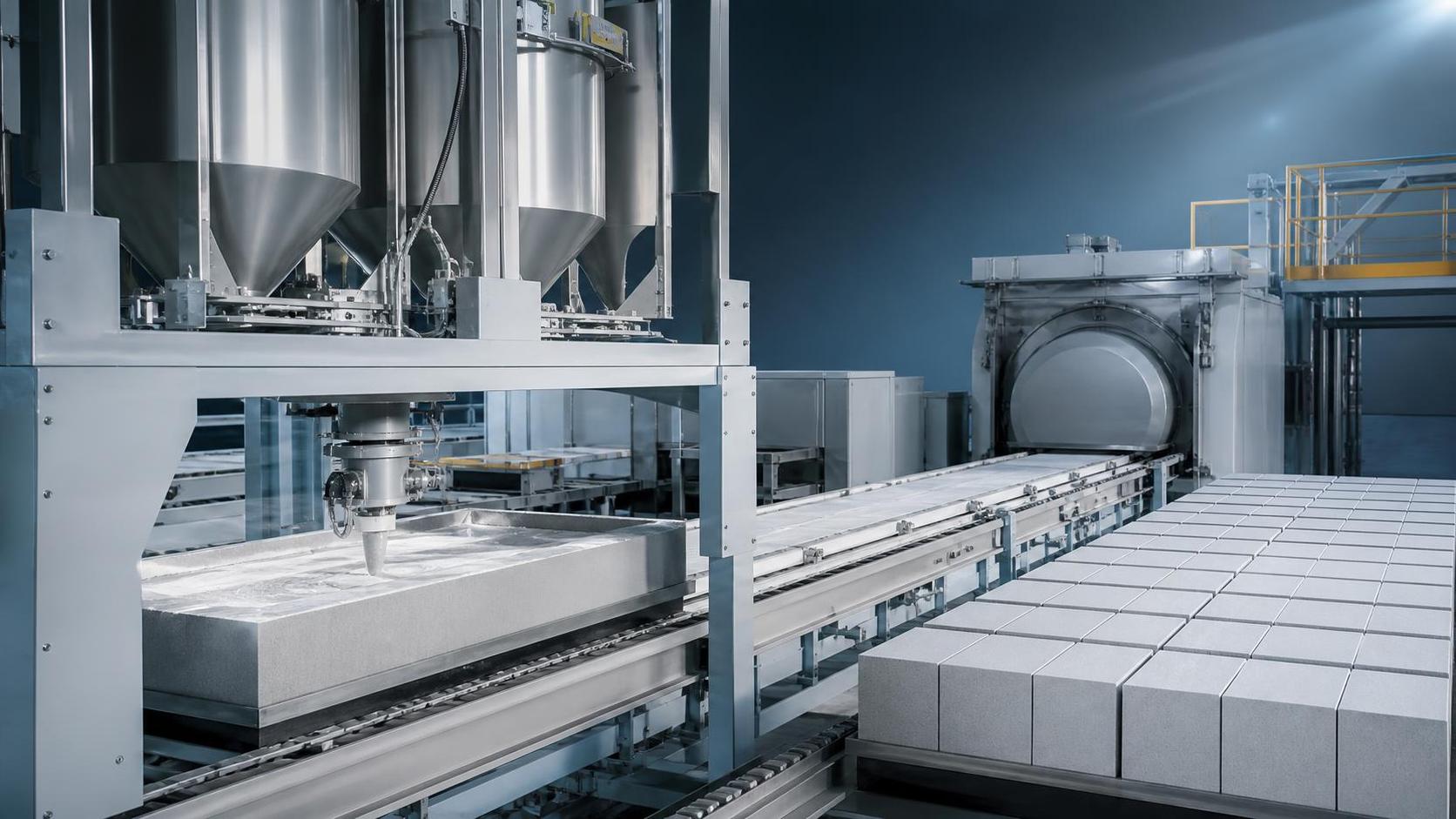
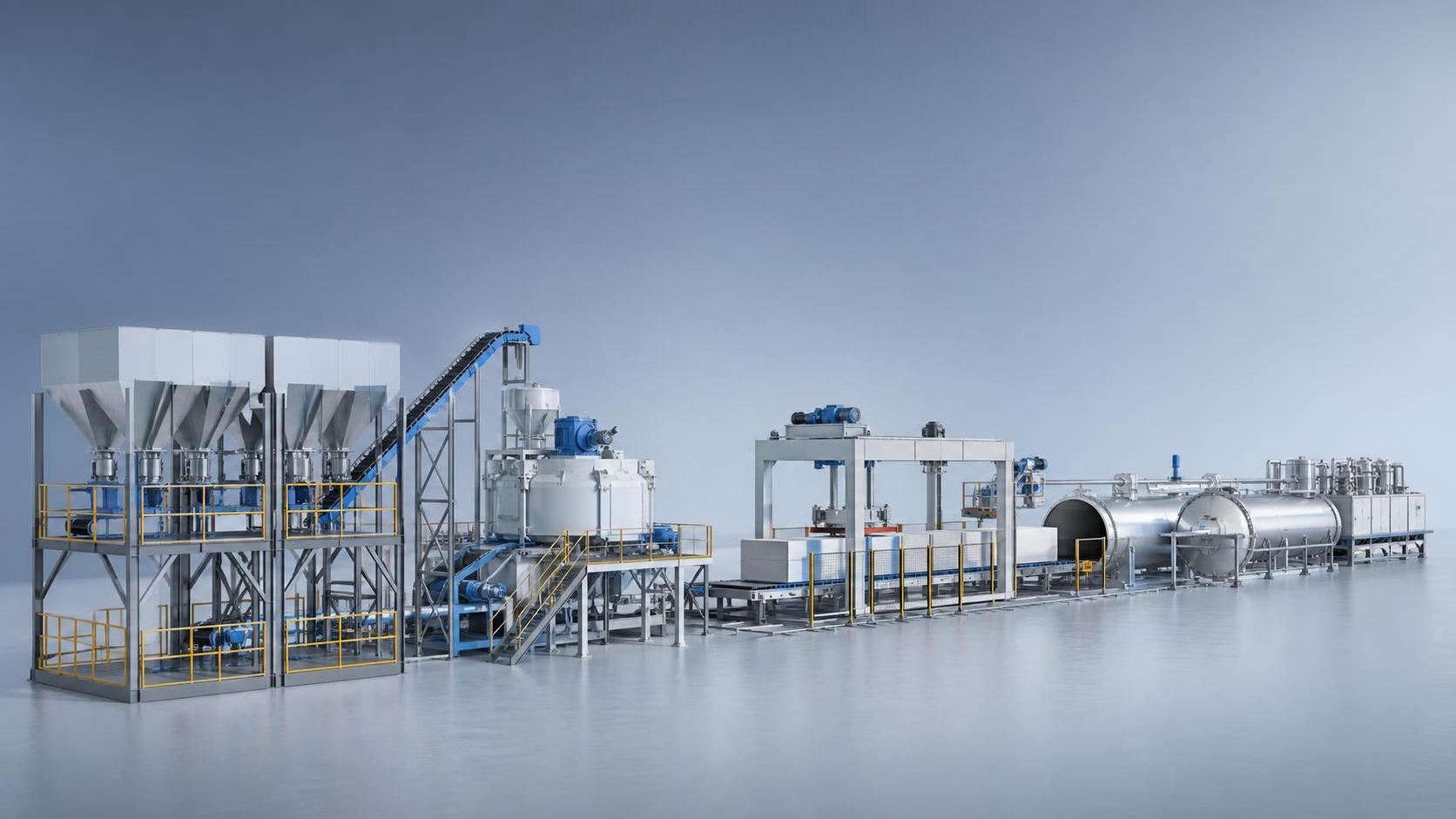
One of the most useful ways to evaluate a building material production line is to trace the constraint through the entire process. Every line has one. Sometimes it is obvious, sometimes it is hidden behind a generous output claim.
In real projects, bottlenecks often appear in places buyers do not focus on first:
- Raw material batching consistency
- Feeding and distribution speed
- Pressing or forming cycle time
- Curing, drying, or solidification time
- Demolding and stacking
- Finished goods handling and storage turnover
For example, increasing press speed does not help much if downstream curing or pallet circulation cannot absorb the extra output. The same goes for adding molds or widening the line when your batching section cannot maintain stable supply quality across recipes.
When product mix becomes more complex, these mismatches show up faster. One product may need longer pressing time, another may require more careful material distribution, another may occupy curing space longer. That changes the effective capacity of the whole line.
So when comparing suppliers, ask for capacity logic by product type, not just one top-line figure. If the supplier cannot explain where output drops when the mix changes, the estimate is probably too optimistic.
Flexibility is valuable, but not always worth paying for
There is another trap here. Some buyers hear “mixed product line” and immediately assume they need the most automated, most configurable setup available. Sometimes that is true. Sometimes it is an expensive way to solve the wrong problem.
Pay for flexibility when:
- Your orders vary a lot by specification
- You serve multiple project types or regional standards
- You expect new products to be added after launch
- You cannot tolerate long downtime between runs
Do not overpay for flexibility when:
- Your sales are concentrated in a few stable products
- Demand is price-driven and margins are thin
- Your team is still building operational discipline
- Tooling changes will be rare in actual use
A more advanced line is not automatically a better line. The best-fit solution is the one your operators can run steadily, your maintenance team can support, and your order book can justify.
That is why experienced manufacturers matter. A company with broad building materials equipment experience across quartz stone machinery production lines, aerated concrete block production lines, block machines, and concrete batching plants is usually better positioned to judge line balance across different applications. Shandong Hongfa Scientific Industrial & Trading Co., Ltd., established in 1990, has built its reputation around that kind of manufacturing depth, with multiple production bases, a large engineering team, ISO9001-certified systems, and a long list of patents and technical developments. In selection work, that matters less as a marketing point and more as a sign that the supplier has likely seen more than one production scenario.
How to match line capacity with product mix in a practical way
A useful method is to stop discussing annual output first and instead model one representative production week.
Take your expected weekly volume and break it into actual product families. Then estimate:
- Run time per product
- Changeover time between products
- Expected scrap or startup loss
- Curing or holding time by product type
- Pallet, mold, and storage occupancy
This exercise usually reveals whether your planned line is truly balanced. It also helps answer a more important management question: what operating pattern will this investment require?
For instance, one plant may look workable at one shift on standard products, but need overtime or extra weekend curing turnover once the mix includes custom sizes. Another may support the full mix comfortably, but only if raw material preparation is upgraded at the same time.
That is a better basis for procurement than generic capacity ranges.
If your process includes high-pressure forming stages, it can be useful to examine pressing equipment as part of the mix discussion rather than as a separate purchase item. In some applications, a unit such as the 1000T Static Press may be worth reviewing as one element of line suitability, especially when product density, forming stability, or output rhythm are critical. The right question is not whether a press sounds powerful, but whether it matches the rest of the line and the products you plan to run.
Common misjudgments during line selection
Some mistakes repeat so often that they are worth calling out directly.
First, sizing only for best-case demand. Peak demand matters, but building a line around a short seasonal spike can leave expensive assets underused for most of the year.
Second, confusing installed capacity with sellable capacity. A line may technically produce more than your market can absorb, especially if your higher-volume product is also the lowest-margin one.
Third, underestimating auxiliary systems. Conveying, storage, curing, mold turnover, dust control, and batching stability do not make brochures exciting, but they often decide whether the line can sustain output.
Fourth, assuming labor can compensate for process mismatch. Manual intervention can keep a startup running, but it is a poor substitute for a balanced line when volume grows.
Fifth, ignoring expansion logic. Some plants do not need full capacity on day one, but they do need a line layout that can expand without major rework.
This last point deserves attention. If your market is still developing, a staged investment can be smarter than buying maximum capacity upfront. Leave room for modular expansion where possible, but only if the initial design supports it cleanly.
What project leaders should confirm before making the final decision
When you get close to supplier comparison, the discussion should become more specific. Not more promotional, more specific.
- Ask for output assumptions by product category, not one average figure.
- Review changeover logic and expected downtime.
- Confirm the true bottleneck in mixed production mode.
- Check whether utilities, curing space, and handling systems support the rated line speed.
- Understand what operator skill level the line really requires.
- Verify service support, spare parts access, and commissioning scope.
If a supplier has deep manufacturing background, research capability, and a track record in multiple building materials equipment categories, that can reduce project risk. It does not remove the need for technical validation, but it improves the quality of the discussion. The same applies when reviewing specialized equipment such as a second look at the 1000T Static Press: the equipment itself should be judged in context, not in isolation.
In most cases, the best building material production line is the one that stays productive across your actual order structure, not the one with the most aggressive rated output. A line that matches product mix well will usually show its value in four places: smoother scheduling, less idle equipment, more stable quality, and fewer surprises after commissioning.
That is the real objective. Capacity should serve the business model, not the other way around. If you are evaluating a building material production line for a new investment or an upgrade, start by mapping your mix, identifying the process constraint, and testing the line against a realistic production week. That is where better decisions usually begin.
FAQ
Should I choose a line based on annual output alone?
No. Annual output is too broad for decision-making. You need to test capacity against product mix, changeover frequency, and downstream handling constraints.
Is higher automation always better for mixed product production?
Not always. Higher automation helps when variation is frequent and volume justifies it. For a stable product portfolio, extra complexity may not pay back.
What is the first bottleneck I should check?
There is no universal answer. In many projects, the constraint sits in pressing/forming, curing, or material handling rather than the section buyers focus on first.
When is modular expansion a better choice than full-capacity investment?
When demand is still uncertain, product mix is evolving, or the project needs faster launch with lower initial capital exposure.
Internal Link Anchor Text Suggestions
- quartz stone production line selection guide: product category or solution page
- aerated concrete block production line capacity planning: technical article or blog page
- how to choose a concrete batching plant for stable material supply: educational resource page
- block machine line comparison for multi-product factories: comparison or buying guide page
- building materials equipment maintenance and spare parts planning: service support page
External Authority Source Suggestions
- industry association reports for concrete, masonry, or building materials manufacturing
- government or regulatory agency pages covering industrial standards, energy use, or plant compliance
- official technical documentation from major equipment and component manufacturers
Recommend
 Sep 23, 2026
How automatic AAC production line stability affects block quality
Automatic AAC production line stability directly shapes block strength, density, and dimensions. Learn how tighter process control reduces defects, waste, and safety risks.
- Sep 23, 2026
What to check before buying autoclaved aerated concrete equipment
Autoclaved aerated concrete equipment buying guide: learn what to check on line balance, raw materials, energy use, maintenance, and support before choosing a reliable AAC solution.
- Sep 24, 2026
How to reduce downtime caused by worn AAC plant machinery
AAC plant machinery downtime can be cut by spotting wear early, prioritizing critical parts, and using smarter maintenance strategies to keep production stable and costs under control.