


What to check before buying autoclaved aerated concrete equipment
It usually starts with a practical problem rather than a technical one. A production project is moving forward, delivery dates are already being discussed, and someone is asked to source autoclaved aerated concrete equipment quickly. At that point, many buying decisions are made under pressure: compare a few quotations, look at nominal capacity, check whether the layout seems to fit, and move on. The trouble is that AAC production lines are not forgiving when key details are missed early. A machine that looks suitable on paper can create years of bottlenecks, unstable output, maintenance headaches, and avoidable operating cost.
Many people run into the same difficulty: the equipment list looks complete, but it is hard to tell whether the line will actually work well as a system. That is the real issue to solve before buying. When reviewing autoclaved aerated concrete equipment, the important question is not only “Can this supplier provide the machines?” but also “Will this configuration match the raw materials, plant conditions, target product, staffing, and maintenance reality?” A careful review before signing can reduce risk far more effectively than trying to fix mismatched equipment after installation.
Start with the production reality, not the catalog
A common mistake is to begin selection from the supplier’s standard model list. That feels efficient, but it often leads to reverse logic: the plant adapts to the machine, instead of the machine being chosen for the plant. Before comparing quotations, it helps to define the production conditions in plain operational terms.
For example, are you planning to produce blocks only, or also panels? Will the line handle one stable raw material source, or are the sand, fly ash, lime, and gypsum qualities likely to vary? Is steam supply already planned? How much workshop space is truly available once storage, access lanes, safety distance, and future maintenance space are considered? These points matter because AAC equipment performance depends heavily on process continuity. A line can be technically advanced and still be unsuitable if it is built around assumptions that do not match the site.
It is worth writing down your expected product range, daily output target, shift arrangement, available utilities, and raw material characteristics before discussing models. This simple step makes later supplier discussions much more useful, because capacity and configuration can be evaluated against real constraints instead of general claims.
Capacity should be checked as a full-line balance
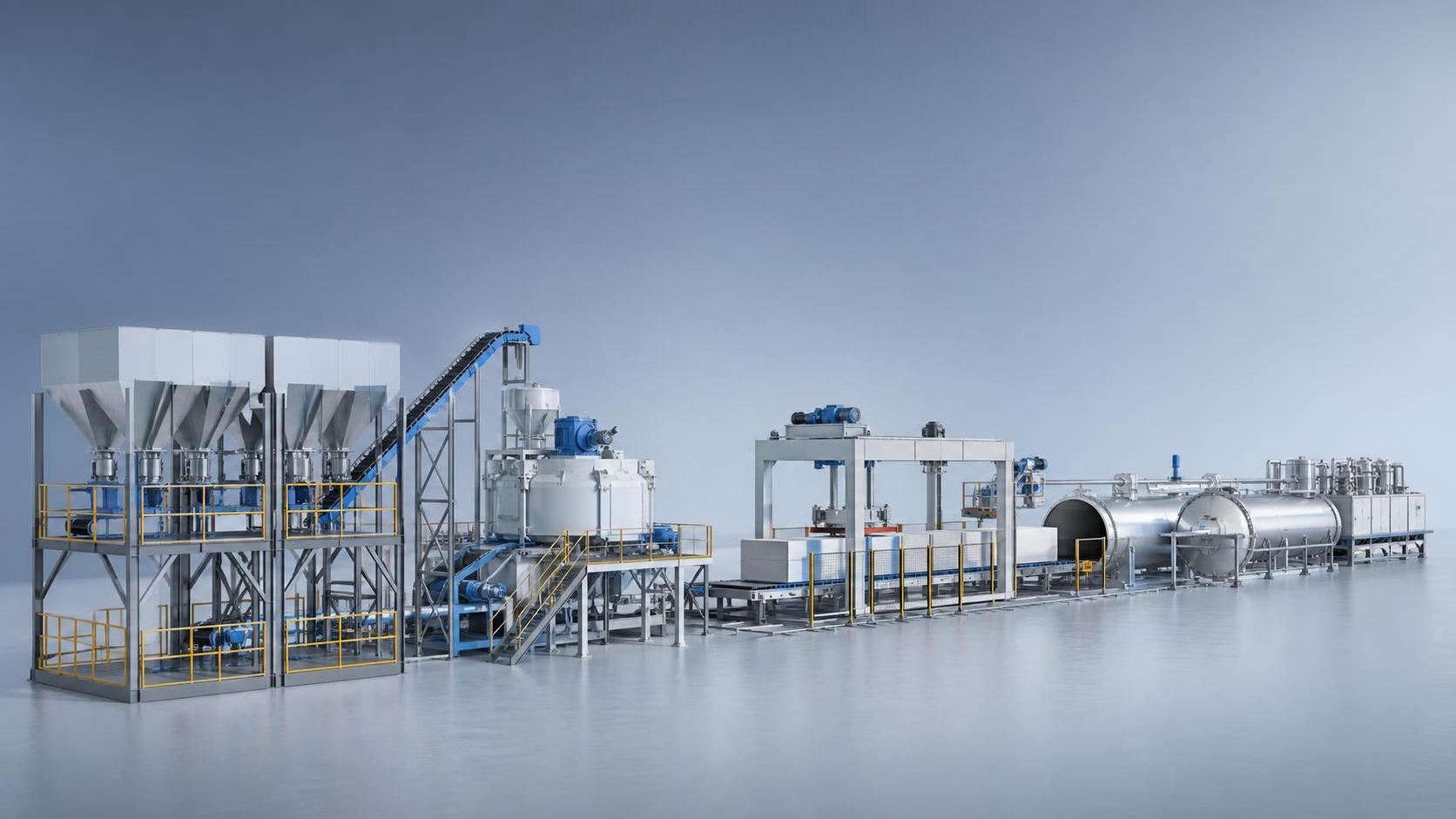
One of the most misleading buying habits is to compare single-machine capacity figures without checking whether the whole line is balanced. In AAC production, the slowest or least stable section will shape actual throughput. So when assessing autoclaved aerated concrete equipment, ask how each section connects to the next: raw material preparation, batching, mixing, pouring, pre-curing, cutting, grouping, autoclaving, unloading, and finished product handling.
If one section is oversized and another is marginal, the result is not efficiency. It is waiting time, interrupted flow, and unnecessary wear caused by stop-start operation. Procurement teams should ask suppliers to explain the rhythm of the line rather than only the peak performance of individual units. In practical terms, that means checking cycle time compatibility, mold turnover logic, curing coordination, and material transfer capacity between stages.
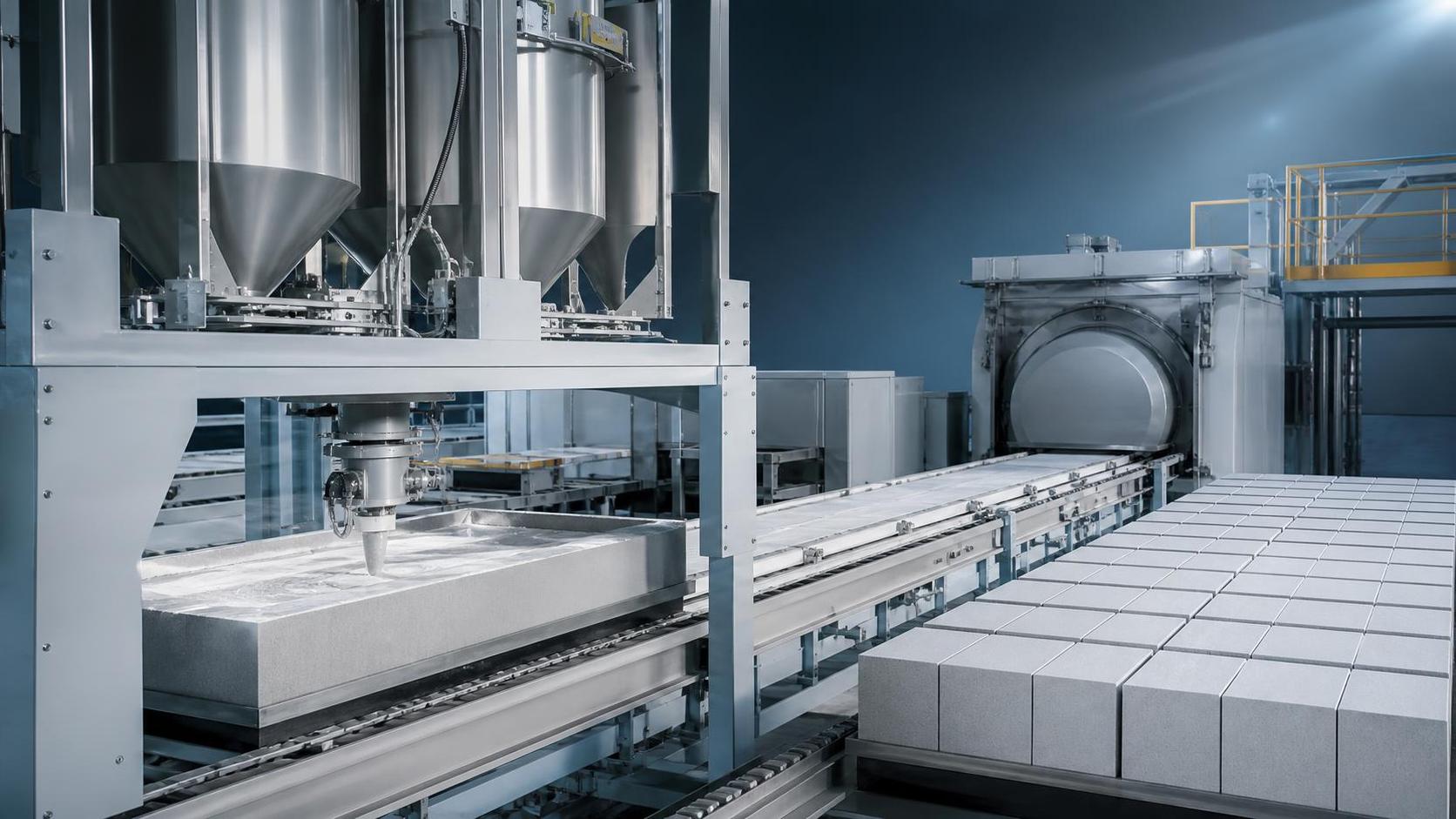
This is also where sub-equipment details matter. A pouring stage, for instance, affects slurry uniformity and process stability more than many first-time buyers expect. In some evaluations, it can be useful to look closely at components such as an AAC Pouring Mixer, because mixing and pouring consistency influence downstream cutting quality and product stability. It should not be treated as an isolated machine; its role has to be reviewed in relation to batching accuracy, timing, and mold handling.
Raw materials decide more than many buyers expect
Another frequent source of disappointment is assuming that AAC equipment can absorb wide raw material variation without process consequences. In reality, raw material properties affect grinding requirements, slurry behavior, reaction control, green cake strength, and final product consistency. Equipment should therefore be checked against the likely material range, not just the ideal sample.
If your plant may use fly ash in one period and sand in another, or if the fineness and moisture levels can shift, the line should be reviewed for adaptability. Ask direct questions about material preparation needs, feeding tolerance, mixing control, and whether the recommended configuration changes with different raw material routes. A serious review includes not only “what machine is included,” but “under what material conditions does this setup remain stable?”
It is also wise to verify what preprocessing burden falls on the plant. Some proposals look competitive until it becomes clear that significant upstream preparation is assumed but not included. Grinding, storage, dosing, or slurry conditioning gaps can turn a low initial quotation into a costly later adjustment.
Look beyond installed power and ask about real energy use
Energy efficiency is often discussed in broad terms, but buying decisions need a narrower view. Installed motor power alone does not tell you much about real operating consumption. Nor does a general statement that a line is “energy saving.” What matters is where energy is used, how consistently the process runs, and whether equipment design helps reduce avoidable waste.
For AAC production, this includes steam utilization, heat loss management, motor control logic, raw material preparation efficiency, and whether material transfer creates unnecessary repeated handling. Procurement teams should ask which parts of the line are the main energy consumers and what operating conditions most affect consumption. This changes the conversation from marketing language to engineering judgment.
It is also useful to ask how the line behaves under non-ideal conditions. Some systems appear efficient only when run continuously at their preferred load. If your actual production plan involves variable shifts, partial loads, or product changes, those conditions should be part of the review. A machine that is efficient only in perfect operation may not be the best decision for a plant with fluctuating demand.
Maintenance access is not a minor detail
When equipment is new, discussions tend to focus on commissioning and output. A year later, the real questions often become simpler: Can technicians reach wear parts safely? Are routine inspections easy or awkward? Does a small issue stop the whole line? Can local teams understand the maintenance logic without depending on emergency remote support every time?
These questions should be raised before purchase, not after installation. Ask to see maintenance points, replacement frequency for common wear items, lubrication requirements, and fault-prone areas that need regular attention. It is better to discover early that a design requires more maintenance discipline than your plant can realistically provide than to learn it after the line enters service.
Spare parts support deserves the same level of scrutiny. Not every part has the same urgency. Some can wait. Others can stop production immediately. Buyers should ask which spares are critical for startup stock, which parts are standard versus custom, and what the expected supply path looks like. A line can be technically sound and still become operationally weak if critical parts are slow or difficult to obtain.
Automation level should match the people who will run it
Higher automation is often assumed to be safer and more efficient, but the best choice depends on the operating team. If control systems are too complex for the available technicians, even a capable line may be underused or frequently overridden. On the other hand, too little automation can make process consistency difficult, especially in stages where timing and dosing matter.
The practical approach is to evaluate automation as an operating fit. Ask what parameters are automatically controlled, what requires manual intervention, how alarms are presented, and whether troubleshooting logic is clear enough for daily use. Also ask what training is needed and how long it normally takes operators and maintenance staff to become confident with the system.
Software and controls should not be treated as invisible extras. Version management, interface language, data access, and fault history records can all affect long-term usability. If production traceability matters to your plant, the control system should support that requirement from the beginning rather than through later patchwork upgrades.
Layout review should include movement, safety, and future changes
Many layout drawings look acceptable until someone imagines real operation inside the workshop. Forklifts need turning space. Steam and electrical routing need practical access. Operators need safe paths. Maintenance staff need room to dismantle components. Finished product flow should not cross with raw material handling if that can be avoided.
For this reason, layout review should not stop at “does it fit in the building.” It should ask whether the line can be operated smoothly every day. If plant expansion is possible in the future, check whether the equipment arrangement leaves room for modification. An arrangement that uses every corner of the workshop may look efficient during procurement and become restrictive later.
It is also reasonable to ask whether the supplier’s proposed layout reflects your site conditions or only a standard template. This can reveal how seriously the line has been matched to the project.
Technical support matters most when conditions are imperfect
Almost any supplier can sound reliable when discussing normal operation. The better test is to ask how support works when things are unclear: process instability, inconsistent raw materials, startup adjustments, operator errors, or unexpected stoppages. Buying autoclaved aerated concrete equipment is not only about hardware delivery. It is also about whether the technical side of production can be stabilized after the equipment arrives.
Useful questions include who provides commissioning guidance, whether process engineers are involved or only mechanical technicians, what training is included, and how troubleshooting is handled after handover. Support should cover process coordination, not just machine assembly. AAC lines depend on interaction between process conditions and equipment behavior, so purely mechanical after-sales support may not be enough.
If a proposal includes key process-stage equipment such as a second review of the AAC Pouring Mixer, the conversation should extend beyond dimensions and motor details. Ask how the supplier recommends setting operating parameters under different slurry conditions and what signs indicate that adjustment is needed. That kind of practical guidance is often more valuable than polished brochures.
Total cost is usually hidden in the gaps
Initial price matters, but it is rarely the full decision. Cost often grows in the spaces between what was assumed and what was specified. Foundations, utility connections, steam systems, cranes, startup consumables, spare stock, tooling, operator training, and integration work can all change the real investment picture.
That is why quotation review should be line-by-line and responsibility-by-responsibility. Buyers should confirm what is included, what is optional, what must be sourced locally, and what site conditions are assumed. Ambiguity is expensive. It is better to have uncomfortable clarification before the order than expensive clarification during installation.
Operating cost deserves the same attention. A lower-priced line may require more labor, more frequent maintenance, tighter raw material control, or more downtime tolerance. Those costs may not appear in the procurement sheet, but they become very visible in plant operation.
A more dependable way to make the decision
If you are comparing multiple suppliers, a practical method is to score them against your actual plant priorities rather than a generic checklist copied from another project. For some plants, raw material adaptability is the deciding factor. For others, it is maintenance simplicity, support depth, steam efficiency, or future expansion compatibility. The right weighting depends on the operating environment.
A good decision process usually includes four layers: confirm the product and output target, verify line balance, test the proposal against site and raw material conditions, and clarify support and ownership boundaries. If one of these layers remains vague, the purchase risk stays high no matter how attractive the quotation looks.
In the end, buying autoclaved aerated concrete equipment is less about finding the most impressive machine and more about avoiding mismatch. The safest choice is usually the one that can be explained clearly in process terms: why this configuration suits these materials, this site, this staffing level, and this production plan. When that explanation is solid, procurement becomes much less about guesswork and much more about control.
Recommend
 Sep 23, 2026
How automatic AAC production line stability affects block quality
Automatic AAC production line stability directly shapes block strength, density, and dimensions. Learn how tighter process control reduces defects, waste, and safety risks.
- Sep 23, 2026
What to check before buying autoclaved aerated concrete equipment
Autoclaved aerated concrete equipment buying guide: learn what to check on line balance, raw materials, energy use, maintenance, and support before choosing a reliable AAC solution.
- Sep 12, 2026
What market factors support investment in an AAC block plant?
AAC block plant investment is driven by energy-efficient building demand, faster installation, lower structural loads, and regional logistics advantages. Explore the key market factors.