



Can One Supplier Deliver an AAC Plant from Design to Commissioning?
Can One Supplier Deliver an AAC Plant from Design to Commissioning?
For many buyers in the industrial equipment and building materials machinery sector, this is not a theoretical question. It comes up when a project has a fixed schedule, a limited internal engineering team, and not much room for interface mistakes. A single supplier sounds attractive: one contact, one design logic, one delivery plan, one team on site. In an AAC plant project, that can be a real advantage. But only if the supplier is strong enough to carry the job beyond selling machines.
The short answer is yes, one supplier can handle an AAC plant solution from design to commissioning. The harder part is deciding whether that supplier should. In this industry, the difference between a smooth start-up and a painful one is often hidden in the details: raw material variation, plant layout, equipment matching, electrical control, curing conditions, and the quality of installation guidance. If any of those are handled casually, the plant may still run, but not in the way the buyer expected.
Why buyers prefer a single-source AAC plant solution
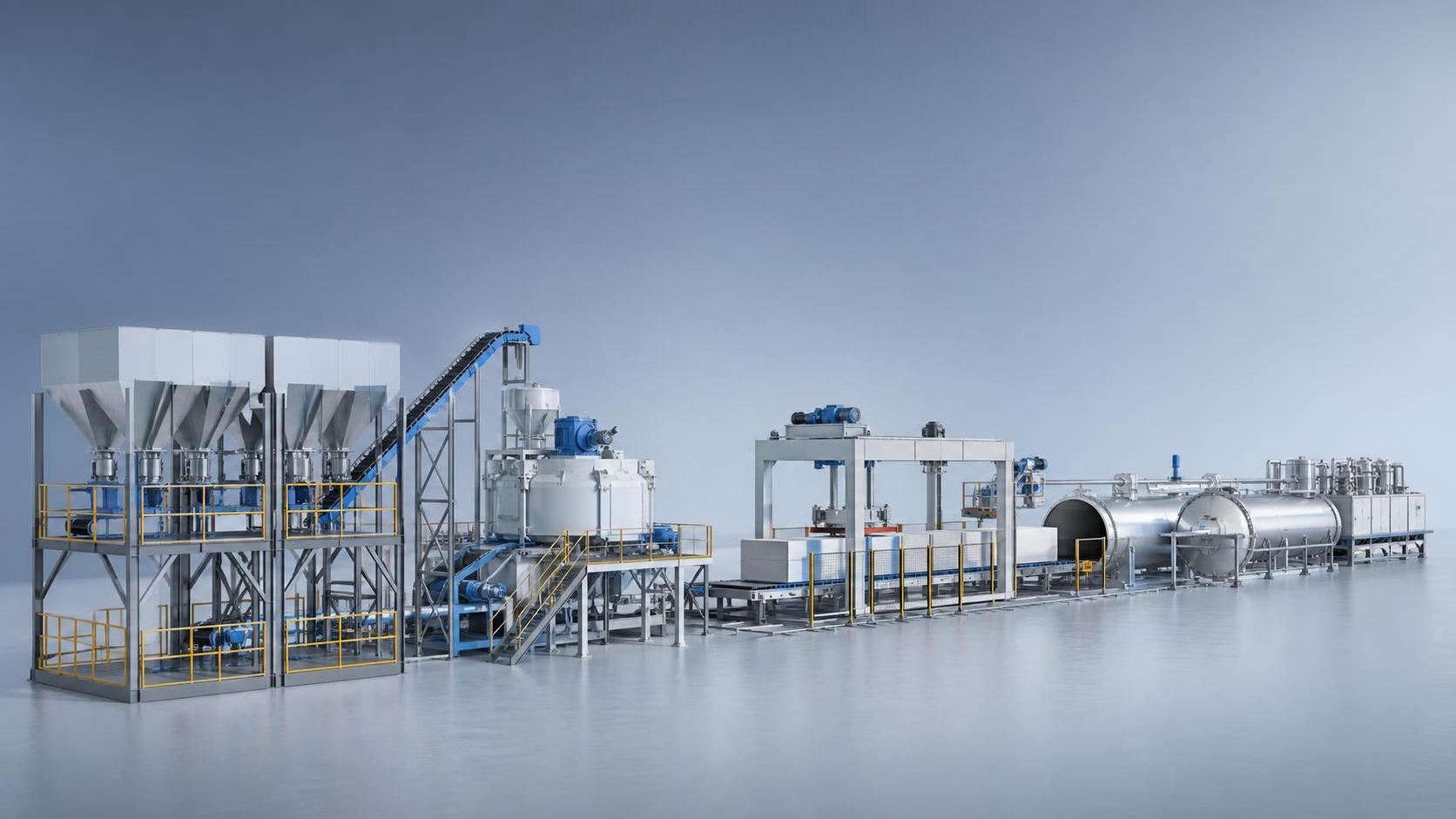
AAC projects are not like buying one standalone machine. The process chain is connected. Mixing, casting, pre-curing, cutting, autoclaving, and handling systems all affect each other. That means a supplier who only delivers equipment, without understanding how the line works as a whole, can leave the buyer with coordination gaps that show up later during installation or trial running.
A one-stop supplier reduces those gaps. The design team knows what the manufacturing team can actually build. The installation team understands the equipment layout. The commissioning engineers know where performance issues usually appear first. That sounds basic, but in practice it saves time because the buyer is not forced to coordinate between separate design institutes, machine makers, electrical contractors, and on-site supervisors who all interpret the project differently.
This is also where project risk changes. With multiple vendors, every delay becomes someone else’s responsibility. With one supplier, accountability is clearer. That does not automatically mean lower risk, but it does make problem-solving faster, especially when the project needs design adjustments after the foundation is already underway or when local installation conditions differ from the original plan.
What “from design to commissioning” really includes
The phrase is often used loosely, so it helps to separate the stages. Design is not just a drawing package. For an AAC plant, it usually involves process planning, capacity matching, building and equipment layout, utility planning, and the logic for material flow. If this part is weak, the plant may look complete on paper but become difficult to operate in real life.
Manufacturing is the next checkpoint. Here, the key issue is whether the supplier can produce the main equipment with stable quality and consistent fit. For AAC lines, mismatched interfaces between mixing, mould handling, cutting, and autoclaving systems can create hidden installation work. A supplier with in-house manufacturing depth usually has a better chance of keeping those interfaces under control than a broker who outsources each section separately.
Installation guidance and commissioning are where many projects are won or lost. A plant can be designed well and still underperform if alignment, leveling, electrical wiring, control tuning, and process parameters are not handled carefully. Commissioning is not just “turn it on.” It is a period of adjustment: confirming material behavior, checking cycle timing, stabilizing cutting accuracy, and making sure the line can keep running without constant manual correction.
When one supplier is the right choice
A single supplier makes the most sense when the buyer wants a coordinated project and does not have a strong internal technical team to manage separate contractors. It is also practical when the project schedule is tight. Fewer interface meetings usually mean fewer surprises, and the design can be adjusted around actual equipment capability instead of theoretical specifications.
This model is especially useful for buyers who are entering AAC production for the first time. They often need more than machinery. They need a partner who can explain how local raw materials may affect slurry behavior, why plant layout affects logistics, and how commissioning should be staged to avoid rushing into full-speed production too early. In that situation, an integrated supplier is not just convenient; it can be the difference between a manageable ramp-up and a costly learning curve.
It also suits expansion projects, where an existing line must be extended or upgraded. In those cases, interface control matters even more because the new section has to work with existing utilities, foundations, and operating habits. A supplier who understands the whole process is usually better positioned to make those adjustments without creating downstream bottlenecks.
Where the one-supplier model can go wrong
There is a common assumption that single-source delivery automatically means better results. In reality, it only works when the supplier has enough depth in engineering, manufacturing, and field support. If any one of those is weak, the buyer may still end up doing the hard coordination work internally.
A typical warning sign is a supplier that can present a neat proposal but cannot clearly explain the commissioning sequence. Another is a team that talks mostly about equipment price while avoiding questions about installation supervision, spare parts, operator training, or process tuning. In AAC projects, those “after delivery” items are not extras. They are part of whether the plant will actually stabilize.
There is also the issue of local conditions. Foundation quality, climate, raw material source, power stability, and labor skill levels can all influence commissioning. A supplier that treats every project as identical is risky, even if its equipment looks strong. The right partner should be willing to revisit the design when site conditions require it, not just push a standard configuration.
How to judge whether a supplier can truly do the whole job
Buyers usually get a clearer answer by asking practical questions instead of asking for promises. Can the supplier explain the full process flow in a way that matches the actual plant capacity? Do they have in-house engineering support for both equipment design and site commissioning? Can they describe how they handle installation guidance when local construction is delayed or when the site differs from the original layout?
It is also worth looking at whether the supplier has a manufacturing base, not only a sales office. In industrial equipment, production capability matters because design intent is only useful if it can be built reliably. For a company such as Shandong Hongfa Scientific Industrial & Trading Co., Ltd., which has long been involved in construction machinery and building materials equipment, that kind of integrated background is relevant. A supplier with multiple production bases, engineering staff, and accumulated process know-how is generally better positioned to connect design, fabrication, and site work into one project flow.
Still, even a strong supplier should be evaluated project by project. The fact that a company has broad manufacturing experience does not mean every AAC plant will be identical. Capacity target, product size, automation level, and local standards can all change the scope. A buyer should ask for the actual project assumptions behind the proposal, not just the headline equipment list.
A practical way to think about the decision
If you already have an experienced engineering team, separate sourcing may give you more flexibility. You can compare each component more aggressively and negotiate interfaces yourself. But if your priority is execution certainty, a single supplier often makes more sense, provided that supplier is genuinely capable of end-to-end delivery.
The best AAC plant suppliers do not just “sell a line.” They help reduce the number of unknowns before steel is cut, before concrete is poured, and before the first trial batch is cast. That matters because once the plant is on site, design mistakes become expensive to fix. In this business, the most valuable supplier is usually the one that can see problems before they turn into installation delays.
So, can one supplier handle an AAC plant solution from design to commissioning? Yes—but only if that supplier has real engineering depth, solid manufacturing control, and enough on-site experience to stay involved after delivery. If those pieces are in place, one-source delivery is often the cleaner route. If not, splitting responsibility may be safer than pretending a weak one-stop package will somehow sort itself out later.
Recommend
 Sep 23, 2026
How automatic AAC production line stability affects block quality
Automatic AAC production line stability directly shapes block strength, density, and dimensions. Learn how tighter process control reduces defects, waste, and safety risks.
- Sep 23, 2026
What to check before buying autoclaved aerated concrete equipment
Autoclaved aerated concrete equipment buying guide: learn what to check on line balance, raw materials, energy use, maintenance, and support before choosing a reliable AAC solution.
- Sep 24, 2026
How to reduce downtime caused by worn AAC plant machinery
AAC plant machinery downtime can be cut by spotting wear early, prioritizing critical parts, and using smarter maintenance strategies to keep production stable and costs under control.