How Do Semi-Automatic and Fully Automatic AAC Lines Compare?
How does a semi-automatic AAC line compare with a fully automatic one? The answer depends on your production targets, labor availability, budget, and plans for growth. While semi-automatic systems typically offer a lower entry cost, fully automatic lines can reduce manual handling and support more consistent, high-volume production. This article compares the two approaches across key factors, helping you choose an autoclaved aerated concrete (AAC) production line that fits your operational needs.
The difference is in the handoffs, not the AAC process
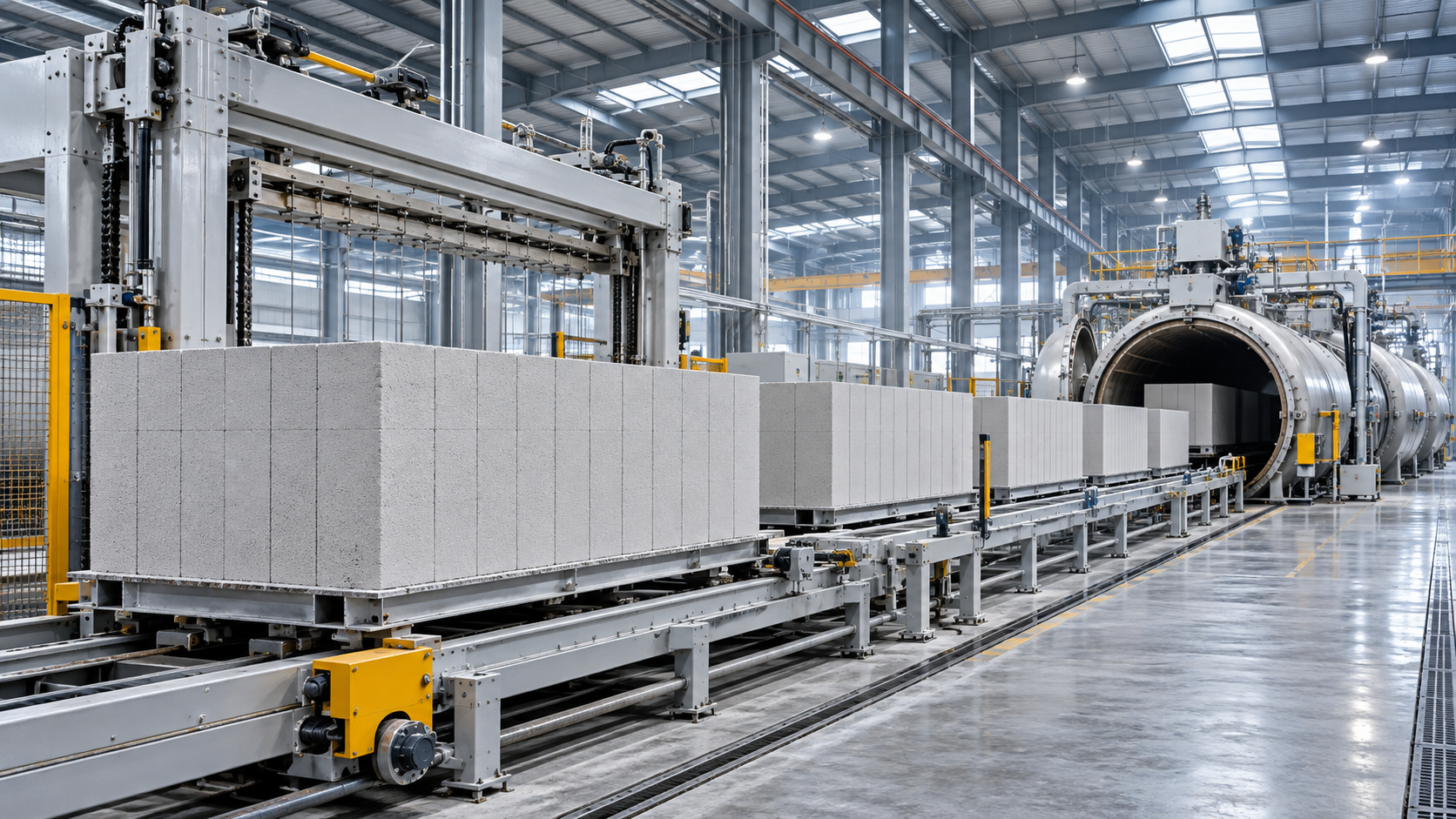
Both types of line follow the same basic production route. Raw materials are prepared and dosed, the slurry is mixed and poured into molds, and the material rises and gains enough strength for cutting. The cut cakes are then steam-cured in autoclaves before the finished products are separated, inspected and packed.
The distinction is how much of that sequence is controlled and moved automatically. A semi-automatic AAC line may use automated weighing and a powered cutting machine while relying more heavily on operators for mold handling, crane movements, autoclave loading or finished-block packing. A fully automatic line generally integrates more of those movements with programmed controls, sensors and conveyors.
Those labels are not standardized equipment lists. One supplier’s “fully automatic” proposal may still require manual inspection, forklift driving or strapping. Another may include automatic packing but leave raw-material feeding outside the quoted scope. Ask for a station-by-station description before comparing prices.
Where automation changes the working day
In a semi-automatic plant, operators often coordinate the transfer points: moving a mold into position, checking whether a cake is ready to cut, or organizing cured material for packing. This can work well when output is modest and the team has time to respond to variations in the process. It also means production depends more directly on operator availability and shift coordination.
A highly automated line reduces some of those repetitive interventions. Dosing sequences, cutting cycles and material transfers can be linked so that the next operation starts when equipment and safety conditions permit. This can make production flow more predictable, particularly over long shifts.
But automation does not eliminate the need for skilled people. Someone still has to manage recipes, inspect cutting wires, monitor steam systems, diagnose faults and maintain sensors. A smaller operating crew may be possible, but the maintenance team needs a different skill mix. Before deciding on a staffing model, ask the supplier which tasks remain manual and what training is included.
Capacity claims need a production schedule behind them
A fast mixer or cutting machine does not guarantee a fast plant. AAC production is a linked process, and output is constrained by the stages that take longest or have the least spare capacity. These can include pre-curing space, mold circulation, autoclave availability, boiler capacity and the handling of finished blocks.
For example, adding automatic mold handling may shorten transfers, but it will not make up for insufficient autoclave capacity. Likewise, an automatic cutting line can wait idle if the cakes have not reached suitable cutting strength. The practical question is not simply how many cubic meters a machine can process; it is how much saleable product the complete plant can produce under an agreed operating schedule.
When reviewing a proposal, establish whether the stated capacity refers to nominal machine throughput, annual production based on assumed operating days, or expected saleable output after downtime and losses. Confirm the assumed product dimensions, density range, shift pattern and curing cycle. Without those conditions, two capacity figures may not be comparable.
Upfront price versus the cost of running the plant
A semi-automatic configuration usually costs less to purchase because it may include fewer automated handling devices, sensors and control systems. For a new producer with uncertain demand, that lower initial commitment can be a sensible choice. It leaves more room in the budget for the building, utilities, working capital and the inevitable adjustments that accompany commissioning.
A fully automatic line generally requires a larger initial investment. Its economic case depends on using the equipment enough to recover that difference. Reduced manual handling may lower labor requirements per unit of output, but savings depend on local wages, actual staffing, maintenance costs and production volume.
Compare complete project costs rather than equipment prices alone. Autoclaves, steam generation, electrical supply, water treatment, foundations, cranes, dust collection, installation and operator training may be quoted separately. Transport and import costs also depend on the project location and contract terms.
A useful calculation is the additional investment for automation divided by the estimated annual net operating savings. Treat the result as a screening tool, not a guaranteed payback: it is sensitive to utilization, wages, downtime and the cost of financing. If the plant is expected to run well below capacity for several years, a highly automated configuration may take longer to justify.
Consistency depends on process control as well as machinery
Automatic dosing and repeatable cutting movements can reduce some sources of variation. That matters when a producer needs consistent dimensions or supplies customers with tight installation requirements. Less manual movement can also reduce opportunities to damage fragile green cakes before curing.
However, a control system cannot compensate indefinitely for inconsistent sand fineness, variable raw-material moisture, an unsuitable mix or poor curing practice. Operators must still check the material going into the process and the finished blocks coming out. Cutting at the wrong stage of green strength, for example, can cause damage even on a sophisticated line.
Product quality should therefore be discussed as a complete control plan: raw-material testing, recipe adjustment, measuring-device calibration, cutting-wire maintenance, curing records and finished-product inspection. The relevant product specifications and local requirements should be confirmed for the intended market; automation alone is not proof of compliance.
Maintenance and downtime: two different exposures
Semi-automatic equipment may be easier for a locally experienced mechanical team to troubleshoot, especially where the design uses fewer integrated controls. The trade-off is greater dependence on people at transfer points. Absences, inconsistent handling or slow coordination can interrupt the schedule even when the machines are available.
A fully automatic line adds components such as sensors, drives, programmable controls and communication links. A fault in one part of an integrated sequence can stop downstream equipment until the problem is resolved. That does not make automation unreliable, but it makes diagnostic access, spare parts and technical support more important.
Before signing, request a recommended spare-parts list, control-system documentation and a clear explanation of remote and on-site support. Check which components can be sourced locally, who owns the program backups, and whether maintenance staff will be trained to diagnose routine faults. Also ask how the line can be safely recovered after a power interruption or an emergency stop.
Choosing for today without blocking tomorrow
A semi-automatic line deserves attention when demand is still developing, capital is limited and a dependable operating team is available. It may also suit a project that values straightforward maintenance over the lowest possible labor input. The risk is buying too little capacity or leaving no practical route to expand once orders grow.
A fully automatic line is easier to justify when demand is established, the plant will operate consistently, and the owner can support a more integrated control system. It is particularly worth examining where repetitive manual handling is difficult to staff or where reliable flow across shifts is a priority. Even then, full automation across every station is not necessarily the best investment; some buyers may benefit more from automating a specific bottleneck.
A phased project can be a workable middle ground, provided expansion is designed in from the start. Reserve space for additional molds, handling equipment or autoclaves where appropriate, and check whether foundations, utilities and control interfaces can accommodate them. Retrofitting around a crowded layout or undersized steam system can erase the apparent savings of the initial purchase.
What to settle with the equipment supplier
Give prospective suppliers the same project brief: target products and dimensions, planned output, raw materials, available utilities, site constraints and expected shifts. Ask each one to identify manual operations, staffing assumptions, equipment exclusions and the basis for its capacity calculation. A process-flow diagram and equipment layout will often reveal differences that a headline quotation does not.
Shandong Hongfa Scientific Industrial & Trading Co., Ltd., established in 1990, produces construction machinery including AAC production lines. When discussing a configuration with Hongfa or another supplier, request a project-specific scope and confirm how the proposed handling, controls and curing equipment fit together. Historical company credentials should be checked against current documentation whenever they are relevant to a purchasing decision.
The most useful comparison ends with a realistic operating plan, not a choice between two labels. Identify the expected bottleneck, price the complete plant, and agree on what the supplier will demonstrate during commissioning. Then select the level of automation your team can operate and maintain at the output your market can absorb.
Next:No more content
Recommend
 Nov 10, 2026
How Do Semi-Automatic and Fully Automatic AAC Lines Compare?
How does a semi-automatic AAC line compare with a fully automatic one? Explore costs, capacity, labor and maintenance to choose the right solution for your plant.
- Nov 09, 2026
What Are the Import Requirements for Construction Machinery?
Understand building machinery import requirements, from customs documents and duties to safety compliance and installation, before you ship.
- Nov 09, 2026
How Accurate Is an AAC Batching System?
Compare AAC sand grinding equipment cost and learn what affects batching accuracy, from slurry control to calibration, before investing in your production line.