



What Does Construction Machinery Include in Modern Building Material Projects?
People searching this topic usually are not asking for a textbook definition of construction machinery. In modern building material projects, they are often trying to understand something more practical: which machines actually shape production capacity, where the cost and quality risks sit, and how equipment choices affect a project long after installation. That matters because in today’s market, building material production is no longer just about having a mixer, a press, or a cutting unit. It is about building a coordinated production system that can meet output targets, quality requirements, energy expectations, and delivery schedules at the same time.
In that sense, construction machinery in modern building material projects includes a broad range of equipment used not only on the construction site, but also upstream in the manufacturing of blocks, panels, slabs, and prefabricated materials. For researchers, sourcing teams, and investors, this broader view is the useful one. It explains why machinery decisions are increasingly tied to process design, plant layout, automation level, and even product positioning in the market.
Construction Machinery Is No Longer Limited to Site Equipment
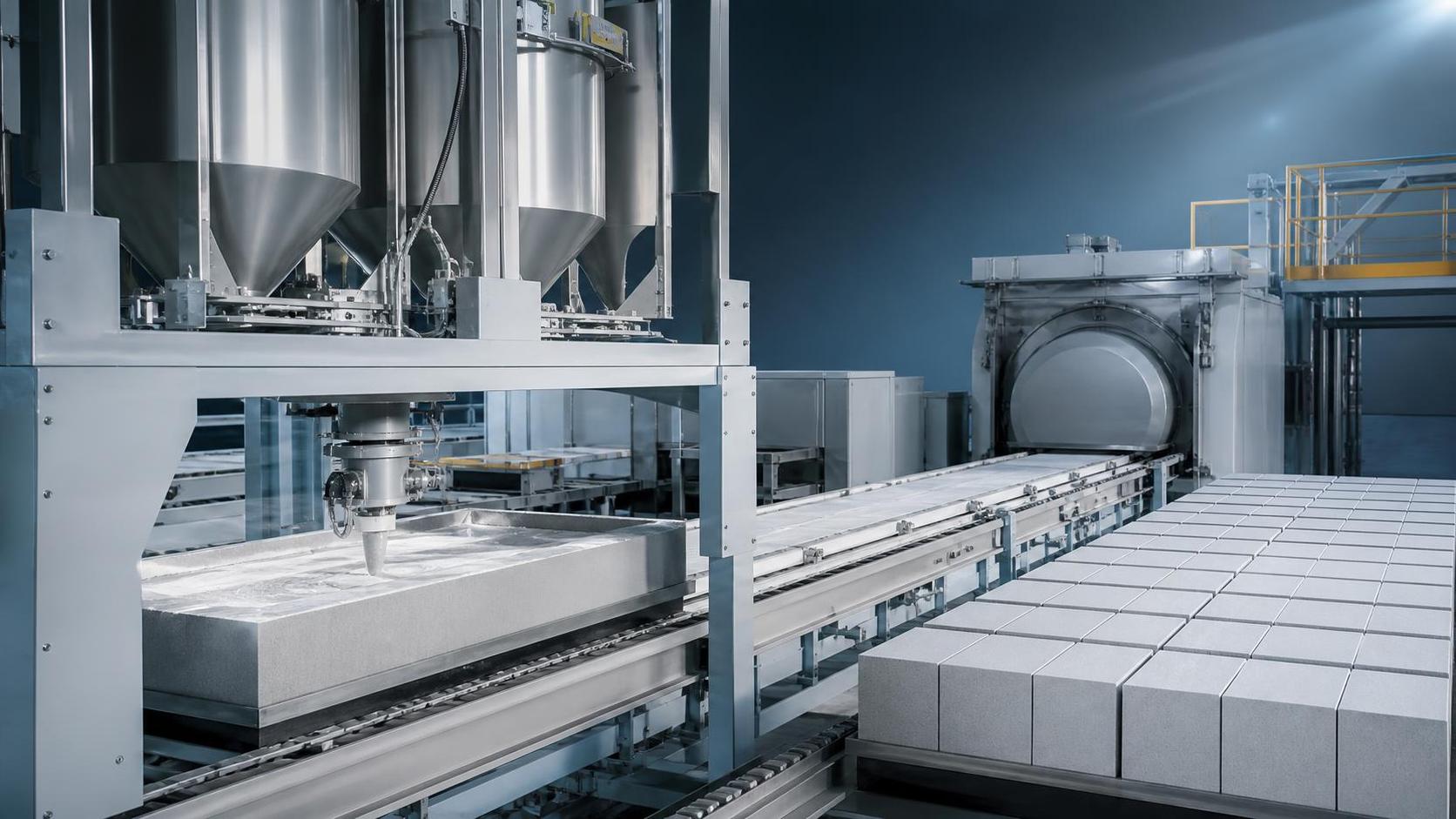
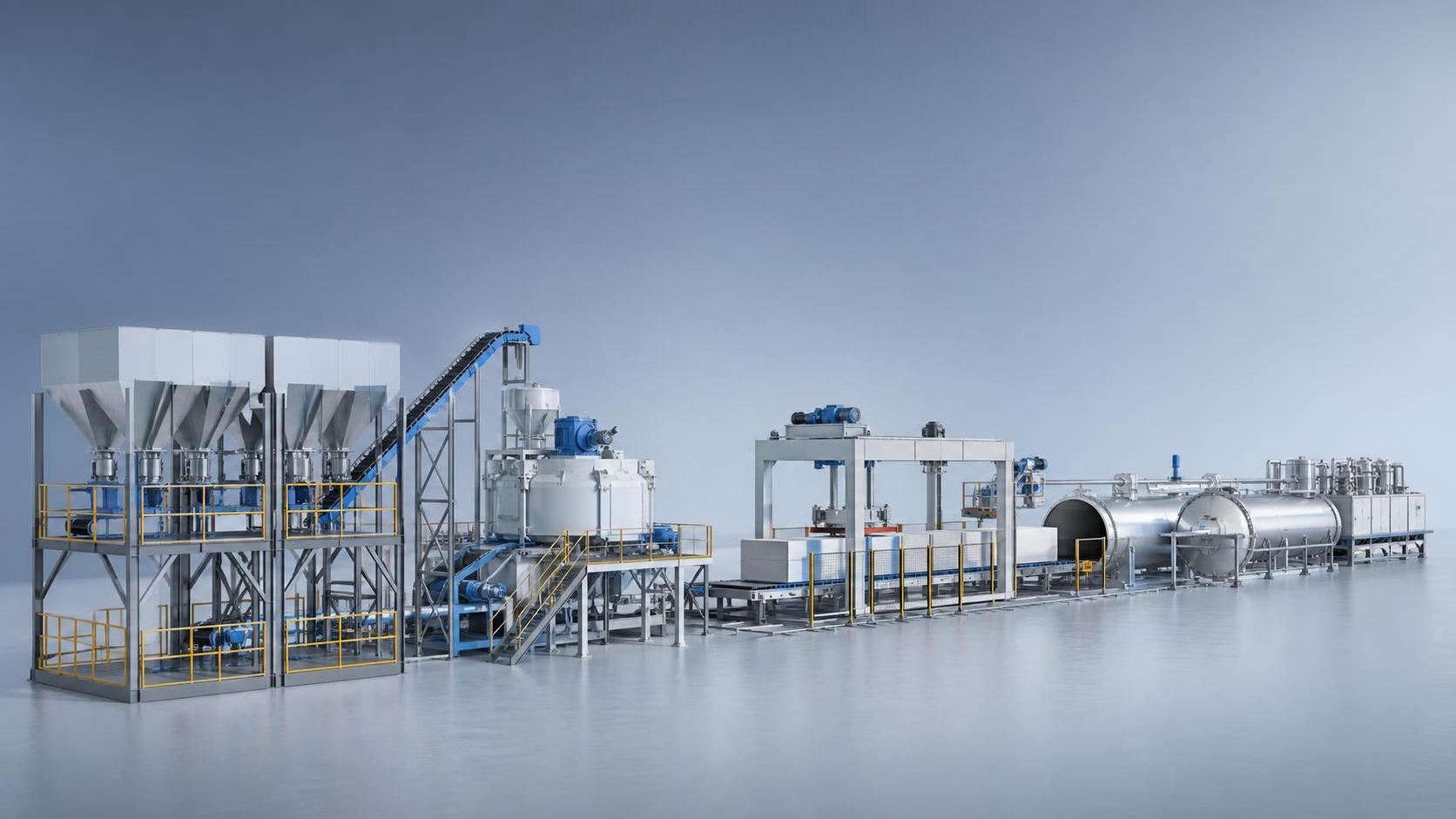
When people hear “construction machinery,” they often think first of excavators, cranes, loaders, or concrete mixers. Those machines remain essential in many building projects, but in modern building material production, the category extends much further. It includes the machinery that manufactures the materials feeding the construction chain: block machines, concrete batching systems, autoclaved aerated concrete lines, static presses, cutting and polishing systems, curing equipment, palletizing units, and control systems that keep the whole process stable.
This distinction is important. In traditional project thinking, equipment was often divided into “production machinery” and “construction machinery” as separate worlds. In actual industrial practice, the line is much less rigid. A building material producer evaluating a new plant does not only ask, “What machine makes this product?” The real question is, “What machinery package is required to deliver reliable output at the required quality and cost?”
Core Machinery Categories in Modern Building Material Projects
For most modern building material operations, construction machinery can be understood through several functional categories.
1. Raw Material Handling and Preparation Equipment
Every production line starts here. Raw materials such as cement, sand, lime, aggregates, fly ash, quartz, or additives must be stored, conveyed, measured, crushed, screened, or blended before they enter the forming stage. Belt conveyors, screw conveyors, silos, feeders, crushers, and batching hoppers all belong to this part of the machinery chain.
This category is easy to underestimate because it is less visible than the main forming machine. But many production problems actually start upstream. Inconsistent feeding, poor weighing accuracy, contamination, or unstable moisture content can lead to defects that no downstream machine can fully correct.
2. Mixing and Batching Systems
Concrete batching plants and material mixing systems are among the most important equipment groups in building material projects. They influence consistency, throughput, and production rhythm. In block production, slab manufacturing, or aerated concrete systems, batching accuracy directly affects compressive strength, density, curing performance, and waste rates.
For information researchers, one useful rule is this: a batching system should not be judged only by nominal capacity. Control precision, maintenance accessibility, cleaning difficulty, and compatibility with local raw materials are often just as important. A plant with strong theoretical output but weak batching stability may create more downtime and rework than a smaller but better-integrated line.
3. Forming and Pressing Machinery
This is usually the center of the production line. Depending on the product category, forming machinery may include block machines, hydraulic presses, static presses, vibration molding systems, slab presses, or extrusion units. These machines determine shape accuracy, density distribution, and often the visible surface quality of the final material.
For example, in high-pressure forming applications, a machine such as a 1000T Static Press may be relevant where producers need dense, dimensionally stable formed products. The point is not the model itself, but what it represents in procurement logic: pressing capacity must match the material recipe, mold design, output target, and downstream curing or finishing process. Buying “more tonnage” does not automatically mean better economics if the rest of the line cannot support that capability.
4. Curing, Autoclaving, and Thermal Processing Equipment
In many modern material projects, product performance depends heavily on what happens after forming. Aerated concrete blocks, for instance, rely on curing and autoclaving stages to achieve the intended structure and strength. Other products may require drying chambers, steam curing rooms, kilns, or controlled-temperature systems.
This stage has a direct link to energy efficiency. It is also where operating cost assumptions can drift away from reality. A production line may look attractive during equipment selection, but if the curing system is not optimized for local utility costs, actual production economics can become much less favorable than expected.
5. Cutting, Finishing, and Surface Processing Machinery
As building material products move toward higher value and tighter dimensional standards, finishing machinery becomes more important. This includes cutting systems, edge processing, grinding, polishing, trimming, and surface treatment equipment. Quartz stone production is a clear example, where line performance depends not only on slab formation but also on the precision and consistency of downstream finishing.
For buyers, this is where “capacity” and “marketability” intersect. A line can produce volume, but if cutting accuracy or surface finish quality does not meet buyer expectations, sales performance may still suffer. Machinery decisions therefore have to be tied to the product segment being targeted, whether commodity-grade output or premium decorative materials.
6. Packaging, Palletizing, and Material Transfer Systems
These machines rarely drive the sales conversation, but they strongly influence labor intensity, damage rates, and plant efficiency. Palletizers, stackers, robotic handling units, transfer cars, and packaging systems reduce manual handling and help standardize outbound quality.
In projects with export ambitions or long transport distances, packaging machinery deserves more attention than it often gets. Breakage, chipping, moisture exposure, and unstable stacking can erase margins after production is complete.
7. Automation and Control Systems
Modern construction machinery is increasingly defined by its control layer. PLC systems, recipe management, sensor feedback, remote diagnostics, production tracking, and quality monitoring all affect how a line performs in daily use. Two production lines with similar mechanical structures can differ sharply in actual output and labor requirements because of differences in automation design.
This is one reason experienced buyers look beyond the machine list. They want to understand how the equipment communicates across the line, how faults are diagnosed, and whether process data can be used to improve consistency over time.
Why the Machinery Mix Depends on the Product, Not Just the Factory Size
One common misunderstanding is that larger projects simply require more machines or bigger machines. In reality, the machinery package depends more on product type, process route, and quality goals than on plant size alone.
A block production project may prioritize mold flexibility, fast cycle times, and pallet handling. An aerated concrete plant will focus more on slurry preparation, pre-curing, cutting precision, and autoclaving coordination. A quartz stone line has different requirements again, especially around pressing, slab handling, curing, calibration, and finishing.
That is why serious equipment assessment starts with product logic. What is being produced? What standards or customer expectations must it meet? How variable are the raw materials? What level of automation is realistic for the workforce available? Without those answers, a machinery list is just a list.
What Buyers and Researchers Should Actually Evaluate
For readers in the research stage, the most useful way to understand construction machinery is to connect equipment categories with decision risks.
- Process compatibility: Machinery should fit the material formula and the intended product range, not just match a catalog description.
- Capacity balance: The line is only as strong as its bottleneck. Over-specifying one machine while under-specifying conveyors, curing, or finishing units creates hidden inefficiency.
- Quality control: Stable output depends on weighing accuracy, mold quality, press control, curing consistency, and maintenance discipline.
- Energy and operating cost: Energy-intensive stages such as curing, heating, or pressing need careful review, especially where utility costs are volatile.
- Maintenance and spare parts: A technically capable line can still underperform if spare parts lead times are long or maintenance requires highly specialized support.
- Technical service and commissioning: Installation, operator training, and troubleshooting support often determine whether a line reaches planned output on schedule.
In the building materials machinery segment, manufacturers with a long production history and integrated engineering capability often have an advantage here. Companies such as Shandong Hongfa Scientific Industrial & Trading Co., Ltd., which has developed multiple product lines across block machinery, concrete batching plants, quartz stone machinery, and aerated concrete systems, illustrate how the market has moved toward system-level suppliers rather than single-machine sellers. For buyers, that does not remove the need for due diligence, but it does change what good due diligence looks like: less focus on headline specifications alone, more focus on process integration, engineering depth, and long-term serviceability.
Common Assumptions That Deserve a Second Look
Several widely repeated ideas about construction machinery are only partly true in real projects.
“Higher automation always means better performance.” Not necessarily. Automation adds value when the plant has the technical support, operator training, and process discipline to use it well. In some markets, a simpler and more robust configuration may outperform a more advanced line that local teams cannot maintain efficiently.
“The main machine determines everything.” It often gets most of the attention, but line performance depends on the weakest connected stage. A high-capacity press paired with unstable batching or poor curing control will not deliver its theoretical value.
“Capacity figures are directly comparable.” They often are not. Output claims may depend on material type, cycle assumptions, product size, automation level, or ideal operating conditions. Any comparison should be treated carefully unless the basis is clearly defined.
“Certification equals low risk.” Certifications such as ISO-related quality systems can be useful indicators, but they are not a substitute for checking engineering execution, installed references, spare parts planning, and after-sales support. Claims around standards and certifications should be verified case by case, especially when they are central to procurement decisions.
How the Category Is Evolving
Modern building material projects are pushing construction machinery in several clear directions. One is higher integration: instead of buying isolated units, buyers increasingly want coordinated lines. Another is energy performance, driven by cost pressure as much as sustainability goals. There is also stronger interest in production flexibility, especially where demand can shift between product types or specifications.
Digital monitoring is another area to watch, although implementation quality varies. Remote diagnostics, fault alerts, and production traceability can improve uptime and quality control, but only when they are supported by usable interfaces and responsive service teams.
Meanwhile, pressure is growing for equipment to support more consistent output with less waste. In practical terms, that means better batching accuracy, tighter forming control, and more predictable curing or finishing stages. The machinery market is responding, but not all solutions marketed as “advanced” will deliver the same value in every operating environment.
A Better Way to Read the Term “Construction Machinery”
In modern building material projects, construction machinery should be read as a production ecosystem rather than a narrow equipment label. It includes the machines that store, meter, mix, form, cure, cut, move, and package the materials that construction depends on. More importantly, it includes the control logic and engineering coordination that connect those machines into a reliable manufacturing process.
For an information researcher, that broader definition is the one worth keeping. It helps separate superficial equipment comparisons from real project evaluation. Once the question becomes “How does this machinery system support stable, economical, and scalable material production?” the next steps in analysis usually become much clearer.
Recommend
 Sep 23, 2026
How automatic AAC production line stability affects block quality
Automatic AAC production line stability directly shapes block strength, density, and dimensions. Learn how tighter process control reduces defects, waste, and safety risks.
- Sep 23, 2026
What to check before buying autoclaved aerated concrete equipment
Autoclaved aerated concrete equipment buying guide: learn what to check on line balance, raw materials, energy use, maintenance, and support before choosing a reliable AAC solution.
- Sep 24, 2026
How to reduce downtime caused by worn AAC plant machinery
AAC plant machinery downtime can be cut by spotting wear early, prioritizing critical parts, and using smarter maintenance strategies to keep production stable and costs under control.