


Turnkey AAC Plant vs Modular Sourcing: Which Buying Model Lowers Project Risk?
Search Intent Insight: Decision-makers searching for “turnkey AAC plant” under this topic are usually evaluating procurement models before committing capital. They want to know which buying approach reduces execution risk, protects timeline and budget, and leads to a faster, more stable start-up.
What This Audience Cares About Most: They are less interested in technical theory alone and more focused on supplier accountability, hidden cost exposure, delivery coordination, commissioning reliability, after-sales support, and the operational impact of delayed or inconsistent equipment integration.
What Helps Them Decide: The most useful content is a practical comparison of turnkey and modular sourcing across risk categories such as schedule, quality, interface management, training, spare parts, and long-term operating efficiency. They also need a clear view of which model fits which type of investor.
Editorial Focus: The article should emphasize business risk, procurement logic, implementation control, and ROI implications. Generic descriptions of AAC technology should be minimized, while real decision criteria, scenario-based guidance, and supplier evaluation points should be expanded.
Turnkey AAC Plant vs Modular Sourcing: Which Buying Model Lowers Project Risk?
Choosing between a turnkey AAC plant and modular sourcing is not just a procurement decision. It shapes project risk, startup speed, cost predictability, and long-term plant performance.
For most investors, the safest answer is straightforward. A turnkey AAC plant usually lowers overall project risk because one supplier is responsible for system design, equipment matching, installation coordination, and commissioning results.
Modular sourcing can still work well in the right context. But it generally requires a stronger internal engineering team, tighter project management, and a greater tolerance for coordination complexity.
That is the central trade-off. Turnkey buying reduces interface risk and simplifies accountability, while modular sourcing may improve purchasing flexibility but often shifts more execution risk to the buyer.
For business decision-makers planning an AAC investment, this comparison matters because project failure rarely comes from one major machine alone. It usually comes from gaps between machines, teams, schedules, and responsibilities.
The more complex the plant, the more those gaps matter. AAC production depends on stable process flow, precise material handling, reliable cutting and autoclaving coordination, and disciplined commissioning.
When these elements are purchased separately, every handoff becomes a possible source of delay, dispute, or underperformance. When they are delivered under one integrated contract, those risks are easier to control.
Why Procurement Model Matters More Than Many Buyers Expect
Many buyers compare suppliers mainly on equipment price. That is understandable, but incomplete. The real financial outcome depends on total project execution, not only on the quoted machine cost.
A lower initial quote can become expensive when civil works need redesign, utilities are misaligned, equipment interfaces do not match, or startup takes longer than expected.
In AAC manufacturing, delays can be especially costly. Interest during construction continues, labor is committed, market opportunities may be missed, and confidence inside the investment team can weaken.
This is why the procurement model deserves board-level attention. It affects who owns the integration challenge and who absorbs the consequences when something does not fit or perform as planned.
A turnkey AAC plant usually provides one point of technical responsibility. That alone does not guarantee success, but it gives the buyer a clearer chain of accountability and fewer coordination gaps.
Modular sourcing divides responsibility across multiple vendors. If the slurry system, batching unit, molds, cutting section, and autoclave support systems come from different parties, the buyer becomes the final integrator.
That role is often underestimated. Even experienced industrial investors can struggle when supplier scopes overlap or leave critical obligations undefined.
What a Turnkey AAC Plant Actually Includes
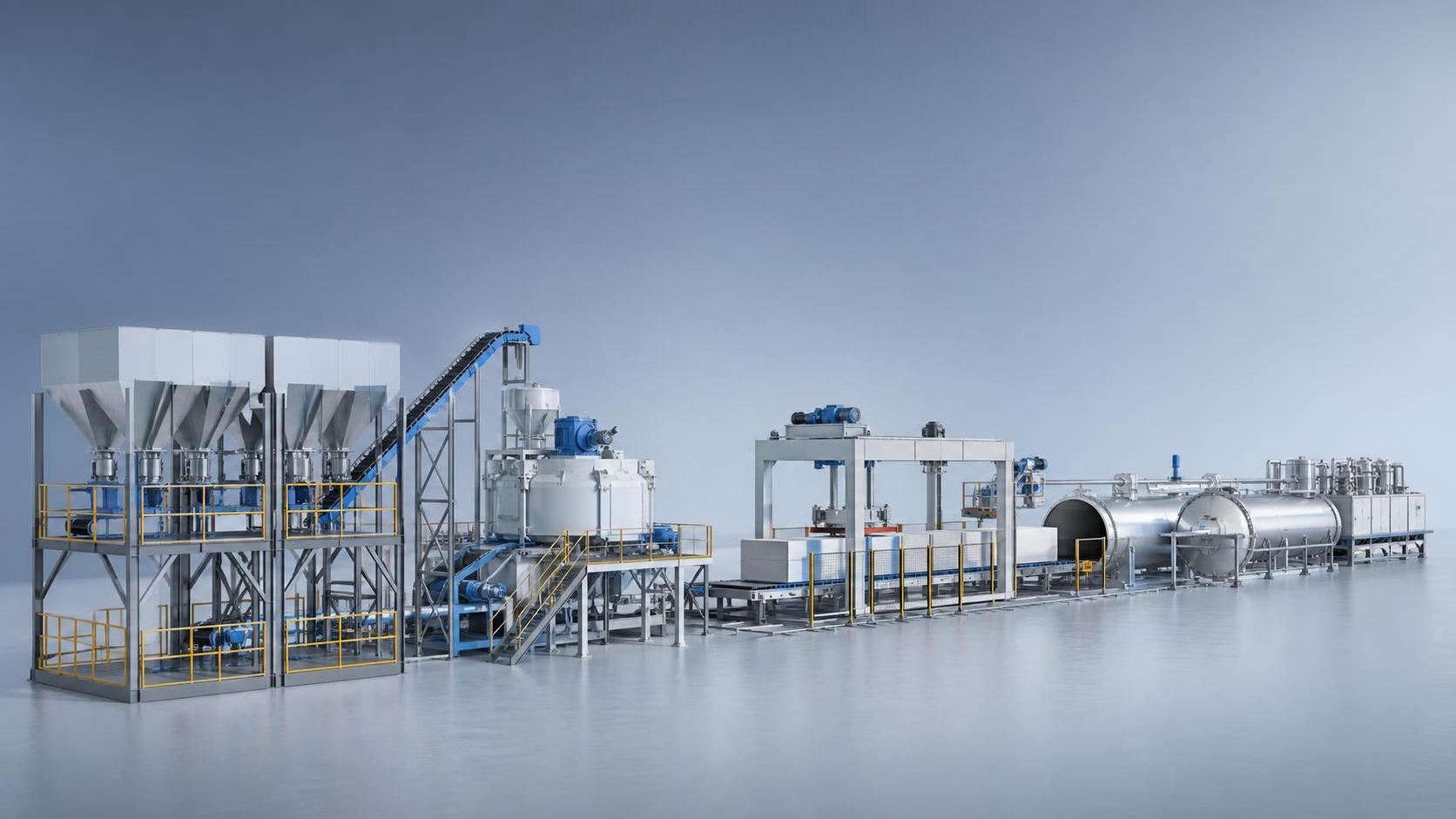
A turnkey AAC plant is more than a collection of machines sold together. In a well-structured project, it combines process design, equipment manufacturing, layout support, installation guidance, commissioning, and operator training.
It may also include raw material analysis, utility planning, production recipe guidance, automation integration, and after-sales service arrangements. The exact scope differs by supplier, so contract clarity is essential.
From a risk perspective, the core value of turnkey delivery is system compatibility. Equipment is selected and configured to work as one production chain rather than as isolated purchases.
This matters because AAC output quality depends on process continuity. Problems in dosing, casting, pre-curing, cutting, or autoclaving can affect density, strength, dimensions, and finished block consistency.
An integrated supplier is more likely to consider those interdependencies early. That reduces the chance of discovering design conflicts during installation or commissioning, when changes are slower and more expensive.
For large machinery groups with broad manufacturing experience, integrated delivery often reflects long-term engineering capability across adjacent product lines as well. Some buyers see value in working with suppliers that also understand related block and batching systems, including solutions such as the QT10-15D Block Making Machine.
How Modular Sourcing Works and Why Some Buyers Still Prefer It
In modular sourcing, the buyer purchases different parts of the AAC line from separate suppliers. This may include one source for batching, another for molds, another for cutting, and another for autoclave-related equipment.
The attraction is clear. Buyers may believe they can combine the best vendor in each category, negotiate lower prices, or avoid dependence on a single supplier.
In some cases, that logic is valid. A company with a highly capable in-house engineering department may already have the technical discipline to integrate multiple suppliers successfully.
Modular sourcing can also be useful when expanding an existing facility. If the investor already has local technical knowledge, spare parts channels, and commissioning experience, the coordination burden may be manageable.
There is another reason buyers choose this route. Some procurement teams are under pressure to compare line-item prices aggressively, and modular buying creates more visible opportunities for price competition.
However, that purchasing advantage often looks stronger on paper than in practice. Lower package prices do not always translate into lower project risk or lower lifecycle cost.
Once integration issues appear, the buyer may spend more on engineering time, modifications, schedule recovery, and operational troubleshooting than was saved in procurement.
Which Model Usually Lowers Project Risk
If the question is purely about project risk, the turnkey AAC plant model usually has the advantage. It reduces fragmentation at the exact stage where fragmentation is most dangerous.
The main risk categories are schedule risk, interface risk, quality risk, commissioning risk, and post-startup support risk. In most of these categories, turnkey delivery offers better control.
Schedule risk: With one lead supplier, planning is more centralized. Manufacturing, shipping, site preparation, and installation milestones can be aligned more realistically.
Interface risk: This is where modular sourcing often struggles. If a machine fails to connect mechanically, electrically, or logically with another vendor’s system, responsibility can become disputed.
Quality risk: A turnkey supplier has stronger incentive to ensure upstream and downstream process stability because final plant performance reflects on the same company.
Commissioning risk: Startup is where hidden incompatibilities emerge. Turnkey suppliers usually arrive with a more complete understanding of how the full line should run under load.
Support risk: After handover, plant operators need spare parts, parameter optimization, and troubleshooting support. One integrated supplier can often resolve issues faster because system ownership is clearer.
That said, turnkey is not automatically low-risk if the supplier lacks true engineering depth. The model works only when the supplier has proven manufacturing capability, installation experience, and process knowledge.
Where Modular Sourcing Creates Hidden Risk
The most serious problem in modular sourcing is not visible in the quotation sheet. It appears in the spaces between suppliers, where obligations are unclear and technical assumptions do not match.
For example, one vendor may assume another will provide sensor logic, cable routing, or structural interface details. When neither side has included the work, the buyer inherits the gap.
Another common issue is performance inconsistency. Individual machines may meet their own specifications, yet the full line may still fail to achieve expected throughput, product quality, or energy efficiency.
This happens because line performance is a systems outcome. It depends on rhythm, timing, material flow, and control coordination across the whole plant.
Modular sourcing also increases communication overhead. More suppliers mean more meetings, more translation of technical requirements, more schedule dependencies, and more chances for misalignment.
After startup, troubleshooting becomes harder as well. A production defect may involve process design, control parameters, raw material behavior, and multiple equipment sections at once.
When several suppliers are involved, root-cause analysis can slow down because each party may defend its own scope first. That delay directly affects output and profitability.
When a Turnkey AAC Plant Makes the Most Business Sense
A turnkey AAC plant is generally the best fit for investors entering AAC manufacturing for the first time. New entrants benefit from simplified coordination and a more structured path to commissioning.
It is also well suited to projects with aggressive launch timelines. If market entry speed matters, reducing the number of interfaces can significantly improve execution efficiency.
Another strong use case is overseas investment. Cross-border procurement adds language, logistics, standards, and after-sales complexity. A single responsible supplier can reduce those challenges substantially.
Turnkey buying also makes sense when the organization lacks a large technical integration team. If senior management wants predictable implementation without building an internal EPC-style structure, turnkey is more practical.
For lenders and investment committees, turnkey delivery can be easier to evaluate because scope, responsibility, and performance expectations are more centralized.
That does not remove all risk, but it improves governance. Decisions can be tracked against one project framework instead of many separate vendor relationships.
When Modular Sourcing Can Be a Rational Choice
Modular sourcing is more suitable when the buyer already operates industrial plants and has strong internal engineering, procurement, and project control capabilities.
It can also be rational when the project is an extension of an existing line and compatibility requirements are already well understood. In that case, the buyer may only need selected equipment upgrades.
Some mature investors use modular sourcing to standardize preferred components across multiple facilities. That strategy can support internal maintenance systems and reduce dependence on one supplier.
However, this approach should be deliberate rather than price-driven. It works best when the buyer has documented interface standards, experienced commissioning managers, and contractual discipline across vendors.
Without those capabilities, modular sourcing often creates a false sense of control. The buyer feels flexible during purchasing but becomes exposed during implementation.
How Decision-Makers Should Compare the Two Models
The most reliable comparison method is to evaluate total project risk and lifecycle value, not just equipment purchase price. Decision-makers should ask structured questions before approving either model.
First, who is accountable for full-line performance at guaranteed capacity and quality? If that answer is vague, risk is already present.
Second, who is responsible for interface engineering between mechanical, electrical, and automation systems? If the buyer must coordinate it, internal capability must be verified honestly.
Third, what happens if commissioning takes longer than planned? Time overruns affect financing, labor, and revenue forecasts, so response obligations should be defined clearly.
Fourth, how will operator training and process optimization be delivered after startup? A plant is not successful because it starts once. It is successful when stable, repeatable production becomes routine.
Fifth, how mature is the supplier’s manufacturing and service organization? A large installed base, engineering depth, and experience across related machinery categories can indicate stronger execution reliability.
For some buyers evaluating broader factory planning, it is useful to work with manufacturers that understand both AAC systems and adjacent concrete product equipment, including lines built around the QT10-15D Block Making Machine. That broader process familiarity can improve consultation quality, even when the immediate project focus is AAC.
What to Look for in a Low-Risk Supplier
Regardless of model, supplier quality determines outcome. Decision-makers should verify engineering resources, project references, manufacturing scale, service response capability, and process understanding.
A credible supplier should be able to explain not only machine specifications but also raw material adaptability, plant layout logic, installation sequence, commissioning methodology, and expected production ramp-up.
It is also worth assessing whether the supplier has sustained investment in R&D, patents, quality systems, and field service. These factors often correlate with better long-term support.
For a company such as Shandong Hongfa Scientific Industrial & Trading Co., Ltd., the value proposition lies in its manufacturing scale, engineering depth, broad building materials machinery portfolio, and long operating history. For buyers, those attributes can matter more than headline pricing when project stability is the priority.
In practice, the best supplier discussions are concrete. They address scope boundaries, performance guarantees, utility requirements, local service arrangements, spare parts planning, and realistic commissioning schedules.
Conclusion: Choose the Model That Matches Your Risk Capacity
If your goal is to lower project risk, speed up commissioning, and simplify accountability, a turnkey AAC plant is usually the stronger choice. It is especially advantageous for first-time investors, overseas projects, and time-sensitive market entry.
Modular sourcing can deliver value, but mainly for buyers with proven integration capability and the internal structure to manage technical interfaces aggressively.
The key insight is simple. AAC investment success depends less on buying individual machines cheaply and more on bringing the whole production system online reliably.
For most enterprise decision-makers, that makes turnkey procurement the more dependable path. It may not always show the lowest initial price, but it often delivers the lower-risk and higher-confidence result that matters most in capital equipment investment.
Recommend
 Sep 23, 2026
How automatic AAC production line stability affects block quality
Automatic AAC production line stability directly shapes block strength, density, and dimensions. Learn how tighter process control reduces defects, waste, and safety risks.
- Sep 23, 2026
What to check before buying autoclaved aerated concrete equipment
Autoclaved aerated concrete equipment buying guide: learn what to check on line balance, raw materials, energy use, maintenance, and support before choosing a reliable AAC solution.
- Sep 24, 2026
How to reduce downtime caused by worn AAC plant machinery
AAC plant machinery downtime can be cut by spotting wear early, prioritizing critical parts, and using smarter maintenance strategies to keep production stable and costs under control.