




What Permits Are Required to Build a Fly Ash AAC Plant?
What Permits Are Required to Build a Fly Ash AAC Plant?
What permits are needed to build a fly ash AAC plant? The exact answer depends on the country, state or province, industrial park, fuel source, plant capacity, and the way fly ash will be received and stored. Still, the approval path is broadly consistent: an AAC investor usually needs land-use clearance, planning and construction permits, environmental approvals, fire and safety reviews, utility connections, and operating registrations before commercial production can begin.
This is not a paperwork issue to leave until equipment has arrived. A fly ash autoclaved aerated concrete plant combines bulk-material handling, lime and cement dosing, slurry preparation, cutting, steam curing under pressure, wastewater management, and heavy internal logistics. A site may be perfectly suitable for a conventional block yard but unsuitable for an AAC line because of steam demand, boiler emissions, autoclave safety requirements, or fly ash transport conditions.
The most practical approach is to treat permitting as part of process design. Before selecting an AAC block production line, confirm which authority approves the site, who regulates pressure equipment, where the fly ash comes from, and whether the local utility infrastructure can support the plant. That early work usually prevents the expensive redesigns that occur after a layout has already been fixed.
The Core Permit Categories for a Fly Ash AAC Factory
Names vary from one jurisdiction to another. In some locations, several approvals are combined into a single industrial-project permit; elsewhere, they are handled by separate land, environmental, construction, labor, and energy authorities. The table below is a useful way to compare the approvals normally encountered during an AAC plant project.
Not every project will require every document shown above, and authorities may use different terminology. However, a project team that has not identified these categories before signing a land agreement is already taking avoidable risk.
Land-Use Approval Comes Before the Machinery Decision
The first question is not whether an AAC machine can fit inside a workshop. It is whether the intended site is legally allowed to operate a building-materials manufacturing facility with bulk powder storage, steam equipment, regular truck movements, and outdoor product handling. Industrial zoning may permit “manufacturing” in general while imposing specific restrictions on boiler fuel, stack height, noise at the boundary, or truck access times.
A fly ash AAC plant also needs a layout that works beyond the main production building. Fly ash and lime silos need safe tanker access. Raw-material stock areas must be separated sensibly from finished blocks and panels. Internal roads must accommodate loading vehicles without conflicting with workers or mold transfer routes. If an investor plans to use rail-delivered ash, port-supplied ash, or a nearby thermal power station as the source, transport infrastructure deserves the same attention as the factory plot itself.
In practice, planning authorities often ask for a site plan before issuing clearance. That plan should show building footprints, utility corridors, drainage, roads, fire lanes, waste storage, green or buffer areas where required, and the location of boilers, autoclaves, chimneys, and material silos. A generic supplier layout can be a starting point, but it should not be submitted unchanged. Local wind direction, plot geometry, soil conditions, fire access rules, and road entrances all affect the final arrangement.
Environmental Approval: Focus on the Actual Emission Points
Environmental permitting is often discussed in broad terms, but the review becomes much more manageable when the plant is broken into real emission and discharge points. For AAC production, the usual areas of attention are dust from fly ash unloading and conveying, lime and cement handling, boiler emissions, process or cleaning water, noise from machinery and vehicles, and the treatment of off-spec material or sludge.
Fly ash is frequently described as a recycled industrial mineral resource, which is true in many supply chains. That does not mean it is exempt from control. Authorities may require documentation of its source, classification, storage method, and transportation arrangement. The composition and consistency of fly ash can vary by source, so this is also a production issue. A plant designed around one ash quality may need adjustments if a supplier changes.
The boiler choice deserves early scrutiny. A plant using a gas-fired steam boiler, an electrically generated steam system, or another fuel arrangement may face different environmental review requirements. It is risky to design the AAC line around a steam source that the site cannot legally install or economically operate. Ask the permitting consultant and utility provider the same question: what fuel and capacity are realistically available at this location?
Water is another area where assumptions cause trouble. AAC plants commonly aim to recover and reuse suitable process water, but the local authority may still regulate wastewater discharge, stormwater drainage, groundwater abstraction, or connection to a public treatment system. Separate clean rainwater from production-area runoff in the civil design where local requirements call for it. Retrofitting drainage after foundations are poured is rarely a small job.
Construction Approval and the Weight of the Process Line
An AAC line is a coordinated industrial system, not a collection of independent machines. The batching section, pouring area, pre-curing zone, cutting machine, transfer equipment, autoclaves, separating equipment, packing section, and control system all depend on civil accuracy. Foundations, embedded parts, rail alignment, floor elevation, overhead cranes, and drainage should be checked against the selected process layout before construction drawings are finalized.
Construction permits generally require professionally prepared structural, electrical, mechanical, fire, and drainage documentation. In some jurisdictions, the equipment supplier’s general arrangement drawings are acceptable supporting material but do not replace drawings stamped or approved by locally authorized engineers. This distinction matters. A supplier understands machine loads and operating sequence; the local engineering team understands the code, soil report, seismic requirement where applicable, and approval procedure. Both sides need to work from the same revision of the layout.
This coordination is especially important for autoclave foundations and lifting systems. If autoclave rails, doors, steam piping, crane coverage, and transfer paths are treated as separate packages, small dimensional conflicts can stop commissioning. The permit stage is the cheapest time to identify them.
Autoclaves, Boilers, and Pressure Equipment Need Their Own Compliance Plan
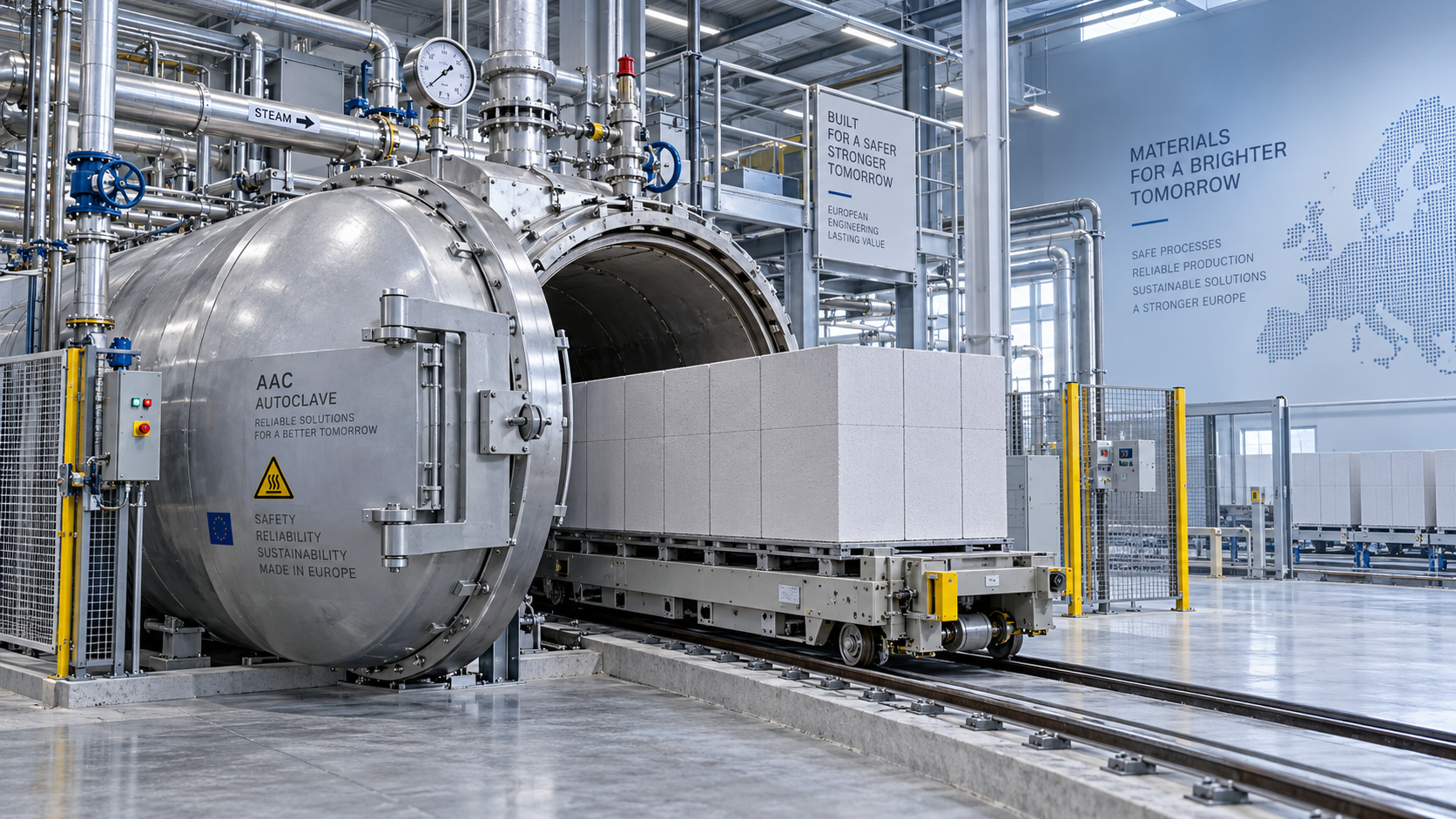
The pressure system is usually the most regulated part of an AAC factory. Autoclaves use saturated steam at elevated pressure to cure the green cake into finished AAC products. Boilers generate or supply the steam. Steam headers, valves, separators, condensate systems, safety devices, and pressure instrumentation connect the two. Many jurisdictions require design review, manufacturing documentation, installation inspection, testing, registration, and periodic inspection for this equipment.
Do not assume that a pressure vessel manufactured for export can automatically be commissioned in the destination market. Local rules may specify acceptable design codes, inspection bodies, nameplate information, operator qualifications, safety-valve certification, or language requirements for documentation. These requirements should be checked before the purchase contract is finalized, not after the autoclaves reach the port.
There are two common project approaches. One is to source the boiler, autoclaves, and steam auxiliaries as an integrated package. The other is to procure the boiler locally while importing the AAC production line. Neither approach is always better. Local boiler sourcing may simplify fuel, inspection, spare-parts, and service arrangements. An integrated solution can simplify process coordination. The better choice is the one that satisfies local pressure-equipment rules while keeping responsibility for steam capacity and control interfaces clear.
Fire, Process Safety, and Worker Protection Are Not Secondary Approvals
AAC production involves several hazards that need to be reflected in the permit documents and plant operating procedures. Fine powders require effective dust collection and housekeeping. Quicklime handling can create burn and dust exposure risks. Aluminum powder or paste used as an aerating agent requires controlled storage and handling because hydrogen is produced during the reaction. Steam systems introduce heat and pressure hazards, while cutting machines, mold movement, conveyors, cranes, and forklifts create mechanical risks.
A serious safety review looks at how people actually move through the factory. Can an operator reach a valve without crossing a forklift route? Is there a protected walkway near the cutting area? Are emergency stops accessible? Is overhead lifting separated from routine pedestrian movement? Are maintenance platforms, stairs, and guardrails included in the equipment and building scope? These questions are more useful than a generic statement that a factory will “follow safety rules.”
Fire authorities may examine hydrant supply, firewater storage, emergency exits, alarm systems, electrical rooms, access roads, and the spacing between buildings or storage areas. Requirements differ significantly by location, so the fire design should be confirmed locally. Equipment suppliers can provide relevant machine information, but final fire-system sizing and approval are normally site-specific.
Operating Licenses, Utilities, and the Permits That Delay Start-Up
Many projects receive construction permission and then discover that commercial operation requires another set of approvals. These may include factory registration, business or manufacturing licenses, final environmental acceptance, water-discharge authorization, boiler operating registration, electrical energization, gas connection, calibration of measuring equipment, and labor-related registrations. The final sequence varies, but it should be mapped before commissioning begins.
Utility approvals can be the quiet bottleneck. AAC plants need dependable electrical capacity for motors, pumps, cutting equipment, automation, and ancillary systems. They need water for batching and cleaning, though consumption and recycling arrangements depend on the process design. Most importantly, they need reliable steam generation or supply. A utility application may involve lead times, off-site infrastructure, deposits, inspections, or fuel pipeline work that cannot be solved by speeding up machine installation.
It is also wise to confirm the product-side obligations. Some markets require AAC blocks or panels to meet defined product standards, labeling rules, factory production-control requirements, or third-party testing before sale. Those are not always “plant permits” in the narrow sense, but they affect the transition from trial production to marketable material.
How Equipment Selection Changes the Permit Burden
The permitting path is influenced by technical decisions made during equipment selection. A compact plant with limited automation, for example, may reduce building size but can increase manual handling and make safe traffic separation harder. A larger automated system requires more capital and more sophisticated controls, yet may create cleaner and more predictable material flow. The right configuration depends on output targets, labor conditions, product mix, and the site’s approval constraints.
Experienced machinery manufacturers can contribute useful input at this stage because their layouts reflect repeated installation and commissioning lessons. Shandong Hongfa Scientific Industrial & Trading Co., Ltd., established in 1990, manufactures building-material machinery including aerated concrete block production lines, block machinery, and concrete batching plants. With production bases in Shandong and Guangxi and a large engineering and technical team, the company’s role in a project can extend beyond supplying individual equipment: process layouts, equipment interfaces, and civil-load information need to be prepared early enough for local designers and permit consultants to use them.
That said, no machinery supplier should be expected to replace the investor’s local legal, environmental, or engineering advisers. A good division of responsibility is straightforward: the supplier provides accurate technical data for the proposed line; the local project team confirms code compliance, submits applications, and manages discussions with the authorities.
A Practical Pre-Purchase Checklist
Before issuing a purchase order for a fly ash AAC plant, the project owner should be able to answer a few hard questions:
- Is AAC manufacturing permitted on the selected site, including boiler operation, bulk storage, and truck movement?
- Has the fly ash source been reviewed for supply reliability, material documentation, transport distance, and storage requirements?
- Which authority approves the environmental assessment, and what information is required for air, water, noise, and solid-waste review?
- Are the autoclaves, boiler, and steam system acceptable under local pressure-equipment rules?
- Does the civil design account for the final equipment layout, equipment loads, crane requirements, drainage, and fire access?
- Can electricity, water, fuel, and road access be available before planned commissioning?
- What certificates, inspection records, test reports, and operating registrations must be completed before commercial production?
The best time to ask these questions is while the project is still flexible. Once equipment dimensions, foundations, fuel selection, and building shells are fixed, compliance choices become far more limited.
For anyone asking what permits are required to build a fly ash AAC plant, the useful answer is not a single universal document list. It is a coordinated approval plan built around the local site and the actual process: land use, environmental controls, construction, pressure equipment, fire safety, utilities, and operating authorization. Get those workstreams moving alongside equipment engineering, and the AAC plant is far more likely to reach commissioning without preventable surprises.
Recommend
 Oct 12, 2026
Is ISO Certification Mandatory for AAC Block Manufacturing Equipment?
Are AAC block manufacturing equipment ISO certified mandatory? Discover legal requirements, supplier risks, and smart compliance checks before investing.
- Oct 11, 2026
How Often Should AAC Molds Be Inspected and Replaced?
How often should AAC molds be inspected and replaced? Discover practical inspection schedules, warning signs, and maintenance tips to reduce defects and downtime.
- Oct 10, 2026
What Safety Standards Apply to AAC Autoclave Systems in Europe?
What safety standards apply to AAC autoclave systems in Europe? Explore PED, EN standards, machinery safety, CE marking, inspections, and supplier compliance essentials.