

Is Importing a Complete AAC Production Line from China Risky?
Is it risky to import a full AAC production line from China? It can be, but the country of origin is rarely the real problem. The serious risks usually come from buying an underspecified line, choosing a supplier that cannot support commissioning, or assuming that a low equipment quotation represents the final project cost. A well-planned import can be a practical and competitive investment. A poorly prepared one can leave a plant with mismatched equipment, delayed installation, and expensive downtime.
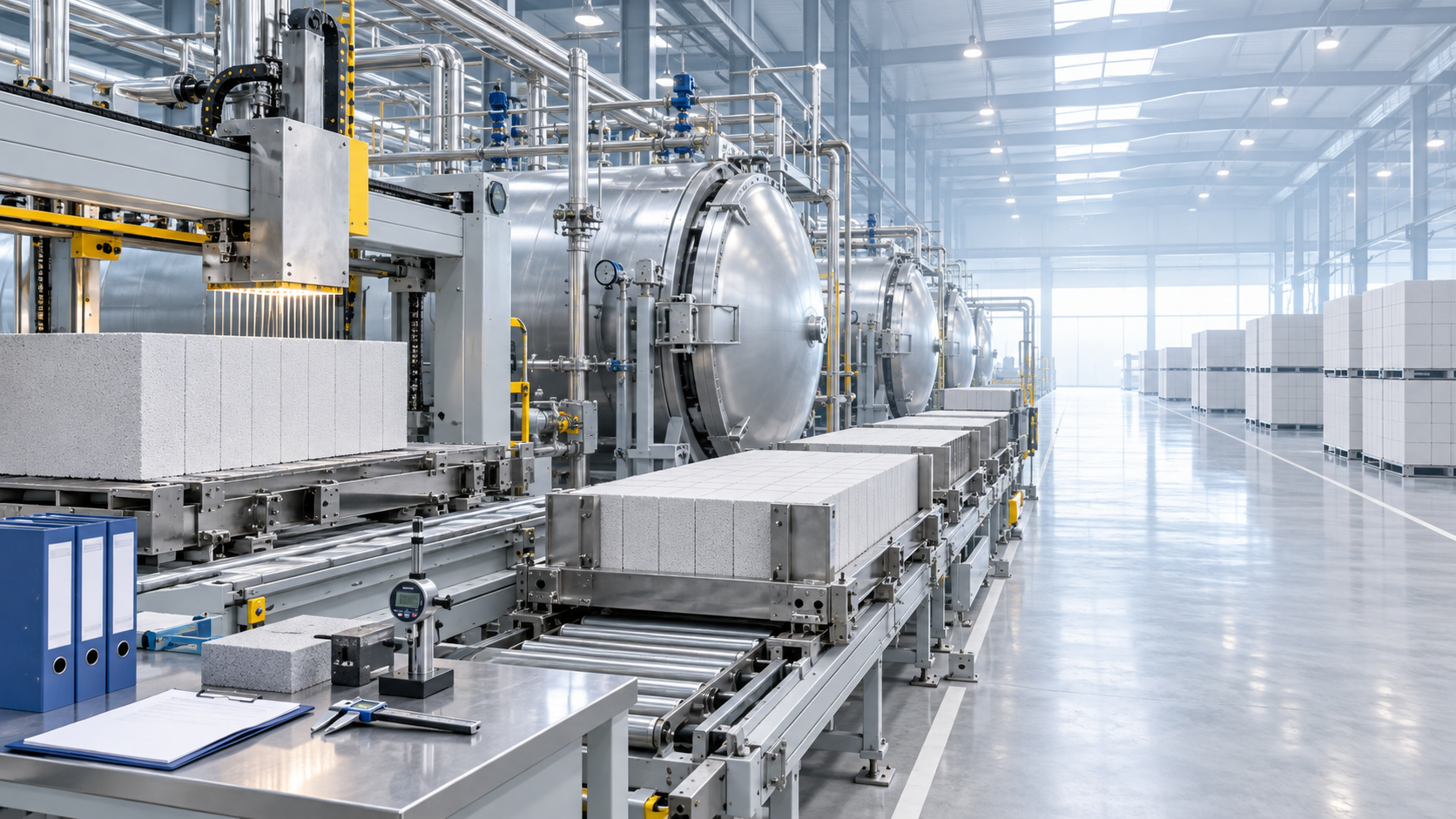
An AAC plant is not a single machine that can be plugged in and started. It is a connected production system involving raw-material preparation, batching, mixing, casting, cutting, pre-curing, autoclaving, handling, control systems, utilities, and often packaging. The line only performs well when those sections are engineered to work together. That is why the first question should not be “Is Chinese equipment cheap?” It should be “Can this supplier design, deliver, install, and support a line that fits my local materials, capacity target, and operating conditions?”
Importing from China is often compared with buying locally or sourcing from a European manufacturer. Each option has strengths, but the comparison needs to go beyond the purchase price.
Is It Risky to Import a Full AAC Production Line from China?
The honest answer is yes, there is risk, just as there is risk in importing a complete plant from any overseas market. The difference is how visible and manageable that risk is before a contract is signed.
China has a broad manufacturing base for building-material machinery, including AAC block production lines. This can give buyers more choice in capacity, automation level, and budget than they may find in their domestic market. However, that same range creates a selection problem: two suppliers may use similar product descriptions while offering very different engineering depth, steel quality, automation capability, documentation standards, and after-sales capacity.
A complete AAC line should be assessed as an industrial project, not a container shipment. If the supplier can demonstrate real manufacturing capability, a defined project scope, quality controls, commissioning experience, and a credible spare-parts plan, the import risk can be controlled. If the quotation is vague and the discussions focus only on price, the risk is high regardless of where the machinery is made.
Comparing the Real Options: China, Local Supply, and Premium Overseas Equipment
Buyers often compare only the headline equipment price. That is understandable, but it is not enough. The more useful comparison is between total project readiness, technical fit, and long-term operating support.
A Chinese AAC machinery supplier may be the better choice when the buyer has a clear technical brief, access to competent local civil and utility contractors, and a realistic budget for installation and commissioning. It may be a poor choice when the buyer expects the supplier to solve every local permitting, utility, logistics, and operating issue remotely without a detailed site assessment.
Likewise, a more expensive supplier is not automatically safer. A plant can still underperform if the mix design is not adapted to available sand or fly ash, if steam supply is inadequate, or if operators receive only superficial training. Equipment quality matters, but process discipline matters just as much.
The Risks That Matter Most
Many first-time buyers worry about shipping damage or customs clearance. Those issues matter, but they are usually easier to manage than the technical risks hidden inside a weak proposal.
A line designed around assumptions instead of your raw materials
AAC production depends heavily on material characteristics. Sand, fly ash, lime, cement, gypsum, aluminum paste, and water do not behave identically from one region to another. Moisture content, fineness, chemical composition, available particle size, and local water quality can affect slurry behavior, expansion, cutting performance, and final block quality.
A supplier should ask for material data or recommend testing before finalizing key process assumptions. A proposal that promises a specific output and product quality without asking what raw materials will be used deserves careful scrutiny. This is not unnecessary complexity. It is basic process engineering.
Scope gaps between the quotation and the actual plant
The term “full AAC production line” is used loosely in the market. One supplier may include mixing, cutting, autoclaves, molds, transfer systems, and central controls. Another may exclude essential items such as boilers, electrical cabinets, steam piping, mold cars, lab equipment, installation tools, packing equipment, or site supervision.
Before comparing quotations, turn every offer into a line-by-line scope matrix. Ask what is supplied, what is excluded, who is responsible for foundations, who provides cables and piping, who handles insulation, and what utility capacities are required. The cheapest offer often becomes expensive when these gaps emerge after the civil works have already started.
Automation that looks modern but is difficult to maintain
Automation can improve consistency and reduce labor dependency, but it should match the plant’s maintenance capability. A highly automated control system is only useful if operators can understand alarms, calibrate instruments, replace sensors, and obtain compatible components without long delays.
Ask for the control architecture, PLC brand, electrical-component list, software access policy, operating language, and remote-support procedure. It is reasonable to prefer internationally serviceable electrical components where local availability matters. It is also reasonable to ask whether the buyer will receive backup copies of operating programs, wiring diagrams, and manuals.
Weak commissioning support
Commissioning is where an AAC line becomes a real factory. Machines can arrive on schedule and still fail to produce stable blocks because sequencing, steam pressure, cutting adjustment, slurry density, and curing cycles have not been tuned correctly.
A supplier should be specific about what commissioning support includes: number of engineers, expected duration, responsibilities of the buyer’s site team, travel-cost treatment, production trials, operator training, and acceptance criteria. Vague promises of “technical guidance” are not enough for a project of this scale.
How to Evaluate a Chinese AAC Line Supplier Before Paying a Deposit
Do not rely on a polished website, trade-show conversation, or a video of one machine operating. Ask questions that require evidence.
- Request a detailed process flow diagram showing every major production stage and material transfer point.
- Ask for a complete equipment list with quantities, main specifications, motor information, and included accessories.
- Review the supplier’s manufacturing facilities, fabrication equipment, quality inspection practices, and technical team structure.
- Ask for operating references that are comparable in capacity, raw material type, and market conditions where possible.
- Clarify whether the supplier manufactures core equipment itself or mainly assembles purchased components.
- Obtain utility requirements early, including power demand, water consumption, compressed air, steam, and boiler-related needs.
- Confirm the recommended spare-parts package for startup and the expected response process for urgent technical issues.
A factory visit is valuable when the project size justifies it. During the visit, look beyond the showroom. Inspect welding and machining areas, storage methods, equipment under assembly, quality records, and the condition of finished machinery awaiting shipment. Speak with engineers, not only sales representatives. A capable supplier should be able to explain why a particular cutting system, mold size, or autoclave arrangement has been selected for your project.
For buyers unable to visit, an independent pre-shipment inspection can reduce uncertainty. The inspection scope should be tied to the signed technical specification, not merely a visual confirmation that equipment exists.
Price Is Important, but Total Cost Is the Better Comparison
AAC plants involve civil construction, utilities, logistics, installation, and working capital in addition to machinery. Freight, insurance, import duties, port handling, local transport, cranes, foundations, electrical work, steam systems, and installation labor may materially change the final investment. Requirements vary by location, so these items should be verified with local contractors, customs advisers, and relevant authorities.
There is also the cost of lost production. A lower initial price does not help if a missing control part stops the cutting section for weeks or if the supplier cannot provide an engineer when the plant needs process support. Conversely, paying for features that the local team cannot maintain may not be sensible either.
The best commercial comparison usually separates three figures: equipment supply cost, site-completion cost, and first-year operating-support cost. That approach exposes unrealistic quotations early.
Where an Established Manufacturer Can Reduce the Risk
Supplier history does not eliminate risk, but it gives buyers more evidence to work with. Shandong Hongfa Scientific Industrial & Trading Co., Ltd. has produced construction and building-material machinery since 1990, including aerated concrete block production lines, block machinery, and concrete batching plants. Its stated manufacturing base spans Shandong and Guangxi, and the company reports an engineering and technical workforce supporting equipment design and production.
For an AAC buyer, the useful point is not a list of honors by itself. It is whether the manufacturer can connect design, fabrication, quality control, installation guidance, and ongoing technical support. Hongfa states that its quality system has ISO 9001:2008 certification and that it uses process-based quality tracking. It also reports patented technologies and research cooperation related to building-material equipment. These claims should still be verified during due diligence, but they are relevant indicators to investigate when comparing suppliers capable of delivering a complete industrial line.
A serious discussion with any manufacturer should end in a project-specific technical proposal. Generic capacity claims are not enough. The supplier needs to understand the desired block sizes, intended annual output, local raw materials, available land, utility conditions, labor skills, and target market requirements before recommending the final configuration.
When Importing from China May Not Be the Right Move
Importing a complete line may be unsuitable when a project does not yet have reliable access to raw materials, steam generation, power infrastructure, or trained operating staff. It can also be the wrong decision when the buyer needs immediate on-site support but has no local engineering partner and the supplier cannot provide a credible service arrangement.
Another warning sign is a business plan built only on equipment cost. AAC manufacturing needs stable sales channels, quality control, curing discipline, and regular maintenance. Purchasing machinery before confirming demand, local building-code acceptance, and distribution capability can create more risk than the import transaction itself.
For a smaller or uncertain market, it may be wiser to begin with a carefully sized project rather than selecting the highest possible capacity. Oversized lines create pressure on working capital, inventory, and sales long before they reach their intended output.
Questions Buyers Commonly Ask
Can an AAC line be installed by a local contractor?
Local contractors can handle much of the mechanical installation, civil work, piping, and electrical work when they receive proper drawings and supervision. However, final alignment, control commissioning, process adjustment, and production trials should involve the equipment supplier’s experienced engineers.
Should I choose the lowest quotation from a Chinese factory?
Usually not. Choose the quotation with the clearest scope, realistic utility requirements, support commitment, and verifiable manufacturing capability. A lower price is meaningful only when the supplied equipment and responsibilities are genuinely comparable.
How important are spare parts?
They are critical. Ask for a recommended startup package covering wear parts, sensors, seals, cutting-related consumables, and other components that could interrupt production. Confirm lead times and shipping arrangements for future orders.
Can remote support replace an on-site engineer?
Remote support is useful for troubleshooting, software guidance, and routine questions. It does not fully replace on-site commissioning or hands-on diagnosis when a new plant is being started or a major mechanical problem occurs.
So, is it risky to import a full AAC production line from China? It is risky when the purchase is treated as a simple machinery order. It becomes far more manageable when the buyer compares complete project scope, verifies the supplier’s engineering depth, tests the assumptions behind the process design, and secures clear commissioning and spare-parts support. The right supplier relationship is not just about delivering machines. It is about helping the factory reach stable, repeatable production after the containers have arrived.
Recommend
 Oct 12, 2026
Is ISO Certification Mandatory for AAC Block Manufacturing Equipment?
Are AAC block manufacturing equipment ISO certified mandatory? Discover legal requirements, supplier risks, and smart compliance checks before investing.
- Oct 11, 2026
How Often Should AAC Molds Be Inspected and Replaced?
How often should AAC molds be inspected and replaced? Discover practical inspection schedules, warning signs, and maintenance tips to reduce defects and downtime.
- Oct 10, 2026
What Safety Standards Apply to AAC Autoclave Systems in Europe?
What safety standards apply to AAC autoclave systems in Europe? Explore PED, EN standards, machinery safety, CE marking, inspections, and supplier compliance essentials.