

What risks come with buying an overseas automatic AAC production line without local support?
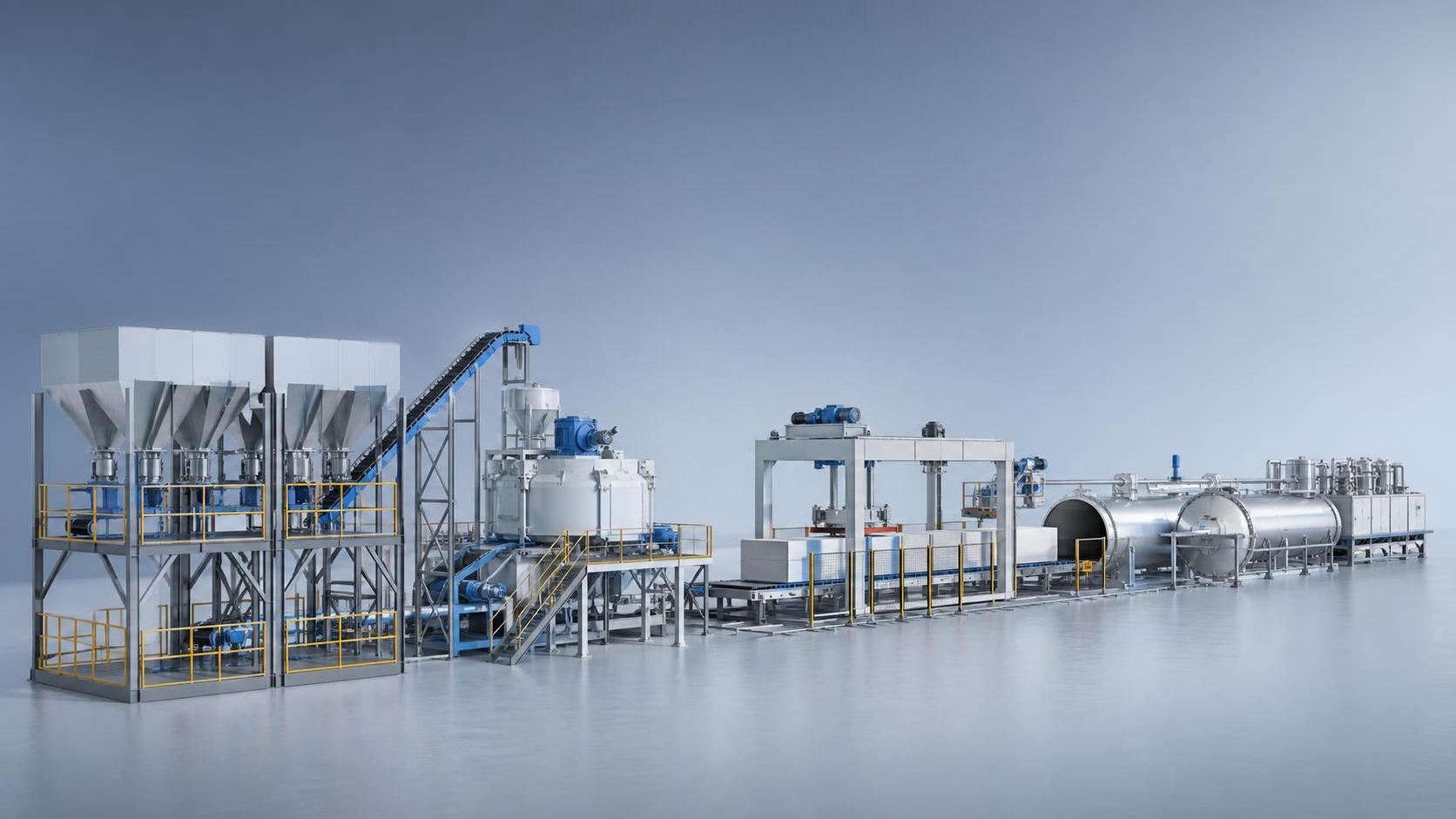
Buying an overseas automatic AAC production line without local support creates risk at every stage after the purchase order is signed. The equipment may be technically sound on paper, but an AAC plant is a process line, not a single machine. It depends on coordinated performance across raw material handling, slurry preparation, foaming, molding, cutting, autoclaving, curing, and utility systems. If one section is misaligned, the entire line can lose stability.
The first risk is mismatch between the line design and the actual site conditions. An automatic AAC production line is sensitive to power supply quality, steam availability, water pressure, compressed air, ambient temperature, and civil foundation accuracy. Overseas suppliers often design around assumptions from their home market. If local conditions differ, the plant may face delayed commissioning, unstable output, or repeated adjustment work. A cutting machine that is specified correctly for one material formulation can still perform poorly if the slurry consistency, aluminum powder activity, or curing regime is different from what the line expects.
Material compatibility is another point that is often underestimated. AAC production depends on the interaction of fly ash, sand, lime, cement, gypsum, aluminum powder paste, and water. Each raw material changes the reaction behavior. Sand fineness, lime reactivity, and gypsum quality affect setting time and green body strength. If the overseas line was tuned for a different raw material profile, operators may struggle with rising, collapsing, cracking, or uneven density. Without local support, that tuning work has to be done remotely, which is slow and usually incomplete.
Commissioning risk is high because automatic AAC lines are heavily sequence-driven. The batching system, mold handling, tilting station, pre-curing room, cutting group, and autoclave loading system must all work in the correct order. A small timing error can create bottle-necks that are hard to diagnose from afar. If sensors, actuators, valves, or servo settings are not calibrated on site by technicians who understand the line, the plant can appear installed while still being far from production-ready. Remote guidance can help, but it cannot replace immediate access to the machine, the controls, and the process data.
Language and documentation gaps create another layer of risk. In an AAC line, technical drawings, wiring diagrams, PLC logic notes, maintenance schedules, and fault codes are not optional. If manuals are incomplete, translated poorly, or written for a different configuration, maintenance staff may misread the sequence or miss a critical adjustment point. That problem becomes serious when a fault occurs in the cutter, steam system, or conveyor interlock and production is already under time pressure.
Spare parts are a practical risk, not a theoretical one. The most vulnerable items are usually bearings, seals, chains, belts, hydraulic components, proximity sensors, solenoid valves, cutters, and wear parts in the mixing and cutting sections. If these parts are not stocked locally, even a minor failure can stop production for days or weeks while freight, customs clearance, and technical confirmation are sorted out. For an automatic AAC production line, downtime often spreads beyond the broken part because the mold cycle, autoclave schedule, and curing space are all linked.
Transport and installation also carry hidden costs. Large AAC equipment includes steel structures, mold assemblies, slicing frames, autoclave-related handling systems, and heavy electrical cabinets. Ocean shipment can expose parts to vibration, moisture, corrosion, and packaging damage. Once the equipment arrives, local lifting capacity, alignment tools, and foundation tolerances matter. If there is no local support team to inspect incoming goods and correct installation issues early, the project can lose time before the first test batch is even made.
There is also the risk of mismatched automation philosophy. Some lines are built for high automation with tight interlocks and limited manual override. Others allow more operator intervention. If the buyer expects a certain level of labor saving but the control system is more rigid than local operators can manage, the plant may run below design capacity. On the other hand, if the line is too dependent on manual workarounds, the promised consistency of automatic production disappears. In AAC manufacturing, inconsistency usually shows up first in dimension accuracy, surface quality, and density variation.
Utility integration deserves careful attention. Autoclaves require stable steam generation and safe pressure control. Mixing and cutting sections need coordinated electrical load management. Water quality can affect slurry behavior, and compressed air stability can affect valves and automation response. Overseas suppliers sometimes assume utility packages that are not identical to local infrastructure. Without local support, it is harder to adapt the line to available boilers, piping standards, electrical codes, or environmental conditions. The result can be a system that is technically complete but operationally awkward.
Maintenance risk increases sharply when no local support exists. AAC equipment is exposed to abrasive materials, alkaline slurry, heat, and continuous cycling. Wear develops in mixers, cutters, conveyors, and mold-handling components. If routine inspection points are not clearly defined and local technicians are not trained on the actual machine configuration, wear may be detected only after product quality has already fallen. A cutter blade that is slightly out of alignment or a mold frame that is not level can affect multiple batches before anyone traces the root cause.
Training is often treated as a short handover, but the line needs more than that. Operators must understand slurry viscosity, foaming behavior, cutting timing, autoclave loading patterns, and basic fault isolation. If local support is absent, training may remain too abstract to be useful under production pressure. A plant can have advanced automation and still suffer from low yield if the team does not know how to respond when the rise curve changes, the cake collapses, or the autoclave cycle drifts.
Project scheduling risk is another issue. An overseas supplier may coordinate shipping, installation, and remote service around its own calendar, not the plant’s construction progress. If foundation work is delayed or utility readiness changes, the line may arrive before the site is prepared, or the installation crew may leave before commissioning is complete. Without local support, each delay becomes harder to absorb because there is no nearby technical team to restart work quickly.
There is a commercial risk as well, but it comes from operations rather than price. A lower equipment quotation can turn into a higher project cost when spare parts are delayed, calibration takes longer, output is unstable, and maintenance depends on expensive travel. In AAC production, the first months matter because they establish process stability, product dimensions, and consumption levels for lime, cement, aluminum powder, steam, and electricity. If those early months are erratic, the whole investment feels heavier than the purchase price suggested.
One practical way to compare options is to ask whether the line can be supported where it will run, not only where it is built. A supplier with strong engineering depth may still leave risk on the table if local installation, troubleshooting, and parts support are missing. In contrast, a line that is slightly less aggressive on specification but easier to service may produce steadier output over time. For an automatic AAC production line, reliability usually comes from the fit between equipment design, raw materials, utilities, and maintenance access.
In short, the risk of buying an overseas automatic AAC production line without local support is not one single failure point. It is a chain of small frictions that can affect commissioning, product quality, maintenance response, and production continuity. The more integrated the line, the more expensive each unresolved detail becomes once the equipment is on site and the schedule is running.
Recommend
 Sep 23, 2026
How automatic AAC production line stability affects block quality
Automatic AAC production line stability directly shapes block strength, density, and dimensions. Learn how tighter process control reduces defects, waste, and safety risks.
- Sep 23, 2026
What to check before buying autoclaved aerated concrete equipment
Autoclaved aerated concrete equipment buying guide: learn what to check on line balance, raw materials, energy use, maintenance, and support before choosing a reliable AAC solution.
- Sep 24, 2026
How to reduce downtime caused by worn AAC plant machinery
AAC plant machinery downtime can be cut by spotting wear early, prioritizing critical parts, and using smarter maintenance strategies to keep production stable and costs under control.