


Can one supplier handle AAC plant design through commissioning?
For AAC project developers, the real question is not whether one supplier says it can handle everything. It is whether that supplier can reduce interface risk across a process that is technically linked but operationally unforgiving: plant design, equipment selection, fabrication, civil coordination, installation supervision, trial runs, and commissioning. In that sense, a single-supplier AAC plant solution can work well, but only when the supplier has enough engineering depth and project control to carry the full chain without creating hidden gaps.
In the AAC industry, those gaps are often more expensive than the equipment itself. A plant may look complete on paper, yet fail to reach stable output because the autoclaving layout, slurry preparation system, cutting line, curing logistics, or utility matching was not coordinated from the start. For investors, that means delays and cash-flow pressure. For technical teams, it means repeated adjustment after installation. For procurement teams, it means a difficult blame game if performance falls short of contract claims.
What single-supplier responsibility really means in AAC projects
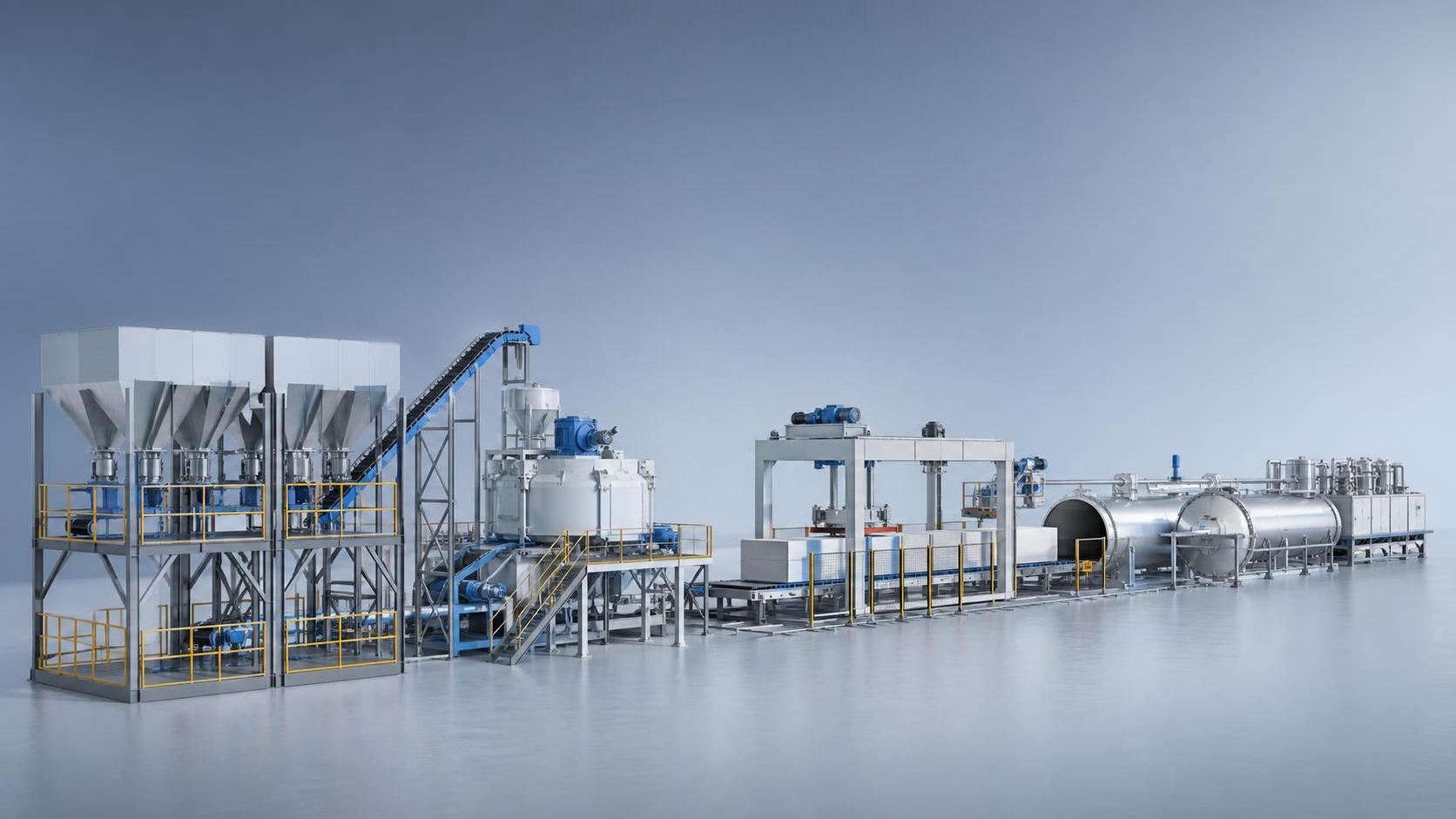
AAC plant delivery is different from buying a standalone machine. The process is integrated by nature. The batching system affects slurry consistency, the pre-curing section affects cutting precision, the cutting line affects waste rate, and the autoclave cycle affects final block strength and throughput. If one part changes, the rest often needs recalibration.
That is why single-supplier responsibility should be judged as a systems capability, not a sales promise. A capable supplier must be able to convert production targets into a workable process flow, define equipment interfaces, coordinate installation sequence, and support commissioning with process tuning. If any one of these steps is outsourced without control, the project may still be “single-source” in the contract sense, but not in the execution sense.
Why many projects prefer one partner for the full chain
Most AAC projects run into trouble not because the equipment is fundamentally unsuitable, but because multiple vendors interpret the same technical requirements differently. One supplier may optimize for output, another for utility load, and another for price. The result is a plant assembled from technically valid parts that do not operate efficiently together.
A unified supplier can reduce this fragmentation. Design decisions can be aligned with equipment specifications from the beginning. Civil dimensions can be matched to actual installation needs. Electrical and steam systems can be planned around real operating loads instead of estimates. During commissioning, the same team that supplied the core equipment can correct process deviations faster because it understands the original design intent.
For overseas projects in particular, this coordination advantage matters. Cross-border procurement often increases the risk of language gaps, delayed drawings, inconsistent standards, and unclear responsibility boundaries. A single supplier with engineering and execution experience can simplify communication and shorten decision loops.
Where the model works well
A single supplier is usually most effective when the project is a greenfield AAC plant, the product specification is relatively clear, and the buyer wants one accountable party for schedule and performance. It also fits investors who do not have a deep in-house technical team and need a partner that can translate business targets into an operational factory layout.
This model is also attractive when local installation resources are limited. AAC plants require careful sequencing of heavy equipment, foundations, utilities, and process alignment. If the buyer tries to split design, manufacturing, installation, and startup among different firms, coordination cost rises quickly. A single supplier can reduce that burden if it has enough field experience and a stable engineering team.
Companies such as Hongfa, with long-term involvement in building materials machinery, illustrate why buyers often look for integrated supply. The value is not just in equipment manufacturing capacity, but in having engineering, production, and project support under one management system. That structure can improve consistency from drawing review to final handover.
Where the model can fail
Single-supplier delivery is not automatically safer. If the supplier is weak in process design, the buyer may end up with a plant that is complete but inefficient. If the supplier can manufacture equipment but lacks commissioning experience, the startup phase becomes slow and unstable. If after-sales support is thin, the customer may have no practical help once the plant begins commercial operation.
Another common problem is over-standardization. Some suppliers try to push a fixed plant configuration into markets with different raw materials, climate conditions, labor skills, energy costs, or building code expectations. AAC performance depends heavily on local material behavior and utility conditions. A plant designed for one market may need adjustment before it can run reliably in another.
Buyers should also be cautious when a supplier claims to cover the full chain but subcontracts core engineering tasks without transparent control. In that case, the interface risk has not disappeared; it has only moved behind the scenes.
Key checks before choosing a single supplier
The most important question is whether the supplier can show project evidence, not just brochures. A serious review should focus on four areas.
Engineering capability: Can the supplier provide process design, layout planning, utility load calculation, and equipment integration for the full plant? If the answer is vague, the project may depend too much on assumptions.
Manufacturing and quality control: Does the supplier actually control core equipment production, or does it assemble third-party parts? For AAC plants, reliability depends on consistency in cutting, lifting, autoclave systems, and controls.
Commissioning support: Can the supplier send a team that understands startup sequencing, parameter tuning, and defect troubleshooting? A plant is not truly delivered until it produces stable qualified output.
Service continuity: After handover, will the supplier still support spare parts, operator training, and process optimization? For investors, this is often the difference between nominal capacity and real capacity.
Single supplier versus divided sourcing
Divided sourcing can look cheaper at the purchase stage, but it often creates hidden costs in coordination, delay, and responsibility disputes. It may work when the buyer has a strong internal engineering department and can manage multiple vendors tightly. In that case, the buyer trades supplier dependence for internal control.
Single-supplier sourcing shifts more responsibility outward. That can be a better fit when time-to-market matters, when the buyer is entering the AAC business for the first time, or when technical resources are limited. The trade-off is that supplier selection becomes more critical, because the wrong partner can affect the whole project.
So the decision is less about which model is universally better and more about which risk the buyer is better equipped to manage. If the buyer has strong project management and local technical capacity, split sourcing may be workable. If not, a capable one-stop supplier is usually the safer route.
What investors and developers should watch next
The AAC market is still shaped by cost pressure, energy efficiency requirements, and the need for more stable product quality. That makes integrated plant delivery more attractive than it was a decade ago. At the same time, buyers are becoming more selective. They want not only equipment, but a working production system that can reach output targets with fewer surprises.
For that reason, the best suppliers are no longer judged only by machine quality. They are judged by their ability to align process design, equipment manufacturing, site installation, and commissioning into one practical execution path. In AAC projects, that capability is often what separates a functioning plant from an expensive installation.
If a supplier can prove that it has delivered similar plants, controlled the engineering interfaces, and stayed involved through startup, then a single-supplier AAC plant solution is not just possible. It is often the most efficient way to reduce project risk and accelerate stable production.
Recommend
 Sep 23, 2026
How automatic AAC production line stability affects block quality
Automatic AAC production line stability directly shapes block strength, density, and dimensions. Learn how tighter process control reduces defects, waste, and safety risks.
- Sep 23, 2026
What to check before buying autoclaved aerated concrete equipment
Autoclaved aerated concrete equipment buying guide: learn what to check on line balance, raw materials, energy use, maintenance, and support before choosing a reliable AAC solution.
- Sep 24, 2026
How to reduce downtime caused by worn AAC plant machinery
AAC plant machinery downtime can be cut by spotting wear early, prioritizing critical parts, and using smarter maintenance strategies to keep production stable and costs under control.