



How Does a Hydraulic Roof Tile Machine Differ from Manual Pressing?
How Does a Hydraulic Roof Tile Machine Differ from Manual Pressing?
Choosing between a hydraulic roof tile machine and manual pressing can directly affect tile consistency, output capacity, labor costs, and long-term profitability. For producers considering the practical question of “color tile or concrete roof tile?”, the forming method deserves as much attention as the mix design, pigment selection, curing arrangement, and sales channel.
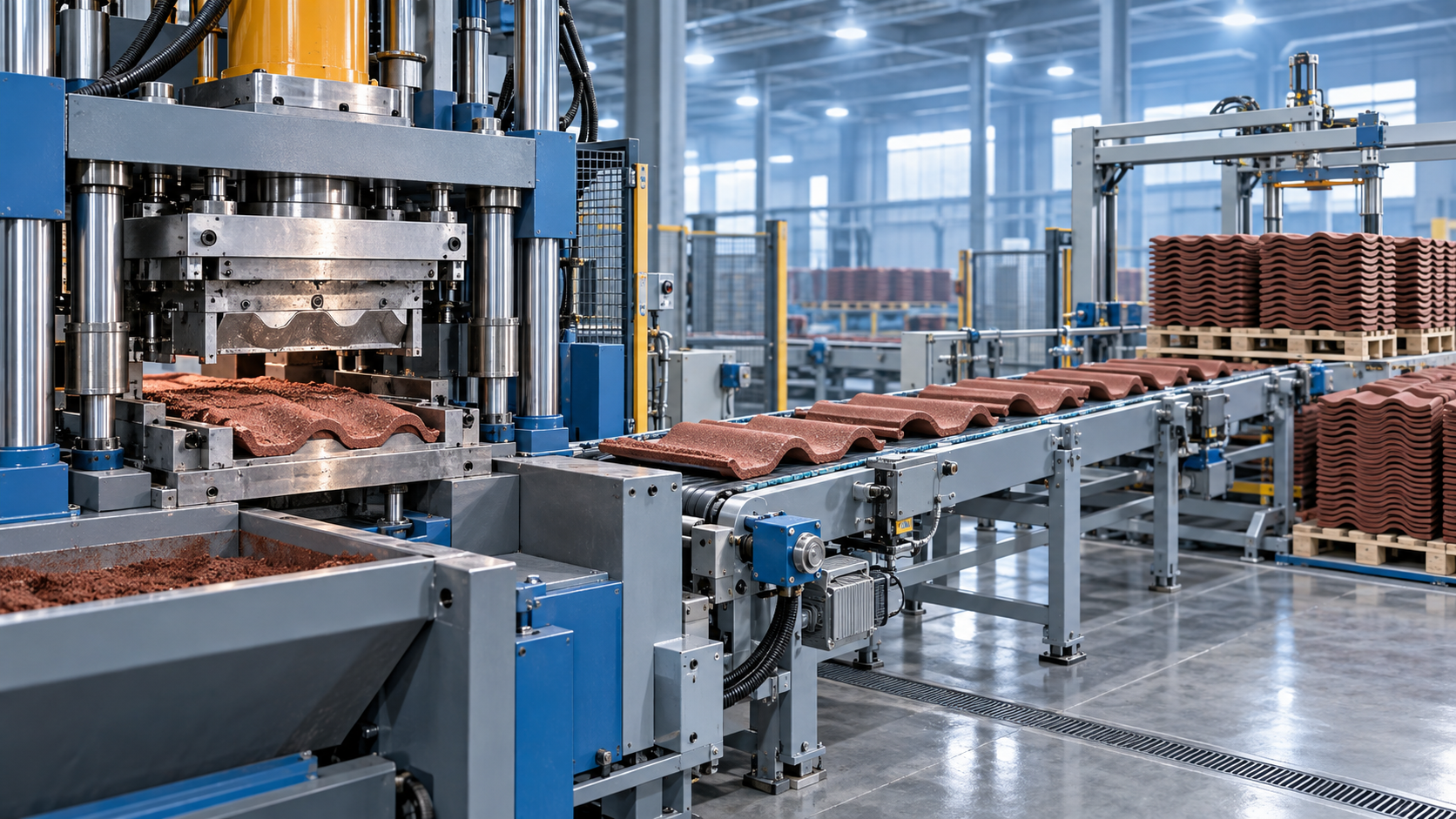
Manual pressing still has a place in very small operations, repair work, or markets with limited power infrastructure. It is familiar, relatively simple to begin with, and can suit short runs where frequent mold changes are required. But it depends heavily on operator judgment. A hydraulic roof tile machine is designed to make the forming stage more repeatable: it applies controlled pressure through a hydraulic system, works with matched molds, and can be integrated with material feeding, conveying, stacking, and curing processes.
The real comparison is not simply “machine versus labor.” It is a decision about how much variation a producer can accept, how reliably the factory must fulfill orders, and whether the production line is ready to support stable quality over time.
The Difference Begins with How Pressure Is Applied
In manual pressing, the operator loads the mix into a mold and uses a hand-operated or mechanically assisted press to compact it. The final result may be influenced by the amount of material placed in the mold, the timing of pressing, the operator’s technique, mold cleanliness, and the condition of the press. A skilled team can produce acceptable tiles, but maintaining the same result shift after shift is difficult when the process depends on individual actions.
A hydraulic roof tile machine uses hydraulic power to drive the press cycle. Pressure is not merely stronger; more importantly, it is controlled and repeatable within the machine’s operating design. The mold is closed with a consistent sequence, and the tile is formed under more stable conditions. This helps reduce variations in tile thickness, profile definition, edge shape, and surface texture.
That repeatability matters because roof tiles are installed as a system. If dimensions drift from one batch to another, installers may encounter poor overlap, uneven roof lines, gaps, or unnecessary fitting work. A tile can look acceptable when inspected individually and still create problems when thousands are laid across a roof.
Why Tile Consistency Is Often the Turning Point
Roof-tile production is sensitive to small deviations. Uneven compaction can influence the green tile’s ability to retain its shape before curing. Inadequate mold filling may leave weak sections or incomplete detail. Excess material may create flash, distort edges, and increase trimming or rejection work. These issues are not always solved by pressing harder. The moisture level of the concrete mix, aggregate grading, cement proportion, additives, mold condition, and curing discipline all remain important.
Hydraulic automation gives the production team a more dependable platform, but it cannot compensate for an unstable upstream process. If one batch of mix has a different moisture condition from the next, a consistent press cycle may simply produce consistently flawed tiles. This is why well-planned roof tile operations treat batching, mixing, feeding, forming, handling, and curing as connected stages rather than isolated pieces of equipment.
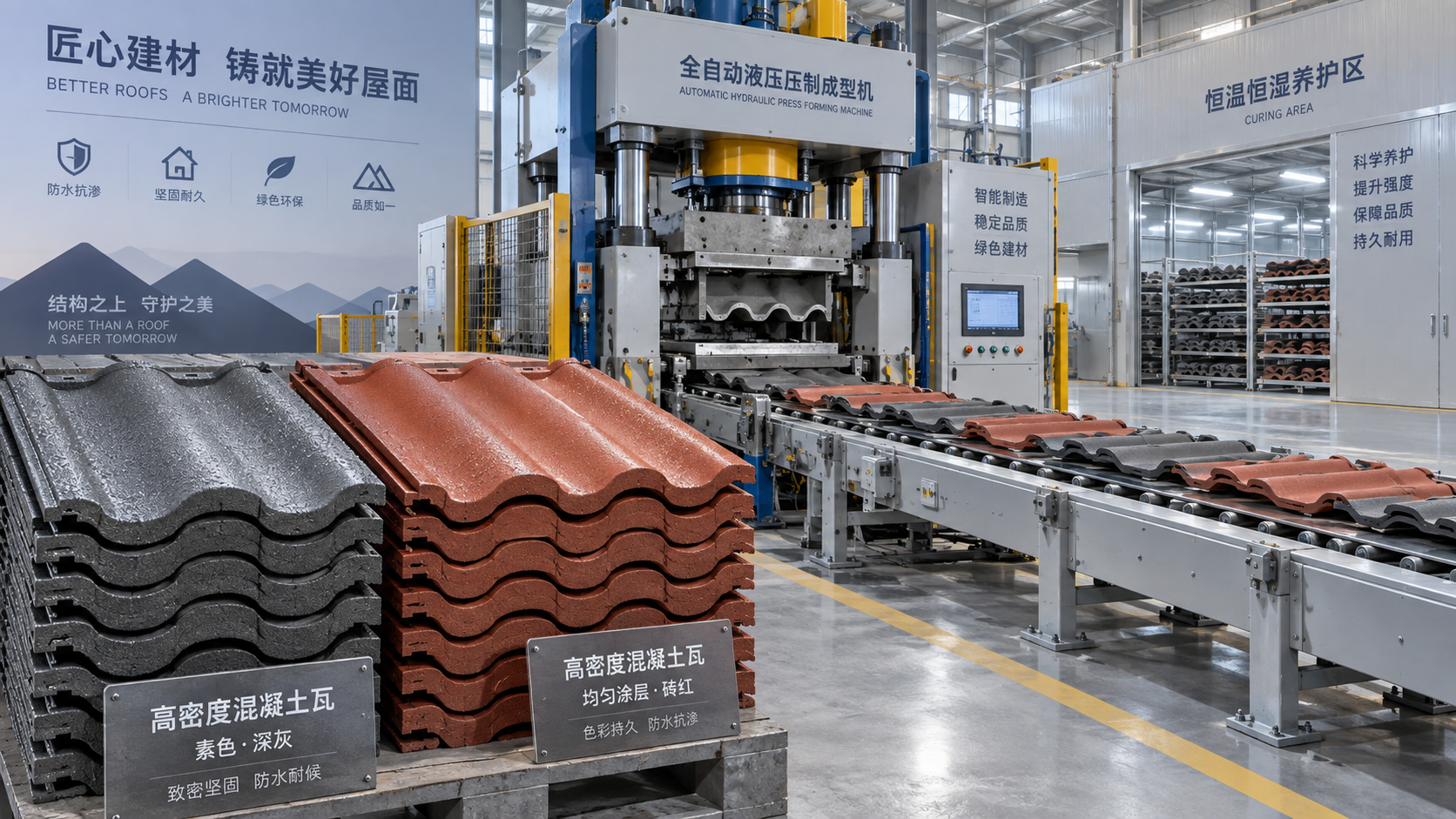
For color tile production, visual consistency adds another layer of control. The color may be introduced through the body mix, a surface layer, coating, or another process selected by the manufacturer. Whatever method is used, uneven feeding and inconsistent surface compaction can make color variation more visible. A well-maintained hydraulic machine and precise mold alignment help create a more uniform face, but pigment quality and dosing control must be evaluated separately.
Color Tile or Concrete Roof Tile? The Machinery Question Is More Nuanced
The phrase “color tile or concrete roof tile?” can be misleading because these categories often overlap. A color roof tile may be a concrete tile with pigment, a colored surface treatment, or a specific decorative finish. The right equipment choice depends less on the label and more on the tile profile, layer structure, expected appearance, local climate exposure, and customer expectations.
For a basic concrete roof tile, producers may focus on compaction, geometry, water management features, and strength development after curing. For a colored or more decorative tile, surface detail and face quality can become especially important. Deep profiles, sharp edges, interlocking features, and textured finishes require molds that are accurately manufactured and kept in good condition. A hydraulic press can support this level of repeatability, provided that the mold, feeder, and release process are properly matched.
It is also worth avoiding a common purchasing mistake: selecting a press based only on a stated capacity. A production rate has little value if the plant cannot prepare consistent material, move fresh tiles without damage, cure them reliably, or inspect finished products before dispatch. The best line configuration is the one that balances each stage around the required tile design and the market’s actual order pattern.
Manual Pressing Has Advantages, but They Are Specific
Manual pressing should not be dismissed as obsolete in every circumstance. It can be reasonable when a producer is validating demand, making a limited range of tiles, serving a small local area, or operating where capital and infrastructure are constrained. It may also allow direct hands-on inspection during early-stage development of a mix or profile.
The trade-off is operational exposure. Output may fall when experienced operators are unavailable. Training new staff takes time, and individual differences can appear in the finished product. Physical work is repetitive, while faster manual cycles can increase the chance of inconsistent mold filling or handling damage. As orders grow, the factory often adds people before it improves process control, which can make quality management more difficult rather than easier.
A hydraulic machine changes that equation by reducing reliance on manual force at the forming stage. It does not remove the need for people; it shifts their role toward setting parameters, monitoring material flow, checking molds, inspecting tiles, servicing components, and keeping the line organized. For factories that intend to build repeatable production rather than depend on a few highly experienced press operators, this can be a meaningful change.
What Buyers Should Check Beyond the Press Itself
Before selecting a hydraulic roof tile machine, buyers should define the finished product before discussing a machine model. The tile length, width, thickness, profile depth, locking geometry, surface finish, and expected weight all influence mold and production-line decisions. Local building requirements and project specifications may also set performance expectations that need to be reviewed with relevant technical documentation.
Several practical questions often reveal whether a proposal is complete:
- How will the raw materials be batched and mixed to maintain stable moisture and workable consistency?
- Is the feeder designed for the selected tile shape and material behavior?
- What mold materials, maintenance practices, and replacement arrangements are appropriate for the planned production?
- How will fresh tiles be transferred without deforming edges or damaging the surface?
- What curing space, handling equipment, electrical supply, hydraulic-oil management, and maintenance capability are available on site?
- Which acceptance checks will be used for dimensions, appearance, breakage, and other required performance properties?
A supplier should be able to discuss these interfaces, not only the press. This is particularly important when a factory is moving from manual work to mechanized production for the first time. Installation layout, operator training, spare-parts planning, and commissioning support can have as much impact on the first months of production as the equipment specification itself.
Hydraulic Equipment Requires Discipline in Return
Hydraulic machinery brings its own responsibilities. Clean hydraulic oil, sound hose and seal inspection, secure electrical connections, proper lubrication, and planned mold maintenance are not optional details. A neglected hydraulic system can lose stability, develop leaks, or cause unplanned downtime. Similarly, damaged molds can transfer defects directly into every tile produced.
The control system also needs sensible operation. Increasing pressure or shortening a cycle to chase output may not improve the product. It can stress equipment, alter the behavior of the green tile, and create handling problems downstream. Process settings should be established through trial production using the actual raw materials and tile design, then documented so that production does not depend on memory or informal habits.
This attention to process control reflects a broader manufacturing principle: a small defect rate can become a major trust issue when building materials are supplied in large quantities. Hongfa expresses this idea as “1% product defects = 100% lack of trust,” a useful reminder for any roof tile producer evaluating automation.
Selecting a Partner That Understands the Whole Line
Roof tile machinery rarely operates alone. Producers may need a coordinated solution involving concrete batching, material handling, molds, tile forming, pallet or tray movement, and curing arrangements. Manufacturers with experience across building-material equipment are generally better positioned to identify bottlenecks between these stages than suppliers focused only on one machine.
Shandong Hongfa Scientific Industrial & Trading Co., Ltd. has been involved in construction machinery manufacturing since 1990. Its product scope includes concrete batching plants, block machine lines, aerated concrete block production lines, quartz stone machinery, and related building-material equipment. The company operates four production bases in Shandong and Guangxi and reports a technical team that includes senior engineers, engineers, and more than 1,120 engineers and technicians.
Its Hongfa-branded construction machinery has ISO9001-2008 international quality system certification, while the company also cites 46 national patents, including 28 invention patents. More relevant than a list of credentials, however, is what this type of technical foundation should mean in a tile project: the supplier needs to understand how forming equipment interacts with batching accuracy, mold design, plant layout, service access, and future expansion.
The Practical Decision
Manual pressing can be sufficient for limited output and simple local demand. A hydraulic roof tile machine is usually the more appropriate route when a producer needs consistent profiles, repeatable press cycles, reduced dependence on manual forming labor, and a production structure that can support larger or more regular orders.
The decision should be based on the complete production plan, not a single output claim. Define whether the product is a standard concrete roof tile, a colored tile with stricter appearance requirements, or a specialized profile. Then confirm raw materials, mold specifications, utilities, curing capacity, operator capability, and quality checks before finalizing equipment. When those elements are aligned, hydraulic pressing becomes more than an automation upgrade; it becomes a controlled foundation for reliable roof tile manufacturing.
Previous:No more content
Next:No more content
Recommend
 Sep 30, 2026
When does an automated building material production line pay off?
Automated building material production line ROI explained: assess capacity, quality, labor, waste, and total costs to make a profitable investment.
- Oct 01, 2026
How a green building material production line reduces material waste
Discover how a green building material production line cuts waste through precise batching, controlled forming, stable curing, and smart material recovery.
- Oct 02, 2026
What to confirm before finalizing AAC factory planning
AAC factory planning: confirm product mix, raw materials, capacity, utilities, layout, automation, and supplier scope before investing in a reliable, efficient AAC plant.