How Long Does AAC Plant Installation Usually Take?
How Long Does AAC Plant Installation Usually Take?
How long does AAC plant installation usually take—and when can production actually begin? Those are different questions. An autoclaved aerated concrete plant may be mechanically complete while still waiting for steam, pressure-equipment approval, control-system checks, or a workable mix design. For investors, the useful schedule runs beyond equipment erection to safe operation and repeatable block quality.
For preliminary budgeting, a project team might allow roughly two to four months for on-site installation after foundations, equipment, lifting access, and essential utilities are ready, followed by several weeks for commissioning and initial production adjustment. This is an indicative planning allowance, not a verified industry average or a supplier commitment. Large, complex, or poorly prepared projects can take substantially longer.
The more useful question is: what must be finished before each stage can start? Understanding those dependencies—and asking “What does AAC plant commissioning include?”—helps prevent a mechanical completion date from becoming an unrealistic sales launch date.
Define Where the Installation Clock Starts
An installation estimate means little without a defined starting point. “Three months” might mean three months after the first shipment arrives, after every shipment clears customs, or after the supplier accepts the site as ready. These conditions can produce very different completion dates.
Keep the overall project schedule separate from the installation schedule. Engineering, equipment manufacture, freight, customs clearance, civil construction, and utility infrastructure may precede installation or overlap with it. They should not disappear from the investment plan simply because the equipment quotation excludes them.
A practical programme distinguishes four milestones:
- Site readiness: foundations, access, buildings, and agreed utility interfaces are ready for equipment work.
- Mechanical completion: equipment and associated systems are installed, with inspection records and outstanding items documented.
- First production: material has passed through the process and the first autoclaved blocks have been produced.
- Performance acceptance: the line has demonstrated the agreed output, product quality, and operating conditions.
The first successful batch is encouraging, but it does not prove stable commercial production. Acceptance should depend on agreed test conditions rather than a photograph of finished blocks.
How the On-Site Work Fits Together
Civil handover and equipment positioning
Before erection begins, the installation team needs to verify foundation dimensions, elevations, anchor locations, and equipment clearances against approved drawings. Underground services and drainage also matter. Correcting a misplaced foundation after heavy equipment arrives can interrupt several work fronts at once.
Delivery sequence matters as much as delivery date. Autoclaves, silos, mills where specified, and major handling assemblies need suitable unloading arrangements and lifting access. If these components arrive after surrounding structures restrict access, the team may need a different lifting plan or temporary dismantling work.
Mechanical erection and alignment
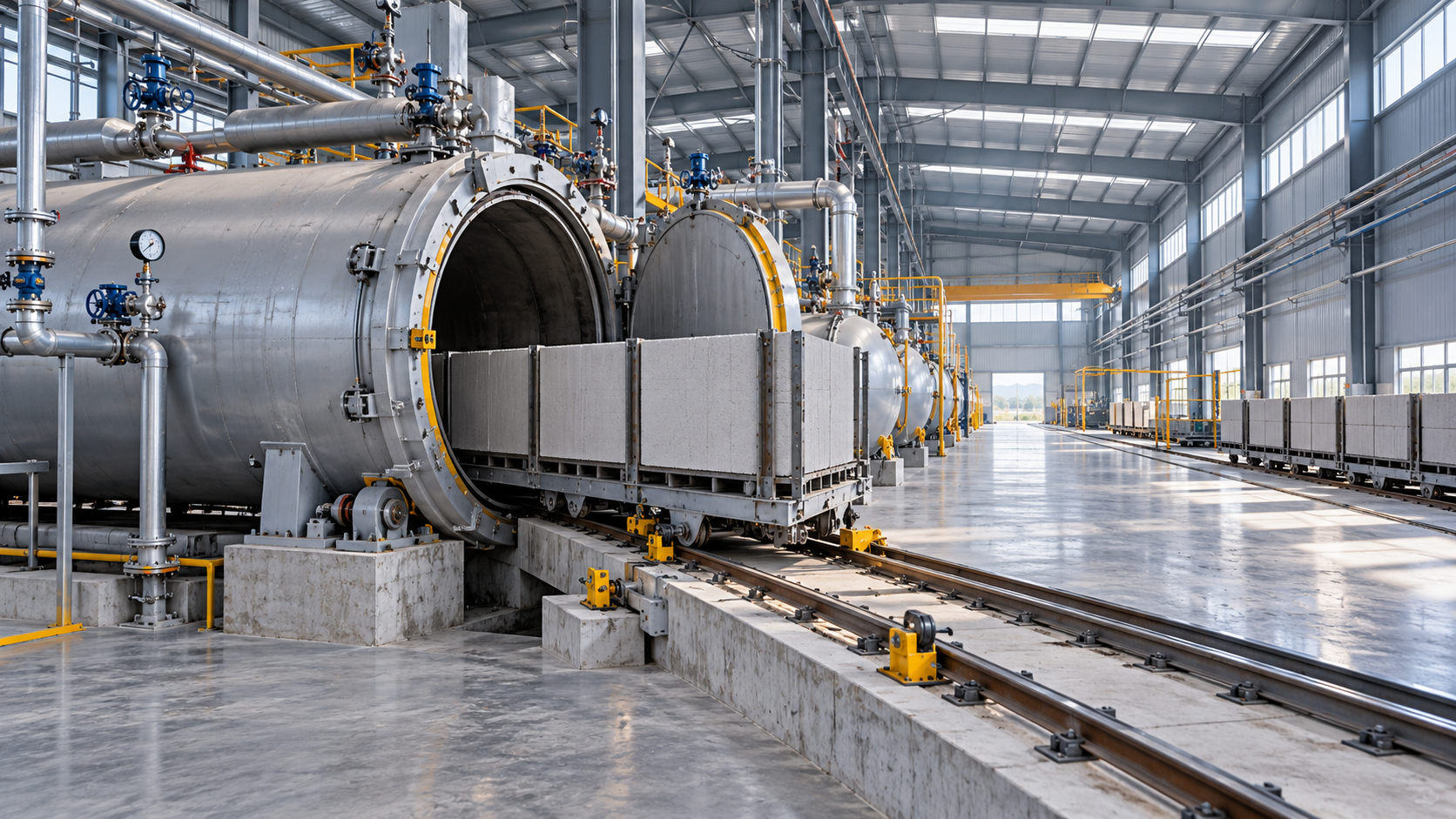
Installation normally covers raw-material preparation, batching and mixing, mould handling, pre-curing arrangements, cutting equipment, autoclaves, and finished-product handling. The precise scope depends on the selected process and automation level. Rail alignment, transfer positions, and mould movement deserve particular attention: a small mismatch can cause repeated interruptions once production begins.
Some work can proceed in parallel, but not without limits. Adding workers will not compensate for missing foundations, unavailable cranes, or incomplete installation drawings. A credible supplier schedule should show which activities can overlap and which must wait for a preceding inspection or handover.
Electrical, controls, and utility integration
Cable installation, instrument connections, control-panel checks, piping, and utility tie-ins often continue alongside mechanical erection. However, integrated testing requires these systems to be complete enough to operate safely. A mixer that runs locally is not yet proof that the batching sequence, weighing signals, alarms, and downstream handling work together.
Steam availability is especially important. The boiler, water treatment, condensate arrangements, and distribution system must support the agreed autoclave operating programme. Having a boiler on site is not the same as having a commissioned steam supply.
What Does AAC Plant Commissioning Include?
Commissioning checks whether the installed plant can operate safely and produce the intended product under agreed conditions. It connects mechanical installation with process performance. The contract should identify who supplies commissioning materials, utilities, operators, laboratory testing, and specialist support.
Pre-start checks and no-load testing
Before introducing production materials, the team checks installation condition, lubrication, motor rotation, guards, emergency stops, instrument signals, and operating sequences. Weighing systems and relevant sensors need calibration or verification. Individual equipment tests are followed by coordinated tests across connected systems.
Safety functions require documented verification, particularly around autoclave doors, pressure indication, and associated interlocks. Pressure equipment must undergo the inspections and approvals required in the destination jurisdiction. Supplier attendance does not replace local authorization, and statutory approval should never be treated as an optional final detail.
Material trials and process adjustment
AAC production depends on the behaviour of the actual raw materials, not simply the equipment settings. Sand or fly ash characteristics, lime reactivity, cement properties, aluminium dosing, and water conditions can affect slurry behaviour, expansion, green strength, cutting readiness, and the finished product.
During trials, the process team adjusts the approved formulation and operating settings within the plant’s design limits. Checks may include slurry consistency, casting temperature, rise behaviour, pre-curing time, cutting condition, and autoclave-cycle performance. The objective is repeatable batches, not one batch that happens to look acceptable.
Representative raw materials should therefore be available before wet commissioning. Changing the raw-material source immediately afterwards may require further adjustment and weaken the value of the original trial results.
Product testing, training, and acceptance
Finished blocks need evaluation against the agreed product specification and applicable market requirements. Relevant checks can include dimensions, dry density, and compressive strength. Sampling, conditioning, test methods, and reporting arrangements should be agreed in advance; a visual inspection alone cannot establish compliance.
Operator training belongs within commissioning, not after it. The operating team should practise normal starts, controlled shutdowns, alarm response, cleaning, and routine maintenance under supervision. Handover should include operating documentation, maintenance requirements, spare-parts information, test records, and a clear list of unresolved items.
What Usually Pushes the Startup Date Back?
The most disruptive delays often occur at interfaces between contractors. The equipment supplier may finish its scope while the electrical contractor is still waiting for permanent power. The civil contractor may release the building while access roads remain unsuitable for heavy deliveries. Each party can appear on schedule while the plant as a whole is not.
Capacity also affects the programme, but annual output alone is a poor scheduling tool. The number of autoclaves, material-preparation arrangement, handling system, automation scope, and installation resources give a more useful picture. A smaller line with difficult site conditions can take longer to install than a larger line on a well-prepared site.
Other risks deserve early attention:
- Incomplete shipments: missing controls or connection components can prevent testing even when major machinery is installed.
- Late design changes: revised layouts may affect foundations, piping routes, cable lengths, and access clearances.
- Inspection availability: required examinations may depend on third-party scheduling and complete technical documentation.
- Insufficient operating staff: commissioning cannot establish reliable shift operation if only a small temporary team receives training.
The response is not simply to add contingency everywhere. Identify the critical dependencies, assign an owner to each, and review them before dispatch. Reserve schedule allowance for genuine uncertainty, particularly approvals and process stabilization.
Turn a Supplier Estimate Into a Usable Project Schedule
Ask for a schedule tied to your layout and scope, rather than accepting an installation duration from a general brochure. It should state the expected working calendar, supplier supervision, locally supplied labour, lifting equipment, utility readiness dates, and responsibilities for inspection. Any assumptions behind parallel working should be visible.
For performance acceptance, define the product mix, raw-material conditions, operating hours, measurement method, and treatment of stoppages. Nameplate capacity is not a complete acceptance criterion. Without an agreed test basis, buyer and supplier may interpret the same production run differently.
Shandong Hongfa Scientific Industrial & Trading Co., Ltd., established in 1990, manufactures construction machinery including AAC production lines, block-making equipment, and concrete batching plants. When discussing a project with Hongfa, the useful focus is how equipment engineering connects with civil works, utilities, installation supervision, and process support. Manufacturing scope should translate into clear project interfaces—not an unsupported promise of a universal startup time.
Before committing to a production launch, request three separate dates: mechanical completion, first trial production, and performance acceptance. Check the prerequisites behind each one. A schedule is credible when it explains what must be ready, who is responsible, and how completion will be demonstrated—not merely how quickly the machinery can be erected.
Recommend
 Oct 27, 2026
How a Concrete Brick Machine Works—and Why Curing Still Matters
Learn how a concrete brick machine shapes and compacts bricks, why curing builds lasting strength, and which production checks help you choose equipment for reliable, saleable output.
- Oct 26, 2026
Hollow Block Making Machine: Fixing Cracks During Demolding
Hollow block making machine cracks during demolding? Discover how to check mix moisture, compaction, mold friction, and pallet support to reduce waste and improve block quality.
 Oct 27, 2026
How Long Does AAC Plant Installation Usually Take?
What does AAC plant commissioning include? Explore installation timelines, safety checks, material trials, and acceptance milestones to plan a smoother startup and avoid costly delays.