



How Much Does an Automated AAC Production Line Cost?
An automated AAC production line can range from a relatively compact, semi-integrated installation to a large industrial plant with automated material handling, cutting, autoclaving, and packaging. The equipment price is only one part of the investment. A credible budget must also account for civil works, steam generation, utilities, installation, commissioning, spare parts, and the operating conditions needed to achieve stable block or panel quality.
For that reason, there is no single useful answer to “How much does an automated AAC production line typically cost?” A low initial quotation may cover only the core machinery, while a higher quotation may include far more of the systems required to operate a plant consistently. Investors should compare scope before comparing totals.
Start with the cost boundary, not the headline price
Suppliers may use the term “AAC production line” to describe very different packages. One proposal may begin at raw-material batching and end after cutting. Another may include silo systems, slurry preparation, mould circulation, pre-curing, autoclaves, steam recovery, finished-product handling, electrical controls, and installation support. Both can be described as automated lines, but they do not represent the same investment or production risk.
Before requesting a price, define which of the following items must be included:
- Raw-material receiving, storage, weighing, and conveying for sand or fly ash, lime, cement, gypsum, and aluminum paste or powder.
- Grinding and slurry preparation equipment, where required by the selected raw material route.
- Batching, mixing, pouring, mould handling, and pre-curing systems.
- Tilting, demoulding, wire cutting, and green-cake transfer equipment.
- Autoclaves, rails, steam piping, condensate handling, and related curing infrastructure.
- Automatic separation, stacking, packing, and finished-product transfer.
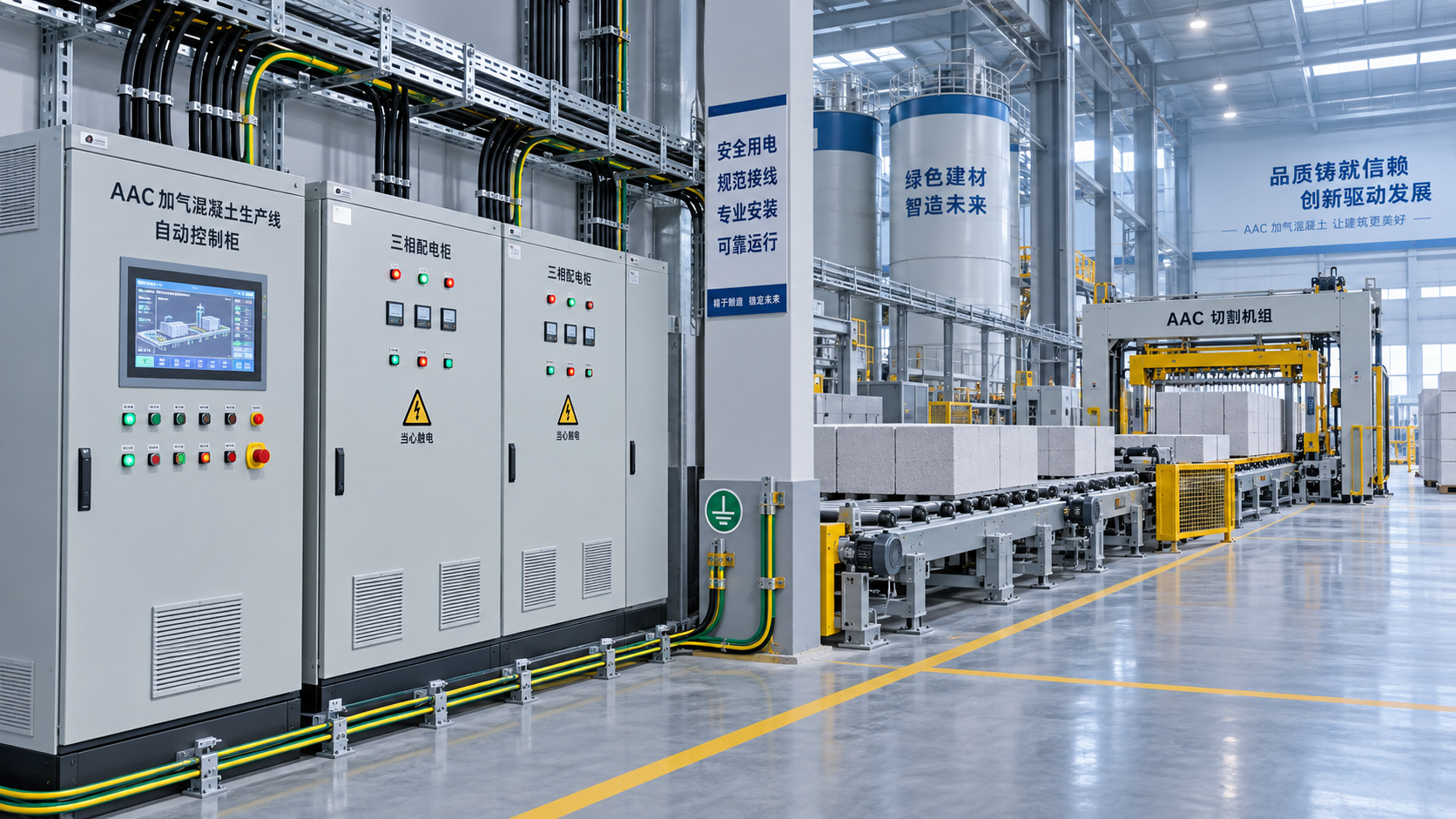
- PLC control, production data collection, electrical cabinets, and safety interlocks.
- Installation, commissioning, operator training, initial spare parts, and service support.
A proposal that excludes autoclaves, boilers, foundations, or installation can appear attractive at first glance. It may still be suitable if the buyer has those assets or intends to source them locally. It should not, however, be treated as the full plant cost.
Capacity drives the investment, but not in a straight line
Annual output capacity is usually the first sizing question because it affects almost every section of an AAC plant: material storage, mixer size, mould quantity, cutting-machine throughput, autoclave loading, handling systems, and finished-product logistics. Higher output normally requires more equipment and more robust infrastructure, yet cost does not rise in perfect proportion to capacity.
A small line can have a lower purchase price but a higher cost per unit of output because major systems such as control platforms, cutting equipment, curing equipment, and utility connections are still required. A larger plant can spread these fixed systems across greater volume, but only if sales demand, raw-material supply, and production scheduling can support high utilization.
This is why capacity should be based on realistic sellable output rather than an aspirational production target. AAC lines need time for mould circulation, pre-curing, cutting, autoclaving, equipment cleaning, maintenance, and quality adjustments. A plant sized solely around theoretical hourly output can leave an investor paying for equipment that remains underused.
Questions that should come before capacity selection
- What block or panel sizes will be sold, and how many product changes are expected?
- Will the plant run one shift, multiple shifts, or operate on a continuous schedule?
- Is the intended volume supported by dependable local demand and distribution capacity?
- Are sand, fly ash, lime, cement, water, and aluminum material available at the required quality and consistency?
- Can the site reliably provide electricity, water, steam, fuel, and maintenance resources?
A moderately sized line with stable operation may produce a stronger return than a larger installation forced to run intermittently or continually adjust its mix design because feedstock varies.
Automation level changes both capital cost and operating discipline
“Automated” does not mean the same thing at every factory. Basic automation may cover weighing, mixing, mould movement, cutting, and autoclave transfer while still relying heavily on operators for material feeding, inspection, adjustments, and packing. A higher level of automation can extend to silo feeding, dosing, mould circulation, process control, finished-product handling, and production reporting.
More automation raises the upfront cost through drives, sensors, conveyors, robotic or mechanical handling systems, software, cabinets, and integration work. It can also reduce manual material movement, improve batch consistency, and make production easier to monitor. Those benefits depend on the plant being properly maintained and operated by personnel who understand the process.
For many buyers, the appropriate question is not whether to choose the highest possible automation level. It is which manual tasks create the greatest bottleneck, quality variation, safety exposure, or labor dependency. Automating those areas first often makes better commercial sense than paying for automation in processes that local labor can handle reliably.
Autoclaving and energy infrastructure can reshape the project budget
AAC derives its final strength and dimensional stability through high-pressure steam curing. The autoclave section is therefore more than an accessory to the line. Its capacity, quantity, loading arrangement, steam supply, and cycle control determine how smoothly upstream and downstream equipment can operate.
Steam generation and distribution deserve separate attention in early budgeting. The project may require a boiler system or another steam source, fuel handling, water treatment, steam piping, condensate recovery, insulation, safety equipment, and local permitting work. These components can represent a substantial portion of the total investment, particularly where site utilities are limited.
Energy efficiency should also be evaluated as an operating-cost issue rather than a brochure claim. Heat recovery, condensate reuse, insulation quality, steam control, and autoclave scheduling can affect the cost of every cubic meter produced. A line with a lower initial cost may become more expensive over time if it wastes steam, creates long curing delays, or requires frequent intervention to maintain stable conditions.
Layout and local construction costs are often underestimated
Equipment capacity alone does not determine whether an AAC factory will fit the site. Raw material storage needs space; mould circulation needs a clear production path; autoclaves require rail access and safe operating clearance; finished blocks or panels require protected storage and truck-loading areas. The building, foundations, drainage, roads, workshops, laboratories, and utility corridors must support that flow.
These costs vary sharply by location, site condition, and local construction practice, so they should be separated from the machinery quotation. The same equipment package can require very different foundation work depending on soil conditions, building design, frost requirements, seismic considerations, and utility connections.
Plant layout also has a direct effect on future operating cost. Long material routes, constrained forklift movement, poor separation between wet and finished-product zones, or inadequate maintenance access can reduce productivity for years. A lower-cost layout that saves building area but complicates daily handling is rarely a bargain.
Compare quotations by scope and lifecycle exposure
When reviewing proposals, buyers should ask for a clear equipment list, process-flow description, utility requirements, civil-work interfaces, excluded items, and performance assumptions. A single lump-sum number does not reveal enough to make a sound comparison.
It is useful to separate the investment into four working categories:
- Core process equipment: batching, mixing, moulds, cutting, autoclaves, transfer systems, and packaging equipment.
- Plant infrastructure: buildings, foundations, utilities, steam systems, electrical distribution, water treatment, roads, and storage areas.
- Start-up requirements: installation, commissioning, training, trial production, initial tooling, and spare parts.
- Lifecycle costs: energy, wear parts, wire systems, maintenance labor, automation support, downtime, and product breakage.
The supplier should also explain the basis for any stated capacity: product dimensions, density range, number of operating hours, autoclave cycle assumptions, raw-material characteristics, and expected equipment availability. Capacity promises are difficult to evaluate without those conditions.
Where the cheapest line can become the most expensive choice
The largest risks often appear after delivery. In AAC production, small inconsistencies in raw materials, slurry temperature, dosing, rising behavior, cutting timing, or steam curing can lead to cracks, dimensional variation, low strength, or excessive waste. The line must have appropriate controls, but it also needs a supplier capable of defining process parameters and supporting commissioning.
Buyers should pay close attention to the engineering depth behind equipment that looks similar on a quotation. Mould rigidity, cutting-wire arrangement, transfer accuracy, valve quality, control components, autoclave design, insulation, and the availability of wear parts can materially affect uptime. So can the supplier's ability to provide drawings, installation guidance, operator training, troubleshooting support, and a workable spare-parts plan.
For an automated AAC production line, the sensible budget is the amount required to produce saleable material consistently, not merely the amount needed to place equipment in a building. A well-defined scope, realistic capacity model, suitable automation level, and credible steam and site plan will make the cost comparison far more meaningful than any headline equipment price.
Recommend
 Sep 30, 2026
When does an automated building material production line pay off?
Automated building material production line ROI explained: assess capacity, quality, labor, waste, and total costs to make a profitable investment.
- Oct 01, 2026
How a green building material production line reduces material waste
Discover how a green building material production line cuts waste through precise batching, controlled forming, stable curing, and smart material recovery.
- Oct 02, 2026
What to confirm before finalizing AAC factory planning
AAC factory planning: confirm product mix, raw materials, capacity, utilities, layout, automation, and supplier scope before investing in a reliable, efficient AAC plant.