

What Raw Materials Does a Fly Ash AAC Plant Need?
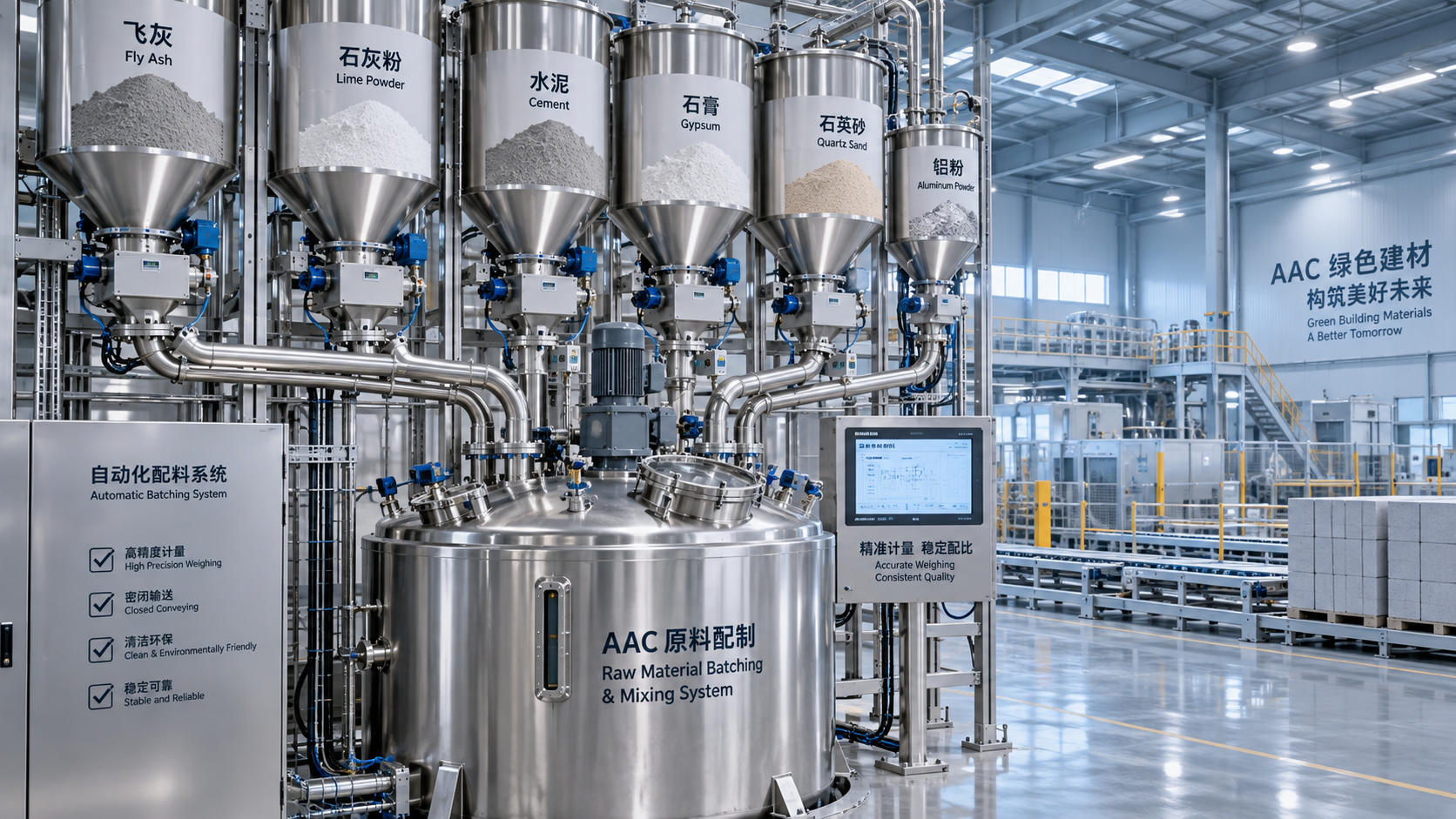
A fly ash AAC plant needs a controlled blend of fly ash, lime, cement, gypsum, aluminum powder or paste, water, and often a supplementary silica material such as sand. Each material has a separate job during slurry preparation, pore formation, pre-curing, cutting, and autoclaving. The required materials are not simply combined by weight: their fineness, chemical activity, moisture, temperature, and consistency determine whether the green cake rises evenly and whether the final AAC blocks achieve stable density and strength.
Fly ash is the main silica-bearing raw material in this type of production route, but it does not automatically replace every other mineral component. A workable mix must provide reactive silica, enough available calcium, suitable alkalinity, controlled gas generation, and sufficient water for pumping and molding. The exact formulation changes with the quality of the local fly ash and the intended block density, so raw-material testing should precede final recipe setting.
Fly Ash: The Primary Silica Source
Fly ash is a fine powder collected from coal combustion systems. In a fly ash AAC plant, it commonly supplies much of the silica and alumina needed to form hydrated calcium silicate compounds during autoclaving. Its particles are already fine compared with many natural mineral materials, which can reduce grinding demand. That advantage is only meaningful when the ash has stable physical and chemical properties.
The most useful fly ash for AAC has reasonably consistent fineness, low levels of unburned carbon, and a composition that supports reaction with lime under high-temperature steam curing. Very coarse ash may settle in the slurry or leave poorly reacted particles in the block. High carbon content can interfere with aluminum-based gas formation and lead to inconsistent expansion. Large changes in ash moisture also alter the actual solids-to-water ratio, even when the dosing system appears to be following the same recipe.
Storage deserves attention because fly ash readily absorbs moisture and can compact in silos. Bridging, irregular discharge, or partial segregation makes batch-to-batch control difficult. A receiving inspection normally considers moisture, particle size distribution, loss on ignition, and chemical composition. These values are more useful when trended over time than when treated as a single pass-or-fail result.
Calcium-Bearing Materials: Lime and Cement
Quicklime, usually processed into lime slurry, supplies reactive calcium oxide. After hydration and mixing, it contributes alkalinity and reacts with silica during the later hydrothermal stage. Lime quality strongly affects the early behavior of the AAC slurry. Under-reactive lime can delay the rise of the green cake, while excessively rapid or uneven slaking can create local temperature spikes, lumps, or unstable thickening.
The relevant property is not merely total calcium oxide content. Reactivity, residue after slaking, grinding fineness, storage condition, and the presence of magnesium-bearing compounds all affect behavior. Lime that looks chemically acceptable on a report can still perform poorly if it hydrates slowly or enters the slurry as coarse particles. For this reason, lime preparation equipment needs enough mixing time and screening capacity to deliver a uniform slurry rather than a mixture of fine hydrate and unreacted grains.
Cement is often added to improve early green strength and support a more reliable cutting window. It also contributes calcium compounds that participate in hydration and autoclave reactions. Cement is not always the dominant calcium source, and its share should not be increased casually to compensate for poor fly ash or lime control. More cement may change slurry setting behavior, increase heat release, and alter the balance between expansion and stiffening. A cake that sets before expansion is complete can produce dense areas, cracking, or uneven pores.
Freshness matters with both lime and cement. Moisture-exposed materials can lose useful reactivity before reaching the mixer. Separate, dry storage and stable feeding equipment prevent a material-handling problem from being mistaken for a formulation problem.
Gypsum Controls the Reaction Window
Gypsum is used in many fly ash AAC formulations to regulate hydration and influence the structure that develops before autoclaving. Depending on the local raw-material system, natural gypsum, desulfurization gypsum, or another suitable sulfate source may be considered. The material must be evaluated for moisture, purity, particle size, and consistency rather than selected solely because it is available nearby.
Its effect is closely tied to cement, lime, and temperature. Too little sulfate control can make the slurry set unpredictably. Too much can slow desirable reactions or leave a cake with poor cutting strength. Moist desulfurization gypsum requires particular care in weighing because its water content affects both the gypsum dose and the total process water. Treating wet gypsum as though it were dry powder is a common source of unexplained slurry variation.
Aluminum Powder Creates the Air-Cell Structure
Aluminum powder or aluminum paste is the gas-forming agent. In the alkaline slurry, aluminum reacts and releases hydrogen gas, creating the fine pores that give AAC its low density. The reaction occurs early in the process, before the material has developed enough strength for cutting. This makes aluminum addition one of the most sensitive points in the entire raw-material system.
The required quantity is small relative to fly ash, lime, and water, but small dosing errors have visible consequences. An insufficient dose can produce blocks that are heavier than intended. An excessive or overly fast reaction can cause overflow, large pores, collapse, and weak zones. Particle size, surface treatment, storage age, mixing method, slurry temperature, and alkali level all influence the gas-release rate.
Aluminum should be stored dry, protected from contamination, and prepared according to the formulation procedure immediately before use where applicable. Clumped powder, poorly dispersed paste, or delayed addition produces uneven pore distribution. The problem is sometimes blamed on the autoclave, although the defect may already be present in the fresh slurry or green cake.
Water Is a Process Material, Not Just a Carrier
Water is needed to prepare fly ash slurry, slake lime, disperse aluminum, adjust slurry flow, and support hydration. Its amount affects density, viscosity, temperature, rise behavior, and the energy needed later to remove excess moisture. A mix with too little water may be difficult to pump or may trap air unevenly. Excess water can delay setting, encourage settling, and weaken the green cake before cutting.
Water quality also deserves review. High concentrations of dissolved salts, suspended solids, oils, or organic contaminants can disturb setting and gas generation. Recycled process water is often technically usable, but its solids content, alkalinity, temperature, and residual fines must be controlled. Its contribution should be included in the batch calculation rather than treated as neutral water.
Temperature is especially influential. Warm slurry accelerates hydration and aluminum reaction; cold slurry slows both. A formulation that performs well under one seasonal condition can behave differently when incoming water, fly ash slurry, or lime slurry temperature changes. Maintaining a defined mixing temperature range is often more effective than repeatedly changing the aluminum dose to correct a seasonal rise problem.
Is Sand Required in a Fly Ash AAC Plant?
Sand is not always required, but it is commonly used when fly ash alone does not provide enough suitable reactive silica or when greater control over the silica fraction is needed. Finely ground quartz sand can supplement fly ash, stabilize material composition, or help meet a particular product design. It must be ground into a sufficiently fine slurry before mixing; coarse sand particles do not react efficiently during the available autoclave cycle and may weaken the finished material.
Adding sand changes more than the silica content. It affects grinding capacity, slurry density, sedimentation tendency, water demand, and the ratio between reactive and less-reactive mineral fractions. A high-sand formula may therefore require changes to milling, slurry tanks, batching accuracy, and cutting timing. Sand should be introduced because test results show a need, not simply because it is listed in a generic AAC recipe.
Material Relationships That Affect the Mix
Raw Materials Should Be Evaluated as a System
A common mistake is to approve each material separately and assume the combined mix will behave predictably. AAC reactions are linked. A change in fly ash fineness can change water demand; altered water demand affects slurry temperature and viscosity; those changes influence aluminum expansion; the expansion profile determines the green-cake condition at cutting. This is why recipe adjustments should be made through controlled plant trials with recorded material properties, mixing time, fill temperature, rise profile, cutting condition, and final block results.
Material substitution requires the same discipline. Replacing one fly ash source with another, using a different gypsum type, or changing aluminum powder grade may appear inexpensive at the receiving point but can create larger losses through unstable production. The correct question is whether the substitute produces equivalent slurry behavior and cured structure after all process settings are adjusted, not whether it has a similar name or nominal composition.
Before the Materials Enter the Mixer
Reliable production begins with preparation. Fly ash and sand slurry need adequate agitation to prevent settling. Lime needs complete and consistent slaking. Dry powders require accurate weighing and dust-controlled transfer. Aluminum needs controlled dispersion. Water addition must account for the moisture already present in fly ash, gypsum, recycled water, and slurries.
The batch sequence also affects results. Introducing aluminum before the base slurry has reached the intended consistency and temperature can start gas generation too early. Conversely, long delays after aluminum addition can reduce the useful filling period. The mixing system, slurry tanks, weighing devices, and mold-filling arrangement must therefore match the material behavior, especially where fly ash properties vary from delivery to delivery.
A fly ash AAC plant does not need every possible mineral ingredient. It needs a compatible raw-material set that consistently supplies silica, reactive calcium, sulfate control, a precisely managed gas-forming agent, and clean process water. Stable inputs and disciplined proportioning give the autoclaving stage a sound green cake to cure; no later operation can fully correct poor pore formation or an unbalanced slurry.
Recommend
 Sep 30, 2026
When does an automated building material production line pay off?
Automated building material production line ROI explained: assess capacity, quality, labor, waste, and total costs to make a profitable investment.
- Oct 01, 2026
How a green building material production line reduces material waste
Discover how a green building material production line cuts waste through precise batching, controlled forming, stable curing, and smart material recovery.
- Oct 01, 2026
What Raw Materials Does a Fly Ash AAC Plant Need?
What raw materials are needed for a fly ash AAC plant? Explore fly ash, lime, cement, gypsum, aluminum, water, and sand requirements for stable AAC block production.