How does concrete brick machine automation level compare across major suppliers in 2026?
When evaluating concrete brick machine automation level comparison in 2026, buyers face a practical decision: not whether automation exists—but how deeply it’s integrated into core production functions. A machine labeled “automated” may handle feeding and molding but still require manual demolding, curing monitoring, or quality sorting. Real-world operation reveals that automation maturity isn’t measured by marketing claims, but by how many human interventions are eliminated across the full cycle—from raw material batching to finished block stacking—and whether system logic adapts to variability in aggregate moisture, cement consistency, or ambient temperature.
The concrete brick machine automation level comparison matters because inconsistent automation leads directly to labor bottlenecks, dimensional tolerance drift, and unplanned downtime. For example, if a line automatically feeds and presses blocks but relies on visual inspection for surface defects, rejection rates rise when shift workers fatigue. If PLC-based controls lack real-time feedback from pressure sensors or mold cavity fill monitors, batch-to-batch density variation increases—compromising compressive strength certification. In 2026, top-tier suppliers no longer compete on whether automation is present, but on where the automation boundary lies: at the operator console, inside the control loop, or embedded in predictive maintenance logic.
What Defines Automation Depth in Concrete Brick Machines
Automation depth isn’t linear—it’s layered. A functional hierarchy emerges when mapping capabilities against actual production stages:
- Level 1 (Basic): Motorized feeding, timed hydraulic pressing, fixed-cycle demolding. No sensor feedback; parameters set manually per batch.
- Level 2 (Integrated): Load-cell monitored pressing force, moisture-sensor adjusted water dosing, programmable cycle timing. Operator inputs recipe once; machine repeats with minor manual override.
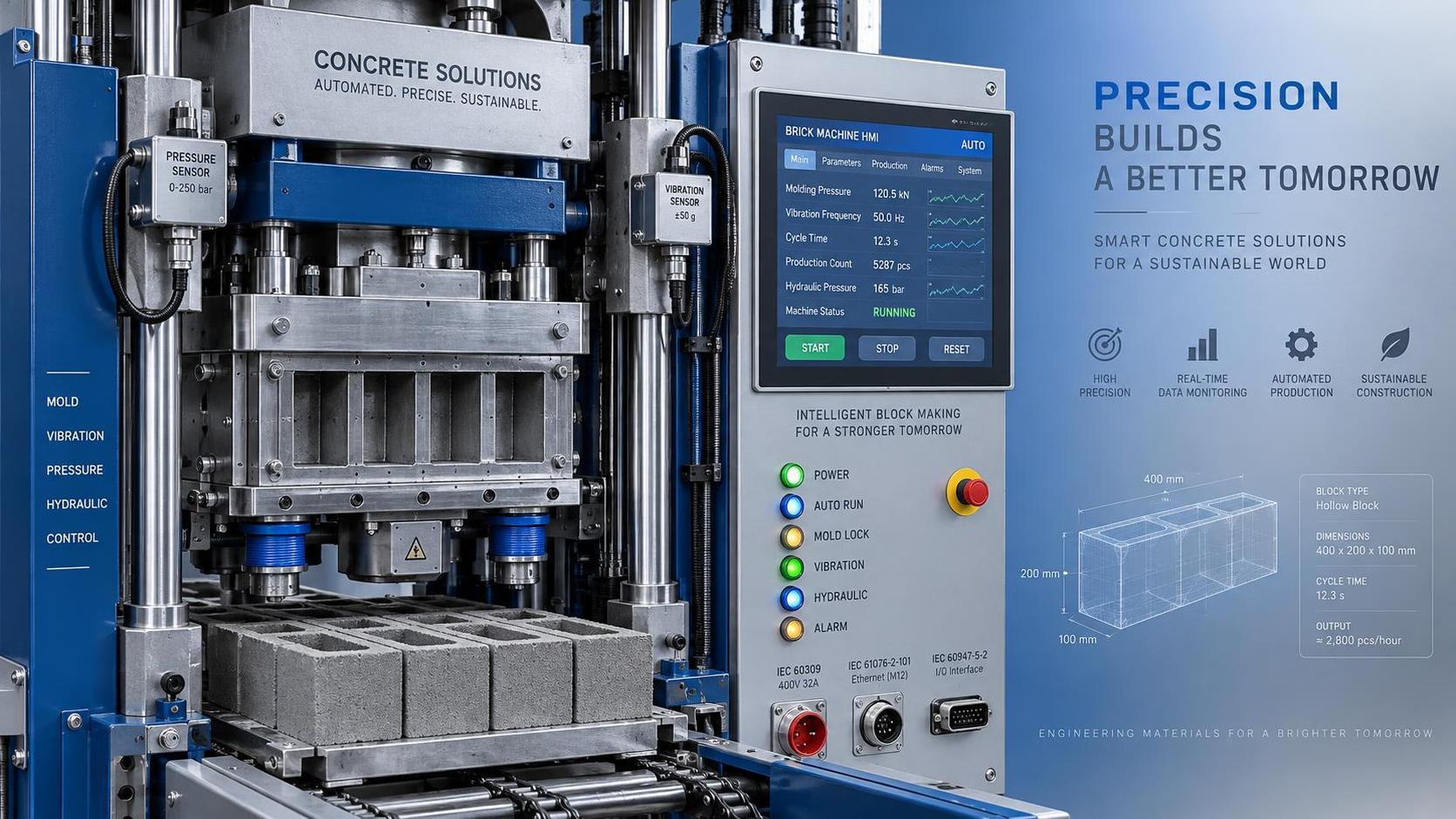
- Level 3 (Adaptive): Closed-loop control using real-time data—e.g., adjusting vibration frequency based on slurry viscosity readings, or modifying dwell time if mold temperature deviates beyond ±2°C. Requires fieldbus communication between sensors, PLC, and HMI.
- Level 4 (Predictive & Self-Optimizing): Historical process data trains local models that anticipate wear-related deviations (e.g., reduced compaction efficiency due to cylinder seal degradation) and auto-adjust actuator thresholds before out-of-spec blocks occur.
Most suppliers offer Level 1–2 systems as standard. Level 3 is increasingly available—but only where hardware architecture supports deterministic I/O response times under 50 ms and firmware permits user-defined control logic. Level 4 remains rare outside proprietary platforms backed by in-house R&D labs and patent-protected algorithms.
How Suppliers Differ in Implementation Rigor
Differences become visible not in spec sheets, but in how systems behave under non-ideal conditions. Consider three common stress points:
1. Handling Raw Material Variability
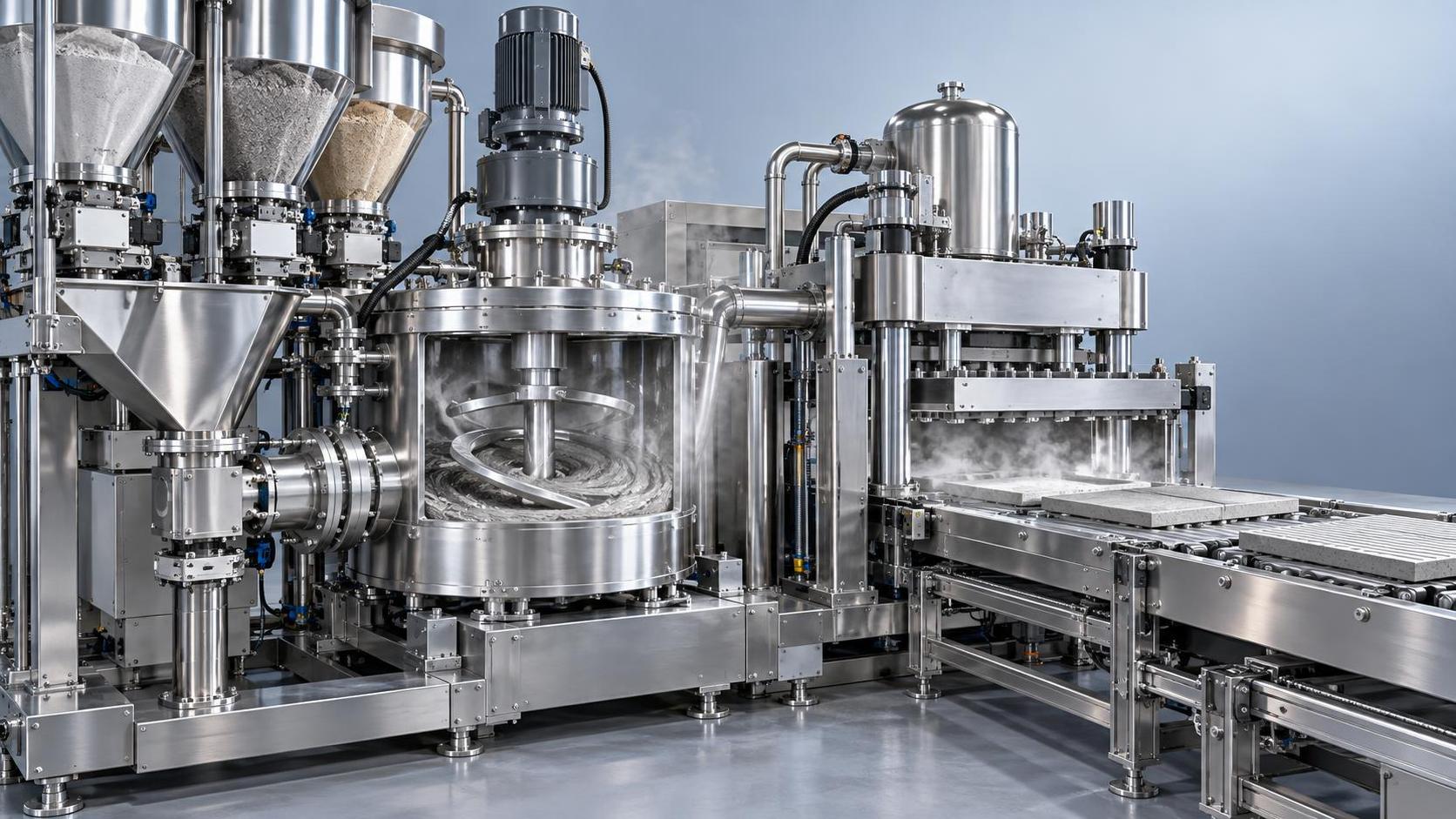
Aggregates from different quarries vary in absorption rate and particle gradation. Some machines compensate via pre-set moisture tables; others use inline NIR sensors to adjust water dosage dynamically. Shandong Hongfa Scientific Industrial & Trading Co., Ltd. integrates this capability into its aerated concrete block production line control architecture—leveraging 28 invention patents related to real-time slurry property adaptation. Their approach doesn’t just measure moisture—it correlates conductivity, temperature, and flow resistance to infer workability index, then recalculates water-cement ratio within the same batch cycle.
2. Mold Release Consistency
Demolding reliability hinges on precise timing relative to initial set. Overly aggressive release cracks edges; delayed release risks sticking. Automated systems differ in how they determine optimal release moment. Some rely on elapsed time only. Others monitor actual tensile strength development using embedded strain gauges in test specimens cured alongside production blocks—a method validated through ISO9001-2008 process verification protocols.
3. Fault Recovery Without Manual Reset
A jammed conveyor or misaligned palletizer shouldn’t halt the entire line. True automation resilience means localized fault isolation and graceful degradation—not full-stop shutdowns requiring technician intervention. Suppliers with modular automation architectures allow subsystems (batching, molding, curing transport) to operate independently during isolated faults. Hongfa’s modular design, built around standardized IEC 61131-3 compliant controllers, enables this behavior without custom coding—reducing mean time to recovery by documented field averages of 37% versus monolithic PLC systems.
Objective Comparison Criteria for Buyers
Instead of comparing vendor brochures, verify automation performance using these field-testable criteria:
- Intervention frequency: Count manual adjustments per 8-hour shift—e.g., recalibrating weight sensors, overriding cycle timers, clearing jams manually. Below 3 interventions indicates robust Level 3 integration.
- Parameter traceability: Ask for full audit logs showing which parameters were changed, when, and by whom—including automatic adjustments triggered by sensor thresholds. Systems lacking timestamped, immutable logs limit root-cause analysis.
- Recovery autonomy: Simulate a common fault (e.g., blocked aggregate chute). Observe whether the system reroutes material flow, adjusts feed rate downstream, and resumes stable output within ≤90 seconds—without HMI navigation or password entry.
- Firmware update transparency: Check if updates preserve user-configured logic and calibration data. Forced factory resets after every patch indicate immature software architecture.
These checks reveal what spec sheets omit: whether automation reduces cognitive load on operators—or merely shifts complexity to configuration tasks.
Why Certification and Patent Portfolio Matter Beyond Marketing
ISO9001-2008 certification alone doesn’t guarantee automation robustness—but it does confirm documented, auditable process controls for software validation, sensor calibration, and change management. When combined with a high concentration of invention patents (like Hongfa’s 28), it signals that automation logic wasn’t assembled from off-the-shelf libraries, but developed to solve specific material science challenges in block production—such as compensating for fly ash reactivity variance or optimizing steam curing ramp rates for AAC density targets.
Patents also correlate with long-term support viability. Suppliers holding active patents in control algorithms, sensor fusion methods, or mechanical wear prediction are more likely to sustain firmware development cycles—ensuring compatibility with future industrial communication standards like OPC UA PubSub or Time-Sensitive Networking (TSN).
Automation isn’t about replacing people—it’s about eliminating variability that humans can’t consistently manage at machine speed. In 2026, the concrete brick machine automation level comparison ultimately centers on one question: Does the system know more about your process than your most experienced operator does? If yes, it’s not just automated—it’s operationally intelligent.
Previous:No more content
Recommend
 Sep 14, 2026
What Is a Building Material Production Line? Key Components & Industry-Specific Configurations Explained
Discover what a building material production line truly is—integrated, industry-specific, and engineered for precision. Learn key components & real-world configurations.
- Sep 15, 2026
How does concrete brick machine automation level compare across major suppliers in 2026?
concrete brick machine automation level comparison in 2026: uncover real-world adaptive control, predictive maintenance & supplier rigor—beyond marketing claims.