

How to Estimate the Cost of an Automated AAC Block Production Line
An automated AAC block production line should be priced as a complete production system, not as a group of individual machines. The quoted equipment price is only one part of the investment. A line with the same nominal output can require very different capital expenditure when raw materials, curing method, automation scope, building constraints, energy supply, installation conditions, and finished-product requirements change.
A practical estimate begins with a defined production target: block dimensions, daily or annual output, density grades, shift pattern, and expected product mix. Without those inputs, a low initial quotation may omit equipment or infrastructure needed to achieve the stated capacity under normal operating conditions. The useful question is not simply, “What does the line cost?” It is, “What scope is required to produce saleable AAC blocks at the required output and quality level?”
Start with the required output, not the machine name
Capacity is often stated in cubic meters per year, but that figure has limited value unless the operating basis is clear. A line designed around continuous production across multiple shifts differs from one intended for limited daily operation. The number of autoclaves, mold circulation time, cutting cycle, green-cake handling rate, and loading arrangement must all support the target output. If one section is undersized, the nominal capacity of the rest of the line becomes irrelevant.
Block size and density also influence the estimate. Larger formats affect mold volume, cutting arrangement, packing, and handling loads. Lower-density AAC can require closer control of slurry preparation, expansion behavior, and cutting strength. A product range that includes blocks, panels, or special dimensions may need different handling equipment, molds, cutting tools, and packing arrangements. These additions should be identified before comparing proposals.
Ask each supplier to state the design basis in the same terms: annual output, operating days, shifts, product density range, standard product dimensions, and assumed reject rate. A capacity quotation without its operating assumptions cannot be compared fairly with another quotation.
Separate the investment into defined cost groups
An automated AAC block production line cost estimate becomes more reliable when it is divided into equipment, site works, utilities, engineering, and startup expenditure. This structure also makes exclusions visible early, when changes are less expensive than during installation.
Each group should be marked as included, excluded, or supplied by a third party. Vague wording such as “complete line” is insufficient unless the boundary between the equipment supplier, civil contractor, utility provider, and installation contractor is documented.
Raw material preparation can reshape the equipment scope
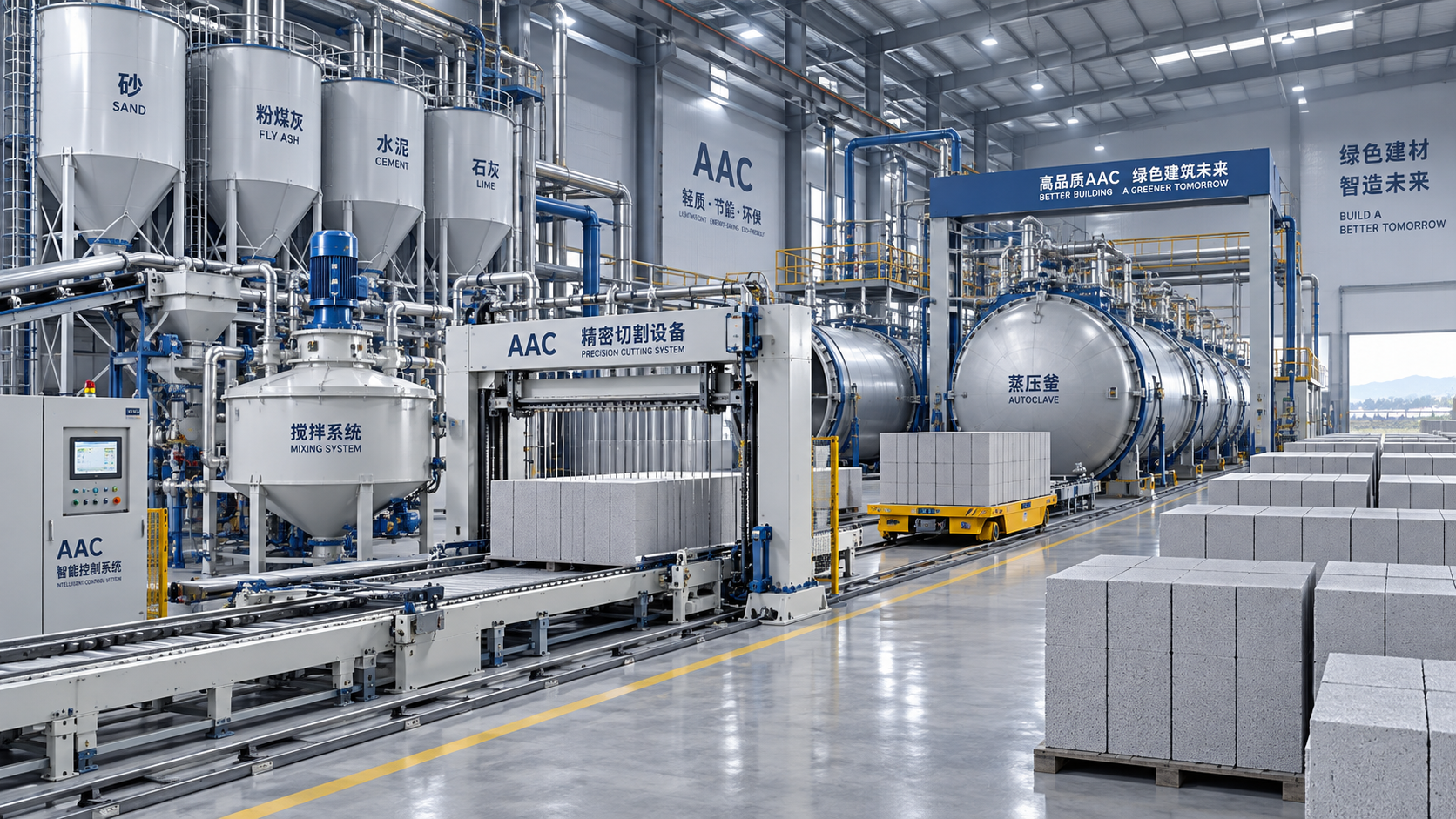
AAC production commonly uses a siliceous material, cement, lime, gypsum or similar additives, aluminum powder or paste, and water. The preparation route depends heavily on the form and quality of locally available raw materials. Sand that requires wet grinding has different equipment needs from fly ash supplied at a stable fineness. Lime delivered in lumps needs crushing, storage, and processing arrangements that differ from hydrated or powdered lime. Material variability can create an ongoing process-control burden even when the initial equipment list appears complete.
The grinding section deserves close attention because it affects both capital cost and operating cost. A ball mill system requires supporting tanks, pumps, classifiers or screening arrangements where applicable, slurry storage, and recirculation. Its capacity must match the batching schedule rather than merely reach a theoretical hourly rate. Undersized grinding capacity may force batching delays; excessive storage and pumping capacity raises investment without improving output.
Storage is another source of omissions. Bulk silos, conveying equipment, dust collection, weighing devices, and unloading arrangements should be matched to the delivery method and material consumption rate. A plant receiving bagged materials has a different labor, handling, and dust-control profile from one supplied by tankers or bulk trucks. The estimate should identify which storage systems are necessary on site and which are outside the equipment package.
Autoclave selection affects much more than vessel price
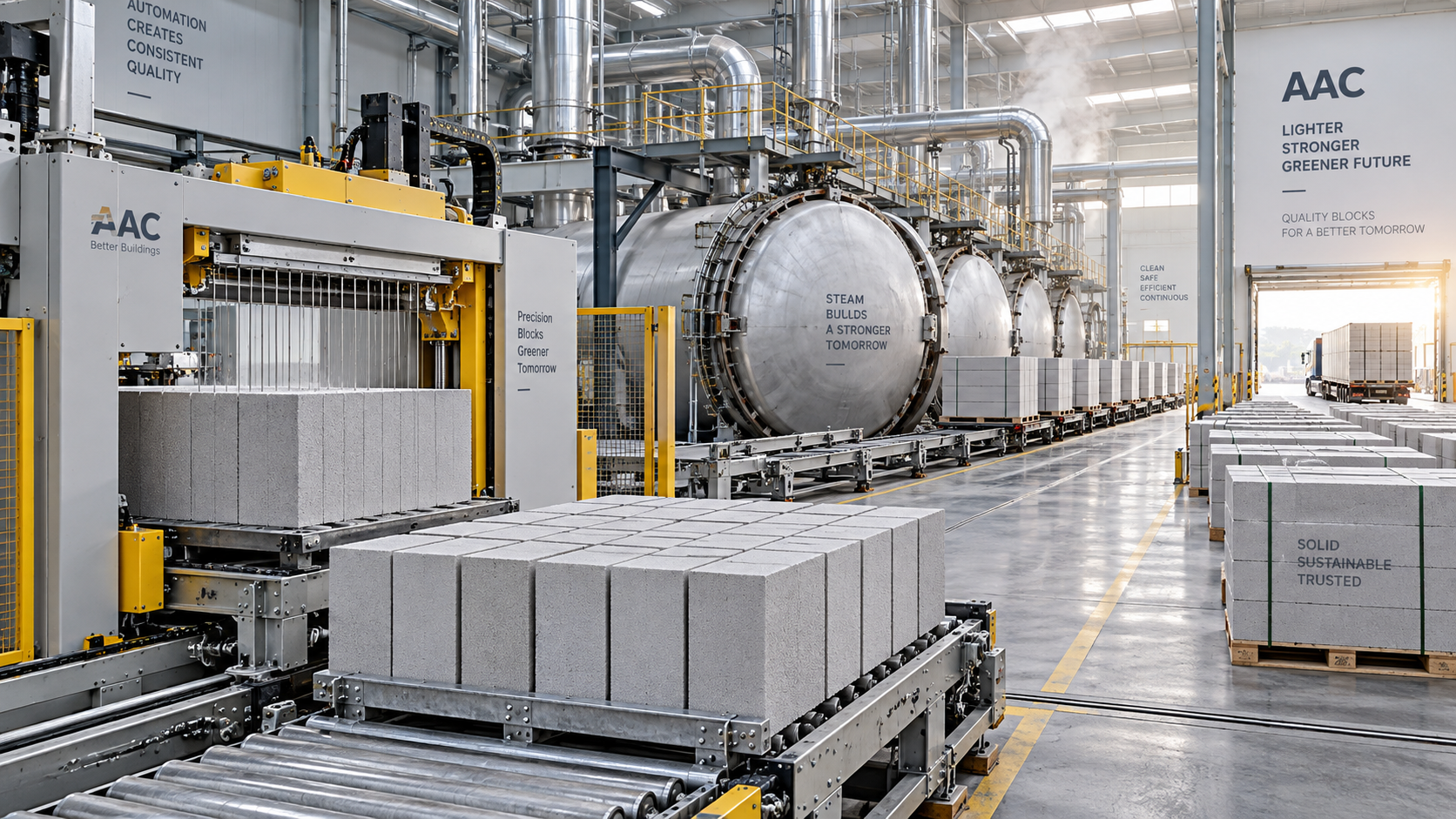
The autoclave section is central to AAC production because it determines curing throughput, steam demand, transfer logistics, and a significant share of the plant layout. Estimating this section only by the number or size of pressure vessels can lead to a misleading result. The budget must also include loading and unloading arrangements, rail tracks or transfer cars, valves, piping, insulation, steam distribution, condensate handling, and safety-related installation requirements.
Cycle time should be assessed as a full sequence: loading, heating, holding, depressurization, unloading, and transfer. A short curing stage does not necessarily mean a short total autoclave occupancy time. If loading and unloading are slow, or if transfer paths interfere with cutting-line movement, the autoclave becomes a production bottleneck even though the vessel itself is correctly sized.
Steam availability must be evaluated alongside autoclave capacity. A dedicated boiler, connection to an existing steam network, fuel handling, water treatment, boiler-house construction, and emissions-control equipment can all fall outside a machinery quotation. Where steam is supplied by another facility, the estimate should confirm pressure stability, available flow during peak demand, condensate return conditions, and the responsibility for distribution piping. A low equipment price can conceal a high utility connection cost.
Automation should be quoted by function
“Automated” can describe very different levels of control. At one level, key stations are electrically controlled but material transfer, mold preparation, loading, packing, or quality checks still rely on manual activity. At another, the line uses coordinated conveyors, transfer cars, recipe management, automatic weighing, mold circulation, cutting positioning, and production data collection. Neither approach is automatically right; the appropriate scope depends on capacity, layout, labor availability, product range, and maintenance capability.
For cost comparison, break automation into functional packages rather than accepting a single label. Clarify whether automatic weighing covers every powder and liquid ingredient, whether slurry density or temperature is monitored, whether mold oiling and mold assembly are mechanized, and whether the cutting system adjusts automatically for product dimensions. Also confirm the scope of finished-block handling. A line may be automated through autoclaving while finished products are still moved and packed with forklifts and manual labor.
Control architecture matters after commissioning. The quotation should identify control cabinets, field instruments, sensors, drives, PLC hardware, operator interfaces, safety interlocks, cable scope, and software access. Spare parts should be compatible with the stated control system. A customized automation package can be valuable when it solves a clear process requirement, but it should not create unnecessary dependence on unavailable components or undocumented programming.
Plant layout turns a machine quotation into a project estimate
The layout must account for material intake, silos, slurry preparation, casting, pre-curing, cutting, autoclaving, finished-product storage, internal traffic, maintenance access, and rejected-material return. Equipment footprint alone is not enough. Long material routes, crossing forklift lanes, tight turning areas, and inadequate space around autoclaves can complicate installation and later maintenance.
Foundation requirements should be developed from actual equipment loads and dynamic behavior. Mills, cutting machines, transfer systems, and autoclave support structures may require different civil treatment. The ground condition, local construction method, drainage, frost exposure where relevant, and existing building constraints all influence the cost. A preliminary layout should show elevations as well as plan views, particularly where slurry tanks, pipe racks, elevated conveyors, or autoclave tracks are involved.
Transport conditions also affect the estimate. Pressure vessels, large molds, steel structures, and oversized assemblies may need special routing, permits, staged delivery, or site assembly. A quotation based on factory loading terms is not comparable with one that includes freight, insurance, port handling, inland movement, and unloading support. The project budget should state the delivery point and which party carries each logistics responsibility.
Use a comparable quotation schedule
Requesting several quotations is useful only when all suppliers respond to the same technical schedule. That schedule should include output basis, raw materials, product types, density range, utility conditions, available site dimensions, required automation functions, and expected commercial boundary. It should also require a detailed equipment list, layout drawing, electrical load list, steam and water demand, foundation data, delivery scope, installation scope, exclusions, and recommended spare parts.
When reviewing the responses, compare the process route before comparing the total. Two proposals can show similar production capacity while using different mold sizes, cutting configurations, autoclave loading methods, or raw-material preparation systems. These choices affect operating reliability, maintenance access, energy use, and future expansion. A lower price may be valid if the project requirements are simpler; it is not valid if necessary functions have been shifted into exclusions.
- Confirm whether the stated output is based on finished, autoclaved product rather than green-cake volume or a theoretical machine rate.
- Review each utility figure against the intended local supply, including electrical capacity, steam source, process water, and compressed air.
- Locate manual transfer points on the layout. They often reveal hidden labor needs, handling equipment, or congestion risks.
- Examine wear parts separately from general spare parts, especially cutting wires, wire frames, seals, valves, pump components, and items exposed to abrasive slurry.
- Record every excluded civil, mechanical, electrical, and commissioning activity in the project budget instead of leaving it as an informal assumption.
Estimate lifecycle cost alongside initial expenditure
The least expensive line to purchase is not always the lowest-cost line to operate. Steam consumption, grinding power, water recovery, cutting-wire consumption, maintenance access, and rejected-block rate influence the cost per cubic meter over the life of the plant. Energy performance should be evaluated through the process design: insulation quality, condensate recovery, steam distribution, heat loss, equipment idle time, and the stability of batching and curing cycles.
Maintenance should be considered during the layout stage. Pumps, valves, gearboxes, cutting assemblies, and instrumentation require safe access and planned replacement space. A compact layout can save building area but create costly downtime if essential components cannot be reached without dismantling adjacent equipment. The same applies to mold circulation: poor alignment or inadequate cleaning arrangements can affect green-cake handling and cutting consistency.
Quality control equipment is modest compared with the main machinery, yet it should not be omitted. Routine checks of raw-material characteristics, slurry behavior, green-cake strength, density, dimensions, and compressive performance are needed to identify process drift before it produces a large volume of rejected material. The estimate should allow for the basic laboratory and sampling arrangements required by the intended product specification.
Build the estimate in stages
At the concept stage, prepare a range based on capacity, process route, local utilities, and a preliminary layout. The next stage should replace allowances with supplier-specific equipment lists, civil load data, transport quotations, and utility connection requirements. Before placing an order, reconcile the machinery contract with the construction and installation budgets line by line. This prevents duplicated scope in some areas and unbudgeted scope in others.
A dependable automated AAC block production line cost estimate therefore has a visible technical basis. It identifies the output assumptions, includes the full process path from raw material receipt to finished-block handling, accounts for the site and energy systems that allow the equipment to operate, and distinguishes firm supplier scope from provisional project allowances. That level of definition makes the final investment easier to control and reduces expensive changes after equipment delivery.
Recommend
 Sep 30, 2026
When does an automated building material production line pay off?
Automated building material production line ROI explained: assess capacity, quality, labor, waste, and total costs to make a profitable investment.
- Sep 30, 2026
Is AAC Block Production Profitable in Developing Countries?
Is AAC block production profitable in developing countries? Explore how materials, demand, energy, capacity, and logistics determine real returns.
- Sep 30, 2026
How to Estimate the Cost of an Automated AAC Block Production Line
Automated AAC block production line cost estimate: learn how capacity, raw materials, autoclaves, automation, utilities, and layout shape total investment. Compare quotes with confidence.