




Is AAC Block Production Profitable in Developing Countries?
Yes, AAC block production can be profitable in developing countries, but only when the plant is matched to local raw materials, construction demand, energy supply, and sales capability. Strong housing demand alone does not guarantee a viable operation. AAC is a capital-intensive material with a process that must remain stable from slurry preparation through autoclaving, cutting, packing, and delivery. A plant earns its margin by producing consistent blocks at a useful utilization rate, not simply by installing a line with a high nameplate capacity.
The commercial case is strongest where fired clay bricks are expensive, restricted, or difficult to transport; where projects value lighter wall materials; and where sand, lime, cement, gypsum, aluminum powder, water, and reliable power can be secured at predictable quality. Where these conditions are absent, the same AAC line can face high rejection rates, slow inventory turnover, or freight costs that erase its material advantage.
Where the profit comes from
AAC blocks are valued because they combine low density with dimensional accuracy and thermal performance. Their lower dead load can reduce handling effort and affect the design of the surrounding structure, while larger units can reduce the number of joints compared with small masonry units. These benefits have economic value only when contractors accept the material, masons understand the laying method, and blocks arrive without excessive breakage.
The margin is influenced by three connected quantities: the cost per cubic meter produced, the saleable yield from that cubic meter, and the price achieved in the delivery area. Focusing only on the selling price per block creates a misleading picture because block dimensions and density grades differ. A better comparison uses saleable volume, delivered cost, and the wall area covered after allowing for jointing, cutting loss, and damage.
AAC manufacturing also turns fixed costs into a major part of the calculation. Autoclaves, boilers or steam systems, cutting equipment, molds, slurry preparation equipment, electrical systems, curing infrastructure, and material handling equipment remain costly whether a line operates near capacity or well below it. At low output, depreciation, maintenance, supervision, and energy losses are spread over too few saleable blocks. A smaller but steadily utilized plant can therefore produce a better financial result than a larger line with irregular orders.
Local material suitability changes the answer
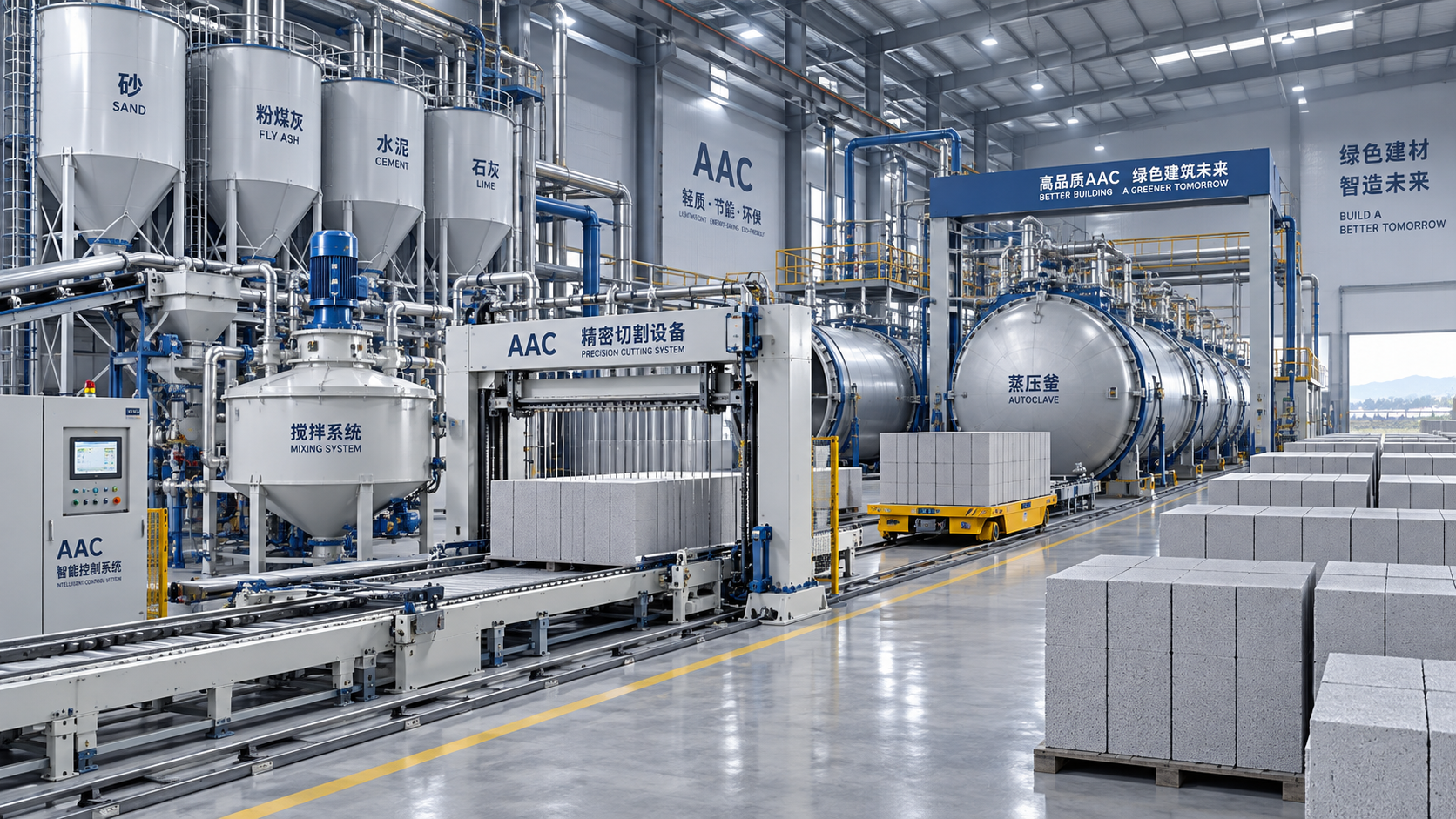
Silica-bearing material is not interchangeable simply because it is called sand, fly ash, or tailings. Its fineness, mineral composition, moisture behavior, contaminants, and consistency affect slurry preparation and reactions during curing. Sand that requires heavy grinding adds electricity demand and wear to mills. Wet material can complicate weighing and stockpile management. A source that changes quality by season can produce density variation, weak edges, or unstable green cakes before cutting.
Lime quality is equally important. Reactivity, available lime content, and particle size influence slurry behavior and early strength development. Cement, gypsum, and aluminum powder are used in relatively controlled proportions, yet small dosing errors can have large effects on pore formation and cake rise. Aluminum powder should be handled in dry, secure conditions with a dosing system designed to avoid inaccurate addition and unnecessary exposure to moisture.
Raw material cost should be assessed as a delivered and processed cost rather than a quarry-gate or supplier quotation. A low-cost sand source located far from the plant may require repeated handling, road transport, storage space, and drying or grinding. Conversely, a more expensive local material with stable chemistry may reduce process adjustments and rejected output. The appropriate choice depends on the full production route, not on a single purchase price.
Material testing should precede equipment sizing
A laboratory mix design is useful, but it is not enough to confirm commercial feasibility. Trial batches need to examine how the selected materials behave at production-scale mixing, molding, pre-curing, wire cutting, autoclaving, and drying after discharge. The relevant result is not merely compressive strength. Density uniformity, edge integrity, shrinkage, moisture condition, cutting accuracy, and the proportion of blocks that remain saleable after handling matter just as much.
When a project assumes that any available silica source can be used without preparation, capital and operating estimates are likely to be understated. Grinding capacity, slurry storage, filtration, wastewater handling, and additional quality control may be required. These additions are justified when they make a locally available feedstock reliable; they should not be discovered after civil works and major machinery purchases are already committed.
Demand must support a continuous production rhythm
AAC is often attractive in cities with fast residential construction, infill walls for framed buildings, and projects that need better insulation or lower structural loading. Yet demand should be tested at the application level. A distributor may express interest in AAC while actual contractors continue using conventional masonry because they have no experience with thin-bed mortar, block cutting tools, wall anchors, or moisture protection details.
The saleable market is not the entire building-material market. It is the portion where AAC dimensions, strength grades, density, and delivery radius fit local building practice. A block used for non-load-bearing infill should not be presented as a substitute for every wall product without confirming the design and code requirements of the intended application. Confusion over this point can lead to returned material, delayed payments, or specifications that change after production has begun.
Transport is particularly important because AAC occupies substantial volume relative to its weight. A truck may reach its volume limit before reaching its payload limit. That makes long-distance delivery expensive and increases the importance of plant location, road access, pallet configuration, and breakage control. A sales plan that looks profitable at the factory gate can fail after including return trips, unloading damage, distributor margins, and the cost of replacing damaged pallets.
Capacity is often misread
Nameplate capacity is normally expressed under defined assumptions about product dimensions, density, operating hours, maintenance, and material behavior. It should not be treated as guaranteed monthly sales volume. The usable capacity of an AAC plant is limited by the slowest part of the system: raw material preparation, mold circulation, pre-curing, cutting, autoclave scheduling, unloading, packing, or dispatch.
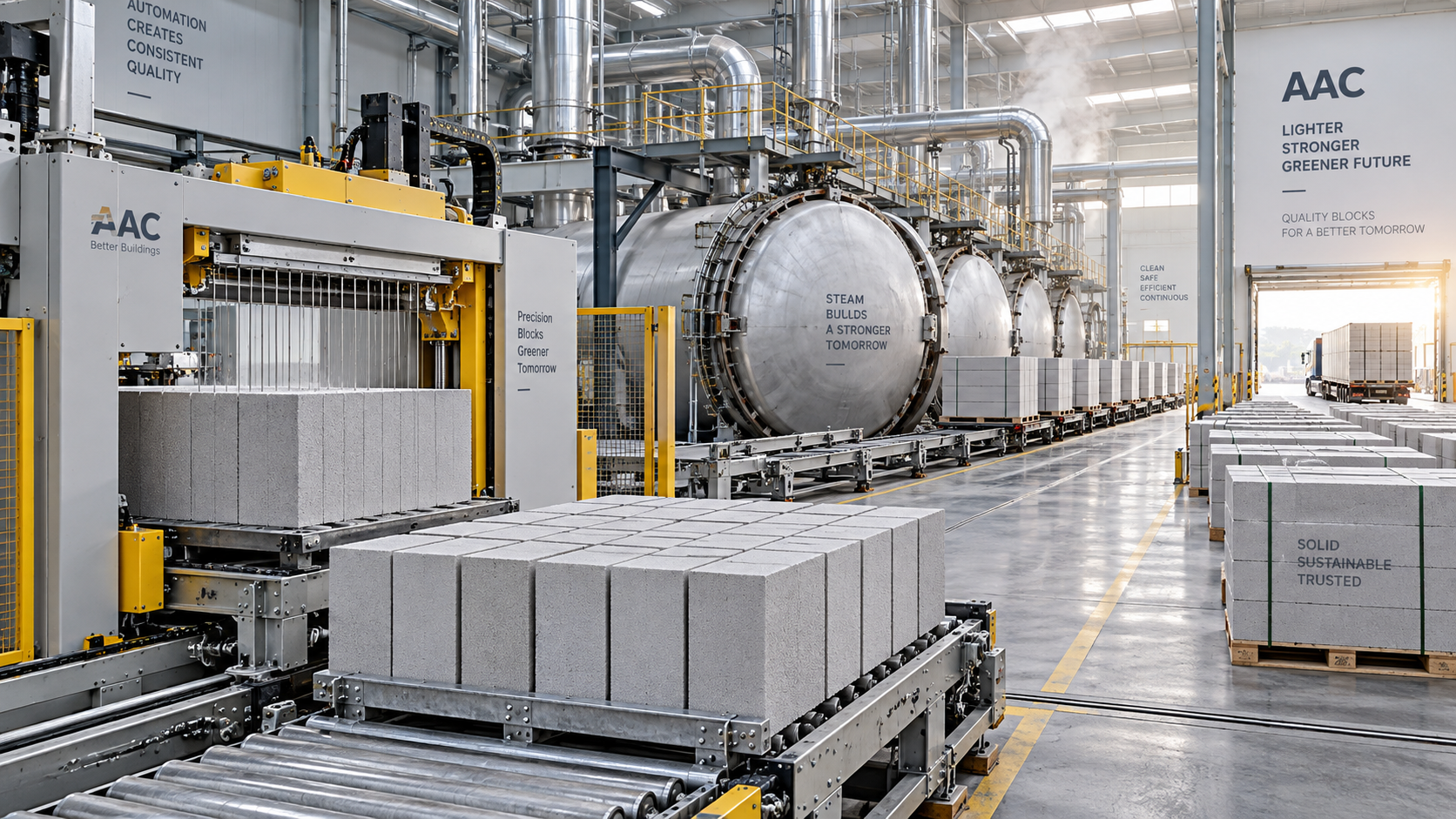
Autoclave availability deserves close attention because it links production batches to steam demand and curing time. Adding cutting capacity does not solve a bottleneck in steam generation or autoclave turnaround. Likewise, a large autoclave does not create an advantage when mold filling, green-cake stability, or packing throughput cannot keep pace. The most credible production estimate is based on a balanced cycle chart that includes cleaning, waiting, maintenance, mold movement, and routine quality checks.
There is a practical tension between scale and market entry. Large lines can reduce certain unit costs when demand is established and operating discipline is strong. They also raise the cash tied up in equipment, buildings, spare parts, utilities, and finished inventory. A capacity choice should be based on realistic dispatch volume during the early operating period, with room for demand growth, rather than on the highest theoretical output that can be quoted.
Automation protects consistency, but it does not remove process responsibility
Automation can improve batching accuracy, mold handling, cutting repeatability, and production records. It is especially useful where labor availability varies or manual handling causes damage. However, automated equipment cannot compensate for unstable raw materials, inadequate steam quality, poorly maintained cutting wires, or incorrect slurry temperature. A plant may be highly automated and still lose money through avoidable variation.
The right automation level depends on the production scale, labor conditions, technical support, and maintenance capability. Complex systems need dependable sensors, electrical components, calibration routines, and access to replacement parts. A simpler configuration may be financially sound when it can be maintained locally and operated consistently. The decision should compare total ownership requirements, including downtime recovery, rather than comparing automation features in isolation.
Quality control should be connected to process decisions. Measuring density and strength only after blocks have been cured identifies a problem too late to prevent the loss. Useful control points include incoming material condition, slurry density, temperature, mixing time, mold fill level, cake rise, green-cake cutting condition, autoclave temperature and pressure records, and post-curing dimensions. A traceable record helps distinguish between a raw-material change, a dosing error, a steam-cycle issue, and mechanical wear.
Common cost assumptions that lead to poor forecasts
- Counting all produced blocks as saleable output. Cutting damage, edge chipping, dimensional deviation, understrength material, and transport breakage must be considered. Even a small quality loss is financially significant when it recurs across high-volume production.
- Using a single energy figure for every season. Fuel and electricity requirements can change with material moisture, ambient conditions, operating interruptions, steam losses, and the amount of production that must be restarted after a disruption.
- Ignoring working capital. Raw materials, packaging, wages, utilities, spare parts, finished stock, distributor credit, and delayed collections create cash requirements separate from the initial machinery investment.
- Assuming ordinary mortar practices will transfer directly. AAC walls often require suitable jointing materials and detailing. Excessive mortar thickness can reduce the dimensional advantage of precision-cut blocks and cause field dissatisfaction.
- Leaving service access out of the equipment decision. Wire frames, wear components, valves, pumps, gearboxes, bearings, control devices, and boiler-related parts need a defined maintenance route. Long downtime has a direct effect on fixed-cost absorption.
Installation and operating conditions matter as much as the line itself
Plant performance begins with site preparation. Foundations must suit dynamic loads and rail alignment where molds or cutting trolleys move on tracks. Internal logistics should prevent raw-material vehicles, finished-product trucks, and maintenance work from obstructing each other. Adequate stockpile drainage is needed because uncontrolled rainwater changes material moisture and adds uncertainty to batching.
Steam generation and water management deserve the same design attention as the forming section. Poor water quality can contribute to scale in boilers and associated equipment. Steam leaks, insulation damage, and inadequate condensate handling increase fuel use while making autoclave conditions less stable. These issues may appear as an energy problem, but they can also show up as inconsistent curing and product variation.
Commissioning should establish a repeatable recipe and operating window before production is expanded. Early batches are a period for validating material preparation, rise behavior, cutting parameters, curing cycles, and packaging resistance. Rushing directly into high-volume output can convert manageable setup adjustments into large quantities of off-spec inventory.
When AAC production is less likely to be profitable
The project is weak when demand is speculative, the plant must deliver far beyond an economical radius, or the intended market does not recognize the product’s installation requirements. It is also weak when key materials are available only through unstable supply channels, fuel availability is uncertain, or site utilities cannot support a consistent autoclave cycle.
A low initial equipment quotation does not correct these conditions. It may increase exposure if essential items such as material processing, boiler systems, control equipment, handling equipment, commissioning support, or spare parts are excluded from the initial scope. The investment should be evaluated as an operating system with a defined material route and dispatch route, not as a group of machines.
Profitability is realistic where production can remain stable, finished blocks can move regularly into nearby construction work, and the product is sold on performance and installation value rather than only on a unit price comparison with conventional bricks. The final decision should rest on verified feedstock tests, a balanced production schedule, delivered-cost calculations, and evidence that local projects will repeatedly use the specified AAC block grades.
Recommend
 Sep 30, 2026
When does an automated building material production line pay off?
Automated building material production line ROI explained: assess capacity, quality, labor, waste, and total costs to make a profitable investment.
- Sep 30, 2026
Is AAC Block Production Profitable in Developing Countries?
Is AAC block production profitable in developing countries? Explore how materials, demand, energy, capacity, and logistics determine real returns.
- Sep 30, 2026
How to Estimate the Cost of an Automated AAC Block Production Line
Automated AAC block production line cost estimate: learn how capacity, raw materials, autoclaves, automation, utilities, and layout shape total investment. Compare quotes with confidence.