Is a Fly Ash AAC Plant Viable with Your Local Ash? Key Feedstock Tests
Local fly ash can support a viable AAC plant when its reactive silica, physical properties, and supply consistency allow repeatable production at the required block density and strength. A favorable chemical analysis is only the starting point. Investment becomes defensible when representative ash samples perform reliably through mixing, rising, cutting, and autoclaving—and when the cost of keeping that performance stable fits the business case.
For a technical evaluator, the central question is how wide an operating window the ash permits. A feedstock that produces acceptable blocks only after precise laboratory adjustments may create an expensive production problem. Before specifying a fly ash AAC plant, establish what the ash contains, how much it varies, and what processing is necessary to make that variability manageable.
Start with samples that represent the supply you will actually receive
A carefully selected sample from a power station cannot establish the suitability of a long-term supply. Ash properties can change with fuel blend, combustion conditions, collection location, and storage history. Fresh dry ash and material excavated from a disposal area should be assessed as separate feedstocks unless testing demonstrates that they can share the same preparation and formulation.
Define the proposed source before commissioning an extensive test program. Record whether deliveries will come from a particular collection stream, a blended silo, several generating units, or reclaimed stockpiles. Establish whether the supplier can preserve that source identity. If deliveries may switch between streams without notice, the qualification program must cover those alternatives.
Collect separate samples across different production or delivery periods. For reclaimed ash, include differences in location, depth, drainage, and weather exposure. A composite sample can help characterize an average feedstock, but retain and test individual samples: averaging can conceal a batch that disrupts production.
Each sample should have a traceable source, collection date, storage condition, and sampling method. Preserve moisture samples appropriately, and report chemical results on a clearly stated basis. Otherwise, differences caused by water content or sample preparation can be mistaken for changes in ash chemistry.
This initial work determines what later trials can prove. A successful trial using one sample supports that sample’s suitability; it provides limited evidence about an uncontrolled supply.
Which feedstock tests change the viability decision?
Reactive silica and mineral composition
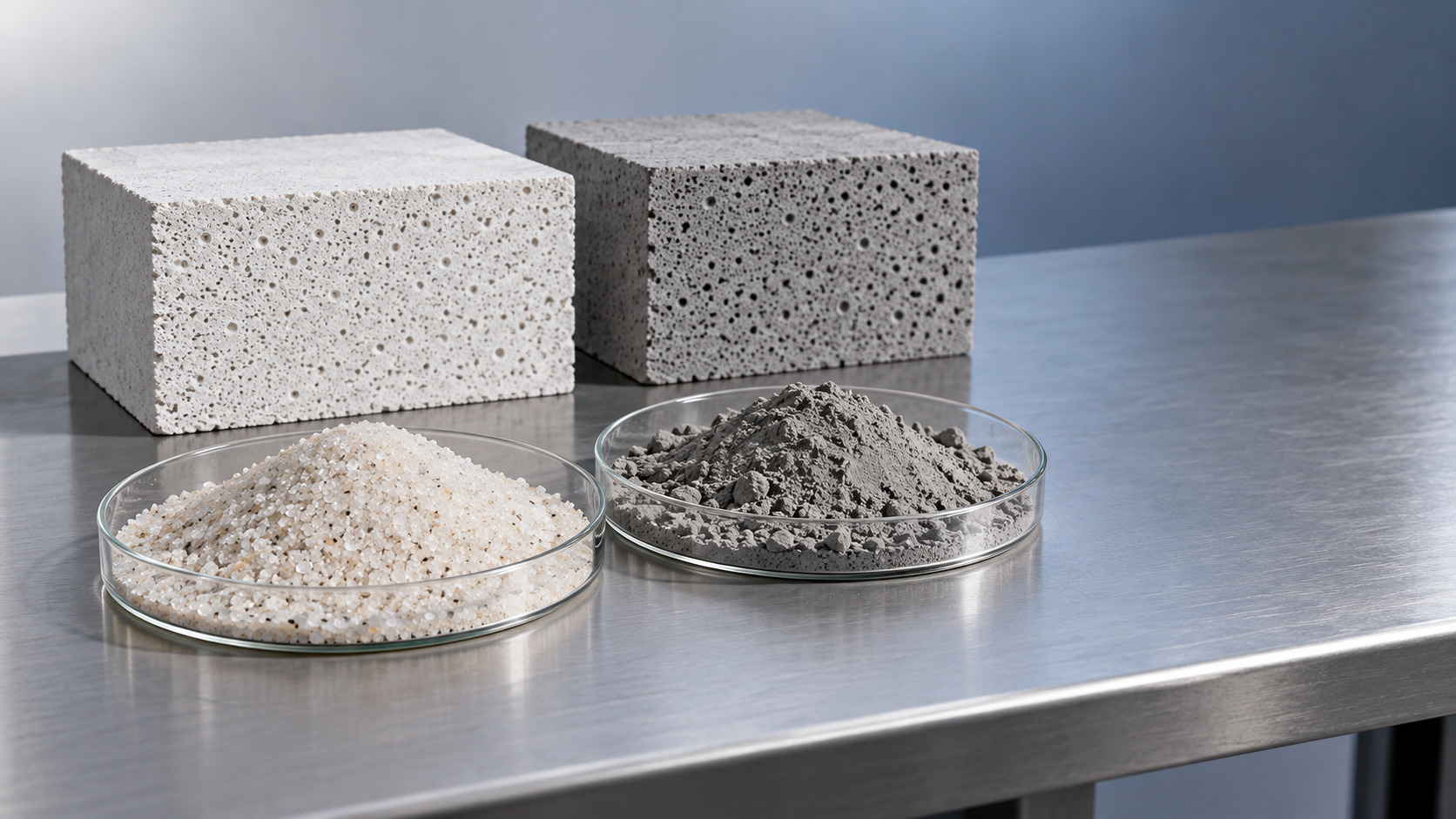
AAC develops its hardened structure through reactions between siliceous material, calcium-bearing ingredients, and water during autoclaving. Total silica content therefore matters, but it does not show how much silica will participate under the proposed process conditions. Ash containing substantial silica in relatively unreactive crystalline phases can behave differently from ash with a more reactive glassy fraction.
Use chemical analysis to establish the major oxide composition, supported by mineralogical characterization where needed. Ask the laboratory to explain how it assesses potentially reactive silica and what the method actually measures. Results from different extraction methods should not be treated as interchangeable, and an isolated reactivity result should not replace AAC trials.
Evaluate calcium, alumina, sulfate, and other relevant constituents alongside silica. These influence the formulation and hydrothermal reactions. An ash classification used for another construction application does not establish suitability for AAC, nor does a high total silica result justify a fixed recipe.
Loss on ignition and residual carbon
Loss on ignition, or LOI, is a useful screening measurement, but it is not a direct carbon measurement in every ash. Depending on the material and test conditions, mass loss can also reflect moisture, bound water, or carbonate decomposition. Where LOI is elevated or inconsistent, investigate its cause rather than assuming that all the loss comes from unburned carbon.
Residual carbon can affect water demand and the behavior of some additives, making mix response less predictable. Its significance depends on the carbon’s characteristics and the complete formulation. Compare LOI and, where necessary, carbon measurements against slurry behavior and trial results. A single passing LOI value cannot demonstrate reliable aeration.
Fineness, particle distribution, and coarse contamination
Particle size influences reaction rate, water demand, suspension behavior, and preparation requirements. Measure the size distribution and coarse residue rather than relying on one fineness figure. Two ashes with similar reported fineness may contain different proportions of fine particles and coarse material, with different consequences for processing.
Check for agglomerates, slag fragments, foreign matter, and persistent coarse particles. Reclaimed material may require screening, disaggregation, or grinding before it becomes usable. These steps affect equipment selection, wear, power demand, and throughput.
Grinding should earn its place through testing. Establish whether the proposed treatment improves block performance or process stability enough to justify its cost. Finer material may also change slurry rheology and water requirements, so additional grinding cannot be assumed to improve every formulation.
Moisture, slurry behavior, and storage condition
Moisture affects transport economics, dry-solids dosing, and the water balance of the mix. If wet ash is dosed without a reliable moisture correction, both the solids input and water-to-solids ratio can drift. The resulting changes may appear as inconsistent rising or setting even when the underlying dry ash composition is relatively stable.
Measure moisture variation across deliveries and assess how the material handles. Flowability, caking, settling, and pumpability determine whether the proposed receiving and slurry preparation systems are appropriate. Stored wet ash may also contain hardened lumps that a moisture measurement alone will not reveal.
Preparation trials should establish an achievable slurry solids content, its viscosity, and its stability during the intended holding period. A slurry that settles rapidly or changes behavior during storage creates demands on agitation, recirculation, measurement, and production scheduling.
Sulfates, salts, and potentially disruptive constituents
Assess sulfur-bearing constituents and soluble salts where the source warrants investigation. Their form and availability matter: total sulfur alone may not explain their influence on setting, hydrothermal reactions, or finished-product behavior. Calcium-bearing phases that affect expansion or reaction balance also deserve attention where indicated by the ash chemistry.
Environmental acceptance is a separate requirement. Depending on the ash source, intended product, and project location, testing may need to address trace constituents, leaching, or radiological characteristics. A feedstock can be technically workable in AAC while still being unsuitable under applicable material-use or product requirements.
There is no single set of chemical limits that can establish suitability for every plant. Set screening limits with the process designer and laboratory, then refine them using the range of ash properties that has actually passed representative production trials.
Turn laboratory results into evidence of a workable process
Once screening identifies a credible feedstock, run trials with the other raw materials expected at the plant. Lime reactivity, cement characteristics, gypsum contribution, aluminum dosing, water quality, and temperature can all affect the outcome. Trials using convenient laboratory substitutes may give a misleading picture of the local material combination.
Begin with a controlled formulation and vary the factors needed to understand the ash. Record dry-solids proportions, water input, slurry temperature, mixing sequence, and preparation conditions. Changing several ingredients at once can produce a good block without revealing why it worked or whether it can be repeated.
Follow the whole production sequence. Rising height alone is an inadequate success criterion. Observe the relationship between gas generation and stiffening: a cake can rise satisfactorily and still collapse, crack, or reach cutting strength at an impractical time. Record settlement, internal uniformity, green strength, cutting behavior, and the consistency of the cutting window.
Autoclave the trial material under a defined cycle that the proposed plant can realistically deliver. Laboratory specimens and full production cakes have different heating conditions, so promising laboratory results should be followed by appropriately scaled confirmation. The evaluation must connect ash preparation and formulation to an achievable steam-curing process.
Compare finished strength at the intended dry-density range. A denser specimen that reaches the strength target does not prove that the specified lighter product is feasible. Assess dimensional stability, visible defects, and other properties required for the intended market, using suitable test methods and consistent specimen conditioning.
When reviewing an equipment offering such as Aerated brick, ask how its proposed preparation, dosing, cutting, and autoclaving arrangements relate to results obtained with the project’s ash. A nominal capacity figure becomes useful when the material preparation requirements, product density, cycle time, and expected reject rate are defined.
The strongest trial program includes both typical material and samples near the observed limits of supply variation. Repeat successful conditions and test realistic disturbances, such as a wetter delivery or a coarser ash batch. These trials reveal whether routine controls can restore performance or whether the process depends on an unusually narrow feedstock specification.
Decide whether the required controls are commercially reasonable
Feedstock suitability has degrees. One source may support direct use after routine preparation; another may need blending, grinding, or supplementary siliceous material. A third may remain too inconsistent despite technically successful individual trials. The investment decision depends on the cost and reliability of the complete route.
Calculate ash cost on a usable dry-solids basis. Include transport water, preparation losses, screening, grinding, storage, testing, and handling. Connect the trial formulation to lime, cement, and other material consumption. Include the effects of longer cycles, lower output, or additional rejects where trials indicate those consequences. A low delivered ash price can lose its advantage once these requirements are counted.
Before committing to equipment and production targets, the evaluation should produce four practical outputs:
- A qualified supply range: the sources and measured property limits covered by successful trials, including relevant variation over time.
- A demonstrated process window: preparation conditions, formulation adjustments, rising and cutting behavior, and an achievable autoclave cycle.
- A control plan: incoming checks, delivery identification, blending or segregation arrangements, and clear actions when material falls outside the qualified range.
- A cost basis tied to that process: realistic material consumption, preparation demand, output, and product acceptance assumptions.
These outputs should also shape the equipment specification. Variable moisture may justify better solids measurement and water correction. A necessary blending strategy requires enough segregated storage and controlled reclaim capacity. Confirmed grinding requirements must be reflected in the preparation line’s capacity and maintenance provisions.
Proceed when representative ash repeatedly meets product targets within a controllable process window and the required preparation remains economical. Keep the decision conditional when results depend on a treatment or supply restriction that has yet to be demonstrated. If acceptable blocks require continual recipe changes or unusually selective sampling, further equipment specification will not resolve the underlying feedstock uncertainty. Resolve that uncertainty while the plant design can still respond to it.
Recommend
 Nov 02, 2026
What Should an AAC Plant Installation Contract Include?
Choosing sand or fly ash? Learn what an AAC plant installation contract should include, from scope and safety to performance tests and warranties, to protect your investment.
- Nov 02, 2026
How Much Land Is Needed for an AAC Factory?
Which is better for AAC production: a compact plot or a larger site? Explore land needs, storage, utilities, and layout planning to choose your factory site with confidence.
- Nov 01, 2026
Which Is Better for AAC Production: Sand or Fly Ash?
How does a hydraulic roof tile machine differ from manual pressing? Discover why process control matters, then compare sand vs. fly ash for AAC costs, quality, and equipment needs.