Sand or Fly Ash: Which Is Better for AAC Production?
Sand is often the stronger choice when a plant has access to a consistent, silica-rich deposit and can support the required grinding. Fly ash can be the better economic choice when a dependable source is nearby and its chemistry and physical properties suit the production process. Either material can produce quality autoclaved aerated concrete (AAC). The decision depends on how reliably the available feedstock can deliver the required block properties at an acceptable cost per saleable cubic metre.
For an investor comparing AAC production lines, this distinction matters immediately. A low fly ash purchase price can lose its advantage through variable moisture, additional conditioning, binder adjustments, or rejected production. Sand may justify its preparation cost through more predictable operation, but dirty or inconsistent sand can create substantial problems of its own. The useful comparison starts with representative samples, a defined product target, and a realistic assessment of the equipment each material requires.
Start with the material source and the block specification.
Both sand and fly ash can provide silica that reacts with calcium-bearing materials during autoclaving to develop the structure responsible for AAC strength. Their suitability depends on the forms in which silica occurs, the other constituents present, particle characteristics, and the production conditions. A supplier’s total silica figure alone cannot establish whether a material will perform well in a particular AAC formulation.
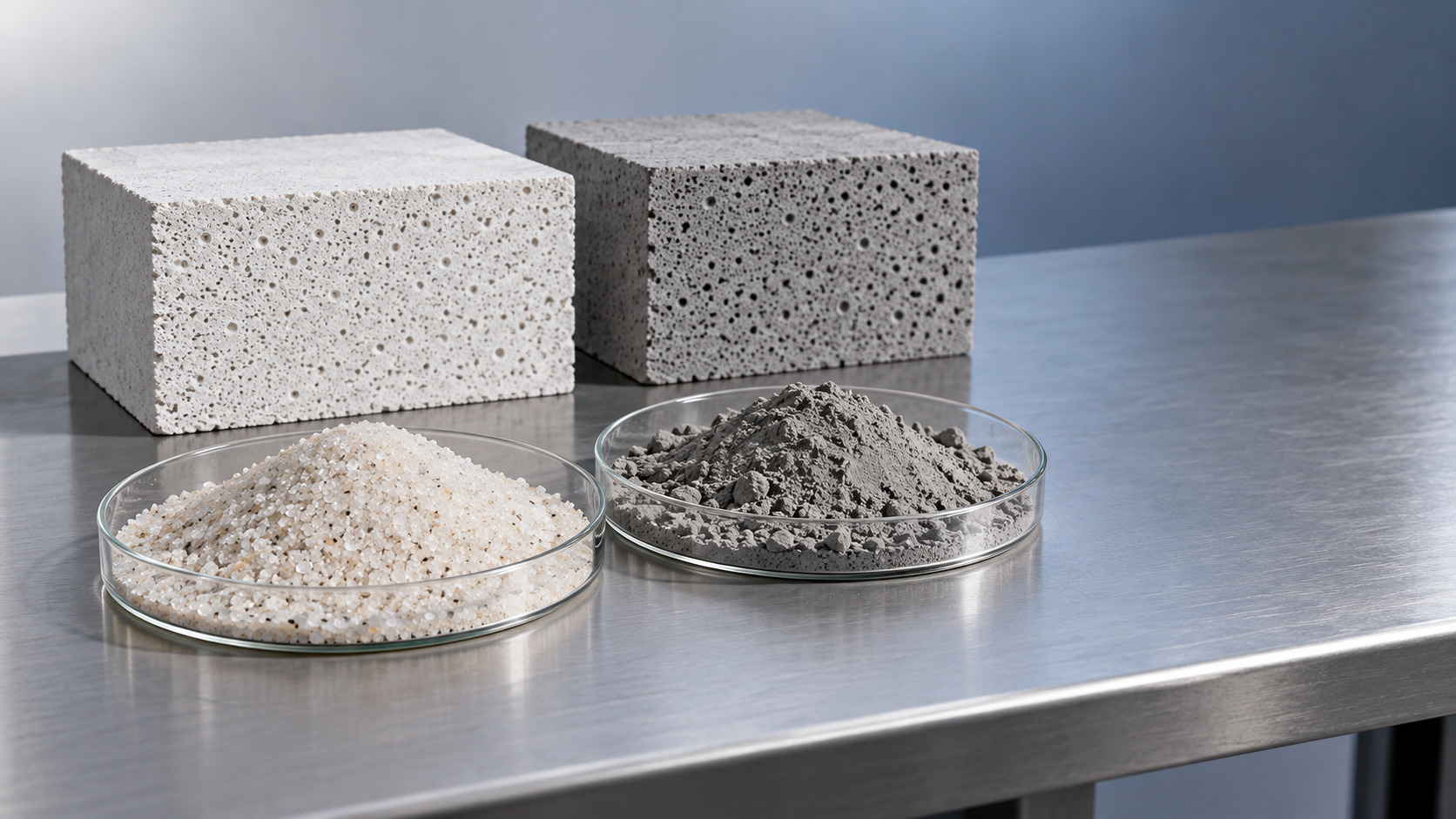
Silica-rich sand contains crystalline quartz, which requires suitable grinding and hydrothermal processing to react effectively. Fly ash contains a mixture of glassy and crystalline phases, with composition influenced by the fuel and combustion process that produced it. Its potentially reactive fraction can be useful, but the name “fly ash” does not describe a uniform raw material. Two sources with similar headline chemical analyses may behave differently in slurry preparation, casting, and autoclaving.
The comparison also needs a common performance target. A block intended to meet one density and strength specification cannot be compared fairly with a heavier block that achieves greater strength through a different formulation. Establish the required dry density, compressive strength, dimensional quality, and other applicable properties before assessing either route. Otherwise, an apparently successful trial may demonstrate a different product from the one the plant needs to sell.
Sand offers a strong starting point where the deposit is well characterised and extraction can supply consistent material. However, clay, organic matter, salts, and changes in mineral composition can complicate processing. A clean sample from one part of a deposit does not establish the quality of future deliveries. Sampling should reflect the areas and handling practices expected during commercial supply.
Fly ash requires similar attention to its origin. Changes in fuel, combustion conditions, collection systems, or stockpile management can alter the delivered material. Freshly collected dry ash and reclaimed pond ash should be assessed separately because storage and recovery can introduce different moisture levels, agglomeration, and contamination. Suitability for another construction application does not automatically establish suitability for AAC.
For an initial technical assessment, the most useful information includes:
- Chemical composition, including silica, alumina, calcium-bearing constituents, alkalis, and sulfur-bearing constituents where relevant.
- Mineralogical information to help distinguish total silica from the phases available for reaction.
- Particle size distribution, moisture content, and the presence of coarse particles or agglomerates.
- Loss on ignition for fly ash, interpreted alongside its composition rather than treated as a complete measure of suitability.
- Evidence of variation across deliveries, production periods, or extraction locations.
These results guide formulation and processing trials. They should not become an isolated pass-or-fail exercise based on a single number. For example, loss on ignition can indicate residual carbon or other components that change during heating, but its significance depends on what causes the measured loss and how the ash behaves in the actual mix.
The practical difference appears in slurry preparation and casting.
A sand-based AAC line normally needs grinding capacity matched to the sand’s characteristics, the required fineness, and the intended output. The mill, slurry storage, agitation, and dosing system must work together. If preparation cannot keep pace with casting, the production line may fall short of its planned capacity even when the downstream equipment has sufficient capacity.
Grinding creates a cost, but it also provides a means of controlling particle size. Consistent fineness helps make slurry behaviour and subsequent processing more repeatable. Excessive grinding should still be avoided: finer material increases surface area and can change water demand and slurry rheology. The target should come from production trials, with energy consumption and product performance assessed together.
Fly ash may reduce the grinding requirement when its delivered particle distribution is suitable. That advantage needs to be established through testing. Some sources require screening, deagglomeration, grinding, or blending to achieve workable consistency. An equipment proposal that assumes all fly ash can enter the process without preparation risks understating both capital expenditure and operating demands.
Moisture deserves particular attention when comparing dry ash with wet or reclaimed material. The batching system must account for the water already entering with the feedstock so that the intended dry solids and water balance are maintained. Variable moisture can affect weighing, handling, slurry concentration, and casting behaviour. A cheap wet material may also carry a significant transport cost for water.
These differences continue into aeration and setting. AAC production requires gas development, slurry stability, and early stiffening to remain compatible. Raw material changes can disturb that balance, producing settlement, an uneven pore structure, or a green cake that is difficult to cut. Binder proportions, water, casting temperature, and aluminium dosing may all need adjustment, but changing one variable without understanding the others can make the process harder to control.
A formulation that rises satisfactorily in a laboratory container has therefore passed only an early check. It must also develop enough green strength for handling and cutting within the intended production schedule. After autoclaving, the resulting blocks must meet the specified properties consistently. The full sequence matters because a material can look promising at casting and still create losses later.
Neither feedstock guarantees stronger or more accurate blocks.
Sand-based AAC can offer consistent properties when the raw material, grinding, formulation, and curing process are well controlled. Fly ash-based AAC can also meet demanding product requirements when the ash is suitable and the process is developed around it. Claims that one route always produces higher strength usually leave out density, binder consumption, particle preparation, or curing conditions.
Compare strength at equivalent dry density and record the formulation required to achieve it. If one material needs more binder or produces a heavier block to reach the target, that difference belongs in the economic assessment. Thermal performance should likewise be evaluated at the intended product density and relevant moisture conditions, rather than attributed to the feedstock name alone.
Dimensional quality also depends heavily on the condition of the green cake at cutting, the cutting equipment, and subsequent handling. A switch from sand to fly ash will not automatically improve cutting accuracy. It may instead require changes to the pre-curing window and cutting schedule. Drying shrinkage and other specified properties should be included in qualification, especially where the blocks will be used in applications sensitive to cracking or movement.
Product appearance may matter commercially. Fly ash can influence block colour, while sand-based formulations may produce a lighter appearance depending on the other ingredients. Colour alone provides little evidence about structural or thermal performance. Where buyers have an appearance requirement, include it in acceptance criteria without allowing it to substitute for physical testing.
Compare costs at the point where acceptable blocks leave the plant.
The raw material quotation is only one part of the decision. A useful comparison includes delivered feedstock cost, preparation energy, binder and additive consumption, water management, maintenance, labour, curing energy, and production losses. Calculate these costs against saleable output. A formulation that produces more rejected blocks can erase a substantial saving in the incoming material price.
Sand brings identifiable preparation costs, including grinding energy and wear on milling equipment. The magnitude depends on the feedstock and the selected process. Fly ash may avoid part of that burden, but additional conditioning, inconsistent deliveries, or changes in binder demand can offset the saving. Neither route should receive an assumed cost advantage before a material balance and trial formulation are available.
Transport and supply continuity can be decisive. A nearby sand deposit with controlled quality may be economically preferable to distant fly ash, even if the ash has a lower ex-source price. Conversely, a dependable nearby ash source may support a compelling production model where suitable sand requires long transport distances or extensive preparation.
Evaluate how the source could change over the investment period. A sand deposit needs sufficient accessible reserves and a workable extraction and delivery arrangement. An ash source depends on the continued operation and practices of the facility producing it. Where supply interruption would stop the plant, assess a second source and qualify it technically. Two suppliers offering material under the same name do not necessarily provide interchangeable feedstock.
Environmental comparisons also need a defined basis. Using fly ash can put an industrial by-product to productive use, but that benefit does not establish the total environmental performance of the blocks. Transport, preparation, binder consumption, curing energy, and yield all contribute. If environmental performance affects a purchasing decision, compare formulations that meet the same product requirements using an appropriate assessment method.
Choose the production route through trials that expose variation.
Before selecting the equipment configuration, obtain representative samples from the sources expected to supply the plant. Develop trial mixes for the intended density and strength class, then assess slurry behaviour, rising, pre-curing, cutting, and autoclaved properties. Record material consumption and processing conditions alongside the finished block results. A successful block without those records provides a weak basis for estimating commercial costs.
Qualification should include samples that represent the expected range of supply quality. This helps establish how much variation the process can tolerate and which incoming properties require control. It also identifies whether separate storage, blending, additional preparation, or more frequent formulation adjustments will be necessary.
For an existing plant, check the installed equipment before considering a change of feedstock. Milling capacity, storage arrangements, material handling, slurry agitation, dosing accuracy, and process control may constrain the conversion. A successful laboratory recipe does not demonstrate that the current line can prepare and process it at the required output.
A mixed sand-and-fly-ash formulation can be worth evaluating where it serves a clear purpose, such as managing supply availability or achieving a suitable particle distribution. It adds another material stream and another set of variables, however. The blend needs its own qualification, including how changes in either component affect the process.
For a new plant with dependable, suitable fly ash nearby, the ash route deserves serious consideration because reduced preparation requirements may improve project economics. Where ash supply is uncertain and a consistent silica-rich sand source is available, sand may provide the firmer basis for investment. Commit to the route only when the intended feedstock has produced acceptable blocks under a repeatable process—and the cost calculation reflects the equipment and controls needed to keep producing them.
Recommend
 Nov 02, 2026
What Should an AAC Plant Installation Contract Include?
Choosing sand or fly ash? Learn what an AAC plant installation contract should include, from scope and safety to performance tests and warranties, to protect your investment.
- Nov 02, 2026
How Much Land Is Needed for an AAC Factory?
Which is better for AAC production: a compact plot or a larger site? Explore land needs, storage, utilities, and layout planning to choose your factory site with confidence.
- Nov 01, 2026
Which Is Better for AAC Production: Sand or Fly Ash?
How does a hydraulic roof tile machine differ from manual pressing? Discover why process control matters, then compare sand vs. fly ash for AAC costs, quality, and equipment needs.