What Determines the Cost of a Concrete Roof Tile Machine?
The cost of a concrete roof tile machine is determined by its production capacity, degree of automation, tile design, and the equipment included around the forming machine. Molds, curing arrangements, installation, utilities, and spare parts can add substantially to the investment, even when they are not included in the initial quotation.
A low equipment price can therefore be misleading. A buyer comparing two offers may find that one covers only tile forming, while the other includes mixing, material handling, controls, and commissioning. Start by defining the finished tile and required production rate, then compare the complete scope and operating assumptions rather than the headline price alone.
Production capacity: compare usable output, not just the rating
Machine size and throughput are major cost drivers. A line designed for higher output generally requires more robust forming equipment and may also need larger mixers, faster handling systems, more curing space, and additional downstream capacity. The machine itself is only one part of that increase.
Suppliers may express capacity in tiles per hour, tiles per shift, or production cycles. These figures are not interchangeable unless the tile profile, operating conditions, and cycle assumptions are comparable. Ask whether the stated rate is a maximum mechanical rate or an expected production rate under specified conditions. A change of mold, cleaning, maintenance, and material replenishment can all affect the output available for sale.
Work backward from the number of acceptable tiles needed in a normal production period. Allow for planned stoppages and any expected rejects, using assumptions appropriate to the proposed operation rather than treating the machine’s maximum speed as guaranteed output. Then check that mixing, handling, curing, and storage can support that target. A faster forming machine has limited value if tiles accumulate before curing or the mixer cannot supply material consistently.
Automation changes both the quotation and the labor plan
A more automated line can include controlled batching, feeding, forming, tile transfer, stacking, and other handling functions. These additions usually increase the purchase price and can introduce more electrical and control components to maintain. They may also reduce repetitive manual handling and make the production sequence less dependent on individual operators.
Less automated equipment may be a reasonable starting point when output is modest, labor is available, and the operation can accommodate manual handling. Its apparent savings should be assessed against the number of people required, the physical work involved, and the consistency needed from shift to shift.
When comparing automation levels, ask for a description of each manual task rather than relying on labels such as “automatic” or “semi-automatic.” One supplier may include automatic feeding but require manual transfer to curing racks; another may include the transfer system but exclude pallet return. Identify where operators load material, remove formed tiles, intervene after a stoppage, and change settings. Those details make labor estimates more useful and expose equipment that may have to be purchased separately.
Tile profile and molds affect more than appearance
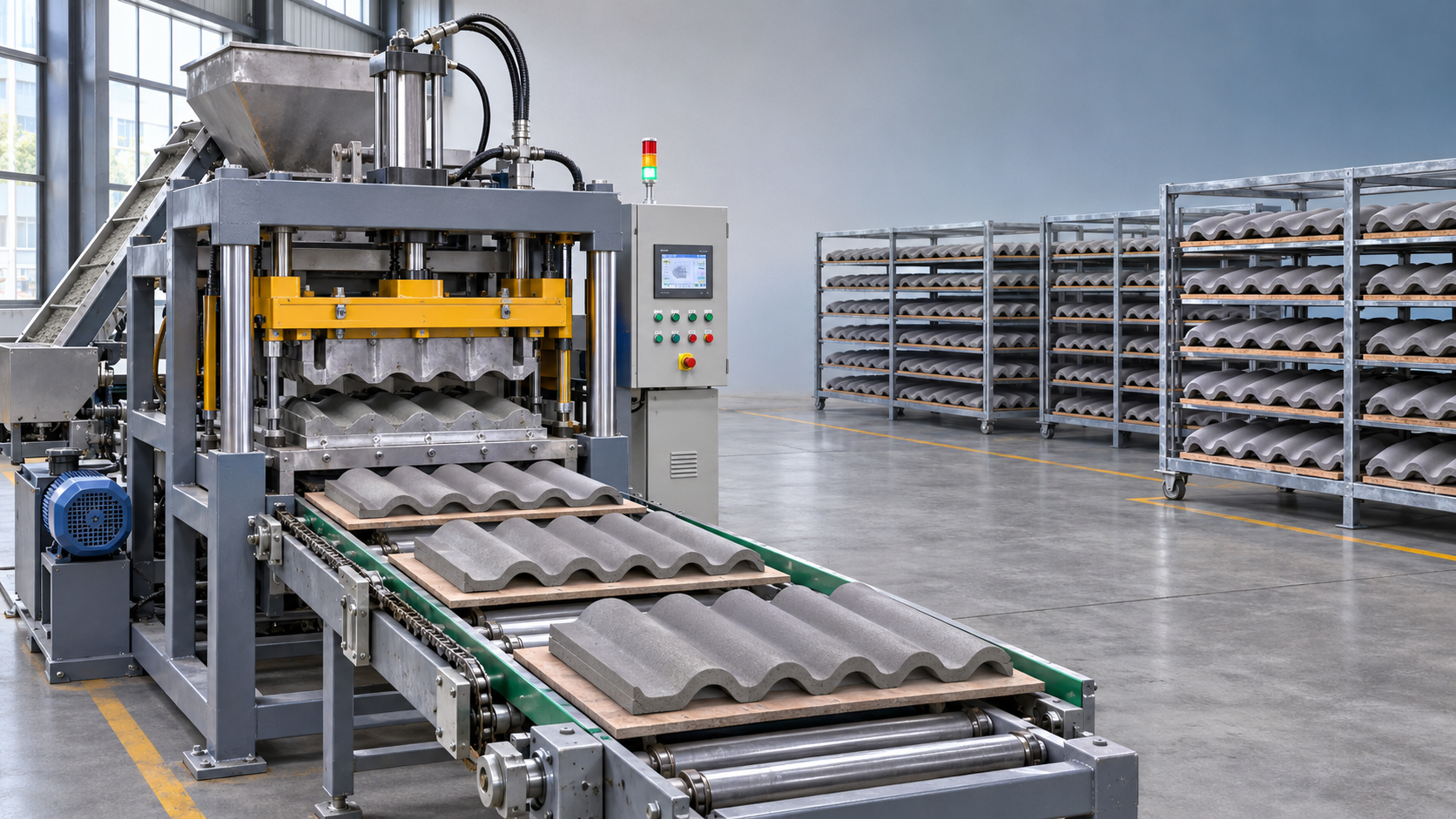
The intended roof tile determines the forming configuration, mold geometry, and handling requirements. Profile depth, dimensions, surface finish, edge details, and any interlocking features should be specified before requesting a firm quotation. A machine priced for one profile may not be ready to produce another without different tooling or adjustments.
Clarify how many mold sets are included and what each set contains. Depending on the forming process, buyers may also need to account for pallets, carriers, or other supports that hold tiles during handling and curing. The number required depends on the production cycle and how long those supports remain occupied. A low initial tooling allowance can restrict output even when the machine itself has sufficient capacity.
For a business planning more than one tile design, ask about changeover time, adjustment requirements, and the price and availability of additional tooling. A flexible machine may cost more initially, but flexibility has value only if the planned profiles can actually be accommodated. Request drawings or agreed specifications for the intended tile rather than assuming that a mold described as “standard” will meet local market requirements.
What sits outside the forming machine?
Concrete roof tile production requires a consistent supply of suitable mix and a way to handle tiles after forming. The purchase decision should cover the full process, even if some equipment already exists at the site. Typical scope questions include:
- Mix preparation: Are batching, weighing, mixing, and material transfer included? Can the proposed system supply the forming machine at the required rate?
- Forming and support equipment: Does the offer include the specified molds, pallets or carriers, and any equipment needed to return or clean them?
- Finishing: Are any required surface-coloring, coating, or finishing systems included, and at which stage are they applied?
- Curing and handling: Who supplies racks, trolleys, conveyors, or a curing arrangement, and how much space do they require?
- Controls: Are electrical cabinets, operator controls, interconnections, and the necessary control software part of the quoted package?
Existing equipment can reduce expenditure, but compatibility should be checked before excluding it from the new line. Mixer discharge height, transfer method, available floor space, electrical supply, and actual mixing capacity can all affect whether an existing mixer can feed a new machine. Include the cost of modifications where an interface is not already defined.
Installation and site preparation can change the budget
The machine quotation may be based on equipment leaving the factory, arriving at a port, or being delivered to the buyer’s site. These are different cost boundaries. Freight, insurance, import charges, unloading, and movement into the building should be identified explicitly rather than assumed to be included. The applicable charges depend on the shipment and destination, so they need to be calculated for the specific purchase.
At the site, check the space and foundations required for the equipment, curing area, raw materials, and finished tiles. A line layout should also show access for forklifts or other handling equipment and enough clearance for maintenance. Utility needs may include electricity, water, compressed air, and drainage, depending on the proposed configuration. Ask for the required supply characteristics and connection points before committing to building work.
Installation and commissioning deserve separate attention. Determine whether the supplier provides supervision or a crew, who supplies lifting equipment and consumables, and whether travel and accommodation are included. Agree on the extent of operator training and the materials needed for commissioning. If acceptance testing is part of the contract, define the tile specification, test conditions, production period, and responsibilities for materials and utilities in advance.
Operating cost depends on the complete production process
Purchase price is a one-time figure, but production cost continues with every shift. Cement, aggregates, pigments or coatings where used, electricity, water, labor, maintenance, and rejected tiles all affect the cost of saleable output. Material consumption is especially sensitive to tile dimensions, mix design, and consistency, so compare offers using the same intended product and production assumptions.
Energy consumption should be requested for the proposed configuration, not estimated solely from the motor rating on the forming machine. The mixer, conveyors, compressed-air system, and any curing or finishing equipment may also use power. Similarly, labor calculations should include mixing, loading, handling, cleaning, quality checks, and packing—not just the person operating the main controls.
Rejects have a double effect: they consume materials and production time without producing saleable tiles. During technical discussions, establish how the machine controls forming and how operators can adjust it when raw-material characteristics change. Avoid treating any supplier’s claimed yield or running cost as transferable to a different tile design, mix, or working schedule without supporting assumptions.
Spare parts and downtime
Ask for a recommended initial spare-parts list with part numbers, quantities, and prices. Separate routine wear items from components whose failure would stop the line, and establish which parts are standard purchased components and which are specific to the machine or mold. Confirm ordering lead times and the information required to identify a replacement accurately.
Documentation matters as much as the list. Drawings, maintenance instructions, electrical diagrams, and a clear parts-identification system make future purchasing and fault diagnosis easier. The same principle applies when sourcing machinery components in adjacent processes, including AAC spare parts: the part must match the equipment and operating specification. AAC components should not be assumed to be interchangeable with roof tile machine parts.
Compare quotations on a common basis
Request each offer against the same tile drawing, target production rate, working schedule, and site conditions. Then place the quoted items and exclusions side by side. A higher-priced package may include tooling, handling equipment, or commissioning that would otherwise have to be purchased later; a lower-priced offer may be appropriate if those items are already available and compatible.
For a practical cost comparison, add the quoted equipment price to estimated freight and import charges, site preparation, installation, initial tooling and spares, and any required auxiliary equipment. Keep operating costs separate and calculate them over the same planned period and production volume for each option. Do not mix a supplier’s installed-line price with another supplier’s machine-only price.
Before placing an order, resolve any item described as “optional,” “by buyer,” or “to be confirmed.” Those phrases are not necessarily problems, but they identify costs or responsibilities that remain open. The most useful quotation is one that makes the boundary clear enough to determine what it will take to produce the specified tile at the intended site.
Recommend
 Nov 27, 2026
How Much Does a Concrete Roof Tile Machine Cost?
Ltd. AAC spare parts differ from roof tile machine components. Explore concrete roof tile machine costs, hidden expenses, and quote comparisons before you buy.
- Nov 27, 2026
What Does a Semi-Automatic AAC Plant Cost?
Explore Ltd. block machine export experience and the key factors behind semi-automatic AAC plant costs, from equipment and freight to installation.
- Nov 26, 2026
How Much Does a Quartz Stone Production Line Cost?
Explore Ltd. overseas installation considerations and the key factors affecting quartz stone production line costs. Compare budgets and plan with confidence.