What wall panel production machine specifications support prefab construction efficiency?
What wall panel production machine specifications actually move the needle in prefab construction?
It’s easy to get lost in spec sheets—linear speed, mold count, PLC brand, power draw. But if you’ve stood on a prefab yard where panels arrive late, warp mid-installation, or require rework at the site, you know: machine specs aren’t theoretical. They’re the difference between hitting your schedule—or explaining why you missed it.
Shandong Hongfa has built wall panel production machines for over three decades—not as standalone units, but as integrated nodes in real prefab workflows. Their experience isn’t abstract. It’s shaped by concrete batching plants running 24/7 in Guangxi summers, by aerated concrete lines adapting to regional aggregate variability, and by quartz stone machinery that tolerates zero dimensional drift across 500+ daily cycles. That kind of operational grounding changes how you read a spec sheet.
Speed isn’t just about output—it’s about consistency under load
A machine rated at “12 panels/hour” sounds impressive—until you realize that’s only true with ideal mix design, ambient temperature between 18–25°C, and no changeover between 120mm and 200mm thicknesses. In practice, most prefab contractors run mixed-spec jobs: load-bearing walls one shift, insulation-integrated façade panels the next. The real metric isn’t peak speed—it’s sustained cycle time across variable configurations.
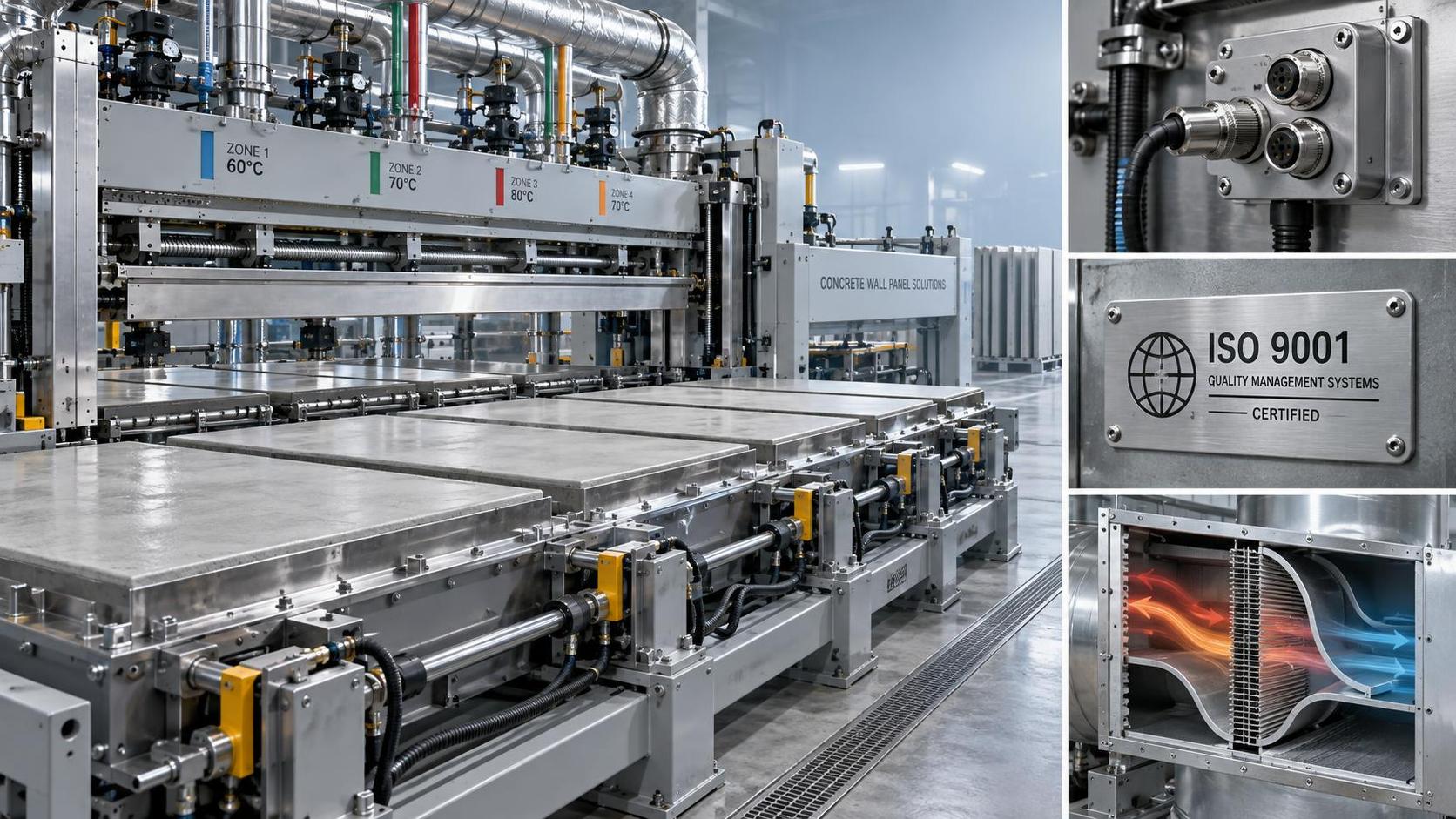
Hongfa’s wall panel production machines, for example, use adaptive hydraulic clamping and multi-zone thermal control—not just to hit target strength faster, but to maintain ±0.8mm tolerance across 15+ consecutive pours, even when switching panel types. That’s not marketing language. It’s what lets a factory avoid manual shimming on-site—and why their ISO 9001-2008 certified process includes point-like quality tracking down to individual mold cavity batches.
Automation that works *with* your labor—not replaces it
Prefabs don’t scale because you install more robots. They scale because fewer people are needed to manage variance—mix inconsistencies, curing delays, reinforcement misalignment. So look past “fully automated” claims. Ask instead: Where does human judgment still matter? And does the machine make that judgment faster, safer, or more repeatable?
Hongfa’s systems embed sensor feedback loops at three critical points: slump monitoring pre-pour, real-time vibration amplitude adjustment during consolidation, and post-demolding moisture gradient mapping. None of these eliminate skilled operators—but they reduce reliance on visual/tactile cues alone. That matters when your crew rotates across shifts, or when humidity swings from 45% to 85% between morning and afternoon.
Energy efficiency isn’t just kWh—it’s uptime and material yield
A “low-energy” label means little if the heating system can’t hold ±2°C across a 30-meter curing bed—or if vacuum de-airing drops below 92 kPa when ambient pressure shifts. Energy savings collapse when you compensate with longer cycles, higher cement content, or extra steam injection.
Hongfa’s approach treats energy as a system constraint—not a standalone KPI. Their patented heat-recycling ducting (one of 28 invention patents) routes exhaust from curing chambers back into pre-heating zones. More importantly, their control logic prioritizes *thermal stability* over raw speed: if ambient drop threatens core hydration, the system holds cycle time rather than risking micro-cracking. That trade-off—slight delay today versus rejection tomorrow—is where real-world efficiency lives.
Modularity that handles real-world constraints—not just catalog drawings
Prefab factories rarely expand in clean-sheet phases. They retrofit. Add capacity beside existing batching plants. Fit new lines into tight yards. Interface with legacy MES systems. A “modular” machine that requires 3-meter clearance on all sides, or demands isolated 380V/50Hz supply, often stalls before first pour.
Hongfa designs for integration—not isolation. Their wall panel production machines use standardized mounting interfaces compatible with common concrete batching plant footprints. Electrical cabinets follow IEC 61439-2 layouts, easing third-party SCADA integration. And crucially: their National Institute of Building Materials Equipment and Technique Research Institute doesn’t just test machines in labs—they validate them against actual site constraints: voltage fluctuation profiles from rural substations, dust ingress levels in inland quarries, and crane hook heights in existing sheds.
The overlooked spec: service depth, not just service hours
When a vibration motor fails at 3 a.m. on a Friday, “24/7 support” means nothing if the nearest certified technician is 400 km away—and spare parts sit in a regional warehouse with no local stock. Prefab schedules don’t pause for logistics.
Hongfa operates four production bases across Shandong and Guangxi—covering over 500 acres—with over 1120 engineers and technicians on staff. That geographic spread isn’t incidental. It enables same-day dispatch for critical components like PLC modules, hydraulic manifolds, or mold alignment sensors—because those aren’t generic industrial parts. They’re calibrated to specific machine generations, backed by traceable calibration logs tied to each unit’s serial number.
None of this guarantees perfect outcomes. Panel warpage still happens. Mix design errors still propagate. But when specs reflect how machines behave—not just how they’re rated—you stop optimizing for brochures, and start building for deadlines.
If your next prefab line needs to deliver panels that install straight, cure predictably, and integrate cleanly into your existing workflow—look past the headline numbers. Look at where the tolerances hold. Where the energy budget stays intact. Where the service network meets your yard gate. That’s where wall panel production machine for prefab construction stops being equipment—and starts being infrastructure.
Next:No more content
Recommend
 Sep 15, 2026
What wall panel production machine specifications support prefab construction efficiency?
wall panel production machine for prefab construction: Discover specs that drive real-world efficiency—precision, adaptability, uptime & integrated support.
 May 07, 2026
The various preparatory works for aerated concrete equipment should meet the designated standards.
Autoclaved aerated concrete (AAC) equipment typically features two production processes: fly ash AAC block
- May 07, 2026
The various preparatory works for aerated concrete equipment should meet the designated standards.
Autoclaved aerated concrete (AAC) equipment typically features two production processes: fly ash AAC block