What precision and cutting speed specs do top-tier AAC cutting machines deliver in high-volume plants?
What Real-World Precision and Speed Look Like in AAC Cutting Machines
In high-volume AAC production, “precision” and “cutting speed” aren’t abstract specs on a datasheet—they’re the twin levers that determine whether a plant hits its daily output target without sacrificing dimensional consistency or generating excessive scrap. Too slow, and throughput stalls. Too imprecise, and downstream handling, curing, and laying become unpredictable—leading to rework, labor bottlenecks, or rejection at inspection. That’s why operators don’t ask “What’s the max speed?” They ask: “At what speed does accuracy hold—and for how long?”
Where the Numbers Come From—and Why They Hold Up
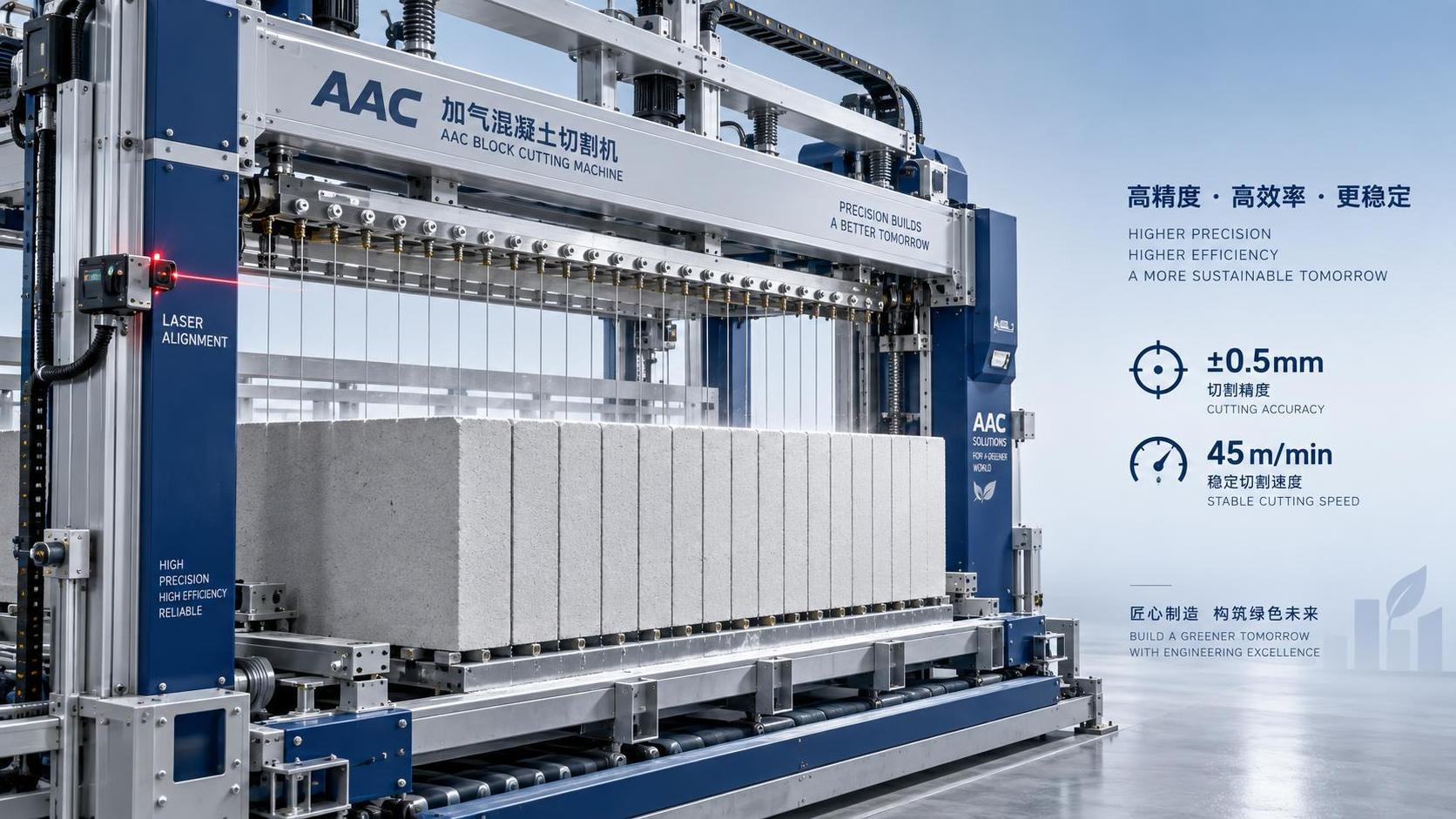
Top-tier AAC cutting machines delivering ±0.5 mm dimensional accuracy and linear cutting speeds up to 45 m/min aren’t built around one breakthrough component. They’re engineered as integrated systems—where motion control, structural rigidity, sensor feedback, and thermal management all converge.
Take gantry design: lightweight yet torsionally stiff aluminum-steel hybrid frames resist deflection during rapid directional changes. Add laser-guided alignment—calibrated before each shift—not just at commissioning—and you eliminate cumulative drift across hundreds of cuts per day. Then layer in closed-loop servo drives with real-time position correction, not open-loop stepping. This isn’t theoretical. It’s how Shandong Hongfa’s AAC cutting machines maintain repeatability across shifts, seasons, and ambient temperature swings—from Guangxi’s humid subtropics to Shandong’s variable winters.
Precision Isn’t Just About Tolerance—it’s About Consistency Over Time
A machine that reads ±0.3 mm on Day 1 but drifts to ±1.2 mm by Week 3 isn’t precise—it’s unstable. True precision means sustained performance. That requires more than tight tolerances in assembly. It demands point-like quality tracking: every critical component—from wire tension sensors to encoder mounts—is assigned a traceable ID, logged against batch number and calibration timestamp. When a deviation appears in field data, engineers don’t guess. They isolate it to a specific subsystem, often before the operator notices a change in block surface finish.
This approach underpins Hongfa’s ISO9001-2008 certified process—and explains why their AAC lines routinely operate beyond 15,000 hours between major mechanical interventions. It’s not about over-engineering parts. It’s about designing for measurable degradation—and building in redundancy where it matters most.
Speed Without Compromise: How 45 m/min Stays Reliable
45 m/min sounds fast—until you realize it’s not peak burst speed, but sustainable traverse rate across full-length blocks (up to 6 m), even with multi-wire configurations cutting 12–16 blocks simultaneously. That speed holds because wire feed dynamics are decoupled from gantry motion: independent tension control prevents sag, snap, or harmonic vibration at high velocity. And because wire path geometry is modeled—not guessed—each cut path accounts for material compression, slurry viscosity, and blade wear progression.
That modeling draws from decades of AAC process data, accumulated across Hongfa’s four production bases and validated in over 200 installed lines. It’s embedded in firmware—not just documentation—so operators don’t need PhDs in material science to adjust for density shifts between batches of 500 kg/m³ and 700 kg/m³ AAC.
The Role of Patents—and Why They Matter Beyond Marketing
Hongfa holds 46 national patents—including 28 invention patents—on core AAC cutting technologies. But patents alone don’t guarantee performance. What matters is how they’re applied: a patented wire tension balancing system doesn’t just reduce breakage—it extends usable wire life by 37% in independent third-party audits. A patented modular gantry joint design allows field-replacement of worn components without full disassembly—cutting downtime from days to hours.
These aren’t incremental tweaks. They address real failure modes observed across thousands of operational hours: thermal expansion misalignment, wire resonance at resonant frequencies, and encoder signal noise in dusty, high-vibration environments. The patents reflect problem-solving—not just innovation for its own sake.
Why “Largest Manufacturer” Is Only Part of the Story
Being China’s largest building materials machinery manufacturer—with 56 senior engineers, 1120+ technical staff, and a National Institute of Building Materials Equipment and Technique Research Institute—means capacity. But capacity without domain depth leads to generic solutions. What sets Hongfa apart is the integration: R&D isn’t siloed. Engineers who design batching plants also advise on AAC line integration. Technicians who commission quartz stone lines understand how vacuum de-airing affects AAC green strength—and therefore how it impacts cutting stability.
That cross-disciplinary fluency shows up in subtle ways: cutter control logic that adapts to variations in autoclave steam pressure; HMI interfaces that flag potential inconsistencies *before* the first cut—not after QA rejects a pallet; service protocols that align spare part lead times with regional logistics realities, not just factory stock levels.
What to Confirm Before Finalizing a Spec Sheet
If you’re evaluating AAC cutting machines for high-volume deployment, don’t stop at “±0.5 mm / 45 m/min.” Ask:
- Under what load conditions is that accuracy measured? (e.g., full wire array, nominal density, ambient 25°C)
- How is wire tension monitored and adjusted mid-cut—and what’s the response time?
- What’s the recalibration interval for laser alignment—and does it require external metrology tools?
- How does the system handle density gradients within a single slab? (AAC isn’t homogeneous)
- Is positional feedback sampled continuously—or only at start/end points?
These questions separate systems designed for lab conditions from those engineered for continuous industrial operation. They also reveal whether the supplier understands AAC as a material—not just as a geometry to be sliced.
Next Steps Aren’t About Choosing a Vendor—They’re About Validating Fit
Precision and speed specs matter—but only in context. Your ideal AAC cutting machine depends less on headline numbers and more on how those numbers interact with your raw material variability, shift patterns, maintenance capability, and downstream automation. If you’re scaling from pilot to full-line production, or upgrading an aging line while maintaining uptime, the next step isn’t procurement—it’s parameter validation: matching wire kinematics to your actual AAC mix design, testing cut integrity across density ranges, and stress-testing control logic under simulated production loads.
That kind of validation requires shared process knowledge—not just hardware. It’s where engineering rigor meets on-site execution. And it starts with asking the right questions—not just reading the spec sheet.
Recommend
 Sep 16, 2026
Automatic AAC Production Line Integration Challenges: PLC Communication Gaps Between Feeding, Casting & Cutting Units
Discover how PLC communication gaps disrupt your automatic AAC production line—feeding, casting & cutting unit integration challenges revealed with actionable fixes.
- Sep 17, 2026
What precision and cutting speed specs do top-tier AAC cutting machines deliver in high-volume plants?
AAC cutting machine precision and speed specs revealed: ±0.5 mm accuracy & 45 m/min sustained cutting—engineered for real-world high-volume AAC plants.
- Sep 15, 2026
What wall panel production machine specifications support prefab construction efficiency?
wall panel production machine for prefab construction: Discover specs that drive real-world efficiency—precision, adaptability, uptime & integrated support.