AAC Plant Machinery Compatibility Guide: Matching Cutting, Curing & Autoclave Systems for Consistent Block Density
Why Block Density Drifts—And Where Compatibility Breaks Down in AAC Production
If your AAC plant consistently produces blocks outside the target density range—say, 580–620 kg/m³—yet raw materials, mix design, and steam pressure appear stable, the issue is rarely in the recipe. It’s almost always in how the cutting, curing, and autoclaving stages interact as a synchronized system. Operators who’ve chased density variation for months often discover too late that the problem isn’t calibration drift or operator error—it’s mechanical and control-layer incompatibility between machines that were never engineered to work together.
This isn’t theoretical. In real AAC lines running at 150–200 m³/day, mismatched equipment introduces cumulative timing offsets, thermal load imbalances, and dimensional misalignments that don’t show up in single-machine commissioning reports—but manifest directly in block weight consistency, surface integrity, and post-autoclave strength recovery.
Cutting System Compatibility: More Than Just Blade Alignment
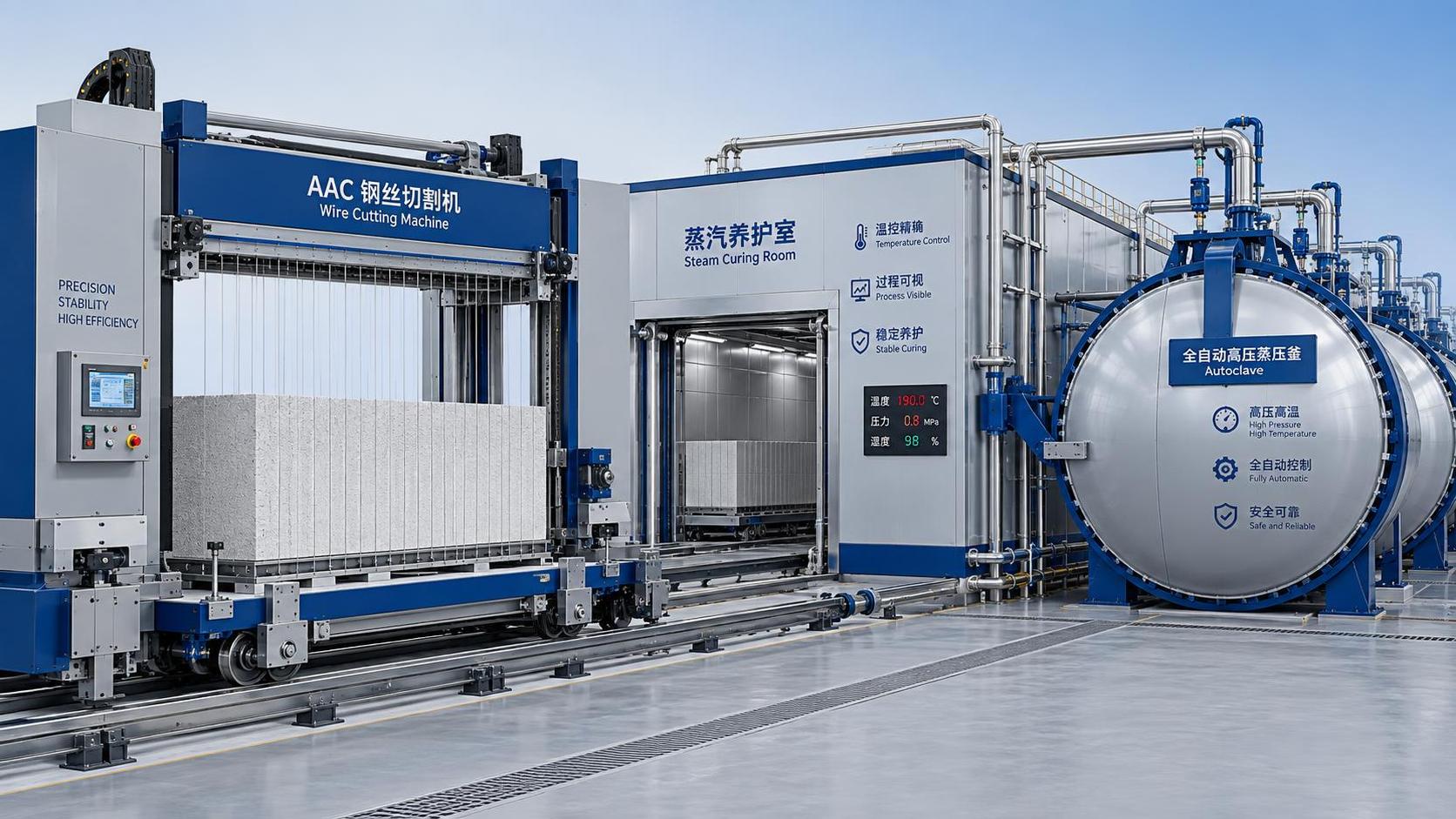
The wire-cutting machine sets the physical envelope for every block. But compatibility here goes far beyond blade tension or traverse speed. What matters operationally is how precisely the cut dimensions match the autoclave car loading grid—and how consistently the cut surface tolerances support uniform steam penetration during curing.
For example: if your cutting line produces blocks with ±1.8 mm length variation (within typical OEM spec), but your autoclave cars are designed for ±0.7 mm tolerance in rail spacing, you’ll get repeated edge binding, uneven stacking pressure, and localized steam channel restriction. That doesn’t trigger alarms—but it creates density gradients across the car, especially in outer layers. The result? A 3–5% density spread across a single batch, even with identical autoclave parameters.
True compatibility requires matching three interdependent specs:
- Cut-face flatness tolerance (≤0.5 mm over 600 mm) aligned with the autoclave car’s support rail profile;
- Block dimension repeatability tied to the curing chamber’s pallet indexing logic—not just nominal size;
- Wire feed synchronization protocol (e.g., pulse-based vs. analog position feedback) compatible with the PLC controlling the transfer conveyor to curing.
When these aren’t matched, operators compensate manually—slowing cycle time, adjusting steam ramp rates, or reworking batches. That masks the root cause and erodes yield.
Curing-to-Autoclave Handoff: The Thermal Load Gap Most Overlooked
Curing isn’t just preheating. It’s where the green block develops early pore structure stability—the foundation for uniform expansion and moisture migration under high-pressure steam. If the curing chamber delivers inconsistent surface temperature (±8°C or more across the pallet), or holds blocks longer than required to reach 60–65°C core temp, you introduce latent thermal inertia into the autoclave. That inertia disrupts the critical first 30 minutes of the autoclave cycle—when hydration kinetics are most sensitive to temperature rise rate.
Here’s what field data shows: lines using curing chambers with non-uniform radiant heating + autoclaves with fixed steam injection profiles report 42% higher incidence of “lightweight skin / dense core” blocks—despite meeting all nominal setpoints. Why? Because the autoclave’s control system assumes uniform starting conditions. When it doesn’t get them, it can’t compensate fast enough without risking thermal shock or condensate pooling.
Compatible systems close this gap by sharing real-time thermal profiling—not just start/stop timestamps. That means the curing chamber’s PLC must output validated core-surface delta-T data (not just ambient air temp) to the autoclave controller, which then dynamically adjusts initial steam flow and vent timing. Without that handshake, you’re running blind.
Autoclave Integration: It’s Not About Pressure Rating—It’s About Response Fidelity
Many operators assume autoclave compatibility is solved by matching nominal pressure (e.g., 1.2 MPa) and volume. But pressure rating tells you nothing about how quickly and evenly the vessel responds to control commands—or how its thermal mass interacts with upstream curing output.
A high-inertia autoclave (thick-walled, low surface-area-to-volume ratio) paired with a fast-ramping curing system creates a control mismatch: the curing chamber pushes blocks in at near-optimal temp, but the autoclave lags on ramp-up, causing temporary under-pressurization and micro-pore collapse. Conversely, a lightweight autoclave with aggressive steam injection may overshoot when fed blocks still holding surface moisture from incomplete curing—leading to spalling and density spikes.
What matters is response fidelity: the degree to which actual pressure, temperature, and condensate level tracks the control setpoint curve—especially during ramp-up and hold phases. This depends on valve sizing, steam distribution manifold design, condensate drainage layout, and sensor placement—all of which must be validated as a system, not per component.
Field-tested compatibility includes:
- Steam inlet manifolds sized to deliver ≥120% of max required flow at 0.1 MPa differential—verified under full-load thermal cycling;
- Condensate drains located at lowest points *between* car rails—not just vessel ends—to prevent pooling under stacked blocks;
- Temperature sensors embedded in representative block positions (not just vessel walls) feeding closed-loop correction to the steam control algorithm.
What You Can Verify Before Finalizing Equipment Selection
You don’t need vendor cooperation to spot red flags. Before signing off on any new AAC plant machinery package—or integrating a replacement unit—run these checks:
- Dimensional traceability: Request CAD overlays showing cut-block footprint vs. autoclave car rail spacing, including tolerance stack-up analysis—not just nominal dimensions.
- Control protocol mapping: Ask for the exact communication protocol (Modbus TCP register map, Profibus DP slave ID assignment, or proprietary handshake sequence) between curing PLC and autoclave controller—not just “they talk to each other.”
- Thermal response validation: Demand test reports showing autoclave pressure/temperature deviation from setpoint during ramp-up *with actual cured blocks loaded*, not empty-vessel tests.
- Maintenance interface alignment: Confirm lubrication points, sensor access locations, and safety interlock reset sequences follow consistent human factors logic across all three systems—reducing operator error during shift handovers.
None of this replaces commissioning—but it prevents discovering incompatibility after concrete has been poured and foundations set.
Final Note: Compatibility Is a System Property—Not a Spec Sheet Checkbox
Consistent AAC block density isn’t achieved by optimizing each machine in isolation. It emerges only when cutting geometry, curing thermal delivery, and autoclave pressure response form a tightly coupled loop—where variation in one stage is actively compensated by the next. That requires shared engineering assumptions, validated thermal models, and interoperable control logic—not just bolt-on integration.
For operators managing multi-shift production, the payoff isn’t just tighter density control. It’s predictable cycle times, reduced rework, lower energy variance per m³, and fewer unplanned stops chasing phantom process faults. That kind of reliability doesn’t come from upgrading one component. It comes from specifying the system as a single functional unit—with compatibility built in, not retrofitted.
Next:No more content
Recommend
 Sep 15, 2026
AAC Plant Machinery Compatibility Guide: Matching Cutting, Curing & Autoclave Systems for Consistent Block Density
AAC plant machinery compatibility isn’t optional—it’s the key to consistent block density. Discover how cutting, curing & autoclave systems must integrate as one synchronized unit to eliminate drift and boost yield.
- Sep 14, 2026
How flexible is the raw material input for hollow block making machines?
hollow block making machine raw material flexibility unlocks real-world production—adapt to fly ash, RAC, slag & more without sacrificing strength or precision.
 May 07, 2026
Wall Panel Production Line