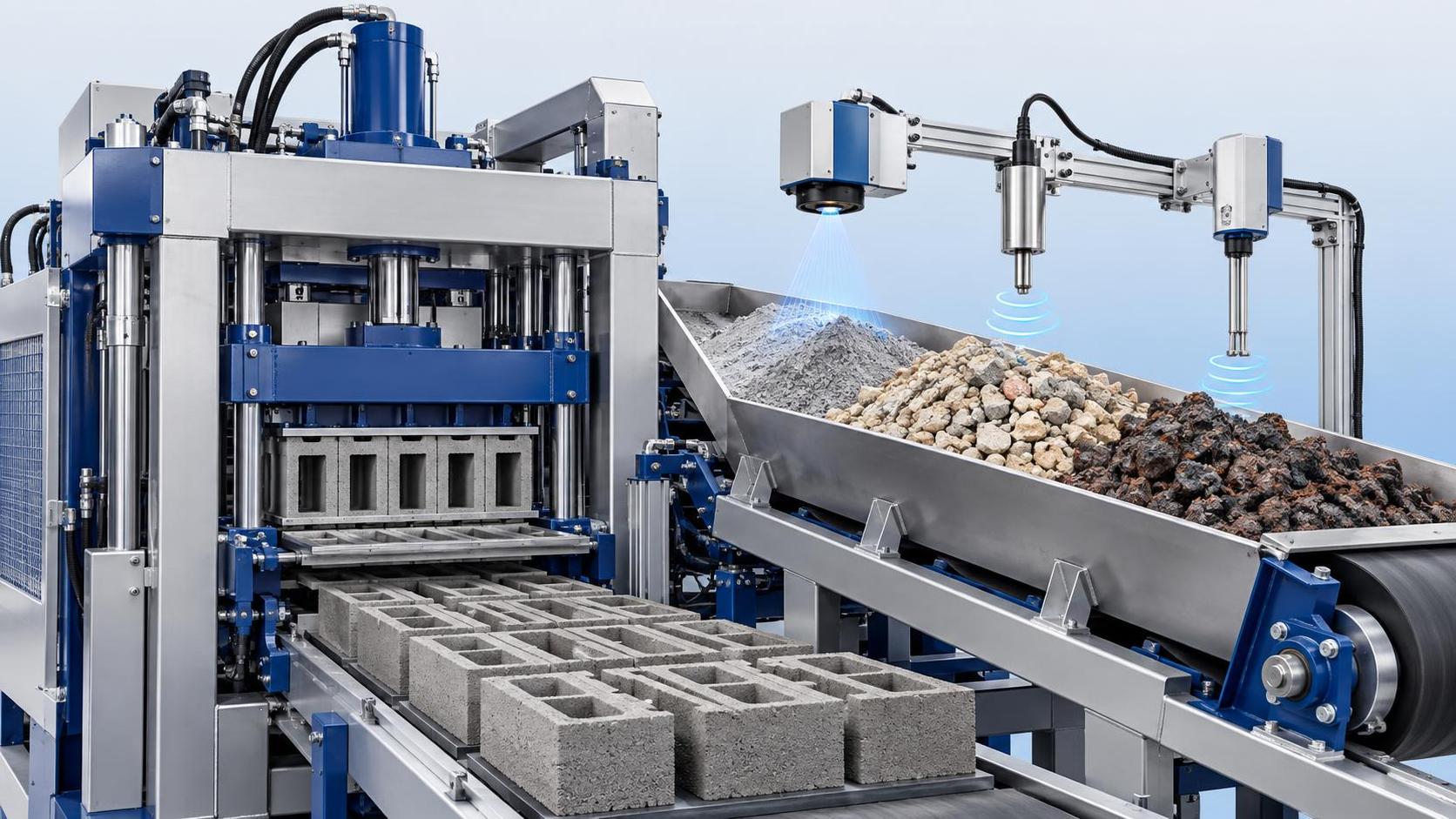
How flexible is the raw material input for hollow block making machines?
How flexible is the raw material input for hollow block making machines?
It’s a question that surfaces early—and urgently—when evaluating hollow block making machines: Can this machine handle what we actually have on hand? Not what’s ideal in a lab, not what’s specified in a brochure, but the sand with variable silt content, the fly ash from a local thermal plant, the crushed concrete from demolition sites, or the slag left over from steel production. Raw material flexibility isn’t a secondary feature—it’s the hinge point between theoretical output and real-world viability.
The short answer: modern hydraulic and vibration-compaction hollow block machines—especially those engineered for industrial-scale, multi-site operations—can accommodate a surprisingly wide feedstock range. But “wide” doesn’t mean “unconditional.” Flexibility is tightly bound to three interdependent factors: machine design philosophy, control precision, and process feedback capability. Without all three, claims of broad material compatibility often collapse under operational stress.
What “flexible input” really means—and what it doesn’t
“Flexible raw material input” is frequently misinterpreted as tolerance for inconsistency. That’s dangerous. A machine that accepts high-moisture clay without adjustment isn’t flexible—it’s uncontrolled. True flexibility means the machine can detect, adapt, and compensate for variation—not just swallow it.
For example:
- Fly ash vs. river sand: Fly ash has lower bulk density and higher water absorption than natural sand. A rigid system will produce under-compacted blocks with low compressive strength unless mix ratios and compaction time are manually re-tuned. A flexible system adjusts vibration frequency and dwell time automatically based on real-time density sensing—or allows rapid, repeatable parameter recall for pre-validated formulations.
- Recycled aggregate (RAC): Crushed concrete introduces irregular particle shape, residual mortar, and variable absorption. Machines relying solely on fixed water dosing and static cycle timing struggle with slump variability and inconsistent green strength. Flexibility here requires dynamic water metering tied to aggregate moisture sensors—and compaction energy modulation calibrated to particle interlock behavior, not just weight.
- Slag or bottom ash: These materials often contain trace metals or unburnt carbon that affect setting time and long-term durability. Flexibility isn’t about feeding them in—it’s about whether the machine’s batching logic supports precise additive dosing (e.g., accelerators or pozzolanic modifiers) and whether its control architecture permits formulation-specific curing profiles post-ejection.
In other words, flexibility isn’t defined by the list of materials you *can* feed in—it’s defined by how reliably the machine maintains dimensional accuracy, compressive strength, and surface finish *across* that list.
The engineering levers that enable real-world adaptability
Three technical elements separate adaptable machines from merely tolerant ones:
1. Multi-point, closed-loop material sensing
Basic machines measure only batch weight and water volume. Flexible systems embed moisture sensors in aggregate bins, conductivity probes in mixing chambers, and even near-infrared analyzers that detect organic content or clay contamination in real time. This data feeds directly into the PLC—not as a log, but as an active input for adjusting water addition, mixing duration, and compaction amplitude.
2. Programmable compaction profiles
Vibration isn’t binary (on/off). Effective machines allow independent control of frequency (Hz), amplitude (mm), and dwell time (ms)—and let operators save these as named profiles (e.g., “Fly Ash + 15% RAC”, “Desert Sand + Lime Stabilizer”). Crucially, they also support adaptive profiles: if moisture sensor readings shift beyond ±2%, the system auto-selects the nearest validated profile and logs the deviation for review.
3. Modular batching architecture
Flexibility falters when batching is monolithic. Machines with segregated, independently controllable silos—for cement, lime, lightweight aggregates, fibers, or chemical admixtures—enable formulation agility without hardware reconfiguration. This matters when switching from standard concrete blocks to AAC-adjacent lightweight variants or sulfate-resistant formulations for coastal projects.
Where flexibility hits its limits—and why that matters
Even advanced machines have boundaries. Understanding where those lines sit prevents costly misalignment during procurement:
- Organic content > 0.5%: While some machines accept quarry dust or weathered gravel, persistent organic contamination (e.g., soil, root matter, or asphalt residue in recycled aggregate) disrupts cement hydration. No control system compensates for biochemical interference—only preprocessing does.
- Particle size distribution outside 0–8 mm range: Coarse slag or oversized crushed brick creates voids that vibration cannot fully close. Fine silt overload increases water demand beyond dosing capacity and risks efflorescence. Flexibility assumes feedstock meets basic gradation envelopes—even if those envelopes are wider than traditional specs.
- Consistent variability ≠ random variability: A machine calibrated for fly ash with 12–14% moisture works well if incoming batches stay within that band. It fails if moisture swings between 8% and 22% without warning—because no sensor reacts instantly, and no actuator corrects mid-cycle. Real flexibility requires predictable, bounded variation—not chaos.
This is why site audits matter more than datasheets. A supplier’s claim of “supports 7 aggregate types” means little without knowing the documented performance envelope for each—and whether those envelopes were validated under your region’s humidity, temperature cycling, and typical supply chain volatility.
Making the call: what to verify before specifying
If your operation depends on variable or locally sourced materials, prioritize verification over specification:
- Ask for formulation validation reports—not just test certificates. Demand data showing compressive strength, water absorption, and dimensional stability across at least three distinct feedstock combinations used at full production rate—not lab-scale trials.
- Test the interface, not just the hardware. Sit with operators during a live switch between two formulations. Can parameters be changed in under 90 seconds? Does the HMI show real-time feedback on compaction energy absorption per cycle? Is there a clear audit trail of every parameter change?
- Confirm service depth, not just warranty length. Flexibility degrades if calibration drifts or sensors foul. Ask whether field engineers carry portable density calibrators and moisture reference standards—and whether firmware updates include new material profiles, not just bug fixes.
Ultimately, raw material flexibility isn’t a spec to check off—it’s a process capability to validate. The most capable hollow block making machines don’t just accept diverse inputs; they turn variability into a controlled parameter. That shifts the value proposition from “what you can make” to “how reliably you can make it—today, next month, and when your supplier’s stock changes again.”
Previous:Wall Panel Production Line
Next:No more content
Recommend
 Sep 14, 2026
How flexible is the raw material input for hollow block making machines?
hollow block making machine raw material flexibility unlocks real-world production—adapt to fly ash, RAC, slag & more without sacrificing strength or precision.
 May 07, 2026
Wall Panel Production Line
- May 07, 2026
Concrete Mixing Plant