



Automatic AAC Production Line Explained: Key Process Stages and Capacity Planning
Automatic AAC Production Line Explained: Key Process Stages and Capacity Planning
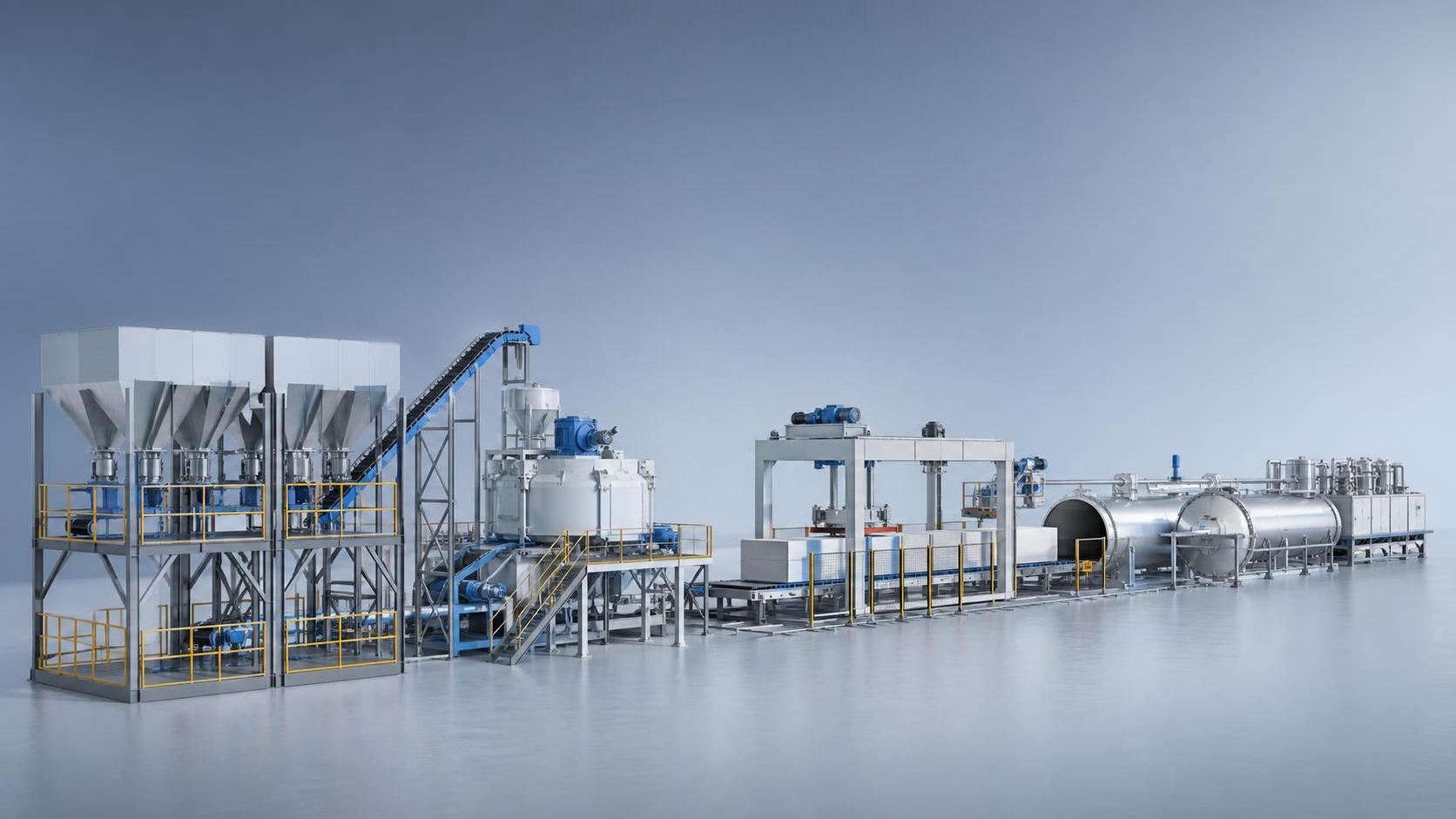
An automatic AAC production line is often described in one sentence: batching, mixing, casting, cutting, autoclaving, and packing are connected into a continuous system. That description is technically correct, but it leaves out the part buyers usually struggle with when they start evaluating equipment. The real question is not just how the line works. It is how each stage affects density consistency, steam consumption, labor demand, plant layout, maintenance rhythm, and the practical output a factory can sustain over time.
In AAC production, automation is not simply about replacing operators. It is about reducing variation between batches, keeping the process synchronized, and preventing one weak section from slowing down the entire line. A well-designed system should make the plant more predictable. A poorly matched system, even with a high level of automation on paper, can still produce bottlenecks in mold circulation, cutting, or autoclave scheduling.
That is why experienced manufacturers in building materials equipment tend to look at the line as a production chain rather than a list of machines. Companies such as Shandong Hongfa Scientific Industrial & Trading Co., Ltd., which has been active in construction machinery since 1990 and manufactures aerated concrete block production lines alongside block machinery and batching plants, have long worked in this reality: equipment performance depends as much on process coordination as on individual machine specifications.
What happens in each process stage
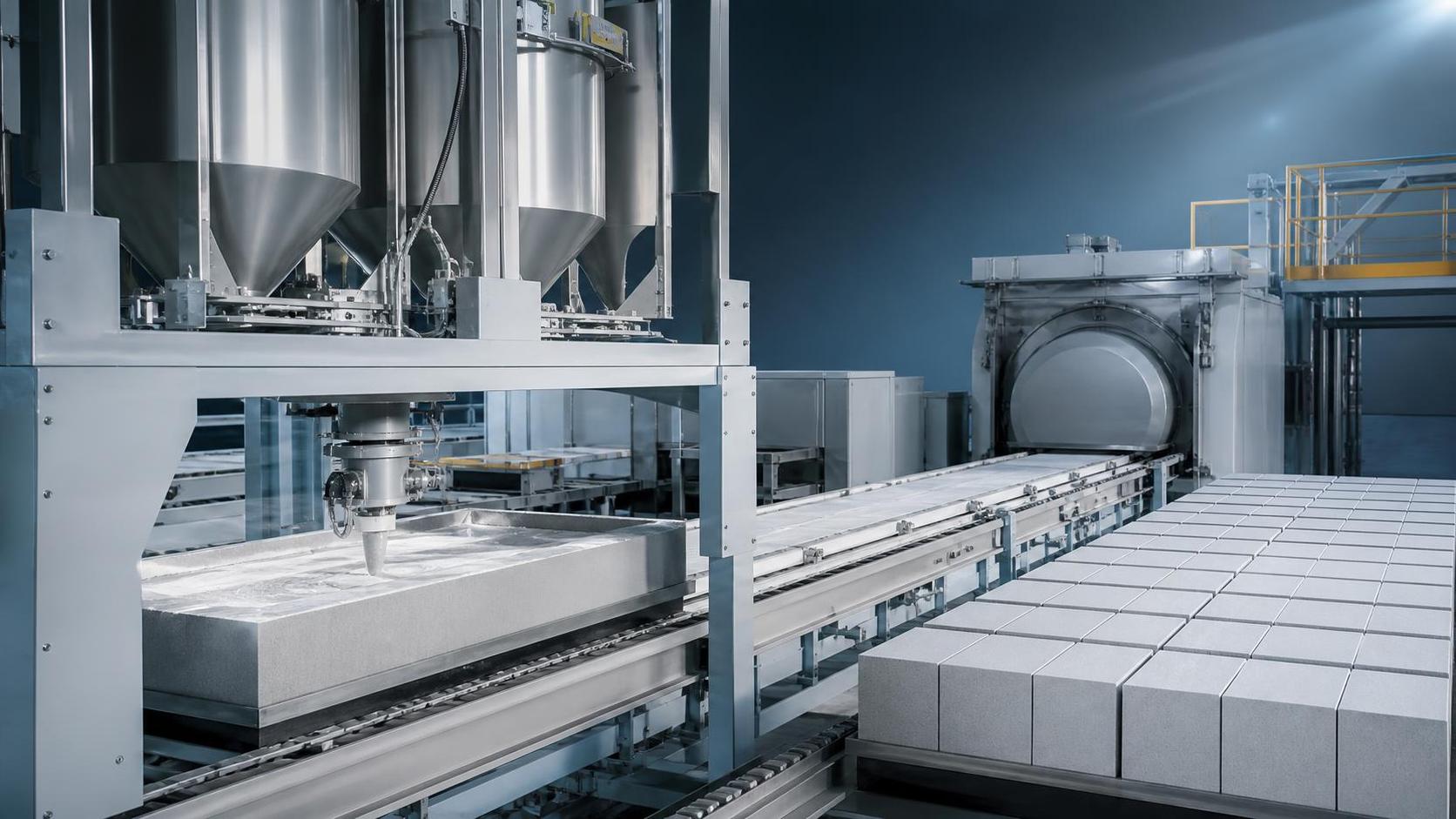
The front end begins with raw material preparation and batching. In AAC, consistency starts here. Cement, lime, gypsum, sand or fly ash slurry, aluminum paste or powder, and water must be measured accurately enough that the slurry behaves the same way from batch to batch. Buyers often focus on mixer size, but dosing precision matters just as much. If batching drifts, downstream automation cannot fully correct it. You may still get unstable rising, off-spec density, or cutting defects.
Mixing and casting follow immediately. The slurry must be homogeneous before it enters the mold. This sounds routine, but the timing window is tighter than many first-time investors expect. AAC relies on a controlled reaction that generates pores and causes the green cake to rise. If the slurry temperature, mixing energy, or additive dispersion is off, the cake may rise unevenly or fail to reach the expected structure before pre-curing. In practice, this is one of the stages where stable control logic is worth more than flashy interface design.
Then comes pre-curing, sometimes underestimated in early project discussions. The purpose is to let the cast cake gain enough green strength for demolding and cutting without overhardening. Conditions in the curing area affect cutting quality directly. Some plants use supporting equipment such as a Static Curing Room to maintain a more controlled environment before the cake moves to the next operation. Whether that configuration is necessary depends on raw material behavior, local climate, and the required production rhythm.
Cutting is where many output claims meet reality. AAC cutting systems have to work with fragile green cakes, not fully hardened blocks. The line must handle vertical and horizontal cuts accurately while minimizing damage during turning, demolding, and transfer. If mold accuracy, cake strength, and cutter synchronization are not aligned, edge breakage and dimensional deviation will show up quickly. This is also why the capacity of the cutting section should never be reviewed in isolation. A fast cutter does not help much if the cake arriving from pre-curing is inconsistent.
After cutting, the product enters autoclaving. This is the pressure-curing stage that gives AAC its final mineral structure and performance. From a process standpoint, the autoclave is not just another machine; it is a time-based constraint that shapes the rhythm of the whole plant. Loading pattern, steam supply stability, pressure curve, and cycle time all influence not only product quality but also line balance. In many factories, the autoclave section becomes the practical capacity ceiling, regardless of how automated the upstream section is.
Packing and finished goods handling are often discussed last, even though they can become a labor and logistics issue very quickly. Once the blocks or panels leave the autoclave, they need to be separated, inspected, packed, and moved without unnecessary damage. If this section is underdesigned, the factory may produce well but still ship inefficiently.
Why capacity planning is more than a nameplate number
When buyers ask about the capacity of an automatic AAC production line, they usually want a simple answer in cubic meters per day or per year. Suppliers can provide those figures, but serious planning needs more context. Nameplate capacity assumes a certain product mix, curing cycle, uptime, raw material stability, and shift arrangement. Change one of those variables and the real output may move quite a bit.
A common mistake is to size the line only around expected market demand. The better approach is to start with three questions: what product dimensions will dominate, what daily operating schedule is realistic, and where will the plant accept process buffers? AAC lines do not flow like a simple conveyorized packaging line. Some sections are continuous in feel, but others are batch-dependent, especially autoclaving. Capacity planning therefore becomes a balancing exercise between cycle-based equipment and flow-based equipment.
Autoclave quantity and cycle time are a good example. If the upstream system produces green cakes faster than the autoclave section can absorb them, you will either need extra buffer capacity or accept idle time upstream. On the other hand, oversizing the autoclave section without enough stable feed from casting and cutting can increase investment and energy burden without creating proportional output.
Energy planning also belongs in the same conversation. Steam demand, power load, water reuse, and compressed air consumption should be checked against the local utility situation before capacity targets are finalized. In regions where steam generation cost is high or fuel supply is variable, the line configuration that looks attractive in a brochure may not be the most practical long-term choice.
Where bottlenecks usually appear
In AAC projects, bottlenecks rarely come from a single dramatic failure. More often, they build up from small mismatches.
- Batching precision is acceptable, but slurry temperature control is weak, so rising becomes less predictable.
- Cutting speed is adequate, but mold turnover is too slow, reducing effective throughput.
- Autoclave volume is sufficient, but steam supply cannot support the intended cycle frequency.
- Packing automation is limited, so labor becomes concentrated at the end of the line.
This is why experienced equipment manufacturers tend to ask for plant layout, utility conditions, local raw material characteristics, and target product mix before making a serious recommendation. Hongfa’s background in multiple categories of building materials machinery, along with its larger engineering and technical team, reflects this broader systems view. In AAC, the machine itself matters, but the surrounding engineering decisions matter almost as much.
How to read automation claims more carefully
“Automatic” can mean different things from one supplier to another. In some cases, it refers mainly to PLC control and conveyor linkage. In others, it includes automated batching, mold circulation, cake transfer, autoclave loading, and packing. Buyers who are still in the research phase should be careful not to compare lines only by headline wording.
A more useful way to compare options is to ask where manual intervention remains necessary and why. Manual work is not always a flaw. Sometimes it is retained because the plant needs flexibility in product changeover or because local labor conditions make that tradeoff reasonable. But if labor dependence remains in a stage that directly affects consistency, such as dosing correction or cake handling, that deserves closer attention.
Control system transparency is another point worth checking. Operators should be able to trace alarms, review batch records, and understand where deviations originated. For a plant manager, that matters more than having a visually impressive control screen.
Practical questions before choosing a line size
Before settling on a capacity level, it helps to work through a few practical filters:
- Is the target market mainly standard blocks, or are there size variations that will influence cutting and packing rhythm?
- How stable are the intended raw materials, especially if using local sand or fly ash sources that may vary over time?
- What is the realistic steam and power infrastructure on site?
- How much floor space is available for mold circulation, buffering, and finished goods handling?
- What maintenance support and spare parts response will be needed after commissioning?
Those questions are less glamorous than talking about maximum daily output, but they usually decide whether the line runs smoothly six months after startup.
It is also worth remembering that a slightly more conservative line can outperform an oversized one if the process balance is right. Buyers researching an automatic AAC production line are often tempted to assume that more automation and more installed capacity automatically mean better economics. In practice, the stronger investment is usually the one that matches local demand, utility conditions, raw material behavior, and the factory’s ability to maintain process discipline.
If you are still at the comparison stage, focus less on a single headline capacity figure and more on how the supplier explains the relationship between batching accuracy, pre-curing control, cutting stability, autoclave scheduling, and product handling. That explanation tends to reveal whether the line has been designed as a real production system or just assembled as a list of equipment.
Recommend
 Sep 23, 2026
How automatic AAC production line stability affects block quality
Automatic AAC production line stability directly shapes block strength, density, and dimensions. Learn how tighter process control reduces defects, waste, and safety risks.
- Sep 23, 2026
What to check before buying autoclaved aerated concrete equipment
Autoclaved aerated concrete equipment buying guide: learn what to check on line balance, raw materials, energy use, maintenance, and support before choosing a reliable AAC solution.
- Sep 24, 2026
How to reduce downtime caused by worn AAC plant machinery
AAC plant machinery downtime can be cut by spotting wear early, prioritizing critical parts, and using smarter maintenance strategies to keep production stable and costs under control.