


How to compare AAC plant machinery for capacity without overbuying
Choosing AAC plant machinery by capacity sounds straightforward until procurement moves from brochure numbers to project reality. On paper, a larger line looks safer: more output, more room for growth, more bargaining power. In practice, overbuying is one of the most expensive mistakes in an AAC project. It ties up capital, raises utility and maintenance burdens, complicates commissioning, and often leaves the plant running below its efficient load range for years.
For procurement teams, capacity comparison is less about asking “which line is bigger?” and more about asking “which line can reliably support our sales plan, raw material conditions, labor model, and payback target?” That shift matters because AAC plant machinery is not purchased as isolated equipment. It is a system decision, and the real output of the system is almost never equal to the nameplate output shown in supplier quotations.
Why nameplate capacity is a weak basis for comparison
Most suppliers present capacity in cubic meters per day or per year. That is useful, but not enough to compare one offer against another. Two lines with the same declared capacity may perform very differently once installed because output depends on the slowest stage in the process, not the strongest one.
In AAC production, procurement should check whether quoted capacity assumes:
- ideal raw material consistency;
- continuous autoclave availability;
- full shift staffing;
- stable steam supply;
- high automation and low changeover losses;
- standard product dimensions only.
If one supplier quotes theoretical capacity and another quotes practical daily output at normal utilization, the lower-looking offer may actually be the more realistic one. This is a common source of bad buying decisions, especially when procurement is pushed to compare offers mainly on headline figures.
Start with market demand, not machine maximums
AAC capacity planning should begin from the sales side. Procurement needs a demand model built on realistic market absorption rather than optimistic internal targets. That means asking a few uncomfortable but necessary questions:
- What volume can the regional market absorb in the next 24 to 36 months?
- How much demand is already served by existing AAC producers, clay brick plants, or concrete block suppliers?
- Will the project rely on one large distributor, government-linked construction demand, or fragmented private builders?
- Is seasonal demand volatility high?
- How much product mix flexibility is required?
If realistic sales volume in the first two years is only 55% to 65% of a large line’s capacity, then the buyer is not purchasing “future readiness.” They may be purchasing underutilization. In heavy industrial projects, underutilization is not a minor efficiency issue; it changes the economics of depreciation, labor allocation, steam consumption per unit, and inventory turnover.
A more disciplined approach is to define three demand cases: base case, conservative case, and expansion case. Then compare machinery options against the base case first. Expansion should be planned, but not paid for in full unless the market case justifies it.
The real comparison unit is effective output
For AAC plant machinery, effective output is more important than designed output. Effective output means what the plant can produce consistently, at acceptable quality, using the buyer’s actual inputs and operating conditions.
Procurement should request from suppliers a capacity breakdown by process stage, including:
- raw material preparation throughput;
- batching and mixing cycle time;
- casting and pre-curing rhythm;
- cutting line throughput;
- autoclave cycle capacity and turnaround time;
- finished product handling speed;
- expected uptime under normal maintenance conditions.
This helps identify whether the line is balanced. A line that looks large because of an aggressive autoclave configuration may still be limited by batching, mold circulation, crane handling, or cutting section performance. In some projects, bottlenecks appear not in the main process equipment but in material transfer and curing logistics.
When comparing suppliers, ask for output assumptions in writing. If the supplier cannot clearly state how the declared capacity is calculated, that is a procurement risk signal.
Capacity must match raw material reality
AAC is highly sensitive to raw material characteristics. Lime reactivity, cement behavior, gypsum quality, aluminum paste performance, fly ash variability, and sand grinding fineness all influence production stability. A plant sized for high throughput on stable inputs may struggle in a market where raw materials are inconsistent.
This is where procurement often faces a hidden trap. A larger capacity line may require tighter raw material control and more disciplined process management to actually reach its designed rate. If the project location has unstable fly ash supply, changing sand sources, or uncertain binder quality, buying the largest line may increase process instability rather than improve output.
Buyers should therefore compare machinery offers with these questions in mind:
- What raw material variability can the line tolerate without major output loss?
- What adjustments are manual versus automated?
- What testing and process control support is included?
- Has the supplier delivered similar capacity lines using similar local raw materials?
For example, the mixing stage is easy to underestimate. Components such as an AAC Pouring Mixer influence slurry uniformity, reaction stability, and casting consistency, all of which affect downstream cutting and curing performance. In other words, practical capacity is not just a matter of machine size; it is also a matter of process stability.
Automation level changes the meaning of capacity
Two AAC lines with equal nominal output can differ sharply in labor intensity and operational discipline requirements. Higher automation may reduce dependence on operator skill, improve consistency, and lower losses during routine production. But automation also raises initial investment, spare parts complexity, software dependence, and service expectations.
Procurement should avoid the simplistic view that “more automation is always better.” The right question is whether the automation level suits the operating environment.
A highly automated line may be justified when:
- labor cost is high;
- operator retention is difficult;
- consistent quality is commercially critical;
- the owner plans multi-shift operation at scale.
A more moderate configuration may be better when:
- the plant is entering a new market cautiously;
- local technical support is limited;
- production volume will ramp up gradually;
- the maintenance team is still developing AAC-specific capability.
Overbuying often happens when capacity and automation are bundled together in a prestige-oriented purchase decision. Procurement should separate them. A buyer may need stable medium-scale output, but not the most advanced control architecture available.
Watch the autoclave section closely
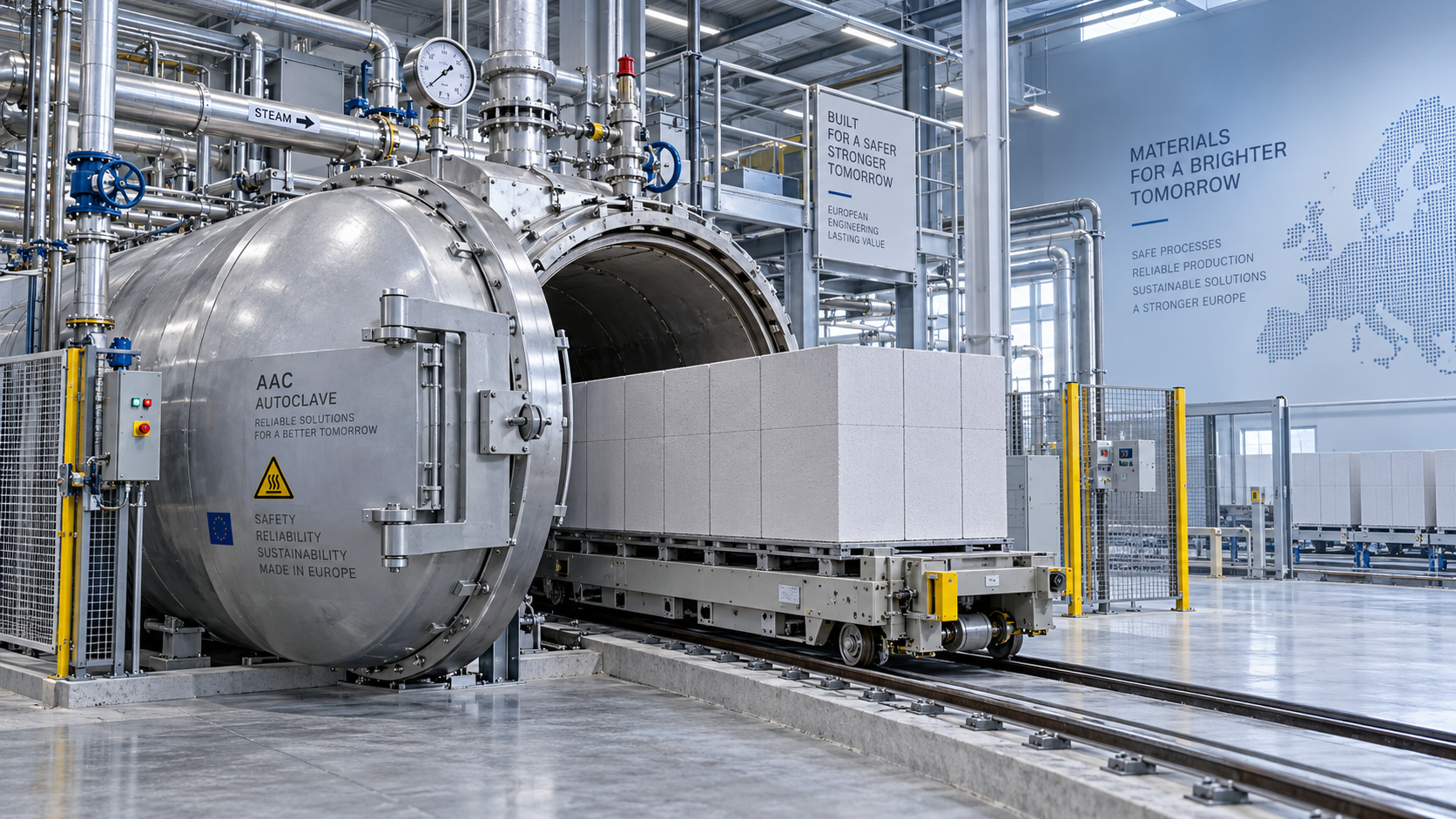
In AAC plants, autoclaving is one of the most capital-intensive and cycle-sensitive stages. Procurement teams frequently focus on the number of autoclaves, but a better comparison includes effective loading, steam system matching, cycle duration, and plant rhythm.
Adding autoclave volume does not automatically create useful capacity if upstream casting and cutting cannot feed it, or if the boiler and steam network cannot support efficient cycles. Likewise, insufficient autoclave capacity can turn a seemingly well-sized line into a bottlenecked one.
Ask suppliers to show:
- autoclave loading assumptions;
- cycle time under typical production conditions;
- steam consumption estimates, with assumptions clearly stated;
- how maintenance downtime affects daily output;
- whether the proposed layout supports future autoclave expansion.
This last point matters. Designing a plant for modular expansion is often better than purchasing full expansion capacity from day one.
The cheapest route to future growth is often expandability, not oversizing
Procurement teams under pressure from management often hear a familiar argument: “Let’s buy bigger now so we don’t need to invest again later.” Sometimes that is correct. Often it is not.
The smarter way to avoid repeat investment is to buy a line with expansion logic. That may include:
- site layout that allows additional molds, autoclaves, or storage;
- utilities sized for phased growth;
- control systems that can integrate future modules;
- foundation and handling design prepared for a second-stage upgrade.
This approach protects capital while preserving growth options. It is usually more procurement-friendly than paying upfront for capacity that the market may not absorb for several years.
Compare total cost per sellable cubic meter
Procurement decisions go wrong when machinery is compared only by purchase price or nominal capacity. A better metric is total cost per sellable cubic meter over time. That includes:
- equipment price;
- installation and commissioning cost;
- civil and utility requirements;
- energy and steam consumption;
- labor requirement;
- maintenance and spare parts burden;
- waste and reject rates;
- downtime exposure.
A larger line may have a lower theoretical cost per unit at full load, yet a much worse actual cost profile at 50% to 60% utilization. Procurement should model at least two utilization levels, because early-stage plants rarely run at target output immediately.
This is especially important in export or cross-border investment projects, where spare parts lead time, engineer travel, and after-sales coordination can materially affect uptime.
Supplier comparison should include delivery and execution risk
AAC plant machinery is not a standard off-the-shelf purchase. Capacity promises are only meaningful if the supplier can execute the project. Procurement should therefore compare suppliers on more than technical specification.
Key checks include:
- reference plants of similar scale and process route;
- documentation quality and clarity of scope;
- manufacturing consistency across key equipment;
- commissioning team experience;
- spare parts availability and response time;
- training support for operators and maintenance staff;
- warranty terms and responsibility boundaries.
If a supplier offers very high capacity at an attractive price but cannot demonstrate successful installations under similar conditions, procurement should treat that offer with caution. In this segment, delivery reliability is part of capacity reliability.
Common procurement mistakes when comparing AAC plant machinery
Several patterns appear repeatedly in AAC investment decisions.
One is using annual output targets without translating them into daily operating realities. Another is assuming that all capacity figures are defined the same way. A third is selecting a line based on peak forecast demand rather than probable demand. There is also the tendency to under-evaluate raw material variability and overestimate local operating capability during the first year.
Another frequent mistake is ignoring process-critical sub-equipment because it appears secondary in the quotation. In reality, consistency in mixing, casting, cutting, and handling often decides whether the plant reaches planned throughput. Even where buyers are evaluating large sections such as autoclaves and cutting machines, the supporting equipment configuration still deserves attention, including items like the AAC Pouring Mixer when process stability is a concern.
What a disciplined procurement comparison looks like
A sound comparison process usually produces a narrower and more defensible decision. Instead of asking suppliers for their “best capacity offer,” procurement should ask each bidder to quote against the same operating assumptions:
- target product mix;
- raw material conditions;
- shift pattern;
- utility constraints;
- expected first-phase sales volume;
- required automation level;
- future expansion expectations.
Then compare on practical output, lifecycle cost, implementation risk, and expandability. This makes inflated capacity claims easier to detect and helps internal stakeholders understand why the lowest bid or the biggest line is not automatically the best choice.
For procurement teams, the strongest buying position comes from treating capacity as a business-fit issue rather than a simple engineering number. The best AAC plant machinery choice is usually not the one with the highest possible output. It is the one that can run steadily, profitably, and credibly within the buyer’s real market and operating conditions—while leaving room to grow when demand has actually arrived.
Recommend
 Oct 12, 2026
Is ISO Certification Mandatory for AAC Block Manufacturing Equipment?
Are AAC block manufacturing equipment ISO certified mandatory? Discover legal requirements, supplier risks, and smart compliance checks before investing.
- Oct 11, 2026
How Often Should AAC Molds Be Inspected and Replaced?
How often should AAC molds be inspected and replaced? Discover practical inspection schedules, warning signs, and maintenance tips to reduce defects and downtime.
- Oct 10, 2026
What Safety Standards Apply to AAC Autoclave Systems in Europe?
What safety standards apply to AAC autoclave systems in Europe? Explore PED, EN standards, machinery safety, CE marking, inspections, and supplier compliance essentials.