



Is Hongfa AAC Block Production Line Reliable for Overseas Projects?
Is Hongfa AAC Block Production Line Reliable for Overseas Projects?
When contractors or plant investors ask whether a Hongfa AAC block production line is reliable for overseas projects, they are usually not asking about a brochure-level question. They want to know something much more practical: will the line arrive on time, fit local power and climate conditions, run stably after installation, and still be serviceable when the project team is no longer standing next to it every day?
That is the right way to evaluate any AAC investment. For overseas projects, reliability is not just a matter of machine quality. It is a mix of design discipline, spare parts support, engineering communication, installation logic, and whether the supplier understands that a factory built in one country must often operate under very different working habits in another.
What “reliable” really means in an overseas AAC project
In a domestic plant, people often measure reliability by output stability and wear resistance. Overseas, the definition is broader. A line may be mechanically sound, but if the control system is hard to maintain, the civil foundation requirements are unclear, or the site team cannot get technical answers quickly, the project still feels risky.
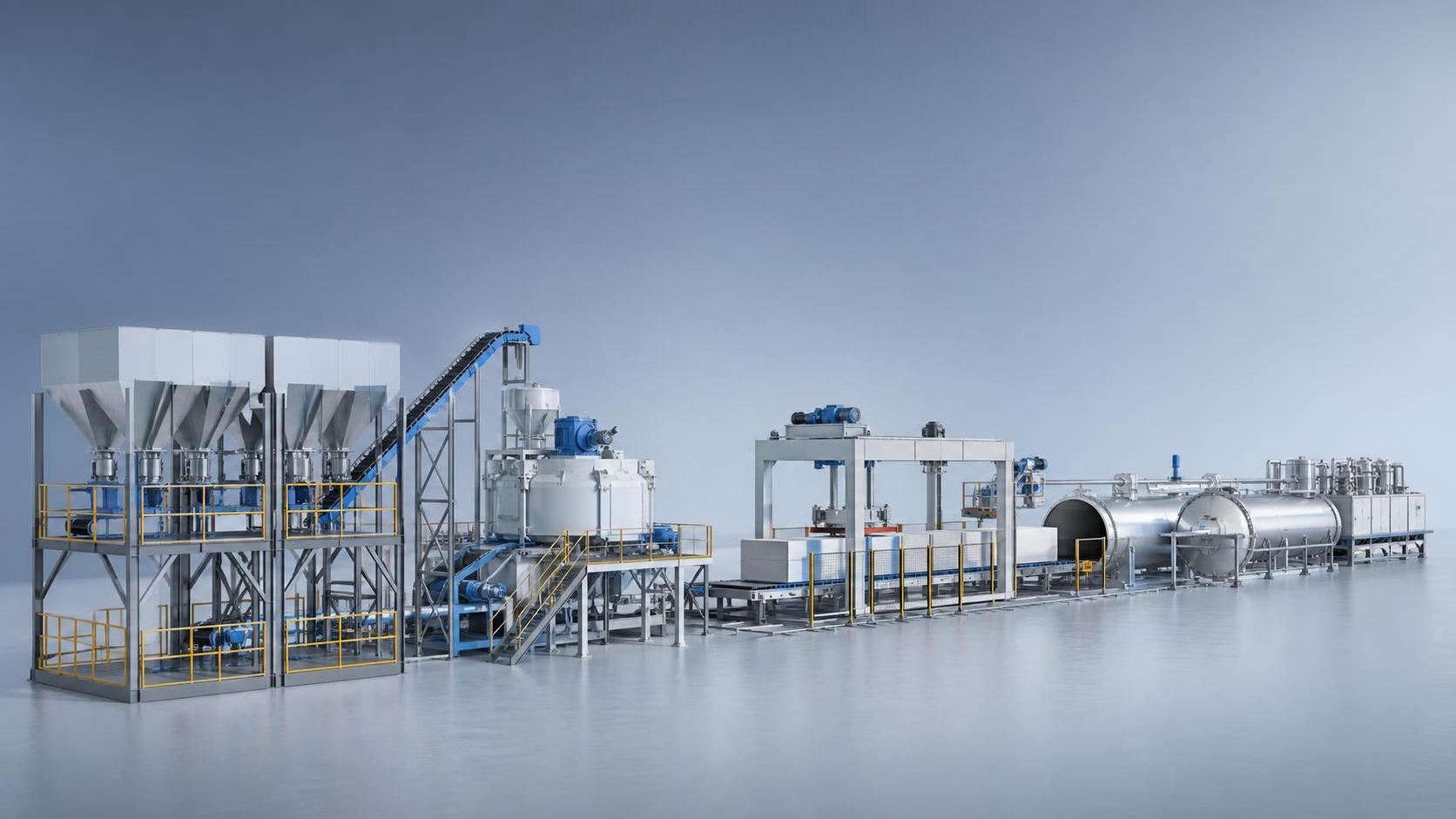
AAC production is especially sensitive to this because the line is not a single machine. It is a process chain: batching, mixing, casting, pre-curing, cutting, autoclaving, and material handling. If one section is poorly matched, the whole operation becomes harder to stabilize. That is why overseas buyers often care less about a headline specification and more about whether the supplier can make the whole system work as one.
Where Hongfa has a real advantage
Hongfa is not a newcomer trying to prove itself with one export story. Shandong Hongfa Scientific Industrial & Trading Co., Ltd. has been in construction machinery since 1990, and its business scope includes AAC block production lines, block machine lines, concrete batching plants, and quartz stone machinery. That matters because overseas buyers usually prefer suppliers who have lived through more than one kind of industrial project. A company that understands batching plants, block lines, and building-material equipment generally has a better grasp of site workflow, utility matching, and process coordination.
Another practical plus is scale. Hongfa operates four production bases in Shandong and Guangxi, with more than 500 acres of coverage, plus a technical team that includes 56 senior engineers and engineers and more than 1,120 engineers and technicians. Large numbers alone do not guarantee a good project, of course, but they usually indicate that the supplier is not depending on a small workshop-style team to handle a complex export job. For overseas projects, that affects everything from drawing turnaround to spare-part preparation.
The company also states that it holds ISO9001-2008 certification and has built a point-like quality tracking system. In real project terms, that kind of quality control matters because overseas problems are rarely dramatic at first. They often start with small deviations: a mismatch in fabricated parts, a cable routing issue, a weak field connection detail, or a tolerance problem that only appears during installation. A supplier with stronger internal tracking is usually better at catching those issues before they become site delays.
The overseas reliability test is usually decided before shipment
A lot of buyers focus on the factory nameplate, but experienced project teams know the real test begins much earlier. For an AAC plant going abroad, reliability depends heavily on how the supplier handles customization. Local voltage, frequency, labor skill level, climate, raw material characteristics, and plant layout all affect the final performance.
For example, a line intended for a hot, humid coastal area may need a different equipment protection strategy than one shipped inland to a dry climate. A project with limited local maintenance capability may benefit from simpler mechanical arrangements and clearer access points. If the site will rely on a small team, then automation level must be matched carefully instead of simply being pushed as “more advanced.” In practice, over-automation can become a liability if the customer cannot support it.
This is where Hongfa’s engineering depth becomes more relevant than its marketing language. The ability to combine design, manufacturing, and technical support under one roof usually makes it easier to adapt the line to overseas conditions. That does not mean every project is plug-and-play. It means the supplier is structurally better prepared to work through non-standard requirements.
A few points overseas buyers should check carefully
Even if the supplier is strong, the project can still fail on details. AAC investors should ask direct questions, not polite ones.
Does the proposal clearly separate equipment supply, installation, commissioning, and operator training? Are spare parts defined by criticality, or only listed vaguely? Is there enough documentation for local electricians and maintenance crews? Can the supplier support remote troubleshooting in a time zone that actually works for the project team?
These questions sound basic, but they determine whether the line is reliable after delivery. In overseas projects, the first production month often exposes weak points that were invisible on paper. A detailed FAT, clear packing list, and well-prepared installation drawings are not paperwork extras. They are part of reliability.
Buyers should also check local compliance early. AAC plants can be affected by environmental rules, building codes, electrical standards, and autoclave-related safety requirements that differ from one country to another. No responsible supplier should pretend that one standard package fits all markets.
How Hongfa compares with a lower-capability supplier
On that basis, Hongfa looks closer to the first category than the second. Its long-term manufacturing history, multiple production bases, and research-backed organization suggest that it can handle the engineering and after-sales demands that overseas projects tend to expose.
What the patents and research setup mean in practice
Hongfa states that it has applied for 46 national patents, including 28 invention patents, along with dozens of core technologies, and has set up a National Institute of Building Materials Equipment and Technique Research Institute. For buyers, those figures should not be read as a shortcut to “best in class.” Patents do not automatically equal better site performance.
But they do tell you something useful: the company is not only assembling standard equipment. It is investing in process improvement, equipment development, and quality control methods. That matters in AAC production because many of the pain points are not obvious until operation begins. Better structural design, more stable control logic, and improved wear-part management all tend to come from a supplier that still iterates its equipment.
The quality philosophy Hongfa uses — “1% product defects = 100% lack of trust” — is more than a slogan if it is actually reflected in inspection discipline. Overseas projects are unforgiving. One missing bracket, one unclear wiring sequence, or one bad fit-up can freeze an installation team for days. Reliable suppliers know that the cost of small mistakes abroad is much higher than at home.
So, is Hongfa reliable for overseas projects?
In most cases, the answer is yes — provided the project is properly defined and the buyer treats the line as a complete engineering task, not a simple purchase. Hongfa has the scale, technical foundation, and manufacturing experience that overseas AAC projects usually require. That makes it a credible choice for contractors and investors who want a supplier with more depth than a trading-only seller or a small fabricator.
Still, reliability should be confirmed project by project. The key questions are never just “Is the brand strong?” but “Can this supplier adapt to my site, support my operators, and help the plant run after handover?” If Hongfa can meet those points clearly in the proposal stage, then the project risk drops materially. If it cannot explain those points well, the brand name alone should not carry the decision.
For overseas AAC investments, that is usually the most honest way to judge any supplier. The best result comes from matching a capable manufacturer with a realistic project plan, not from expecting the machine to solve every site problem on its own.
Recommend
 Sep 23, 2026
How automatic AAC production line stability affects block quality
Automatic AAC production line stability directly shapes block strength, density, and dimensions. Learn how tighter process control reduces defects, waste, and safety risks.
- Sep 23, 2026
What to check before buying autoclaved aerated concrete equipment
Autoclaved aerated concrete equipment buying guide: learn what to check on line balance, raw materials, energy use, maintenance, and support before choosing a reliable AAC solution.
- Sep 24, 2026
How to reduce downtime caused by worn AAC plant machinery
AAC plant machinery downtime can be cut by spotting wear early, prioritizing critical parts, and using smarter maintenance strategies to keep production stable and costs under control.