



What CE Certification Does AAC Equipment Need for Export in 2026?
For AAC equipment exported to the EU in 2026, the CE mark usually applies because the line contains machinery, electrical assemblies, pressure-related parts, and safety functions that fall under EU product legislation. In practice, autoclaved aerated concrete equipment CE certification requirements are rarely satisfied by a single paper or one test. An AAC line is normally assessed as an integrated machine or as several linked machines, and the technical file must show that hazards from feeding, mixing, cutting, conveying, autoclaving, lifting, and control operations have been addressed in a coherent way.
The first distinction is between components that carry their own CE obligations and the production line as a complete assembly. A stand-alone motor, inverter, sensor, low-voltage cabinet, safety relay, pressure gauge, or burner train may already be CE marked by its original manufacturer. That does not automatically make the full AAC system compliant. Once those parts are installed into a cutting line, slurry preparation station, mold circulation section, autoclave loading area, or finished block handling system, the final machine builder still needs to assess the combined risks: unexpected restart, trapped energy, hot surfaces, steam release, crushing zones, falls from maintenance platforms, and loss of control during automatic cycles.
Which EU rules usually matter most
For most AAC lines, the Machinery framework is at the center of CE work because the equipment performs moving, powered, automated industrial operations. Depending on the configuration, the Low Voltage and EMC regimes also apply to electrical and control equipment. If the system includes pressure vessels, piping, steam manifolds, safety valves, or autoclaves supplied as part of the export scope, pressure-related legislation may also need to be reviewed carefully. The exact legal route depends on how the autoclave is classified, who places it on the market, whether it is treated as pressure equipment or a separately regulated assembly, and how the steam system interfaces with the rest of the line.
This is where many misunderstandings begin. An exporter may assume that an autoclave itself is the only pressure concern, while the real issue can extend to connected steam lines, valves, pressure-retaining fittings, interlocks, and protective devices. Another common mistake is treating the control cabinet as a standard electrical box when it actually performs machine safety functions such as emergency stop processing, guard locking logic, speed monitoring, or safe position control. In that case, the documentation needs more depth than a basic wiring diagram and parts list.
If gas-fired boilers, burners, or thermal process equipment are included, other directives or regulations may become relevant as well. The applicable set depends on the actual scope of supply, the fuel system arrangement, and whether the combustion equipment is part of the machine package or sourced locally after import. That is why the CE review should start from the line boundary and bill of materials, not from a generic certificate template.
What parts of an AAC line typically trigger the most review
The raw material section may look simple, but cement, lime, gypsum, aluminum paste or powder dosing, slurry mixing, and mold filling create several risk categories. Agitators, screw conveyors, bucket elevators, and pumps bring entanglement and guarding issues. Dust control matters because lime and cement handling can expose operators to fine particulate during bag unloading, silo venting, transfer points, and maintenance. If access doors or hatches are opened during cleaning, the design should show how rotation is prevented and residual motion is managed.
The pre-curing and demolding sections raise different concerns. Mold tilting frames, lifting beams, clamping devices, and transfer cars often involve synchronized motion and suspended loads. CE documentation should describe the load assumptions used for frames, hooks, rails, and stopping devices. In AAC production, mold mass changes significantly between empty return, fresh cake transport, and semi-cured material handling. That affects braking distance, rail end-stop design, and overload protection.
The cutting section usually receives the closest scrutiny. Horizontal and vertical cutters can contain tensioned wires, reciprocating or traveling assemblies, servo-driven positioning axes, and automatic scrap removal. The risk assessment should cover wire break events, access during setup, interlocked doors, safe speed during adjustment, and prevention of manual reach into the cutting envelope while the machine is in cycle. If product size changeover requires operators to enter the guarded space, the control system should clearly define setup mode behavior, reset logic, and restart conditions.
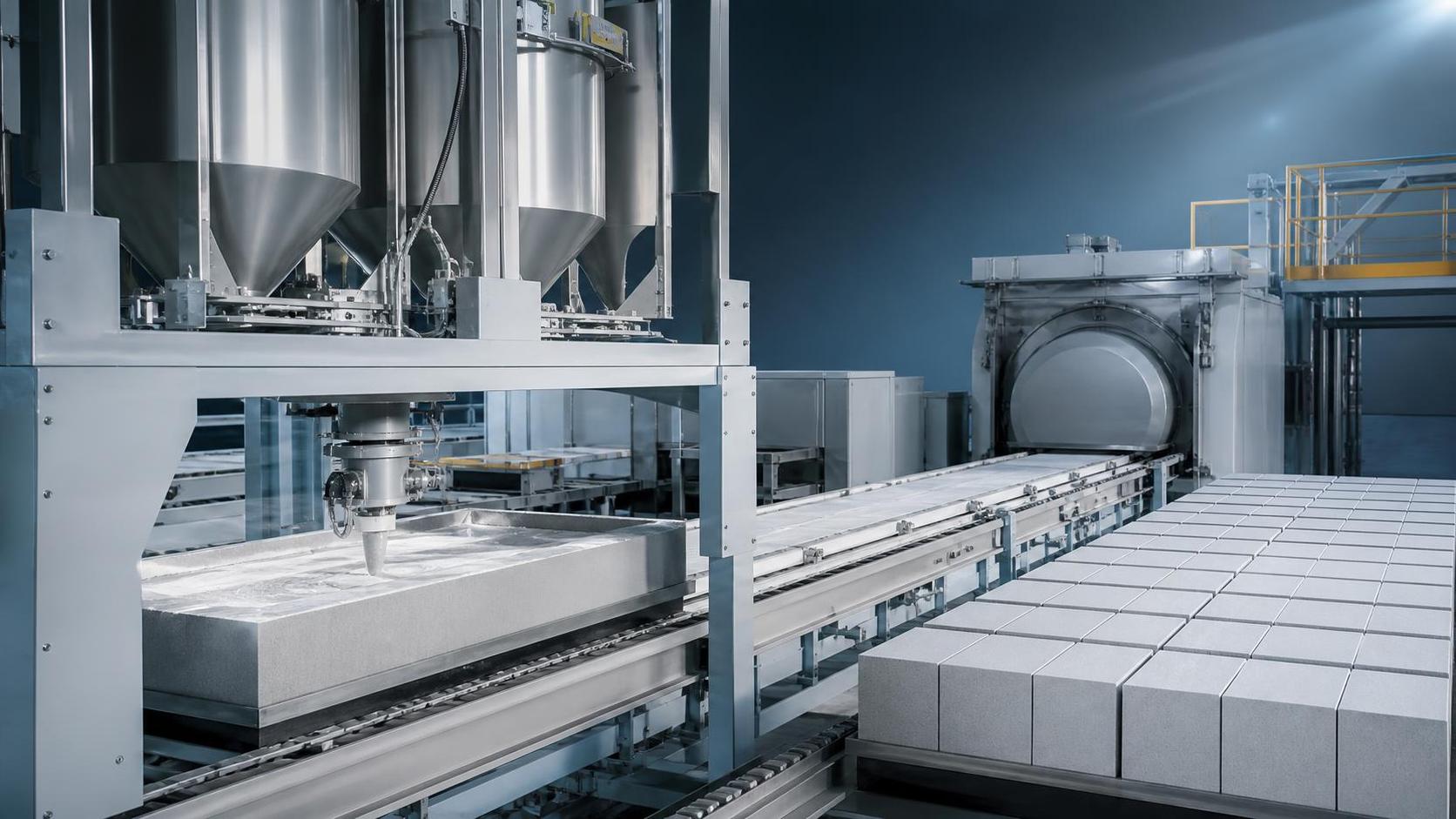
Autoclaving introduces heat, pressure, condensate, steam release, and loading logistics. The autoclave body itself may be procured from a specialist supplier, but the CE responsibility for the complete line still includes safe integration of door interlocks, loading rails, transfer trolleys, limit switches, and pressure status signals. A pressure-retaining vessel without a dependable interface to the loading machine can still leave the whole installation noncompliant as an assembled system. Door sealing, pressure confirmation before opening, condensate drainage, and lockout arrangements during maintenance should all be traceable in the technical file.
Documents usually expected for CE marking
The Declaration of Conformity is the visible end point, not the main body of work. What normally matters is the technical file behind it. For AAC equipment, that file often includes general arrangement drawings, electrical schematics, pneumatic and hydraulic diagrams, control descriptions, a risk assessment, relevant design calculations, and the list of standards applied. It should also identify safety components used in the system and explain how protective measures were selected when a hazard could not be designed out.
The instruction manual is frequently underestimated. For this kind of heavy industrial machinery, the manual should not stop at basic operation. It usually needs installation conditions, foundation requirements if relevant, utility interfaces, permissible ambient conditions, lubrication points, maintenance intervals, lockout procedures, residual risks, noise or heat warnings where applicable, and instructions for replacing wear parts such as cutting wires, seals, rollers, chains, and sensors. If a machine requires compressed air quality within a certain range, or steam pressure stability within a defined limit for safe cycling, those operating conditions should be stated clearly.
Language is another practical issue. The required language set depends on the destination member state. A technically good manual may still cause problems if warnings, labels, HMI messages, and maintenance instructions are not available in the language expected for installation and use. In AAC plants, where operator interaction includes manual cleaning, mold preparation, wire replacement, and autoclave area intervention, unclear translation can create direct safety exposure.
Testing and assessment are broader than factory no-load running
Many export projects rely on pre-shipment trials, but CE evidence usually needs more than a video of motors turning or cylinders extending. Functional safety checks should confirm that emergency stops remove hazardous motion in the intended way, guard doors generate the correct stop category, reset requires deliberate action, and faults in safety circuits are detected as designed. Where the line uses variable-frequency drives, PLC control, distributed I/O, and networked safety devices, the validation record should show that the actual machine behavior matches the safety concept.
Electrical conformity often includes verification of cabinet construction, conductor sizing, short-circuit protection, earthing, insulation, terminal identification, and enclosure suitability for the plant environment. AAC plants can be humid, dusty, alkaline, and thermally uneven. A cabinet suitable for a dry workshop may not perform the same way near slurry preparation, steam zones, or outdoor conveyor transfer points. Cable routing, gland sealing, and corrosion resistance deserve closer attention than generic CE templates usually give them.
EMC is also easy to dismiss until communication faults appear on site. Long motor cables, inverters, solenoid valves, load cells, and analog sensors in a noisy industrial setting can affect reliable control. When the system includes weighing modules, automatic dosing, wire position feedback, or encoder-based travel control, electromagnetic compatibility should be considered as part of machine reliability and safety, not as a separate paperwork exercise.
Where AAC equipment differs from simpler block machinery
Compared with a basic block machine, an AAC production line usually has longer process flow, more interlocked subsystems, and a wider spread of hazards. The material state changes from slurry to green cake to autoclaved product, and each stage alters the handling method. Fresh cake is fragile and unstable under poor support; cured blocks are heavier in cumulative stacked loads and move through sawing, packing, or transport sections with different collision risks. This means the CE file should reflect process-specific handling conditions instead of copying a standard document package used for unrelated concrete equipment.
The presence of steam curing is another major difference. A non-autoclaved line might focus mostly on moving machinery and electrical safety. AAC equipment adds pressure interfaces, hot condensate, thermal expansion, and maintenance access around insulated vessels and pipework. The layout around the autoclave zone matters: spacing for escape, guarding around transfer paths, anti-slip treatment near condensate areas, and safe access to valves, instruments, and service platforms are all relevant to conformity.
Common errors that delay export clearance
- Using CE marks from purchased components as if they covered the entire installed line.
- Issuing one declaration for a complex system without defining the exact equipment boundary, optional modules, and excluded utilities.
- Leaving the autoclave, steam valves, or pressure instrumentation outside the conformity review even though they are supplied together and function as one process unit.
- Providing manuals that describe operation in broad terms but omit lockout, wire replacement, mold cleaning access, or intervention during jam removal.
- Assuming that a successful trial run proves compliance, while electrical verification, guarding validation, and safety logic testing remain undocumented.
- Overlooking local installation effects such as foundation levelness, rail alignment, earthing quality, and steam line support, which may affect safe operation after assembly.
There is also a recurring confusion between “machine ready for export” and “machine ready for CE declaration.” AAC lines are often shipped in sections, then reassembled and commissioned on site. If protective devices, fencing, access platforms, field cabling, steam connections, or software logic are completed only after arrival, the conformity assessment may need to be finalized at the installation stage rather than entirely before shipment. That point should be resolved early in the contract and documentation plan.
Installed line, partly completed machinery, or separate machines
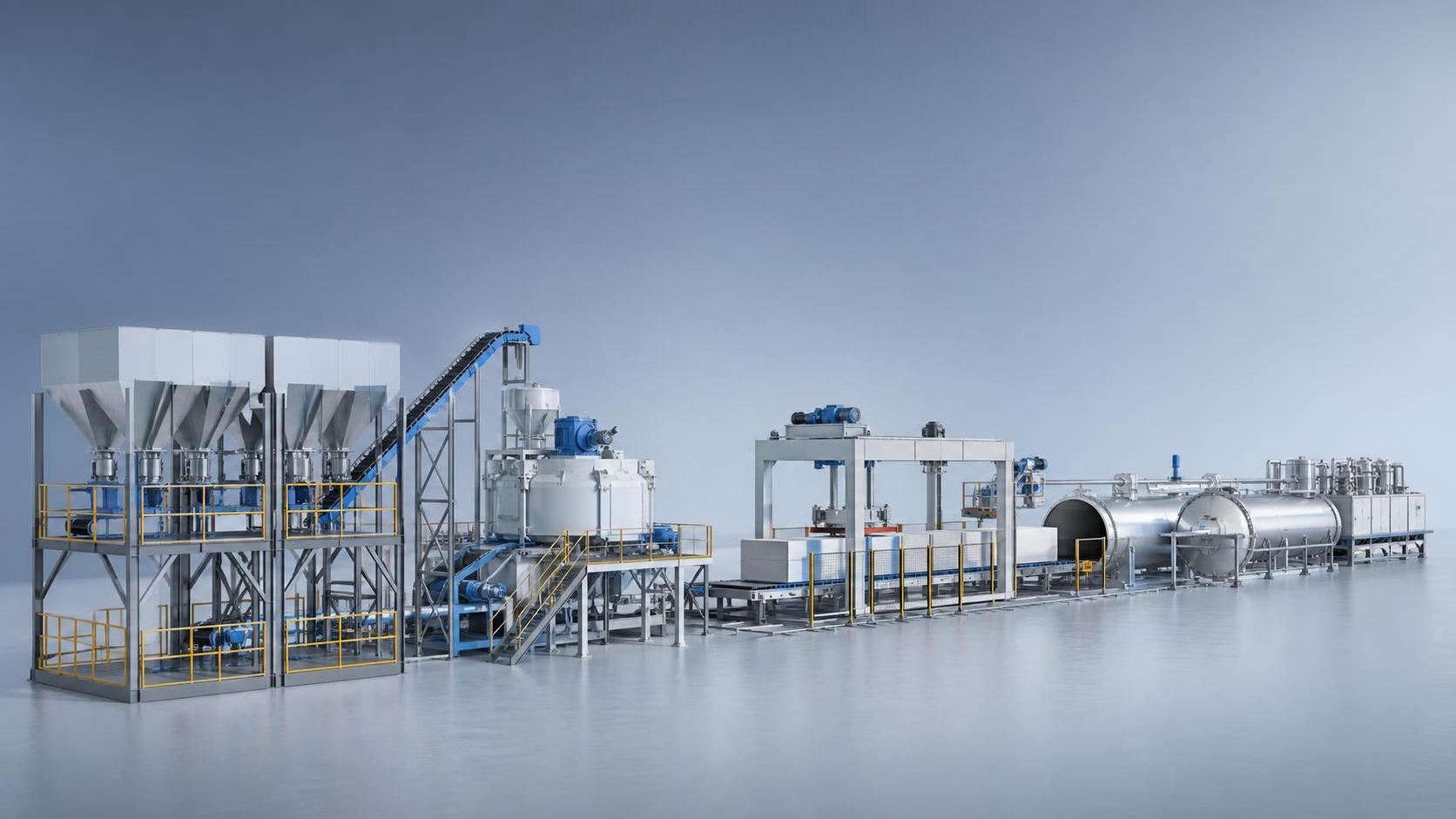
The export route can differ depending on whether the supply is treated as complete machinery, an assembly of linked machines, or partly completed machinery. A cutting machine sold as a stand-alone module with clear interfaces may follow one documentation path. A full AAC plant with mixers, casting, pre-curing, cutting, autoclave transfer, steam integration, and packing conveyors may require a broader system-level assessment. In some projects, certain sections are intentionally supplied as partly completed machinery because they cannot perform their intended function until incorporated into the final plant. In that case, the documentation package and declarations are different from those used for fully completed machinery.
That classification cannot be guessed from product names alone. It depends on functional independence, control integration, and whether the equipment can operate safely as delivered. A mold circulation station connected to a plant-wide PLC and dependent on remote safety fencing may not be documented the same way as a self-contained screw conveyor package.
Practical preparation before shipment
Well-prepared CE work for AAC equipment usually starts with a machine list that separates main process equipment, utility-related items, outsourced pressure parts, lifting devices, and excluded civil works. Then the electrical and mechanical boundaries are aligned with drawings, so there is no gap between what is sold, what is installed, and what is declared. This matters especially where site-fabricated steam pipes, local burners, customer-supplied boilers, or third-party packing systems connect to the exported line.
Serial number traceability should be consistent across nameplates, manuals, declarations, and test records. Safety labels need to match the real hazards present at each section: rotating shafts near slurry pumps, hot surfaces around steam branches, pinch points at mold return carriages, and suspended load zones near lifting beams. If stainless parts are used in corrosive or wet areas while carbon steel is used elsewhere, the maintenance instructions should distinguish them because coating repair, corrosion inspection, and fastener replacement intervals may differ.
Spare parts information is not a formal substitute for CE documentation, but it affects safe maintenance. Wire tension ranges, seal materials for steam service, bearing specifications near hot zones, and sensor type compatibility in dusty or humid conditions should be clearly identified. An incorrect replacement part can undermine the original conformity assumptions, particularly in guarding circuits, pressure service, or control feedback.
For 2026 exports, the core issue remains unchanged: the CE mark for AAC equipment is not a label to be attached after fabrication. It is the result of defining the machine boundary correctly, applying the relevant EU rules to the actual line configuration, validating safety functions, and documenting the hazards created by cutting, handling, pressure, heat, and automation in one connected process.
Recommend
 Sep 23, 2026
How automatic AAC production line stability affects block quality
Automatic AAC production line stability directly shapes block strength, density, and dimensions. Learn how tighter process control reduces defects, waste, and safety risks.
- Sep 23, 2026
What to check before buying autoclaved aerated concrete equipment
Autoclaved aerated concrete equipment buying guide: learn what to check on line balance, raw materials, energy use, maintenance, and support before choosing a reliable AAC solution.
- Sep 24, 2026
How to reduce downtime caused by worn AAC plant machinery
AAC plant machinery downtime can be cut by spotting wear early, prioritizing critical parts, and using smarter maintenance strategies to keep production stable and costs under control.