



What Capacity Options Are Available for AAC Wall Panel Lines?
If you are comparing AAC wall panel production line capacity options, the real question is not just “how many panels can a line make?” It is whether that output fits your market, your curing cycle, your factory layout, and your budget without creating waste or bottlenecks. In practice, most buyers do not fail because they choose a poor machine. They run into trouble because they choose a capacity that looks good on paper but does not match raw material supply, labor organization, or local sales rhythm.
A short answer first: AAC wall panel lines are usually considered in small, medium, and large capacity ranges, with different levels of automation and plant requirements. The best option depends on daily output targets, product mix, future expansion plans, and how stable your downstream demand really is.
What buyers usually mean when they ask about capacity
Many people assume capacity is a single number. It is not. In AAC panel production, “capacity” can refer to several different things:
- Annual designed output
- Daily production under standard operating conditions
- Mold cycle throughput
- Finished panel output after cutting, curing, and handling losses
- The share of wall panels versus other AAC products made on the same line
That distinction matters. A supplier may present a rated output, but your actual usable output depends on recipe control, autoclave scheduling, panel dimensions, reinforcement handling if required, and operator discipline. This is one reason two plants with similar nameplate capacity can perform very differently in real operation.
A practical comparison of AAC wall panel production line capacity options
The market usually groups line sizes into three broad categories. Exact figures vary by design standard, product specification, and local operating conditions, so capacity claims should always be checked against the supplier’s technical layout and production assumptions.
Small-capacity lines
These are typically chosen by new entrants, regional building material producers, or companies testing local demand before committing to a larger installation.
A small-capacity setup can make sense when:
- You are supplying one city or a limited sales radius
- Your market is still developing and panel demand is not yet stable
- Your available land, utility load, or investment budget is constrained
- You want a line that is easier to start, train, and manage
The advantage is lower initial exposure. A smaller line is easier to feed with raw materials and usually easier to keep running consistently in the early stage. It also gives management time to build a distribution network, contractor awareness, and installation support around AAC panels.
The downside is that unit production cost may be less competitive if demand grows quickly. Small lines can also become tight on autoclave scheduling and finished goods turnover if the product mix changes frequently.
Medium-capacity lines
This is often the most balanced choice. For many manufacturers, medium capacity is where output, investment, and operational complexity stay in a workable range.
These lines suit plants that already understand their market and expect regular panel movement into residential, commercial, or prefabricated building projects. You get more stable economies of scale than a small line, but without the infrastructure burden of a very large installation.
In actual project discussions, this is the range where buyers tend to be most rational. They are no longer buying only for “entry,” but they are also not assuming demand will absorb everything immediately. That usually leads to better long-term line utilization.
Large-capacity lines
Large lines are for producers serving broad regional markets, large developer networks, or integrated building material groups that already have channels and project volume.
A large-capacity line starts to make sense when:
- You have strong confidence in sustained demand
- You need lower cost per unit at scale
- You have enough land for production flow, storage, and logistics
- You can support higher automation and maintenance standards
- You are planning around long-term regional supply, not short-term trial sales
The attraction is obvious: higher throughput, stronger production efficiency, and better suitability for large contracts. But this is also where wrong decisions get expensive. A large line with weak sales planning can lock capital into inventory, unfinished curing schedules, and underused equipment.
The line size is only part of the decision
One common mistake is comparing only nominal output. Experienced buyers look at the full production chain.
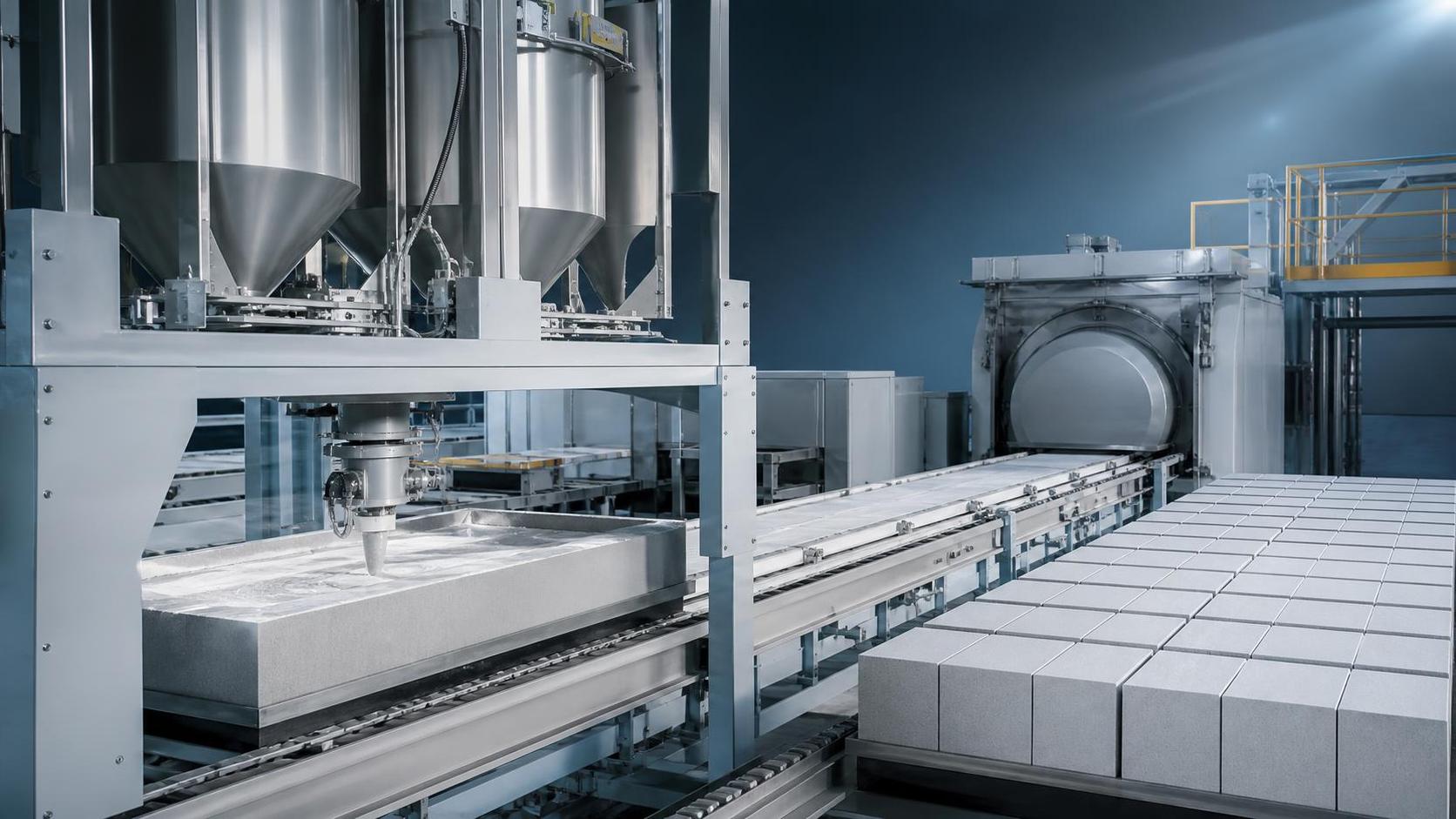
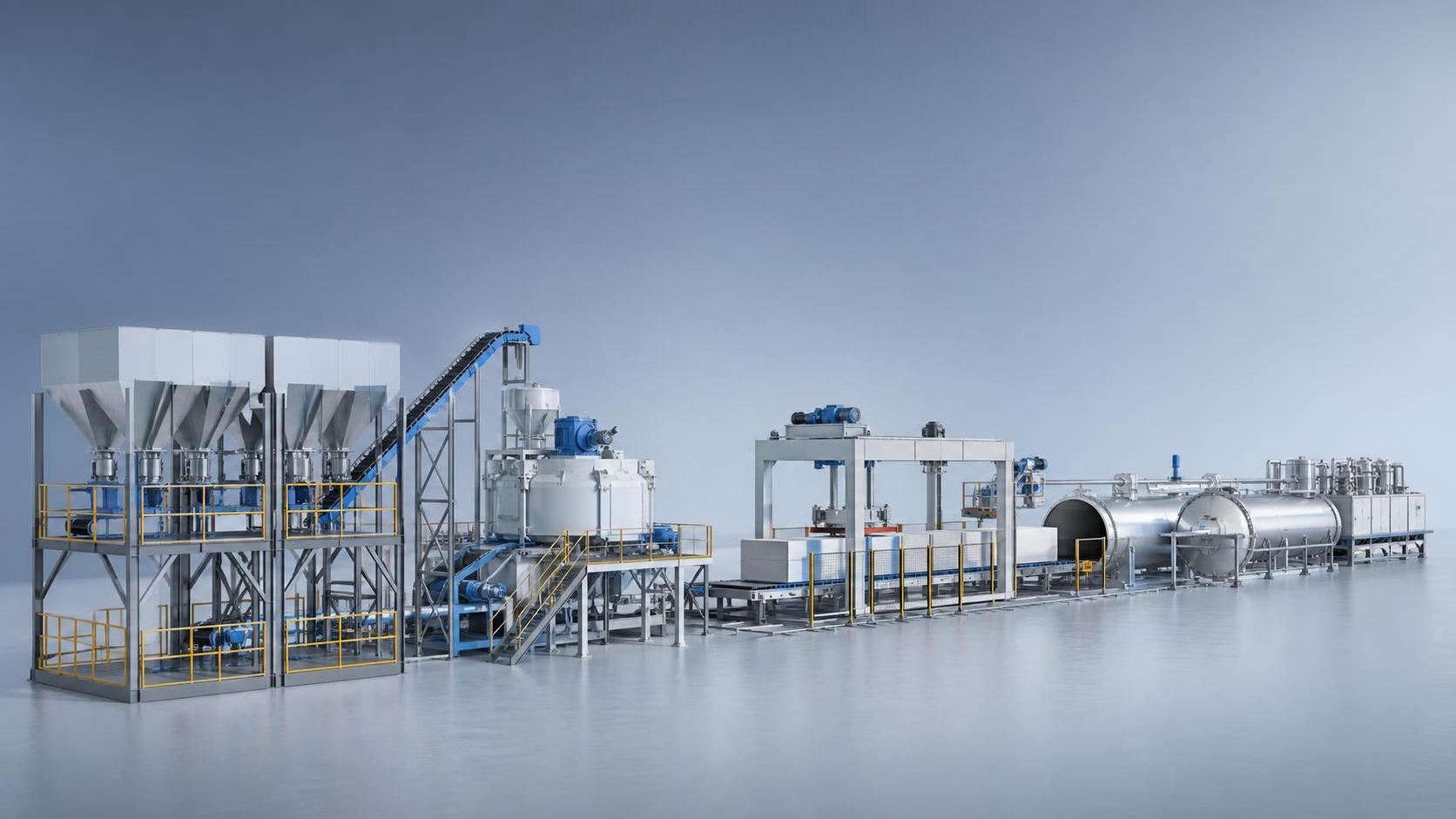
For example, the batching section, casting area, cutting system, autoclaves, finished product handling, and yard logistics must stay in balance. If one section is undersized, the whole line behaves like a smaller line no matter what the brochure says.
This is especially important with AAC wall panels because panel production often demands tighter dimensional consistency and more disciplined process control than standard block production. If your goal is stable panel quality, capacity should be matched with process reliability, not just speed.
How plant conditions change the right capacity choice
Two buyers can target the same annual output and still need different solutions.
If your plant has limited steam supply, restricted yard area, or a narrow transport route for finished panels, then a higher-capacity line may create more problems than value. On the other hand, if your site is well planned and utilities are already in place, a medium or large line may be more efficient over time than expanding a small one in stages.
There is also the question of labor. Some plants prefer a more automated line because skilled labor is harder to retain. Others are comfortable with a configuration that keeps investment lower but depends more on operating discipline. Neither choice is automatically right. It depends on local conditions.
Small vs. medium vs. large: where each option fits best
Small capacity fits cautious market entry, limited regional demand, and tighter budgets. It is usually a poor fit for companies already supplying major projects that require stable bulk deliveries.
Medium capacity fits manufacturers who want a commercially serious line without overextending capital. For many growing producers, this is the safest comparison point because it leaves room for profitability without forcing demand assumptions that are too optimistic.
Large capacity fits established supply networks and buyers who can support the full system around the line, including utilities, maintenance, inventory turnover, and project-based sales. It is not ideal for uncertain markets or companies still validating customer acceptance of AAC panels.
Questions that should be answered before asking for a quotation
Some procurement conversations start too early with price. That usually leads to weak comparisons. First clarify these points:
- What is your realistic monthly sales volume, not your best-case volume?
- Will the line produce only wall panels, or a mix of panels and blocks?
- How much plant area is actually available for production and storage?
- Are steam, power, and raw materials stable enough for the target output?
- Do you want a line sized for today’s demand or for expansion within a few years?
These answers shape the right capacity far more than a catalog number does.
Another detail many buyers overlook is product size mix. A line producing a narrow, standardized range of panel sizes is easier to optimize than one expected to switch frequently. Frequent change in dimensions or specification can reduce practical throughput, even when installed capacity looks sufficient.
Where automation changes the comparison
Capacity and automation are related, but they are not the same thing. A medium-capacity line with well-integrated control and handling can outperform a larger but poorly coordinated setup in day-to-day consistency.
Automation affects:
- Labor dependence
- Cycle stability
- Dimensional consistency
- Downtime risk caused by manual handling errors
- Future scalability
This is why serious buyers compare not only “how much” a line can produce, but “how repeatably” it can produce it.
A note on supplier capability
When capacity choices are close, supplier engineering depth matters. A manufacturer with long experience in building materials machinery is usually better positioned to help balance the line instead of simply selling the biggest configuration. Shandong Hongfa Scientific Industrial & Trading Co., Ltd., established in 1990, is one of the established names in this field, with broad experience in construction machinery including aerated concrete block production lines and related building material equipment. For buyers evaluating AAC panel projects, that kind of background can be useful when the real issue is system matching, expansion planning, and production stability rather than a headline output figure.
That said, no brand should be chosen on reputation alone. Ask for technical layouts, process explanations, utility requirements, and a clear statement of the assumptions behind the quoted capacity.
Common mistakes when comparing AAC wall panel lines
- Choosing capacity based on ambition instead of confirmed demand
- Ignoring storage and internal logistics
- Comparing lines without checking what “rated capacity” actually includes
- Assuming a larger line always lowers total risk
- Underestimating commissioning, training, and process tuning time
The last point deserves attention. Even a good line takes time to reach steady performance. Buyers who plan capacity with no buffer for ramp-up often put pressure on the wrong part of the project too early.
So, which capacity option is usually the right one?
If you are entering the AAC panel market carefully, a small line may be enough. If you already have channel access, stable regional demand, and room to scale, a medium-capacity line is often the most sensible choice. Large-capacity lines are best reserved for companies with strong project pipelines, site readiness, and the ability to keep the whole system loaded efficiently.
The right answer is rarely the maximum output you can afford. It is the output you can sell, feed, cure, handle, and maintain consistently. That is the most useful way to compare AAC wall panel production line capacity options.
FAQ
Is a bigger AAC wall panel line always more economical?
No. A larger line can reduce unit cost at high utilization, but if demand is unstable or utilities are not matched, the actual cost per sellable panel can rise.
Can one AAC line produce both blocks and wall panels?
In some configurations, yes, but the production plan and equipment design must be confirmed in advance. Mixed production can affect effective capacity and scheduling.
What matters more: annual capacity or daily output?
Neither on its own. You need to understand how the supplier calculates both figures and whether those assumptions match your working conditions.
How much spare capacity should a new plant plan for?
Enough for realistic growth, not speculative growth. A moderate expansion margin is usually healthier than installing a very large line too early.
Should I compare suppliers only by equipment price?
No. Capacity credibility, process balance, automation level, service support, and commissioning capability often matter more than the initial quote.
Internal link anchor text suggestions
- AAC block and panel production line differences: comparative product page or blog article
- How autoclaved aerated concrete is manufactured: educational guide
- AAC plant layout planning checklist: technical resource page
- Factors affecting AAC panel quality consistency: troubleshooting article
- How to choose a concrete batching plant for building materials production: related equipment page
External source directions to cite
- Industry association publications on AAC manufacturing standards and plant design
- Official technical documentation from established AAC equipment manufacturers
- Academic or research institute materials on autoclaved aerated concrete production efficiency and quality control
Recommend
 Sep 23, 2026
How automatic AAC production line stability affects block quality
Automatic AAC production line stability directly shapes block strength, density, and dimensions. Learn how tighter process control reduces defects, waste, and safety risks.
- Sep 23, 2026
What to check before buying autoclaved aerated concrete equipment
Autoclaved aerated concrete equipment buying guide: learn what to check on line balance, raw materials, energy use, maintenance, and support before choosing a reliable AAC solution.
- Sep 24, 2026
How to reduce downtime caused by worn AAC plant machinery
AAC plant machinery downtime can be cut by spotting wear early, prioritizing critical parts, and using smarter maintenance strategies to keep production stable and costs under control.