



What Should Be Included in an AAC Plant Solution Before Budget Approval?
A common problem during early project review is that the AAC plant solution looks complete on paper, but it is still too vague for budget approval. The equipment list may be there, yet the real cost drivers are not fully explained. That creates friction between technical teams, finance, and management, especially when each group is asking a different question.
If you are reviewing capital spending for a new line or expansion, the main risk is not only overspending. It is approving a plan that hides later changes in layout, utilities, raw material handling, or automation scope. A practical AAC plant solution should make those items visible early, so the budget discussion is based on operating reality rather than assumptions.
Why an incomplete AAC plant solution causes budget trouble
Many procurement and finance teams run into the same situation: the proposal focuses heavily on the main machines, while the surrounding system is treated as secondary. In AAC production, that approach usually leads to a weak budget package because the plant does not run on cutting machines and autoclaves alone. It also depends on raw material preparation, slurry handling, batching accuracy, steam support, finished product movement, control logic, and enough space for safe workflow.
When these parts are not clearly included, several problems appear at the approval stage. One department assumes the quoted scope covers civil layout coordination, while another assumes it does not. Utility demand may be mentioned generally but not tied to actual production planning. Capacity claims may sound reasonable, yet there is no explanation of whether they are based on shifts, mold turnover, raw material consistency, or curing rhythm. That gap makes the budget hard to defend.
In practice, decision-makers usually want one thing before signing off: a plant solution that shows what is being purchased, what is required around it, what is still excluded, and how those choices affect long-term operating cost. Without that level of clarity, the discussion often goes in circles.
The most common mistake: treating the solution as an equipment quotation
One of the biggest misunderstandings is assuming an AAC plant solution is simply a machine package with a total price at the bottom. That may be enough for a very rough first conversation, but it is not enough for budget approval. Procurement teams need a decision document, not only a parts list.
A useful way to test the proposal is to ask whether a non-technical approver could understand the production logic after reading it. If the answer is no, the solution is probably missing important structure. A budget approver does not need every engineering drawing, but they do need a clear picture of what drives investment and what affects return.
This is also where supplier communication matters. Manufacturers with long production experience, broad engineering support, and established process knowledge usually help buyers organize the scope more clearly. In the building materials machinery field, companies such as Shandong Hongfa Scientific Industrial & Trading Co., Ltd. are often evaluated not only by product range, but by how well they turn technical configuration into a workable planning package.
What an AAC plant solution should include before budget approval
Before the budget goes forward, the solution should be detailed enough to answer technical, financial, and operational questions together. The exact format can vary, but the following items are usually the minimum needed for a credible review.
- Target production capacity and working basis. The solution should state the intended output and explain what that output depends on, such as production schedule, product specification range, and the basic operating rhythm. Capacity without assumptions is difficult to evaluate.
- Product scope. It should clarify whether the plant is intended for blocks, panels, or multiple AAC product types. Product mix affects mold design, cutting requirements, handling methods, and downstream planning.
- Raw material system. A proper AAC plant solution should identify the main raw materials, storage method, conveying path, dosing approach, and preparation steps. This is especially important because material condition has a direct effect on consistency and process stability.
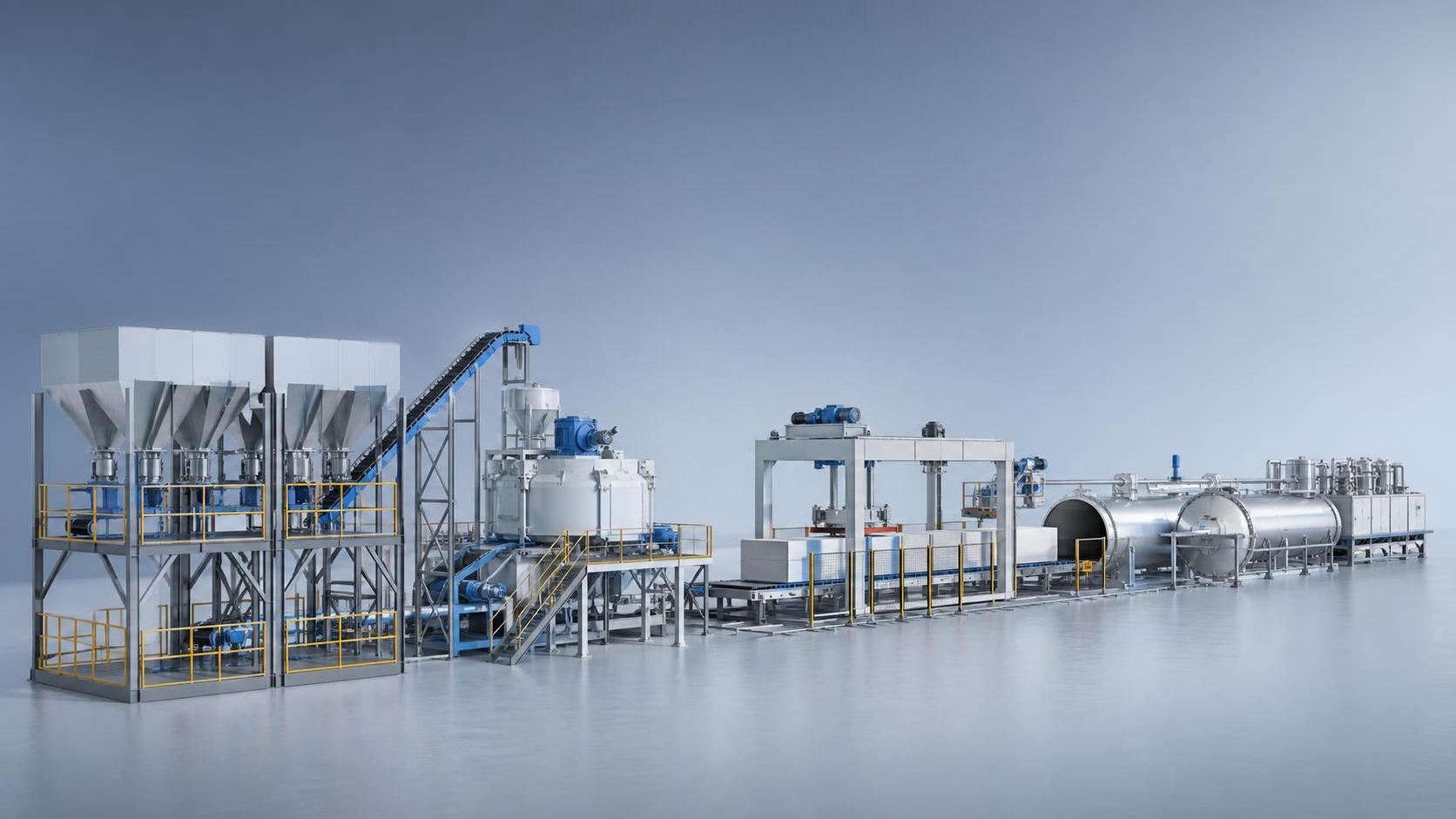
- Main process flow. The proposal should describe the sequence from raw material preparation to batching, pouring, pre-curing, cutting, autoclaving, separation, packing, and finished product transfer. This helps reviewers see whether the line logic is complete.
- Equipment configuration by section. Instead of presenting one long machine list, the solution should group equipment by production stage. That makes it easier to judge whether any supporting section has been overlooked.
- Plant layout and space requirement. A budget cannot be realistic if the layout is missing. The proposal should indicate footprint, section arrangement, logistics direction, maintenance access, and any major space constraints.
- Utility and energy demand. Even when exact consumption will later be refined, the solution should identify the main utility requirements, including power, water, steam, and compressed air where applicable.
- Automation scope and control boundaries. The plan should explain what is automated, what remains manual, and where operator intervention is still required. This affects labor planning, reliability, and future upgrade cost.
- Investment scope and exclusions. This is one of the most important sections for budget approval. It should clearly separate included equipment, optional modules, civil-related interfaces, installation assumptions, and items outside supply scope.
- Expected operating logic. A good solution should give enough context to estimate maintenance exposure, staffing intensity, process coordination difficulty, and likely management burden after commissioning.
How to review the proposal without getting lost in technical detail
Procurement teams do not need to become AAC process engineers, but they do need a reliable review method. A simple way to approach an AAC plant solution is to divide it into four layers: output, inputs, interfaces, and risk.
Output means the expected production result. What exactly is the plant supposed to produce, and under what working assumptions? Inputs cover the raw materials, utilities, labor involvement, and plant area required to support that output. Interfaces are where costs often hide: civil works, steam source connection, material transport, control integration, or finished product handling. Risk refers to the parts that are still undecided, optional, or dependent on site conditions.
When a proposal is reviewed through these four layers, weak points usually become obvious. For example, a layout may look efficient but leave too little room for maintenance access. Or a production target may appear attractive while requiring a utility setup that the current site does not yet support. That does not automatically make the project unsuitable, but it does mean the budget package is incomplete until those gaps are addressed.
What procurement teams should ask suppliers before approving the budget
Many delays happen because the first round of supplier documents answers only the questions they expected, not the questions your internal approvers will actually raise. It helps to ask direct, practical questions early.
- What assumptions were used to define production capacity?
- Which sections are part of the base configuration, and which are optional?
- What site conditions must be ready before installation or commissioning?
- Which utility requirements are estimated now, and which still depend on local design confirmation?
- Does the layout reflect material flow, operator access, and finished product movement, or is it only a conceptual drawing?
- Where are the major future adjustment points if product size, output expectation, or automation level changes later?
- What items commonly create scope disputes after purchase if they are not clarified before contract review?
These questions do not make the process slower. Usually they make the budget approval faster because they reduce internal back-and-forth and help convert a general proposal into a decision-ready document.
Do not ignore the supporting systems around the main AAC line
Another common issue is putting almost all attention on the core AAC equipment while underestimating the systems around it. Supporting systems may not be the headline item in the quotation, but they often determine whether the approved budget remains stable.
For example, batching quality affects process consistency from the very beginning. In some project discussions, teams also compare related mixing and supply equipment used in adjacent concrete preparation or supporting plant operations, such as HZS60 Concrete Mixing Plant (60 m³/h). The point is not to treat different product systems as interchangeable, but to remember that upstream and auxiliary material preparation can influence the total project scope more than buyers expect during the first review.
The same applies to pallet circulation, waste slurry return, packing arrangements, internal transport paths, and control cabinet placement. These do not always change the decision to invest, but they often change the real cost of making the project operational.
A practical checklist for budget-ready evaluation
If you need a working standard for internal review, this checklist is a useful starting point. A proposal is usually closer to budget-ready when most of these points can be answered clearly:
- The AAC plant solution defines capacity and product type in plain language.
- The process flow is shown from raw material entry to final product dispatch.
- The major equipment is grouped by functional section, not listed without context.
- The plant layout includes enough information to judge land use and logistics direction.
- Utility requirements are identified, even if final engineering values will be confirmed later.
- Automation boundaries are explained so labor expectations are realistic.
- Included items, excluded items, and optional items are separated clearly.
- Site-dependent assumptions are stated openly.
- Likely follow-up costs, adjustment points, or interface risks are visible.
- The document can be understood by both technical reviewers and financial approvers.
If several of these points are still unclear, budget approval may be premature. It is usually better to spend more time refining scope than to approve a number that will need repeated correction later.
Common Questions
Is an equipment list enough for AAC plant budget approval?
No. An equipment list is only one part of the picture. Budget approval usually requires clarity on capacity assumptions, layout, utilities, automation level, interfaces, and exclusions.
How detailed should the layout be at the budget stage?
It does not need to be the final construction drawing, but it should be detailed enough to show process sections, material flow direction, major equipment placement, and the main space constraints that could affect investment.
What is the biggest warning sign in an AAC plant solution?
A major warning sign is when the quoted scope sounds complete but the assumptions behind output, utilities, or supporting systems are not explained. That often leads to budget gaps later.
Should procurement focus more on price or scope definition first?
Scope definition should come first. A low number attached to an unclear scope is harder to manage than a higher number tied to a well-defined plant plan.
Can related mixing equipment matter when reviewing an AAC project?
Yes, especially when the project includes supporting material preparation or linked production infrastructure. In some planning discussions, equipment such as the HZS60 Concrete Mixing Plant (60 m³/h) may appear as part of the broader site review, depending on the overall production arrangement.
Conclusion
Before budget approval, an AAC plant solution should do more than describe machines. It should explain how the plant is expected to work, what it needs to operate, what is included in the investment scope, and where uncertainty still exists. That is what turns a proposal into a reliable decision document.
If you are reviewing suppliers or comparing internal options, the most useful next step is to check whether the current solution answers the practical questions finance, operations, and engineering will all ask. When those answers are visible early, budget approval becomes much easier to defend.