

AAC plant technical training that helps operators avoid startup errors
A successful AAC plant startup is decided before the first batch reaches the mixer. Most early failures are not caused by a single major fault. They begin with small mismatches: a scale that has not returned to zero, slurry prepared at an unexpected temperature, a valve left in manual mode, a cutting-wire frame that has not been aligned after maintenance, or a control sequence started while a downstream conveyor is unavailable. Technical training should turn these points into repeatable decisions rather than assumptions made under production pressure.
The most useful training connects each machine action to the condition it creates in the next process. Aerated concrete production is a linked system. A material deviation at batching can become an expansion problem in the mould, an unstable green cake at cutting, or dimensional variation after autoclaving. Treating each station as an isolated machine encourages startup errors because a local reading may appear acceptable while the process as a whole is already drifting.
Start with the line condition, not the start button
Before energizing the production sequence, the line needs a confirmed physical state. Training should distinguish between an inspection that verifies presence and an inspection that verifies readiness. Seeing that a pump, conveyor, mould, or valve is in place is not enough. The relevant question is whether it is clean, connected, lubricated where required, free to move, and set to the correct initial position.
For example, a slurry transfer pump may rotate normally during a brief jog test while its suction path is partly restricted by settled material. When the batch is released, the pump then loses stable flow, and the actual mould-fill volume differs from the recipe value. Likewise, a mould can be correctly positioned on the casting line but still carry hardened residue around the sealing surfaces. That residue may affect filling behavior or make subsequent stripping less consistent.
A practical pre-start routine follows product flow rather than a random walk around the workshop. Begin at raw-material preparation, continue through batching and mixing, then casting, pre-curing, demoulding, cutting, grouping, autoclave loading, and finished-product handling. At each point, confirm that the next machine is available before the upstream machine is permitted to create material. This avoids a common startup error: producing a slurry batch or green cake before the receiving stage is genuinely ready.
- Material bins should contain the intended materials, with no unresolved carryover from a prior recipe or cleaning operation.
- Agitators, slurry tanks, and pipework require attention to sediment, because settled solids can alter the first batch more than later batches.
- Moulds need both mechanical inspection and release-agent verification. Excess release agent can contaminate surfaces; insufficient or uneven application may complicate stripping.
- Conveyors, transfer tables, and lifting devices must complete their travel without interference, especially after adjustments to guides, stops, sensors, or mechanical guards.
- Emergency stops and safety interlocks should be functionally verified through the plant's approved procedure, then restored before production begins.
Training is stronger when it requires the reason behind each check. A person who understands that a blocked slurry return line can distort solids concentration is better able to recognize the warning signs than someone who only knows that a valve must be open.
Material preparation is where the first batch is often lost
AAC mixes are sensitive to the relationship among solids, water, temperature, and gas-forming addition. Startup training should therefore avoid reducing material preparation to recipe entry. A correct recipe does not guarantee a correct mix when raw materials have changed condition during storage, when a tank has stratified, or when moisture content differs from the value assumed during batching.
Fine silica-bearing material, cementitious materials, lime, gypsum, recycled slurry, water, and aluminum paste or powder each affect the process differently. The immediate concern is not simply whether the right ingredient is present. It is whether it is delivered in a form that permits predictable mixing and expansion. A slurry that is too dense may appear normal when viewed in the tank but impose a different water balance at the mixer. A mixture that is too cool or too warm can change the timing between casting and cutting. The same observed defect, such as a weak green cake, may arise from poor material dispersion, unsuitable temperature, delayed casting, or an inconsistent aluminum addition. Training should prevent premature conclusions based on one symptom.
The first batch after an extended shutdown deserves special attention. Recirculated slurry may have settled. Water retained in a line may be different from the process water used for the main batch. Dry ingredients can bridge in a bin, allowing a feeder to run without delivering the expected mass. A feeder speed display alone cannot prove material flow. Where the equipment design permits, batch records, load-cell behavior, and physical discharge observation should be considered together.
Recipe values need process context
Recipe control is essential, but several values are often read in isolation. A target weight may be reached while the actual material is wrong because of bin selection error. A mixer timer may expire even when a material has not dispersed because the load condition changed. A slurry temperature reading may be valid at the sensor location but fail to represent a poorly mixed tank. Training should emphasize cross-checking values that ought to agree: selected bin against material identification, feeder activity against weight change, mixer load against expected consistency, and mould-fill behavior against batch volume.
Aluminum addition deserves controlled handling because its timing influences expansion behavior. Introducing it too early, too late, or with poor dispersion can produce a cake that rises unevenly. Attempts to correct this by changing only one downstream setting often create further variation. When expansion is abnormal, the response should begin by preserving the batch data and reviewing the sequence of actual additions, temperatures, mixing conditions, and transfer delay. Disposal or rework decisions should follow the plant's established quality procedure rather than an improvised correction.
Control-system training must include sequence logic
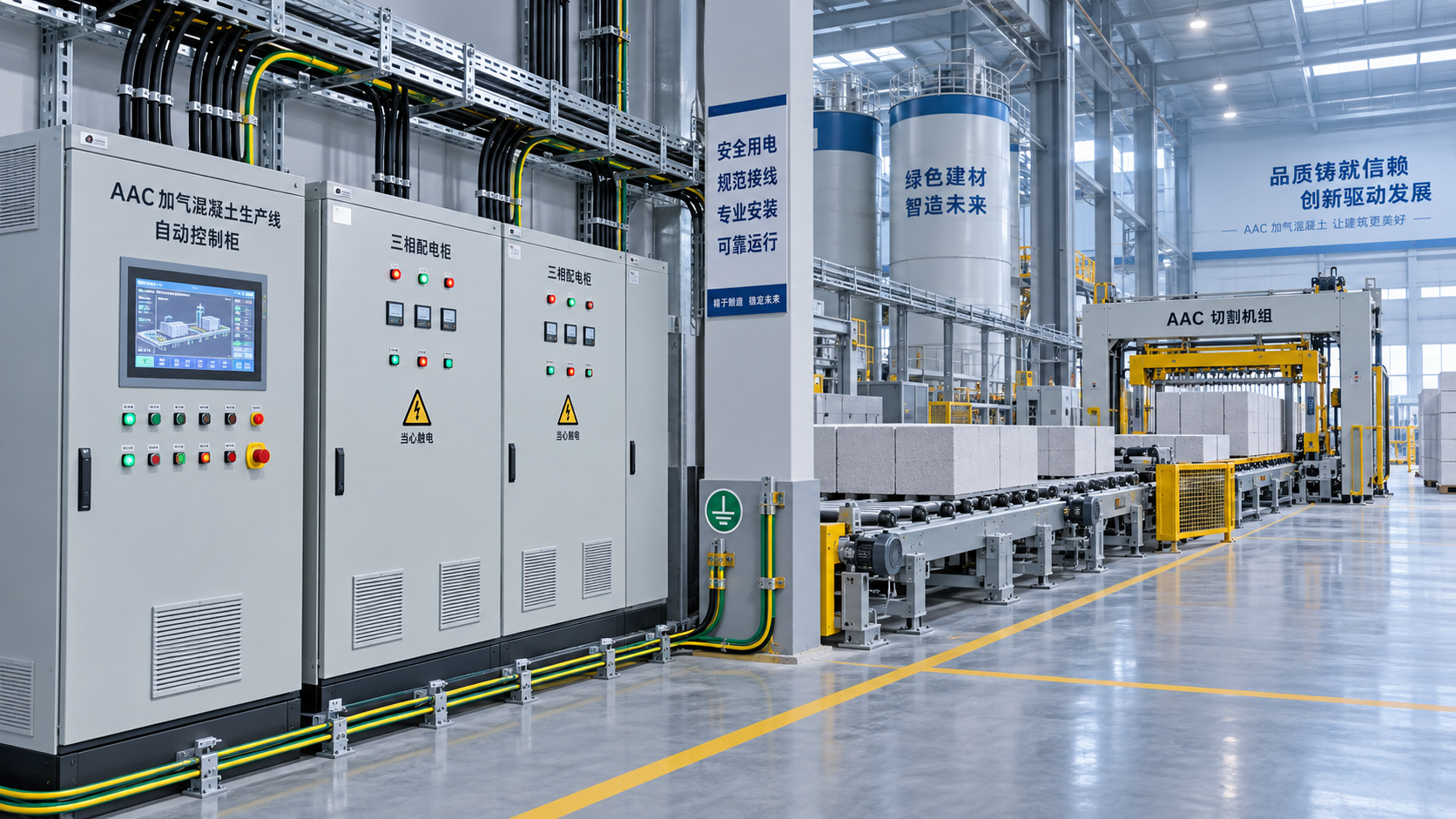
Human-machine interface screens can create false confidence. A green status indicator may mean that a device has electrical power, no active alarm, or permission to run; it does not always confirm successful process performance. Technical training should explain the exact meaning of common statuses, alarms, permissives, hand/auto selections, and command acknowledgements on the installed control system.
Manual mode is particularly important during commissioning, cleaning, maintenance recovery, and fault investigation. It is useful for testing individual motion, but it can bypass the normal sequence protections that keep equipment synchronized. A transfer table moved manually may leave a mould outside the position expected by automatic control. A valve opened for flushing may remain open when a recipe starts. A pump run manually may prime a line but also move material into an unintended destination. The return to automatic operation should therefore include confirmation of actual equipment position, not merely changing the selector on the screen.
A sound training exercise uses controlled, safe scenarios to show how sequences stop and recover. The purpose is not to make alarm handling faster by memorizing reset actions. It is to establish a disciplined order: secure the equipment, identify the failed condition, correct the physical or control cause, verify positions and material status, then restart from the approved point in the sequence.
Cutting quality begins before the cutting machine
When a green cake tears, drags, cracks, or produces inconsistent dimensions, attention often moves immediately to wires and drive settings. Those components matter, but they are only part of the diagnosis. Green-cake strength, pre-curing time, expansion completion, mould condition, and transfer stability can all influence cutting behavior. Training should make clear that a clean wire is not proof that the cake is ready to cut.
Timing is especially sensitive. Cutting too early can deform a cake that has not developed enough stability. Waiting too long can increase resistance and make wire passage less clean. The appropriate window is tied to actual material behavior and the plant's established process parameters, rather than a fixed elapsed time copied from another raw-material condition. Changes in ambient temperature, slurry temperature, or ingredient properties may shift the observed behavior even if the nominal schedule remains unchanged.
Mechanical alignment also needs a practical interpretation. Wire tension, frame alignment, mould positioning, and travel smoothness should be assessed as a system. Replacing one broken wire without checking adjacent wire tension and guide condition can leave the cutting grid uneven. If a dimensional deviation repeats at the same location on consecutive cakes, investigate fixed references such as guides, stops, encoder feedback, mould squareness, and wire-frame geometry before adjusting the recipe.
Autoclave preparation requires disciplined handover
Autoclaving is not a corrective stage for unstable cutting or poor green-cake quality. Loading damaged or poorly grouped material into the autoclave can increase breakage and complicate unloading. Before loading, confirm that the product arrangement permits stable support and that the transport equipment, doors, sealing surfaces, and rail path are ready for the intended movement.
Steam treatment must follow the approved process curve for the product and equipment. Training should explain why uncontrolled changes to pressure, heating rate, holding time, or cooling behavior are not suitable responses to an upstream quality issue. Thermal treatment affects product development, but it cannot reliably compensate for a batch with incorrect composition, incomplete expansion, or major cutting damage. Abrupt changes may also place unnecessary stress on equipment and product.
The handover between casting, cutting, and autoclaving should preserve traceability. When a defect is found after curing, the team needs enough information to connect it to the relevant mould, batch, mixing time, material condition, cutting event, and autoclave cycle. A short, accurate record is more useful than a long narrative entered after the shift. The record should capture deviations when they occur, including manual interventions and alarms that were reset.
Fault finding should separate symptom from cause
Repeated resetting is one of the costliest startup habits because it hides information. An intermittent level alarm, for example, can come from a genuine low level, a fouled sensor, unstable material surface, loose connection, or incorrect scaling. Resetting may restore operation temporarily while allowing the same issue to recur under a more difficult condition.
Training should encourage evidence-based fault finding. Start with the last confirmed normal condition and identify what changed: material source, cleaning activity, maintenance work, recipe selection, manual operation, utility interruption, or an abnormal sequence stop. Then compare the control indication with the physical process. If they disagree, the discrepancy itself becomes the priority. A tank shown as full while visibly empty points toward instrumentation or signal logic; a tank that is physically full but shown as empty may indicate a sensor, wiring, or configuration issue. Neither condition should be corrected by assuming the display is right.
Good startup performance comes from controlled repetition. The sequence should be run in the same verified order, with deviations recorded and reviewed before they become routine workarounds. When material condition, machine position, control logic, and downstream readiness are treated as connected conditions, the first production cycles become a confirmation of process control rather than an expensive trial run.
Recommend
 Sep 30, 2026
When does an automated building material production line pay off?
Automated building material production line ROI explained: assess capacity, quality, labor, waste, and total costs to make a profitable investment.
- Oct 01, 2026
How a green building material production line reduces material waste
Discover how a green building material production line cuts waste through precise batching, controlled forming, stable curing, and smart material recovery.
- Oct 02, 2026
What to confirm before finalizing AAC factory planning
AAC factory planning: confirm product mix, raw materials, capacity, utilities, layout, automation, and supplier scope before investing in a reliable, efficient AAC plant.