



Can an AAC Line Use Local Industrial Waste as Raw Material?
In many industrial regions, the same question comes up whenever a new autoclaved aerated concrete project is being planned: Can a green building material line use local industrial waste? The short answer is yes—provided that the material is suitable, stable enough to control, and incorporated through a properly engineered AAC mix design.
An AAC line does not simply “consume waste.” It converts selected mineral by-products into a controlled porous concrete product through grinding, batching, slurry preparation, pre-curing, cutting, and high-pressure steam curing. That distinction matters. A nearby ash pond, steel plant, power station, or mining operation may offer a valuable raw-material source, but proximity alone does not make a material usable.
For plant investors, local authorities, and building-material producers, the appeal is clear. Suitable industrial residues may reduce landfill pressure, shorten raw-material transport routes, and replace part of the virgin silica normally required for AAC blocks or panels. Yet the decision should be based on laboratory evidence and production trials—not on the name of the waste stream.
Which Industrial By-Products Can Be Used in an AAC Line?
Fly ash is the most widely recognized alternative raw material for fly ash AAC production. When its chemical composition and fineness are appropriate, it can supply much of the silica and alumina needed in the AAC slurry. This is why coal fly ash has been used for decades in many aerated concrete plants.
Other locally available materials may also be considered, depending on their properties and the intended product:
- Ground granulated blast-furnace slag: A steel-industry by-product with useful cementitious potential, often used as part of a balanced mineral system rather than as a direct one-for-one replacement.
- Silica-rich tailings or mine waste: These may be relevant where quartz content is high and the material can be processed to a suitable particle size.
- Stone-cutting sludge and silica dust: Some residues from quarrying, sand processing, or engineered-stone production contain usable silica, although moisture and particle distribution require attention.
- Bottom ash or pond ash: These materials can sometimes be upgraded, screened, dried, or milled before use, but their variability is often greater than that of fresh fly ash.
- Selected metallurgical or mineral-processing residues: Use is possible only after careful assessment of chemistry, expansion behavior, and environmental compliance.
Not every powder-like industrial residue belongs in an autoclaved aerated concrete block production line. Materials with excessive organic matter, unstable free lime, harmful soluble salts, high carbon content, or uncontrolled contaminants can disrupt the process and create avoidable quality risks.
The Real Question Is Not “Is It Waste?” but “Is It Consistent?”
AAC production is sensitive to the interaction between silica-bearing material, lime, cement or other binders, gypsum where applicable, water, and aluminum powder or paste. The aluminum reaction generates hydrogen, forming the characteristic pores in the green cake. After autoclaving, calcium silicate hydrate phases—especially tobermorite under suitable conditions—give AAC its lightweight yet functional structure.
When a local industrial by-product changes from one delivery to the next, the entire balance can shift. A small variation in fineness, moisture, reactive silica, calcium content, or loss on ignition may affect slurry viscosity, expansion rate, cake strength, cutting quality, and final compressive performance.
That is why a project team should ask a supplier more specific questions:
- Does the material come from one stable production source or several changing sources?
- Is there a reliable history of chemical and physical test data?
- How much does moisture vary during storage and transport?
- Can the material be milled to the required fineness economically?
- Are chloride, sulfate, heavy metal, unburned carbon, or organic-content levels within acceptable limits for the intended market and standard?
- Will the available volume support continuous AAC plant operation, not merely a short trial run?
A material can be environmentally attractive and still be commercially impractical if it requires too much drying, sorting, blending, or corrective additive. Good AAC economics come from a dependable raw-material system, not just a low purchase price.
How a Local-Waste AAC Feasibility Study Should Be Carried Out
The most reliable approach begins before equipment selection. Producers sometimes choose a production line based on a nominal annual capacity, then discover that their local ash or tailings require additional preparation equipment that was never included in the original layout. A feasibility study should connect the material, process, product specification, and equipment configuration from the beginning.
1. Sample across time, not only once
One laboratory sample can look promising while hiding seasonal or operational variation. Collect representative samples over different batches and, where possible, different months. This is especially important for stockpiled ash, pond ash, mixed industrial residues, and materials recovered from legacy disposal sites.
2. Test the properties that affect both chemistry and handling
Chemical analysis is necessary, but it is not enough. The assessment should include particle-size distribution, specific surface area or grindability, moisture, density, mineral composition, loss on ignition, and behavior in slurry. For some waste sources, leaching and environmental tests may also be needed to meet local regulations and customer expectations.
The goal is to understand what the material will do inside the process—not simply to assign it a chemical label.
3. Develop a trial mix before finalizing the plant design
Laboratory and pilot tests help determine how much of the local material can be used, what grinding fineness is required, and whether adjustments are needed in lime, cement, gypsum, water, or aluminum dosage. The target is not the highest possible waste replacement ratio at any cost. The target is a repeatable formula that provides workable slurry, stable expansion, clean cutting, reliable autoclave performance, and finished products that meet the required density and strength class.
4. Match the equipment to the material
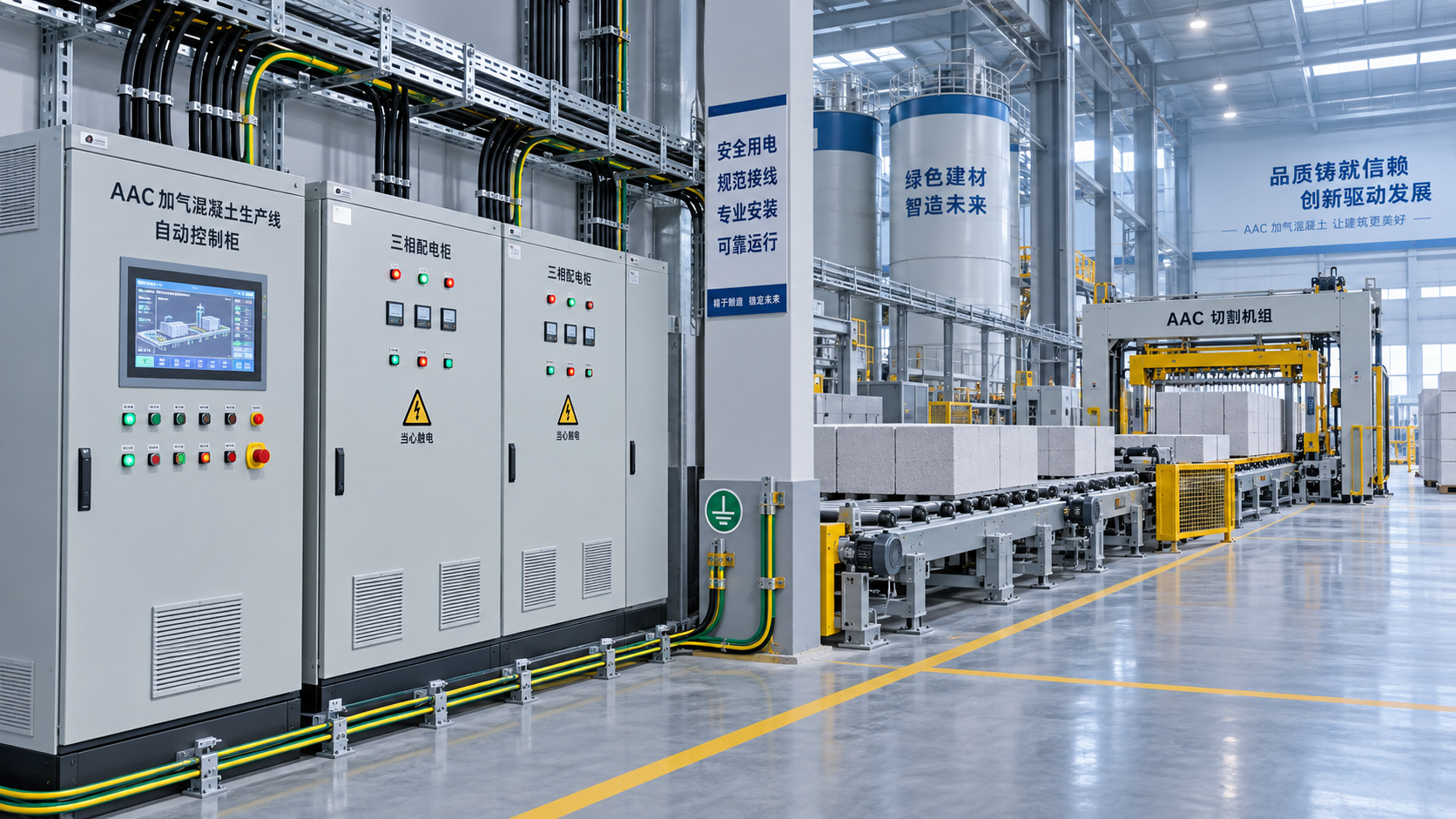
AAC equipment should be selected around the actual feedstock condition. Wet fly ash may need slurry storage and agitation. Dry, coarse mineral residues may require crushing, conveying, milling, and powder storage. Variable raw materials may justify separate bins, weighing systems, moisture measurement, and controlled blending capability.
In other words, raw-material flexibility is created by a combination of process design and automation. It is not achieved simply by adding more materials to the mixer.
What Changes in the AAC Production Process?
The core stages remain familiar: raw-material preparation, batching, mixing, casting, pre-curing, demolding, cutting, autoclaving, and finished-product handling. However, local industrial waste may change the operating window at several points.
Grinding and slurry preparation often become more important. A coarse silica-rich residue may be chemically suitable but still produce poor AAC if it is not ground finely enough. Conversely, an extremely fine powder can affect water demand and slurry rheology. Storage systems must also prevent segregation, caking, or excessive moisture pickup.
Batching accuracy becomes critical when material moisture fluctuates. If wet ash is dosed by nominal weight without compensation, the actual solids and water balance can drift. Automated weighing, consistent slurry density control, and routine operator checks are practical safeguards.
Pre-curing and cutting may require adjustment because the green cake develops strength differently when the mineral composition changes. Cutting too early can damage edges and wires; cutting too late can increase resistance and reduce dimensional precision. The plant needs a process window that operators can monitor and repeat.
Autoclaving is where earlier decisions show up in the final product. A well-designed mix should react predictably under steam curing conditions. If the mineral system is poorly balanced, the result may be weak blocks, inconsistent density, shrinkage concerns, or a product surface that does not meet customer expectations.
Common Misunderstandings About Using Industrial Waste
“Any fly ash works for AAC.” This is too broad. Fly ash quality differs by coal source, combustion technology, collection method, storage condition, and contamination. Fresh, classified fly ash and aged, mixed pond ash should not be treated as identical inputs.
“More waste content automatically means greener production.” A higher replacement ratio may sound impressive, but it is not automatically better if it creates excessive energy use for drying and grinding, increases rejected blocks, or demands large quantities of corrective chemicals. A sound environmental outcome considers the whole production system.
“The plant can solve any raw-material problem after installation.” Equipment has limits. A well-built AAC line can provide accurate batching, grinding, mixing, cutting, and curing control, but it cannot turn a severely unstable or unsuitable residue into a dependable construction product without proper preprocessing and formulation.
“Local supply means secure supply.” A nearby source can still disappear when an industrial plant changes fuel, upgrades its process, lowers output, or begins selling the by-product to another market. Long-term supply agreements and alternative-source planning remain important.
When Local Industrial Waste Is a Strong Fit
Using local by-products is most compelling when three conditions come together: the material has a stable usable composition, the source is close enough to offer a logistics advantage, and the regional market values lightweight, thermally efficient wall materials.
This combination is particularly relevant in areas with active power generation, metallurgy, mining, stone processing, or large-scale industrial development. Instead of moving virgin sand over long distances while sending mineral residues to disposal sites, a producer may establish a more circular material flow around an AAC block or panel operation.
There is also a practical market reason to consider AAC. Lightweight blocks can reduce wall dead load and offer thermal advantages compared with conventional dense masonry. For developers seeking more resource-efficient construction methods, the origin of the mineral component can become part of a broader sustainability story—provided that product quality, safety, and applicable building requirements are fully respected.
Equipment Planning for Material Flexibility
An AAC project should not be designed as a generic line if its business case depends on local industrial waste. The raw-material section deserves the same attention as the autoclave section. Storage capacity, conveying method, grinding configuration, slurry tanks, dosing precision, and process-control points all affect whether the line can operate calmly day after day.
Shandong Hongfa Scientific Industrial & Trading Co., Ltd. manufactures building-material machinery, including aerated concrete block production lines, batching systems, block machinery, and related equipment. For projects evaluating locally available ash, slag, or silica-bearing residues, the useful conversation is not only about machine capacity. It is about how the production configuration can be aligned with material preparation, formula control, and the required finished-product standard.
With decades of experience in construction machinery and a technical team supporting equipment development, Hongfa can participate in the early equipment-planning discussion where raw-material characteristics influence line design. The best outcome is a production system sized around real feedstock conditions and realistic operating discipline, rather than an assumed “standard” material that may never be available locally.
FAQ: Can an AAC Line Use Local Industrial Waste as Raw Material?
Can a green building material line use local industrial waste?
Yes. An AAC or other green building material line can use suitable local industrial waste as a partial or primary mineral raw material. Fly ash, slag, silica-rich tailings, and selected stone-processing residues are common candidates. Each source must be tested for composition, fineness, moisture, contaminants, consistency, and performance in the intended mix.
Is fly ash required for AAC blocks?
No. AAC can be produced with different silica sources, including finely ground sand and qualified industrial mineral by-products. Fly ash AAC is common, but the most appropriate formula depends on locally available materials, production technology, product requirements, and cost structure.
Will using waste raw materials reduce AAC block quality?
Not necessarily. Properly selected and controlled by-products can support consistent AAC quality. Problems arise when materials are variable, poorly prepared, or introduced without reformulating the mix and adjusting process parameters.
What should be done before purchasing an AAC production line?
Arrange representative raw-material sampling and testing, develop trial mixes, estimate the full preprocessing cost, verify long-term supply, and define the target block or panel specification. Those results should guide the equipment layout, automation level, and capacity selection.
Local industrial waste can become a meaningful resource for AAC manufacturing, but only when it is treated with the same discipline as any other critical raw material. The opportunity is real: less disposal, lower dependence on virgin minerals, and a more locally rooted building-material supply chain. The route to that opportunity is equally clear—test carefully, design the mix scientifically, and build the line around the material reality on the ground.
Previous:No more content
Next:No more content
Recommend
 Sep 30, 2026
When does an automated building material production line pay off?
Automated building material production line ROI explained: assess capacity, quality, labor, waste, and total costs to make a profitable investment.
- Oct 01, 2026
How a green building material production line reduces material waste
Discover how a green building material production line cuts waste through precise batching, controlled forming, stable curing, and smart material recovery.
- Oct 02, 2026
What to confirm before finalizing AAC factory planning
AAC factory planning: confirm product mix, raw materials, capacity, utilities, layout, automation, and supplier scope before investing in a reliable, efficient AAC plant.