



What Should Be Included in an AAC Factory Planning Report?
An AAC project can look straightforward on paper: secure a site, purchase an aerated concrete block line, install utilities, and begin production. Planning problems usually appear earlier than that. A proposed capacity may not match local demand, fly ash or sand may be inconsistent, the autoclave area may not fit the building layout, or the available steam supply may be insufficient for the planned production rhythm. These gaps can lead to higher operating costs, delayed commissioning, unstable block quality, or equipment that cannot run at its intended output.
So, what should be included in an AAC factory planning report? It should be a practical decision document covering market demand, product mix, capacity, site and layout, raw materials, process design, equipment configuration, utilities, staffing, investment, environmental controls, implementation timing, and operating risks. The report should not merely describe an AAC plant; it should test whether the proposed plant can be built, supplied, operated, and expanded under real local conditions.
Start with the commercial purpose of the plant
The planning report should first define what the factory is expected to produce and who will buy it. AAC may be manufactured as blocks, panels, or related lightweight concrete products, but each product requires different molds, handling systems, cutting arrangements, curing capacity, packaging methods, and quality controls. A plant designed only around general “AAC demand” can become poorly matched to the local construction market.
Market analysis should address the intended sales area, likely customer groups, existing competing products, delivery distance, preferred block sizes, and seasonal changes in construction activity. It should also distinguish between theoretical demand and demand that can realistically be served. AAC products are bulky relative to their value, so transport conditions and freight distance may strongly affect competitiveness.
The report should state:
- Target products, dimensions, density grades, and planned packaging form;
- Expected annual and daily output, with a realistic allowance for maintenance and commissioning periods;
- Sales territory and delivery radius;
- Local building practices and buyer expectations for strength, dimensional accuracy, and thermal performance;
- Potential demand changes caused by weather, infrastructure access, or construction cycles;
- Whether the project is intended for a single product range or staged expansion.
This section gives meaning to every later equipment decision. A larger cutting line or additional autoclave capacity is not automatically better if local demand cannot support the output or if finished goods cannot move efficiently from the factory yard to customers.
Capacity must be translated into a production balance
A common planning error is treating nominal equipment capacity as actual plant output. AAC production is a linked process. Raw material preparation, batching, slurry mixing, mold circulation, pre-curing, cutting, autoclave curing, unloading, sorting, and packing must work at compatible rates. A bottleneck in any one stage can limit the whole plant.
The report should build a production balance from the desired finished output backward through the process. It needs to estimate how many batches, molds, cutting cycles, autoclave cycles, and handling movements are required during a normal operating day. The calculation should include expected curing time, equipment cleaning, mold preparation, changeover, maintenance access, and practical handling intervals rather than assuming uninterrupted operation.
Capacity planning should also identify future expansion points. For example, a project may reserve land and utility connections for additional autoclaves or storage silos, while installing only the equipment required for the first stage. This approach is useful only when the initial layout, foundations, access routes, and control system can accommodate expansion without disrupting daily production.
Assess the site before fixing the equipment layout
An AAC factory needs more than sufficient land area. The site must support the movement of incoming materials, internal production traffic, steam-related equipment, finished product loading, drainage, maintenance access, and safety separation. A report should include a site survey and a preliminary general layout rather than relying on a simple building footprint.
Important site conditions include ground bearing capacity, drainage, flood exposure, road access for bulk materials and finished goods, electrical connection conditions, water availability, and the feasibility of steam generation or steam supply. The plant location should also be checked against raw material sources and the intended sales radius. A cheap site that requires long-distance transport for both sand and finished blocks can weaken the economics of the project.
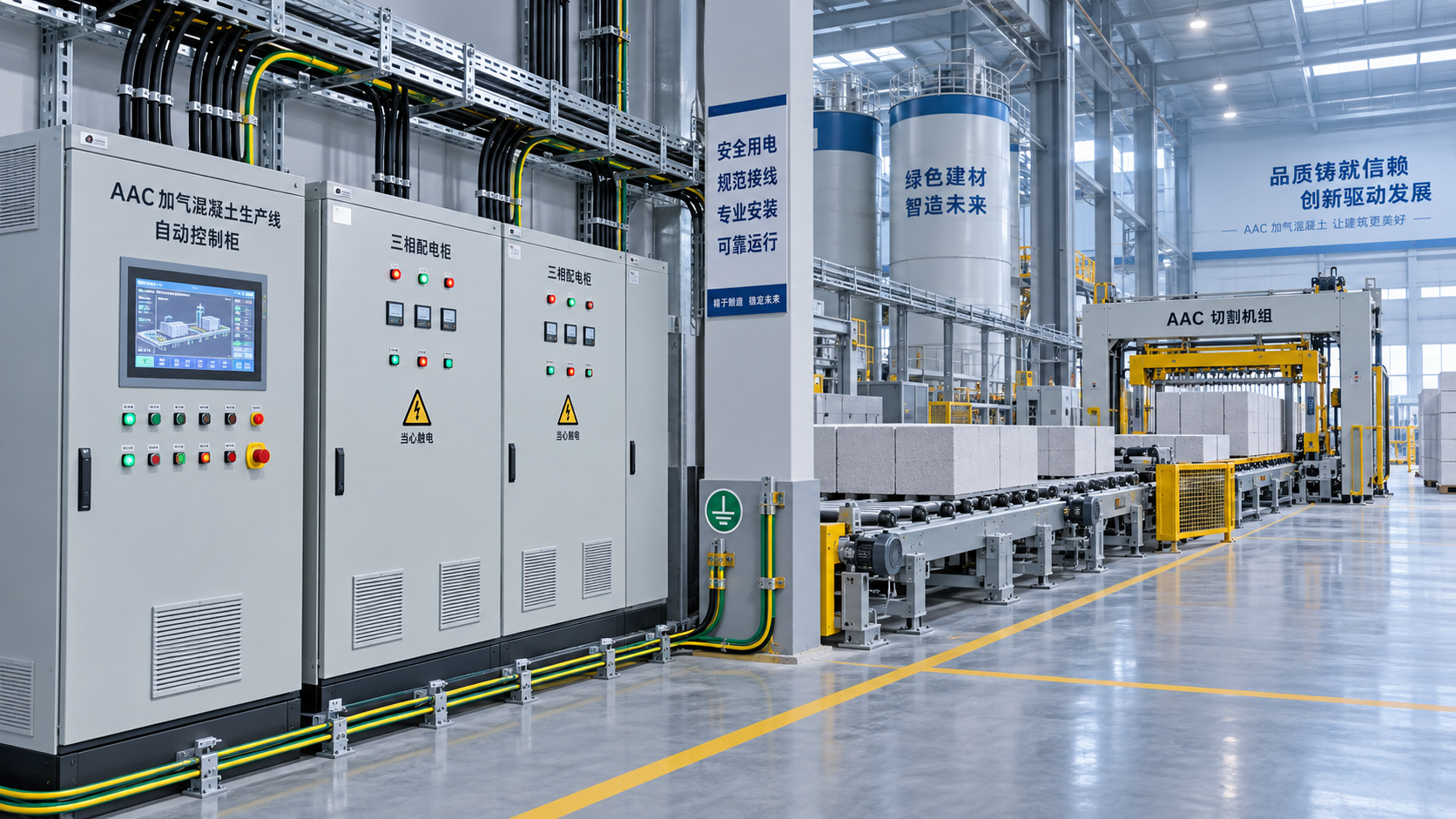
The layout should show the logical material route: receiving and storage, crushing or milling where required, slurry preparation, batching, casting, pre-curing, cutting, autoclaving, packing, and dispatch. Material should move forward through the plant with as little crossing traffic and manual intervention as practical. Congested routes around molds, cutting machines, and autoclave loading areas can create downtime even when the main equipment is technically adequate.
Storage areas need their own planning
Raw materials may arrive in different forms: bulk powder, wet slurry, lumps, sand, lime, cement, gypsum, aluminum paste or powder, and recycled process returns. Their storage conditions differ. The report should specify which materials require silos, enclosed stockpiles, tanks, covered areas, dosing rooms, or protected chemical storage. It should also estimate stock days based on supply reliability, not only on lowest-cost inventory targets.
Finished AAC blocks need protected, organized storage and safe forklift or loading access. The planning document should account for product separation by size or grade, package curing and handling needs, and the space required for loading vehicles without blocking internal production traffic.
Raw material suitability should be verified, not assumed
AAC quality depends heavily on material consistency. Sand, fly ash, cement, lime, gypsum, water, aluminum agent, and any other additives affect slurry behavior, pore formation, green-cake strength, cutting performance, autoclave reaction, density, and final compressive strength. A planning report should identify the proposed material sources and define the tests needed before final equipment selection.
For sand-based production, the report should examine particle size distribution, mineral composition, moisture variation, grinding requirements, and whether washing or classification is needed. For fly ash-based production, chemical composition, fineness, loss on ignition, moisture, and supply stability should be investigated. Lime reactivity is especially important because it affects the reaction rate and process control window.
The report does not need to promise a final mix formula at the planning stage, but it should establish a raw-material qualification plan. That plan should explain what samples must be collected, which physical and chemical properties require analysis, how often incoming materials will be checked, and what happens when a material falls outside the accepted range.
It should also address backup supply. A plant designed around one source of fly ash, lime, or sand becomes vulnerable if that source changes quality, reduces output, or becomes difficult to transport. Alternative sources may require different handling or grinding arrangements, so they should be considered early rather than after installation.
Describe the process route and equipment scope in enough detail
The report should define the intended production route from raw material reception to finished-product dispatch. This is the section where broad investment ideas become an engineering basis. The process description should identify the major systems and show how they connect.
- Raw material receiving, conveying, storage, and dosing;
- Sand grinding or fly ash slurry preparation;
- Batching, mixing, and casting equipment;
- Molds, mold handling, pre-curing area, and hardening control;
- Tilting, demolding, cutting, and scrap return systems;
- Autoclaves, loading frames, rail transfer, and steam distribution;
- Finished-product separation, packing, storage, and dispatch equipment;
- Dust collection, wastewater handling, process-water recovery, and control systems.
Equipment selection should be based on the production balance and material characteristics, not only on the supplier’s standard configuration. The report should identify key technical choices that need confirmation, such as mold size, cutting method, autoclave diameter and length, number of autoclaves, automation level, handling method, and degree of recycling for cutting waste and process water.
Automation should be evaluated carefully. Automated handling can improve repeatability and reduce manual work around heavy molds and high-temperature curing areas, but it also requires reliable controls, maintenance capability, spare parts planning, and trained operators. In a location where technical support or electrical reliability is limited, the report may need to favor a configuration that is easier to maintain without sacrificing essential process control.
Utilities are production inputs, not secondary details
An AAC plant cannot be planned accurately without a utility study. Electricity, water, compressed air, steam, fuel, drainage, and ventilation should be sized against the actual production schedule. Inadequate utility capacity can leave installed machinery underused, while oversized systems can add unnecessary capital and operating cost.
Steam deserves particular attention because autoclave curing is central to AAC production. The report should clarify whether steam will come from an on-site boiler system or an external source, then assess supply pressure, temperature, cycle demand, peak loads, condensate return, water treatment, fuel availability, emissions controls, and backup arrangements. It should also consider the effects of steam interruptions on curing schedules and product quality.
Electrical planning should cover connected load, peak demand, transformer capacity, backup requirements for critical controls, cable routes, and the impact of large motors, pumps, compressors, and cranes. Water planning should separate process water, boiler feedwater, cleaning water, and domestic use where relevant. Recovering suitable process water can reduce consumption, but the report should verify that recycled water will not destabilize slurry composition or introduce excessive solids.
Build the investment estimate around the full project boundary
A useful planning report separates equipment purchase cost from total project cost. The latter may include land preparation, civil works, steel structure, roads, drainage, warehouses, utility connections, boiler-related systems, installation, commissioning, laboratory equipment, handling equipment, packaging, initial spare parts, and working capital. Leaving these items outside the first estimate can distort investment decisions.
The financial section should present assumptions clearly: intended output, anticipated product mix, operating schedule, material consumption basis, utility requirements, labor structure, logistics assumptions, and stock levels. It should then test how sensitive the project is to changes in major cost drivers, particularly raw material transport, fuel or steam cost, electricity price, actual utilization, product breakage, and sales volume.
A report should avoid presenting a single financial result as certain. Its value comes from showing which assumptions have the greatest influence and which items need verification before committing to procurement.
Quality, environmental control, and operating readiness
Quality control should be included from the beginning because AAC defects are often rooted in process variation rather than visible at the shipping stage. The report should identify a basic laboratory and inspection plan covering incoming material checks, slurry density and temperature, casting behavior, green-cake condition, dimensional tolerances after cutting, density, strength, moisture condition, and visual defects in finished units.
Environmental planning should cover dust from dry-material handling, noise, wastewater, sludge or solid residues, boiler emissions where applicable, and the controlled reuse or disposal of production waste. Requirements differ by location, so the report should identify permits, local review points, and design information needed for approval rather than assuming that standard equipment alone will satisfy every condition.
Finally, the project needs an operating-readiness section. It should estimate staffing by function, define training needs for production and maintenance teams, identify critical spare parts, and describe commissioning priorities. A factory may have correctly selected machinery but still struggle if operators do not understand slurry control, mold circulation, cutting adjustment, autoclave scheduling, or routine inspection of pumps, valves, rails, and handling equipment.
Questions that often arise during AAC factory planning
Is a feasibility study the same as an AAC factory planning report?
They overlap, but they are not always identical. A feasibility study usually focuses on whether the investment is commercially and financially reasonable. A factory planning report should go further into site conditions, process flow, equipment scope, utility demand, layout, implementation needs, and operating risks. For a serious equipment decision, both commercial feasibility and technical planning are needed.
When should raw materials be tested?
Testing should begin before finalizing the process configuration and equipment specifications. Material testing is especially important when using locally sourced sand, fly ash, lime, or alternative industrial by-products. Results may affect grinding capacity, slurry preparation, dosing equipment, storage design, and the expected process-control range.
Should the report select a specific equipment supplier?
It can define the required technical scope and evaluation criteria before a final supplier is chosen. This makes quotations easier to compare because suppliers are asked to address the same capacity basis, automation needs, utility assumptions, quality targets, and service requirements. Equipment proposals should then be reviewed against the report rather than becoming the only source of planning information.
What is the most damaging omission?
There is no single omission in every project, but an unverified production balance is particularly risky. When market expectations, raw materials, mold circulation, autoclave capacity, steam supply, yard space, and dispatch capability are not checked together, the plant may be designed around a nominal output that cannot be maintained in routine operation.
Recommend
 Sep 30, 2026
When does an automated building material production line pay off?
Automated building material production line ROI explained: assess capacity, quality, labor, waste, and total costs to make a profitable investment.
- Oct 01, 2026
How a green building material production line reduces material waste
Discover how a green building material production line cuts waste through precise batching, controlled forming, stable curing, and smart material recovery.
- Oct 02, 2026
What to confirm before finalizing AAC factory planning
AAC factory planning: confirm product mix, raw materials, capacity, utilities, layout, automation, and supplier scope before investing in a reliable, efficient AAC plant.