



Does AAC Plant Installation Require Local Electrician Support?
Does AAC Plant Installation Require Local Electrician Support?Does AAC plant installation require local electrician support? In most cases, yes. Qualified local electrical professionals are essential for safe connection, code compliance, commissioning, and reliable long-term operation.
Hongfa can supply AAC plant equipment, integrated line design, control systems, and technical guidance. However, site electrical work must reflect local regulations, utility conditions, and construction practices.
For investors, project managers, and factory operators, the practical question is not whether electricians are needed. It is how to define responsibilities before installation begins.
A clear division between equipment supplier, local electrician, utility provider, and plant owner prevents delays, avoids rework, and makes production startup more predictable.
What Is the Real Search Intent Behind This Question?
People searching “Does AAC plant installation require local electrician support?” are usually planning a new autoclaved aerated concrete production project or evaluating supplier installation requirements.
They want to know whether imported or externally supplied equipment can be connected directly, or whether local contractors must complete important electrical installation work.
Most readers are also estimating project costs. They need to understand whether electrical labor, transformers, cable routes, grounding, permits, and testing belong in the initial budget.
Another concern is accountability. Plant owners want to know who is responsible if motors fail to start, control cabinets alarm, or utility power does not meet equipment requirements.
The answer depends on project scope, local laws, plant capacity, voltage conditions, and supplier service arrangements. Still, local electrician support should generally be treated as necessary.
This does not reduce the value of supplier guidance. Instead, it creates a practical partnership between the AAC equipment manufacturer and professionals familiar with local installation conditions.
For decision-makers, the best approach is to confirm electrical responsibilities before equipment shipment, civil construction completion, and utility connection applications are finalized.
Why Local Electricians Are Usually Required for AAC Plant Installation
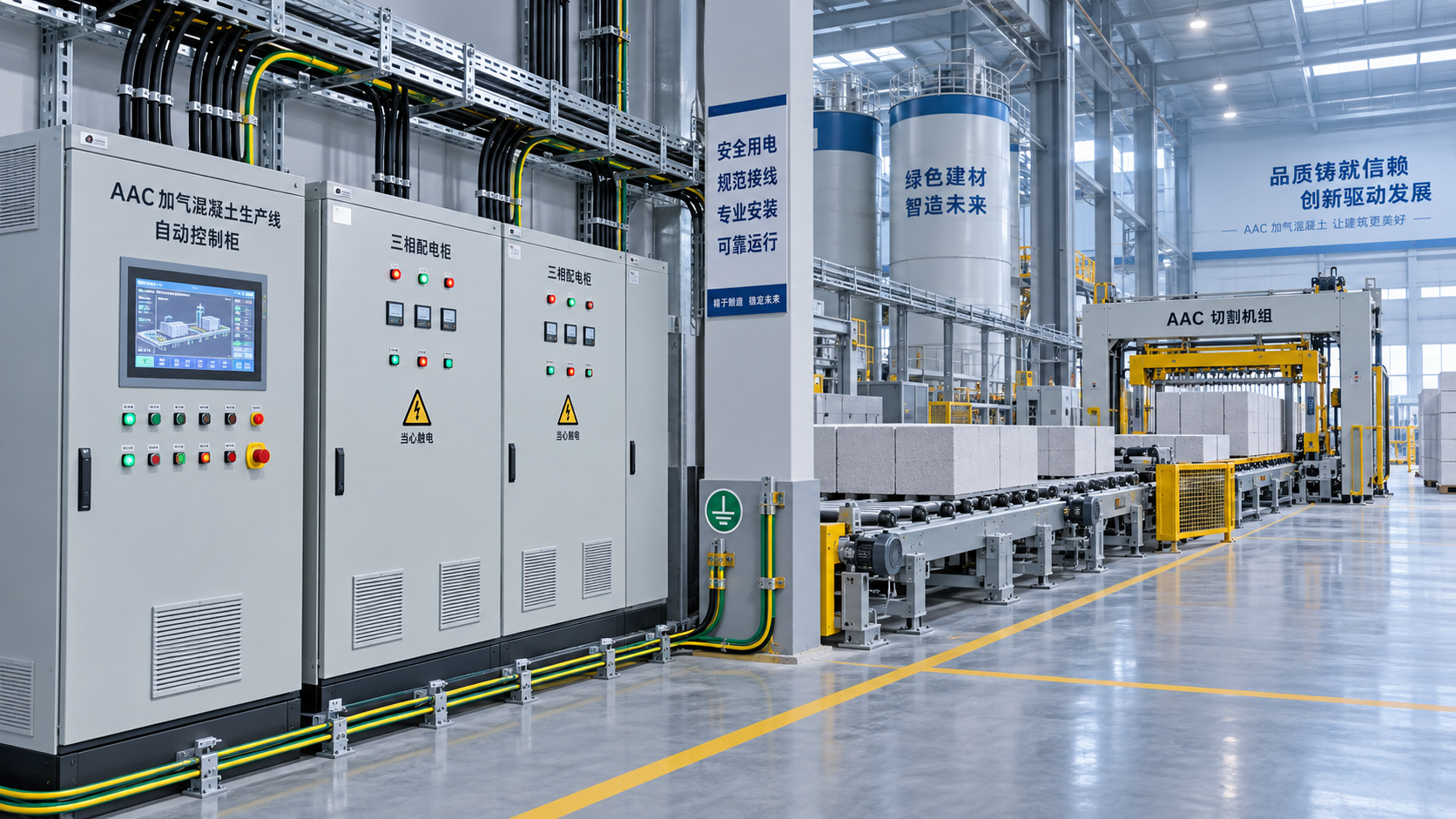
An AAC plant is not a single machine with a simple plug connection. It is an integrated industrial system containing multiple motors, panels, sensors, drives, pumps, and safety devices.
Typical equipment includes raw material handling machines, batching systems, slurry mixers, cutting machines, molds, conveyors, hoists, autoclaves, compressors, and packaging equipment.
Each section may require different power loads, protective devices, cable specifications, control signals, and emergency isolation arrangements. These details must be coordinated during installation.
Local electricians understand the regional electrical code, required permits, utility procedures, approved materials, and inspection standards. That knowledge is difficult to replace through remote instructions alone.
They can also assess site-specific factors, including available grid capacity, transformer distance, climate exposure, cable routing limitations, grounding conditions, and local fire protection requirements.
Even when Hongfa provides detailed electrical drawings, local electricians are normally responsible for installing external cables, utility interfaces, earthing systems, and locally required safety components.
In many countries, only licensed local electrical contractors can legally connect industrial facilities to public power networks or sign documents required for inspection and energization.
Without proper local support, a completed AAC production line may remain unable to operate because approvals, electrical tests, or utility acceptance procedures are still incomplete.
Which Electrical Tasks Can the Equipment Supplier Support?
A capable AAC plant supplier should provide much more than machinery. Electrical planning support is important because plant performance depends on accurate system integration.
Hongfa can provide equipment layouts, power consumption information, motor lists, electrical control cabinet specifications, wiring diagrams, automation interfaces, and commissioning guidance for supplied machinery.
These documents help the owner and local contractor prepare suitable transformers, distribution cabinets, cable trays, circuit protection, and connections before equipment arrives at the site.
The supplier’s engineers can explain the operating logic of mixers, cutting systems, conveyors, batching controls, autoclave auxiliary equipment, and safety interlocks during installation.
They can also verify that internal equipment wiring, control cabinet connections, sensor circuits, and motor rotation directions are correct before the line enters trial operation.
For larger projects, supplier technicians may supervise equipment assembly and commissioning. Their role is especially valuable when connecting process sections into a coordinated production line.
However, supplier technicians should not be assumed to replace licensed local electricians. Their expertise is usually focused on equipment operation, automation logic, and production process requirements.
The strongest arrangement combines supplier engineering documents with local electrical execution. This gives the project both equipment-specific knowledge and compliance with local installation requirements.
What Local Electricians Should Handle on an AAC Plant Project
Local electrical contractors should be involved early, ideally during plant design rather than after machinery arrives. Early involvement prevents expensive changes to foundations, trenches, and electrical rooms.
They should review the total connected load and calculate realistic demand load. This helps determine whether the selected transformer and incoming service can support startup conditions.
Large motors, compressors, pumps, and material-handling equipment can create significant starting currents. Electrical design must account for these loads without causing unacceptable voltage drops.
Electricians should install the connection from the local utility supply to the main distribution equipment. This may include switchgear, metering, transformers, protection relays, and power factor correction.
They should also install cable trays, conduits, power cables, control cables, grounding conductors, lightning protection, local disconnects, and emergency stop connections where required.
Proper grounding is particularly important in industrial plants with moisture, metal structures, moving equipment, and automated controls. A poor earthing system can create safety and reliability problems.
Local teams should test insulation resistance, phase sequence, protective device performance, grounding continuity, and emergency shutdown circuits before the supplier begins formal commissioning work.
They may also need to prepare inspection records, permit applications, certification documents, and final as-built electrical drawings required by authorities or insurers.
How to Divide Responsibilities Before Installation Starts
Electrical responsibilities should be written into the project contract, technical agreement, or installation scope document. Verbal assumptions create disputes when schedule pressure increases.
The equipment supplier should identify the electrical scope included with the AAC plant. This normally covers supplied motors, control cabinets, internal machine wiring, and relevant technical documentation.
The plant owner should confirm responsibility for utility applications, transformer procurement, external cable installation, labor coordination, permits, and local construction management.
The local electrician should receive supplier drawings before work begins. This allows the contractor to identify missing information and propose locally compliant alternatives when necessary.
A useful responsibility matrix lists every interface point. For example, it should identify where the owner’s main power supply ends and where the equipment supplier’s cabinet connection begins.
The matrix should also define who provides cable glands, terminal lugs, circuit breakers, cable trays, electrical room ventilation, lighting, backup power, and communication cabling.
For automated AAC plants, clarify responsibility for network connections, remote monitoring, programmable controller interfaces, instrumentation power, and integration with auxiliary plant systems.
When responsibilities are documented early, commissioning engineers can focus on process adjustment instead of spending valuable time solving unfinished civil or electrical interface problems.
What Electrical Information Should Be Confirmed Before Ordering Equipment?
Before placing an AAC plant order, confirm the available utility voltage, frequency, phase arrangement, and maximum power capacity at the proposed factory location.
Many industrial plants use three-phase power, but voltage standards differ by country and region. Equipment motors, drives, transformers, and control circuits must match the site supply.
Ask the supplier for a complete connected-load list. This should identify rated power, voltage, quantity, duty cycle, starting method, and electrical control requirements for every major machine.
Also request estimated peak demand and diversity assumptions. Connected load alone does not always represent the actual transformer capacity required during normal production operations.
Plant owners should confirm whether the utility can provide the required capacity within the project schedule. Grid upgrades can take longer than machinery manufacturing or building construction.
Electrical room location should be planned carefully. It should allow practical cable routes, safe maintenance access, suitable ventilation, moisture protection, and separation from heavy dust areas.
Consider future expansion during the first design stage. Leaving spare capacity in transformers, switchboards, cable trays, and panels can reduce costs when production volume increases.
It is also wise to identify critical loads that may require backup power. Control systems, emergency lighting, communication equipment, and selected safety devices may need uninterrupted operation.
Common Risks When Local Electrical Support Is Missing
The most immediate risk is delayed commissioning. Equipment may be mechanically installed, yet production cannot begin because incoming power, testing, or approvals are unfinished.
Another common issue is undersized power infrastructure. A transformer selected without accurate demand calculations may overload during simultaneous operation of high-power production equipment.
Incorrect cable sizing can cause overheating, voltage drops, nuisance trips, and unreliable motor performance. These problems are especially damaging in continuous industrial production environments.
Improper phase sequence may cause pumps, fans, conveyors, or compressors to rotate in the wrong direction. This can damage equipment during initial startup.
Weak grounding can create electrical shock hazards, unstable sensor readings, communication interference, and increased vulnerability to lightning or fault currents.
Unfamiliarity with AAC process equipment can also create problems. Local electricians need supplier guidance so they understand interlocks, emergency circuits, and the importance of process sequence.
Conversely, supplier technicians may not know local regulations or utility practices. That is why a coordinated installation plan is more reliable than relying on only one party.
Owners should avoid choosing contractors solely by lowest price. Industrial experience, licensing, documentation ability, and willingness to coordinate with the equipment supplier are more important factors.
How to Select the Right Local Electrical Contractor
Select a contractor with experience in industrial manufacturing projects, not only commercial buildings or residential electrical installations. AAC plants require a higher level of system coordination.
Ask whether the contractor has worked with motor control centers, variable frequency drives, programmable controllers, industrial sensors, and high-capacity three-phase distribution systems.
Verify that the contractor holds valid licenses and can manage required permits, inspections, utility coordination, and official documentation in the project location.
Request examples of previous industrial projects. Relevant experience may include concrete plants, block factories, mining systems, material handling lines, or other automated processing facilities.
The contractor should be willing to review Hongfa’s drawings and communicate directly with the supplier’s technical team when questions arise during installation or commissioning.
Good communication matters because equipment labels, wiring diagrams, and control logic must be understood accurately. Translation support may be useful for international projects.
Include testing and handover requirements in the contractor’s scope. The owner should receive test reports, final drawings, panel schedules, cable records, and maintenance recommendations.
A professional contractor can also train the plant maintenance team on safe isolation procedures, routine inspections, fault reporting, and basic electrical preventive maintenance practices.
How Local Electrical Support Improves Long-Term AAC Plant Performance
Local electrician support continues to matter after installation. Industrial electrical systems require periodic inspection, maintenance, troubleshooting, and modification as operating conditions change.
During early production, the plant may need adjustments to overload settings, sensor wiring, motor protection, control signals, or auxiliary equipment interfaces.
A local contractor can respond faster than an overseas service team when there is a cable fault, damaged component, power-quality problem, or utility-related interruption.
Reliable local support also helps with preventive maintenance. Regular inspection of terminals, breakers, grounding connections, cables, and panels can prevent unexpected production stoppages.
As the factory expands, local electricians can add new machinery, upgrade transformers, extend power distribution, and maintain compliance with changing safety requirements.
For AAC block producers, stable electrical operation protects more than equipment. It supports consistent batching, cutting accuracy, material movement, curing operations, and finished product quality.
Electrical reliability also affects operating costs. Correctly sized equipment, appropriate motor protection, and sound cable installation can reduce energy losses and avoid unnecessary repair expenses.
When evaluating an AAC plant investment, local electrical capability should therefore be viewed as part of operational readiness, not simply as an installation expense.
Conclusion: Plan for Both Supplier Guidance and Local Electrical Expertise
Does AAC plant installation require local electrician support? For nearly every commercial AAC production project, the answer is yes.
Hongfa can provide advanced AAC equipment, production-line knowledge, technical documents, and commissioning support. Local electrical professionals provide the site execution and legal compliance needed for safe operation.
The best results come from defining responsibilities early, confirming utility capacity, sharing drawings before construction, and selecting contractors with industrial electrical experience.
This coordinated approach reduces commissioning delays, protects equipment, improves safety, and gives plant owners greater confidence that the production line can operate reliably from day one.
Before finalizing an AAC plant project, include electrical infrastructure, local contractor support, testing requirements, and commissioning interfaces in the overall investment and implementation plan.
Does AAC plant installation require local electrician support? In most cases, yes. Qualified local electrical professionals are essential for safe connection, code compliance, commissioning, and reliable long-term operation.
Hongfa can supply AAC plant equipment, integrated line design, control systems, and technical guidance. However, site electrical work must reflect local regulations, utility conditions, and construction practices.
For investors, project managers, and factory operators, the practical question is not whether electricians are needed. It is how to define responsibilities before installation begins.
A clear division between equipment supplier, local electrician, utility provider, and plant owner prevents delays, avoids rework, and makes production startup more predictable.
What Is the Real Search Intent Behind This Question?
People searching “Does AAC plant installation require local electrician support?” are usually planning a new autoclaved aerated concrete production project or evaluating supplier installation requirements.
They want to know whether imported or externally supplied equipment can be connected directly, or whether local contractors must complete important electrical installation work.
Most readers are also estimating project costs. They need to understand whether electrical labor, transformers, cable routes, grounding, permits, and testing belong in the initial budget.
Another concern is accountability. Plant owners want to know who is responsible if motors fail to start, control cabinets alarm, or utility power does not meet equipment requirements.
The answer depends on project scope, local laws, plant capacity, voltage conditions, and supplier service arrangements. Still, local electrician support should generally be treated as necessary.
This does not reduce the value of supplier guidance. Instead, it creates a practical partnership between the AAC equipment manufacturer and professionals familiar with local installation conditions.
For decision-makers, the best approach is to confirm electrical responsibilities before equipment shipment, civil construction completion, and utility connection applications are finalized.
Why Local Electricians Are Usually Required for AAC Plant Installation
An AAC plant is not a single machine with a simple plug connection. It is an integrated industrial system containing multiple motors, panels, sensors, drives, pumps, and safety devices.
Typical equipment includes raw material handling machines, batching systems, slurry mixers, cutting machines, molds, conveyors, hoists, autoclaves, compressors, and packaging equipment.
Each section may require different power loads, protective devices, cable specifications, control signals, and emergency isolation arrangements. These details must be coordinated during installation.
Local electricians understand the regional electrical code, required permits, utility procedures, approved materials, and inspection standards. That knowledge is difficult to replace through remote instructions alone.
They can also assess site-specific factors, including available grid capacity, transformer distance, climate exposure, cable routing limitations, grounding conditions, and local fire protection requirements.
Even when Hongfa provides detailed electrical drawings, local electricians are normally responsible for installing external cables, utility interfaces, earthing systems, and locally required safety components.
In many countries, only licensed local electrical contractors can legally connect industrial facilities to public power networks or sign documents required for inspection and energization.
Without proper local support, a completed AAC production line may remain unable to operate because approvals, electrical tests, or utility acceptance procedures are still incomplete.
Which Electrical Tasks Can the Equipment Supplier Support?
A capable AAC plant supplier should provide much more than machinery. Electrical planning support is important because plant performance depends on accurate system integration.
Hongfa can provide equipment layouts, power consumption information, motor lists, electrical control cabinet specifications, wiring diagrams, automation interfaces, and commissioning guidance for supplied machinery.
These documents help the owner and local contractor prepare suitable transformers, distribution cabinets, cable trays, circuit protection, and connections before equipment arrives at the site.
The supplier’s engineers can explain the operating logic of mixers, cutting systems, conveyors, batching controls, autoclave auxiliary equipment, and safety interlocks during installation.
They can also verify that internal equipment wiring, control cabinet connections, sensor circuits, and motor rotation directions are correct before the line enters trial operation.
For larger projects, supplier technicians may supervise equipment assembly and commissioning. Their role is especially valuable when connecting process sections into a coordinated production line.
However, supplier technicians should not be assumed to replace licensed local electricians. Their expertise is usually focused on equipment operation, automation logic, and production process requirements.
The strongest arrangement combines supplier engineering documents with local electrical execution. This gives the project both equipment-specific knowledge and compliance with local installation requirements.
What Local Electricians Should Handle on an AAC Plant Project
Local electrical contractors should be involved early, ideally during plant design rather than after machinery arrives. Early involvement prevents expensive changes to foundations, trenches, and electrical rooms.
They should review the total connected load and calculate realistic demand load. This helps determine whether the selected transformer and incoming service can support startup conditions.
Large motors, compressors, pumps, and material-handling equipment can create significant starting currents. Electrical design must account for these loads without causing unacceptable voltage drops.
Electricians should install the connection from the local utility supply to the main distribution equipment. This may include switchgear, metering, transformers, protection relays, and power factor correction.
They should also install cable trays, conduits, power cables, control cables, grounding conductors, lightning protection, local disconnects, and emergency stop connections where required.
Proper grounding is particularly important in industrial plants with moisture, metal structures, moving equipment, and automated controls. A poor earthing system can create safety and reliability problems.
Local teams should test insulation resistance, phase sequence, protective device performance, grounding continuity, and emergency shutdown circuits before the supplier begins formal commissioning work.
They may also need to prepare inspection records, permit applications, certification documents, and final as-built electrical drawings required by authorities or insurers.
How to Divide Responsibilities Before Installation Starts
Electrical responsibilities should be written into the project contract, technical agreement, or installation scope document. Verbal assumptions create disputes when schedule pressure increases.
The equipment supplier should identify the electrical scope included with the AAC plant. This normally covers supplied motors, control cabinets, internal machine wiring, and relevant technical documentation.
The plant owner should confirm responsibility for utility applications, transformer procurement, external cable installation, labor coordination, permits, and local construction management.
The local electrician should receive supplier drawings before work begins. This allows the contractor to identify missing information and propose locally compliant alternatives when necessary.
A useful responsibility matrix lists every interface point. For example, it should identify where the owner’s main power supply ends and where the equipment supplier’s cabinet connection begins.
The matrix should also define who provides cable glands, terminal lugs, circuit breakers, cable trays, electrical room ventilation, lighting, backup power, and communication cabling.
For automated AAC plants, clarify responsibility for network connections, remote monitoring, programmable controller interfaces, instrumentation power, and integration with auxiliary plant systems.
When responsibilities are documented early, commissioning engineers can focus on process adjustment instead of spending valuable time solving unfinished civil or electrical interface problems.
What Electrical Information Should Be Confirmed Before Ordering Equipment?
Before placing an AAC plant order, confirm the available utility voltage, frequency, phase arrangement, and maximum power capacity at the proposed factory location.
Many industrial plants use three-phase power, but voltage standards differ by country and region. Equipment motors, drives, transformers, and control circuits must match the site supply.
Ask the supplier for a complete connected-load list. This should identify rated power, voltage, quantity, duty cycle, starting method, and electrical control requirements for every major machine.
Also request estimated peak demand and diversity assumptions. Connected load alone does not always represent the actual transformer capacity required during normal production operations.
Plant owners should confirm whether the utility can provide the required capacity within the project schedule. Grid upgrades can take longer than machinery manufacturing or building construction.
Electrical room location should be planned carefully. It should allow practical cable routes, safe maintenance access, suitable ventilation, moisture protection, and separation from heavy dust areas.
Consider future expansion during the first design stage. Leaving spare capacity in transformers, switchboards, cable trays, and panels can reduce costs when production volume increases.
It is also wise to identify critical loads that may require backup power. Control systems, emergency lighting, communication equipment, and selected safety devices may need uninterrupted operation.
Common Risks When Local Electrical Support Is Missing
The most immediate risk is delayed commissioning. Equipment may be mechanically installed, yet production cannot begin because incoming power, testing, or approvals are unfinished.
Another common issue is undersized power infrastructure. A transformer selected without accurate demand calculations may overload during simultaneous operation of high-power production equipment.
Incorrect cable sizing can cause overheating, voltage drops, nuisance trips, and unreliable motor performance. These problems are especially damaging in continuous industrial production environments.
Improper phase sequence may cause pumps, fans, conveyors, or compressors to rotate in the wrong direction. This can damage equipment during initial startup.
Weak grounding can create electrical shock hazards, unstable sensor readings, communication interference, and increased vulnerability to lightning or fault currents.
Unfamiliarity with AAC process equipment can also create problems. Local electricians need supplier guidance so they understand interlocks, emergency circuits, and the importance of process sequence.
Conversely, supplier technicians may not know local regulations or utility practices. That is why a coordinated installation plan is more reliable than relying on only one party.
Owners should avoid choosing contractors solely by lowest price. Industrial experience, licensing, documentation ability, and willingness to coordinate with the equipment supplier are more important factors.
How to Select the Right Local Electrical Contractor
Select a contractor with experience in industrial manufacturing projects, not only commercial buildings or residential electrical installations. AAC plants require a higher level of system coordination.
Ask whether the contractor has worked with motor control centers, variable frequency drives, programmable controllers, industrial sensors, and high-capacity three-phase distribution systems.
Verify that the contractor holds valid licenses and can manage required permits, inspections, utility coordination, and official documentation in the project location.
Request examples of previous industrial projects. Relevant experience may include concrete plants, block factories, mining systems, material handling lines, or other automated processing facilities.
The contractor should be willing to review Hongfa’s drawings and communicate directly with the supplier’s technical team when questions arise during installation or commissioning.
Good communication matters because equipment labels, wiring diagrams, and control logic must be understood accurately. Translation support may be useful for international projects.
Include testing and handover requirements in the contractor’s scope. The owner should receive test reports, final drawings, panel schedules, cable records, and maintenance recommendations.
A professional contractor can also train the plant maintenance team on safe isolation procedures, routine inspections, fault reporting, and basic electrical preventive maintenance practices.
How Local Electrical Support Improves Long-Term AAC Plant Performance
Local electrician support continues to matter after installation. Industrial electrical systems require periodic inspection, maintenance, troubleshooting, and modification as operating conditions change.
During early production, the plant may need adjustments to overload settings, sensor wiring, motor protection, control signals, or auxiliary equipment interfaces.
A local contractor can respond faster than an overseas service team when there is a cable fault, damaged component, power-quality problem, or utility-related interruption.
Reliable local support also helps with preventive maintenance. Regular inspection of terminals, breakers, grounding connections, cables, and panels can prevent unexpected production stoppages.
As the factory expands, local electricians can add new machinery, upgrade transformers, extend power distribution, and maintain compliance with changing safety requirements.
For AAC block producers, stable electrical operation protects more than equipment. It supports consistent batching, cutting accuracy, material movement, curing operations, and finished product quality.
Electrical reliability also affects operating costs. Correctly sized equipment, appropriate motor protection, and sound cable installation can reduce energy losses and avoid unnecessary repair expenses.
When evaluating an AAC plant investment, local electrical capability should therefore be viewed as part of operational readiness, not simply as an installation expense.
Conclusion: Plan for Both Supplier Guidance and Local Electrical Expertise
Does AAC plant installation require local electrician support? For nearly every commercial AAC production project, the answer is yes.
Hongfa can provide advanced AAC equipment, production-line knowledge, technical documents, and commissioning support. Local electrical professionals provide the site execution and legal compliance needed for safe operation.
The best results come from defining responsibilities early, confirming utility capacity, sharing drawings before construction, and selecting contractors with industrial electrical experience.
This coordinated approach reduces commissioning delays, protects equipment, improves safety, and gives plant owners greater confidence that the production line can operate reliably from day one.
Before finalizing an AAC plant project, include electrical infrastructure, local contractor support, testing requirements, and commissioning interfaces in the overall investment and implementation plan.
Recommend
 Sep 30, 2026
When does an automated building material production line pay off?
Automated building material production line ROI explained: assess capacity, quality, labor, waste, and total costs to make a profitable investment.
- Oct 01, 2026
How a green building material production line reduces material waste
Discover how a green building material production line cuts waste through precise batching, controlled forming, stable curing, and smart material recovery.
- Oct 02, 2026
What to confirm before finalizing AAC factory planning
AAC factory planning: confirm product mix, raw materials, capacity, utilities, layout, automation, and supplier scope before investing in a reliable, efficient AAC plant.