



What Problems Commonly Occur During AAC Plant Commissioning?
What Problems Commonly Occur During AAC Plant Commissioning?
AAC plant commissioning is the point where a production line moves from installation drawings and equipment lists into real manufacturing conditions. It is also where small deviations become visible. A mixer that runs smoothly without load may behave differently when handling slurry. A cutting machine that appears correctly installed may show dimensional drift once green cake density changes. An autoclave system may reach pressure, yet still produce uneven curing because condensate removal or steam distribution is not stable.
This is why the question “What are common problems during AAC plant commissioning?” cannot be answered by looking at one machine alone. Autoclaved aerated concrete production is a linked process involving raw-material preparation, batching, slurry mixing, mould handling, pre-curing, cutting, autoclaving, unloading, and product handling. Problems often travel downstream. A density variation noticed after curing may originate in sand grinding, moisture measurement, aluminium dosing, or mixing time much earlier in the line.
A disciplined commissioning program does not aim merely to make every motor rotate. It verifies whether the entire plant can repeatedly produce AAC blocks or panels that meet the intended density, geometry, strength, appearance, and handling requirements under normal operating conditions.
Installation Accuracy Problems Often Surface Under Production Load
Mechanical alignment is one of the first recurring issues. During installation, rails, conveyors, mould transfer systems, tilting equipment, and cutting lines may be checked individually. Yet an AAC line depends on the alignment of these systems relative to one another. A minor level difference between a transfer carriage and a cutting section can cause impact, vibration, or inconsistent positioning of the green cake. Over time, this may damage mould edges, disturb the cake before cutting, or increase maintenance work on wheels and guide components.
Thermal expansion also deserves attention. Equipment around the autoclave area experiences changing temperatures, and pipe supports, valves, and connection points need enough allowance to operate safely. Rigidly installed steam piping may impose stress on connections when the system heats up. Conversely, poorly supported piping can vibrate, collect condensate in undesirable locations, or place strain on valves and instruments.
Commissioning teams should verify foundations, anchor bolts, rail straightness, equipment elevations, gearbox lubrication, chain and belt tension, and the free movement of all transfer equipment. These checks may sound basic, but postponing them until production is underway normally makes corrections more expensive and disruptive.
Raw Materials Rarely Behave Exactly Like the Trial Formula
AAC recipes are sensitive to the properties of local raw materials. Sand, fly ash, lime, cement, gypsum, aluminium powder or paste, and water do not arrive as perfectly fixed inputs. Sand fineness may fluctuate. Fly ash can vary in moisture, loss on ignition, and chemical composition. Quicklime reactivity may differ between deliveries. Even water temperature can influence slurry behavior and gas-generation timing.
A common startup mistake is assuming that an established formulation can simply be transferred from one location to another. In reality, the commissioning formula should be developed around actual material testing and observed process response. If sand grinding is too coarse, the reaction and final structure can be affected. If moisture data are inaccurate, the solids-to-water ratio changes even when the weighing system appears correct. If lime is stored improperly and absorbs moisture, its effective performance may no longer match the original assumption.
The most useful approach is to create a controlled baseline: document incoming-material properties, record each trial batch, retain samples, and adjust one meaningful variable at a time where possible. Trying to solve density, cracking, cutting damage, and curing defects by changing several ingredients at once usually obscures the real cause.
Batching Errors Create Quality Problems That Look Like Equipment Failures
Inaccurate weighing and dosing are among the most consequential commissioning faults because their effects appear in many forms: unstable density, inadequate green strength, irregular expansion, cracking, poor cutting performance, and inconsistent finished-product properties. The issue may be mechanical, such as a scale that is not calibrated, a material bridge in a hopper, or a feeder that does not discharge consistently. It may also be procedural, including incorrect tare settings, unverified moisture compensation, or an operator using a manual override without recording it.
Aluminium addition requires particular control. The gas-forming agent influences pore generation and expansion, so timing, dispersion, concentration, and dosing accuracy matter. An incorrect dose is not always obvious at the mixer. It may become visible when the cake rises too quickly, fails to reach the intended height, forms a weak internal structure, or develops surface defects before it reaches the cutting line.
Rather than judging the batching system only by its displayed values, the commissioning team should conduct practical verification: compare recorded quantities with physical checks, inspect discharge consistency, test alarms and interlocks, and confirm that material flow remains stable across multiple cycles. A plant can produce one acceptable batch by chance; reliable commissioning requires repeatability.
Slurry Mixing, Pouring, and Pre-Curing Need to Be Treated as One Stage
The period between mixing and cutting is frequently underestimated. AAC slurry must be mixed sufficiently to disperse materials, but excessive mixing or delayed pouring can change the intended reaction window. Once the slurry enters the mould, its expansion and setting behavior depend on material temperature, ambient conditions, recipe balance, mould preparation, and the timing of subsequent handling.
Common symptoms include uneven cake rise, low green strength, top-surface cracking, edge collapse, sticking to mould surfaces, or a cake that is too soft to cut cleanly. These symptoms do not point to one universal cause. For example, a weak cake may relate to insufficient pre-curing time, but it can also result from raw-material variation, excessive water, poor mixing, incorrect aluminium dispersion, or unsuitable temperature conditions.
Mould release treatment is another practical concern. Uneven application may cause sticking and damage when the cake is removed or tilted. Too much release agent can introduce a different set of surface and handling issues. Operators need a repeatable method, not simply an instruction to “apply evenly.” During startup, it is worth defining the preparation sequence, inspection points, and acceptable visual condition of each mould before pouring.
Cutting Defects Are Usually a Process Signal, Not Just a Wire Problem
Cutting is highly visible, so it is often blamed first when block dimensions are inaccurate or edges chip. Worn, loose, or incorrectly tensioned cutting wires can certainly cause defects. So can incorrect machine positioning, dirty guides, or inadequate synchronization between cutting movements and cake transfer. However, a cutting machine cannot compensate for a green cake with unstable density, insufficient strength, or poor internal cohesion.
If wires drag material, create torn surfaces, or show repeated breakage, the investigation should extend beyond the cutting frame. Is the cake at the correct maturity when it arrives? Has it expanded consistently? Is there variation between the top and bottom of the cake? Are mould dimensions and cake positioning stable? The same logic applies when finished blocks are out of square. A mechanical setting may be involved, but mould distortion, rail misalignment, or movement during transfer can also contribute.
Dimensional control should be checked across a representative production sequence rather than from one selected block. Measurements taken after cutting, after autoclaving, and after final handling can reveal at which stage a deviation begins to grow.
Steam Curing Instability Can Undermine an Otherwise Good Production Day
Autoclaving is not simply a matter of reaching a target pressure. The quality of steam, pressure ramping, temperature distribution, holding conditions, condensate management, sealing performance, and loading arrangement all influence the curing result. A rapid or poorly controlled heating sequence may create thermal stress. Uneven steam distribution may leave products with inconsistent properties across the autoclave load. Excessive condensate can affect heat transfer and produce operational complications.
Leaks around doors, valves, flanges, or instrument connections should never be treated as minor commissioning details. In addition to energy loss, they can make the curing cycle less stable and create safety concerns. Steam traps and drainage points require attention because a system can appear operational while still carrying more condensate than intended.
The boiler and steam network are part of AAC quality control, not merely utility infrastructure. Before increasing output, plant teams should confirm that steam supply remains stable under realistic demand and that the autoclave cycle is recorded in a form engineers can review. When quality shifts occur, those records are often more informative than visual inspection alone.
Control-System Logic and Field Signals Need a Full Functional Test
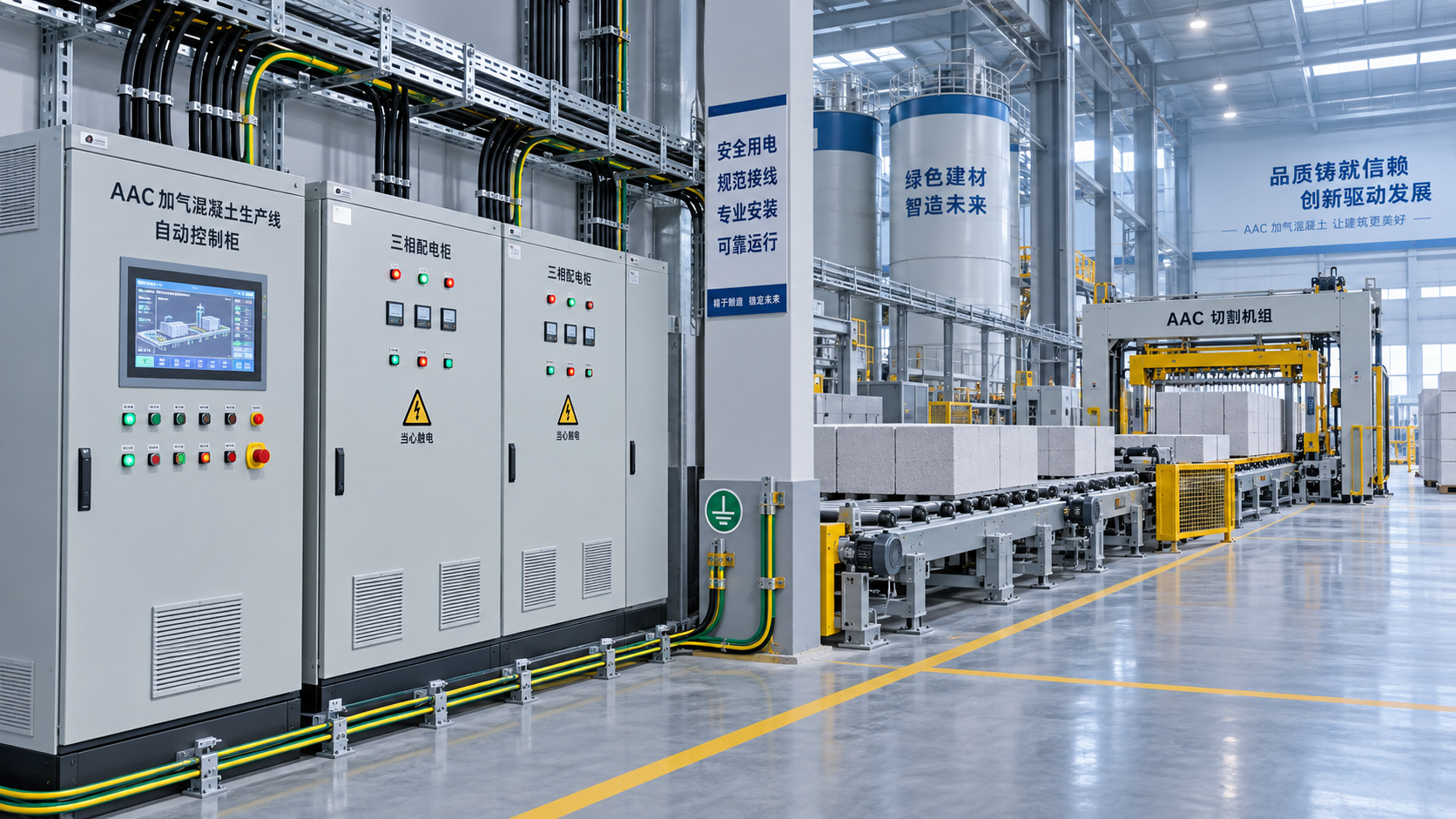
Modern AAC plants depend on PLC controls, sensors, weighing modules, limit switches, motor drives, and safety interlocks. A screen may show that a sequence is complete, but field devices may not be giving reliable information. A reversed sensor, incorrect travel limit, unstable load-cell signal, or poorly configured timing parameter can interrupt production or cause equipment to act out of sequence.
Commissioning should include both dry testing and wet testing. Dry testing confirms motion, direction, sequence, and interlocks without process material. Wet testing introduces the actual slurry, loads, moisture, temperatures, and cycle times that expose different problems. Emergency stops, gate interlocks, overload protection, alarm messages, manual modes, and restart procedures should all be tested deliberately. Safety logic should not be validated only after an unexpected stoppage.
Equally important, operators need to understand the meaning of alarms. Repeatedly clearing a fault without identifying its cause can turn a small commissioning adjustment into a recurring production issue.
The Missing Element Is Often Operating Discipline
A new line is sometimes handed over with the expectation that automation will remove the need for process knowledge. It does not. AAC production requires operators to recognize abnormal slurry behavior, evaluate mould condition, inspect green cakes, notice cutting changes, and respond appropriately to curing-cycle deviations. Maintenance personnel also need lubrication schedules, spare-part identification, and a clear method for reporting recurring faults.
A practical commissioning record should include recipe versions, material test results, batch data, mould numbers, expansion observations, cutting settings, autoclave-cycle records, defects, corrective actions, and the person responsible for each decision. This may feel demanding during a busy startup, but it prevents the plant from relying on memory and informal assumptions.
For equipment manufacturers, commissioning quality is inseparable from design support, process understanding, and response speed. Shandong Hongfa Scientific Industrial & Trading Co., Ltd., established in 1990, has developed building-material machinery including AAC block production lines, block machinery, and concrete batching plants. Its manufacturing and research resources, including four production bases and a technical workforce, reflect the scale of coordination required in this type of project. More importantly, the company’s stated emphasis on point-based quality tracking is relevant to commissioning: faults are easier to resolve when they are traced to a specific stage, setting, or component rather than treated as a general “plant problem.”
A Better Way to Judge Whether Commissioning Is Complete
Commissioning should not be declared complete because the line has produced its first saleable blocks. A stronger standard is whether the plant can run repeated cycles with controlled materials, documented parameters, stable equipment movement, safe operating practices, and predictable product quality. The exact acceptance criteria will depend on the project design, local product requirements, raw materials, and the agreed technical scope.
Before moving from trial production to regular output, managers should review the unresolved items that are easy to overlook: calibration status, spare parts for high-wear components, steam-system checks, maintenance responsibilities, operator training, production records, and the availability of technical documentation in a usable form. A commissioning period that identifies these issues early is not a delay; it is the stage that prevents repeated waste, unstable output, and avoidable downtime after the installation team leaves.
Recommend
 Sep 30, 2026
When does an automated building material production line pay off?
Automated building material production line ROI explained: assess capacity, quality, labor, waste, and total costs to make a profitable investment.
- Oct 01, 2026
How a green building material production line reduces material waste
Discover how a green building material production line cuts waste through precise batching, controlled forming, stable curing, and smart material recovery.
- Oct 02, 2026
What to confirm before finalizing AAC factory planning
AAC factory planning: confirm product mix, raw materials, capacity, utilities, layout, automation, and supplier scope before investing in a reliable, efficient AAC plant.