How Do You Choose a Hydraulic Paving Block Machine?
Choose a hydraulic paving block machine by matching it to your required paver specifications, realistic daily sales volume, available materials, and factory resources—not by comparing hydraulic pressure or purchase price alone. The strongest evidence is a production trial using representative materials and molds, supported by a clear capacity calculation, finished-product testing, and written service commitments.
A machine may look productive during a short demonstration yet create problems once regular production begins: chipped edges during handling, inconsistent heights, excessive rejects, or pallets waiting for curing space. These problems can come from the forming machine, but also from mixing, material variation, pallet condition, or an unbalanced production line. Your selection process needs to examine the complete route from aggregate storage to saleable pavers.
Define the pavers before comparing machines
Start with a product schedule rather than a supplier catalog. Record the shapes, dimensions, thicknesses, surface finishes, and colors you intend to sell. Separate your regular production items from occasional orders, because frequent mold changes and small batches affect useful output.
Product requirements determine more than mold size. A machine intended mainly for plain concrete pavers may need additional feeding and mixing equipment to produce a separate colored face layer. Thicker units require suitable mold depth, filling capacity, and handling arrangements. A large advertised molding area does not automatically mean every desired shape or thickness is supported.
- Product drawings: Include dimensions, tolerances, chamfers, spacer features, and surface requirements.
- Performance requirements: Identify the applicable market specifications for strength, abrasion resistance, water absorption, and other required properties.
- Production mix: State which products will run most often and how frequently molds or colors will change.
- Delivery basis: Express demand in square meters or units per day, with the corresponding paver dimensions.
Keep the specification tied to the finished product. Compressive strength alone may not establish suitability for a paving application; the required test properties and methods depend on the product and destination market. Ask suppliers to demonstrate how their proposed equipment supports those requirements without treating machine specifications as a substitute for product testing.
Convert advertised capacity into saleable output
Catalog capacities commonly assume a particular mold, uninterrupted feeding, and a stated cycle time. Those figures are useful only when the assumptions match your operation. A capacity quoted for one paver size cannot be transferred directly to another because the number of cavities and molded area change.
Estimated saleable units per shift = units per cycle × cycles per operating hour × scheduled shift hours × operating availability × saleable yield.
Use consistent definitions when applying this calculation. If the quoted hourly output already includes normal stoppages, do not deduct the same losses again. Convert units into square meters using the product’s specified coverage rather than assuming every shape has the same footprint.
Ask what the supplier includes in “cycle time.” Filling, vibration, pressing, demolding, and pallet movement must all be accounted for. Mold changes, cleaning, material shortages, and adjustments reduce actual shift output even when the machine runs at its stated speed between interruptions.
A forming machine also cannot produce continuously if the mixer, pallet return system, or curing area falls behind. Request a line balance showing the capacity of each stage. For variable demand, compare the cost of running a larger line below capacity against the limitations of a smaller line during peak orders.
Look beyond the hydraulic pressure rating
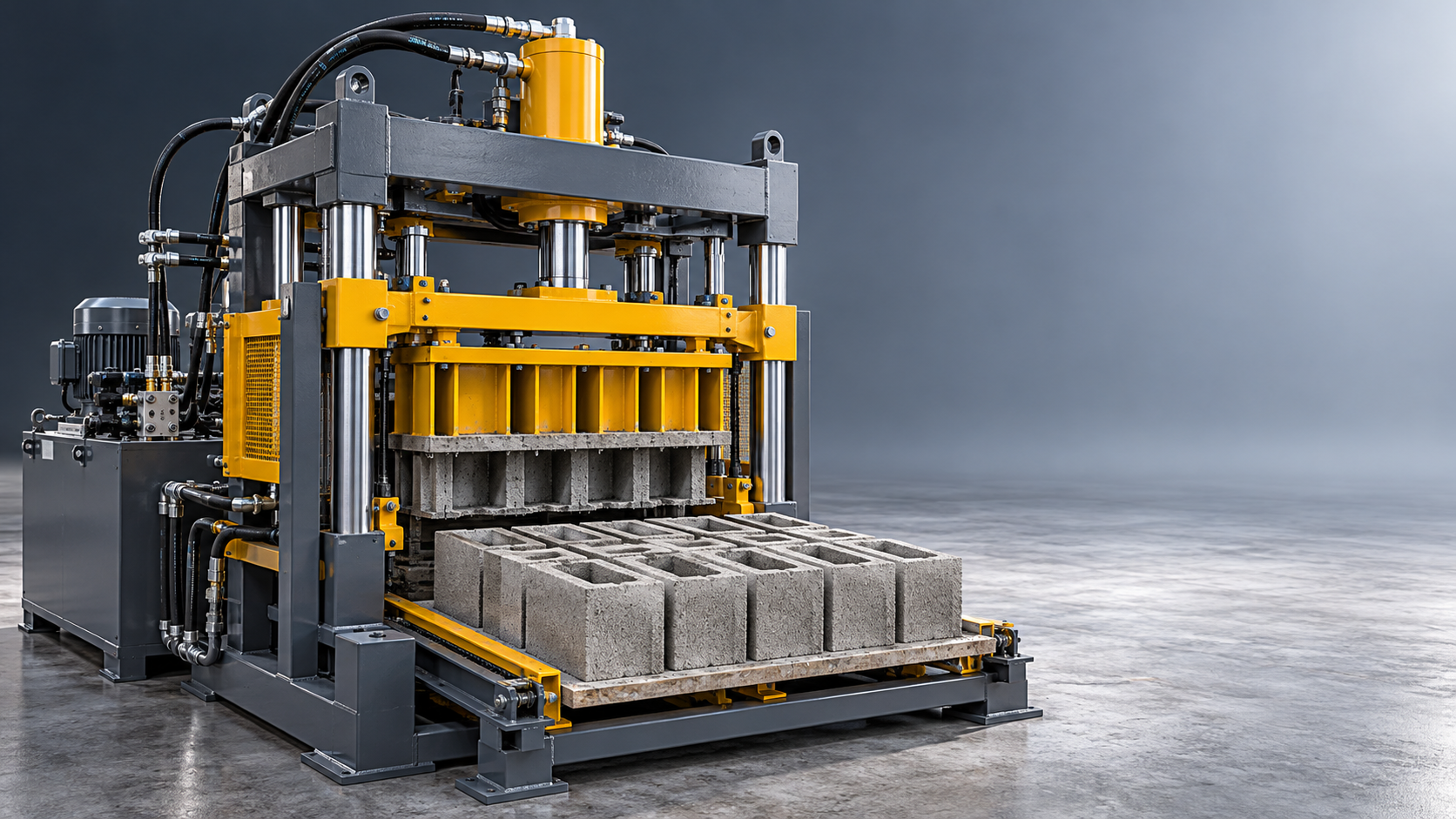
In typical dry-cast paver production, vibration and applied pressure work together to compact a low-moisture concrete mix. Hydraulic systems may operate the pressing head, mold movement, and other machine functions. Their value depends on controlled, repeatable movement—not simply on the highest pressure listed in a brochure.
Hydraulic pressure is not the same as compaction force. Cylinder dimensions and the mechanical arrangement affect the force delivered, while the loaded area affects how that force relates to the product. Comparisons therefore need to include the stated force, its measurement basis, and the machine’s forming arrangement.
During a demonstration, compare pavers from different positions across the pallet. Persistent differences in height, edge definition, or density may warrant checks of filling distribution, vibration, mold condition, and pallet stiffness. Increasing pressure indiscriminately is not a reliable correction for poor material distribution.
Prove compatibility with your actual raw materials
A hydraulic paving block machine should be evaluated with a concrete mix representative of your available cement, aggregates, fines, and pigments. A demonstration using unfamiliar, tightly controlled materials may show the machine’s capability without proving that your planned production conditions are workable.
Dry-cast mixes need controlled moisture and suitable particle grading. Excess moisture can impair demolding and shape retention; insufficient moisture can interfere with compaction and green strength. Changes in aggregate moisture also change the effective water content unless batching adjustments account for them.
Ask how the proposed line measures materials, controls water addition, and handles moisture variation. Inspect aggregate storage and batching arrangements as carefully as the press. Contaminated stockpiles or inconsistent feeding can make a capable machine appear unreliable.
For face-mix products, establish whether the quotation includes a separate mixer, material transport, and face-layer feeding system. Confirm how layer thickness is controlled and how color changeovers are cleaned. Surface appearance and bonding depend on the materials and process as well as the machine’s ability to place the layers.
Match molds and automation to the way you will operate
Molds are recurring production tools, not a minor accessory. Confirm the supported product-height range, mold attachment system, changeover procedure, and availability of replacement wear components. Ask whether mold changes require lifting equipment and whether the required lifting arrangement fits your building.
Clarify ownership and supply arrangements for custom mold drawings. A low initial machine price can become restrictive if replacement tooling is expensive, slow to obtain, or available from only one source. Conversely, a nominally compatible mold still needs verified fit, clearances, and operating settings.
Choose automation around staffing and workflow
Semi-automatic equipment can suit operations with manageable production volumes and dependable manual handling. However, assess the actual work required for pallet movement, product transfer, and stacking. Manual handling can become the limiting stage before the forming machine reaches capacity.
Higher automation is more useful when the surrounding process can support it: consistent batching, reliable pallet circulation, organized curing, and trained maintenance staff. It may reduce repetitive handling and improve process repeatability, but adds sensors, drives, controls, and transfer mechanisms that need technical support.
Request a staffing plan by task rather than a single operator count. Include batching, forklift movement, quality checks, cleaning, mold changes, and maintenance. Also check whether operators can save product recipes, diagnose alarms, and recover safely from an interrupted cycle.
Check the factory layout before placing the order
Obtain a dimensioned layout covering the whole production system. The forming machine’s footprint is only one part of the space requirement. Aggregate bins, conveyors, mixers, pallet storage, curing arrangements, stacking, and vehicle access may determine whether the proposed line is practical.
- Utilities: Verify electrical supply, installed and operating power requirements, water supply, and compressed air where applicable.
- Civil works: Obtain equipment loads, foundation requirements, anchoring details, and any pit requirements before construction.
- Material flow: Separate raw-material delivery, fresh-product movement, and finished-product dispatch where practical.
- Curing and pallets: Calculate space and pallet inventory from planned output, handling arrangements, and the intended curing cycle.
Pallet specifications deserve particular attention. Flatness, stiffness, dimensions, and condition influence support during compaction and transport. Confirm the approved pallet types and replacement criteria instead of purchasing solely by price.
Freshly demolded pavers also need controlled handling and curing. A faster machine will not compensate for damage during transfer or inconsistent curing conditions. These downstream constraints should be resolved before selecting additional press capacity.
Compare the cost of accepted pavers, not just equipment prices
Request itemized quotations with a common scope. One offer may include batching, molds, pallets, installation, and training, while another covers only the forming machine. Compare freight, civil works, utility connections, commissioning materials, and spare parts separately so exclusions remain visible.
For operating costs, use the expected cost per saleable square meter or accepted unit. Include cement and aggregates, energy, labor, wear parts, mold replacement, pallet replacement, maintenance, and rejects. Ask how any quoted energy figure was measured and which equipment it includes.
Service arrangements can materially change the ownership cost. Establish which hydraulic, electrical, and control components are standard items, which are proprietary, and what replacement lead times apply. Confirm access to operating manuals, electrical diagrams, hydraulic schematics, maintenance schedules, and control backups where provided.
Remote troubleshooting is useful only when responsibilities and access are clear. Put commissioning support, operator training, warranty exclusions, and the process for obtaining technical assistance in writing. Do not assume that general sales support includes on-site repairs or immediate parts availability.
Make the acceptance trial part of the purchase agreement
Before committing, agree on a trial that represents your intended production rather than a brief display of machine movement. Record the mold, mix, material condition, staffing, machine settings, and included auxiliary equipment. The run should be long enough to observe feeding consistency, temperature behavior, stoppages, and handling—not just one successful pallet.
- Observe production: Record complete cycles, interruptions, operator interventions, and visible defects.
- Check fresh products: Measure dimensions and inspect corners, edges, surface texture, and stability during transfer.
- Assess cured products: Use agreed curing conditions and the applicable test methods to evaluate required performance.
- Verify maintainability and safety: Review access, lubrication points, guarding, interlocks, emergency stops, and energy-isolation procedures with qualified personnel.
Define acceptance criteria before the trial, including dimensional consistency, output measurement, allowable defects, and the treatment of nonconforming results. Product performance depends on mix design and curing as well as forming, so document who controls each variable. The final order should identify the tested configuration, supplied equipment, required utilities, tooling, documentation, and commissioning obligations. That makes the purchase a verifiable production agreement rather than a comparison of brochure claims.
Recommend
 Oct 31, 2026
Which Is More Durable: Color Tile or Concrete Roof Tile?
Which is more durable: color tile or concrete roof tile? Compare materials, weather resistance, and manufacturing quality to choose the right roofing with confidence.
- Oct 31, 2026
What Does Hongfa AAC Factory Planning Consulting Include?
Explore what Hongfa AAC factory planning consulting should cover, from raw materials and layouts to utilities and deliverables, to make informed investment decisions.
- Oct 30, 2026
Which Hongfa Hydraulic Brick Machine Specifications Should Buyers Check?
Compare Hongfa hydraulic brick making machine specifications, from forming pressure and output to molds and power demand. Discover what to verify before investing in your production line.