How Do You Choose an AAC Block Machine for a New Plant?
Choose an AAC block machine by matching the complete production line to your required saleable output, local raw materials, product specifications, and site utilities. Compare equipment prices only after these conditions are defined. A fast cutting machine cannot compensate for insufficient autoclave capacity, and automated batching cannot correct a recipe that has never been tested with the intended materials.
The strongest starting point is a written production basis: which blocks will be produced, how much finished product is required, which materials are available, and how the plant will operate. Use that same basis for every quotation so that capacity, equipment scope, and performance commitments are comparable.
Define capacity as finished blocks leaving the line
A quoted capacity has little value without its operating assumptions. Establish whether the figure refers to cast volume, cut volume, autoclaved volume, or accepted finished blocks. These quantities differ because trimming, breakage, rejected batches, and handling losses reduce the volume available for sale.
State the required output in cubic meters of accepted blocks over a defined operating period. Identify the intended working calendar, shift arrangement, product sizes, and density range. A line sized for one block format requires a fresh capacity review when a different format changes cutting operations, separation, or packing demands.
Required gross process volume = target saleable volume ÷ expected saleable yield. Yield must have a documented basis, such as trials or operating records from a comparable installation. An unsupported yield assumption makes a capacity calculation look more precise than it is.
Ask for a production schedule showing mold circulation, pre-curing residence time, cutting cycles, autoclave loading, curing, and unloading. The slowest sustained stage sets output. Brief peak speeds provide little evidence that the whole plant will maintain the quoted production rate.
Let raw-material trials determine the process configuration
AAC production relies on controlled interactions among siliceous material, lime, cement, water, aluminum-based aerating material, and other recipe components. Their behavior affects expansion, green-cake strength, cutting readiness, and the properties developed during autoclaving. Selecting equipment before investigating these interactions creates avoidable commissioning work.
Test representative samples from the actual supply sources, including realistic variation between deliveries. A trial made with specially selected material does not establish that routine production will remain stable.
Sand-based and fly-ash-based processes require different preparation arrangements. Sand commonly requires grinding to an appropriate fineness. Fly ash requires assessment of its fineness, composition, and consistency; its availability alone does not establish suitability. Lime reactivity also matters because the timing of heat release influences how the cake rises and stiffens.
Useful trial outputs include:
- A workable formulation linked to measured raw-material properties, with clear limits for variations that require recipe adjustment.
- The relationship between slurry temperature, expansion, and the point at which the cake has sufficient strength for cutting.
- Finished-block results after autoclaving, including dry density, compressive strength, and dimensional accuracy against the intended product specification.
- Preparation requirements such as grinding, slurry storage, agitation, and temperature control, together with the proposed method for returning cutting waste to the process.
Recycled slurry deserves particular attention. It changes the water and solids balance, so its quantity and condition must be included in batching control. A recovery system should support a stable recipe as well as reduce waste.
Match molds, cutting equipment, and autoclaves as one system
Mold dimensions influence batch volume, cake handling, cutting geometry, and autoclave loading. Assess these components together. Increasing mold size without reviewing lifting capacity, cutting behavior, and curing arrangements can move the production constraint elsewhere.
Pre-curing and cutting must share a workable operating window
The green cake needs enough strength to survive demolding and transfer while remaining suitable for wire cutting. Cutting too early encourages deformation or collapse; cutting too late increases wire resistance and the potential for tearing. Temperature variation and inconsistent raw materials narrow this operating window.
Ask how the proposed line controls the pre-curing environment and determines cutting readiness. A fixed timer alone gives limited protection when material conditions change. The process should provide a defined readiness assessment and enough mold capacity to accommodate the validated pre-curing time without starving the cutter.
Evaluate cutting accuracy through finished blocks. Wire condition, tension, cake support, transfer movement, and subsequent handling all affect the result. Obtain evidence for the intended block sizes, including how changes in product format affect setup time and output.
Autoclave capacity must include the complete operating cycle
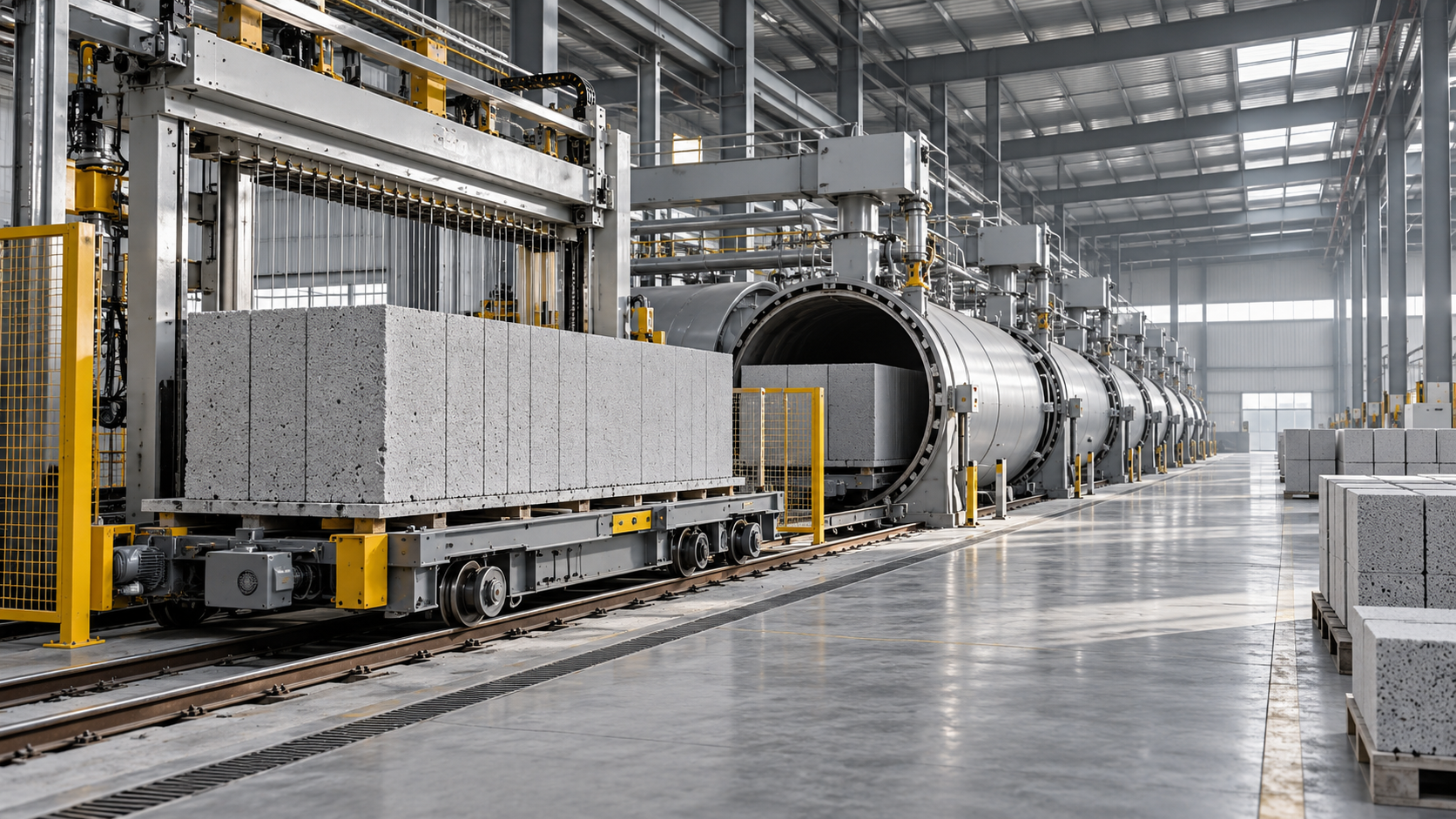
Compare usable loading volume and the full door-to-door cycle, including loading, heating, holding, depressurization, unloading, and turnaround. Vessel volume by itself does not establish daily output. The loading arrangement must also be compatible with the cake dimensions and transport system.
Steam supply should be assessed against the production schedule. Average consumption can conceal short periods of high demand when several vessels require steam. An undersized supply can delay heating and disrupt the schedule even when its average daily capacity appears adequate.
Ask for a steam balance showing vessel sequencing, distribution losses, condensate arrangements, and any proposed steam transfer between vessels. Pressure-vessel documentation and installation provisions must also suit the project location.
Use the site layout to expose missing equipment
A quotation becomes easier to assess when every major item appears on a layout tied to the actual plot. Follow material movement from delivery and storage through preparation, casting, curing, and packing. Include maintenance access, vehicle routes, drainage, and finished-product storage.
A compact equipment footprint can conceal substantial space requirements. Blocks need room for unloading, inspection, packing, and dispatch. Limited storage can interrupt production when dispatch slows, even though the process equipment remains available.
Foundation loads, pits, rails, and embedded items should be resolved before civil construction. Late changes to mold handling or autoclave positioning can require structural alterations and delay installation.
Choose automation around process control and fault recovery
Automation is most valuable where it maintains repeatability or coordinates connected stages. Accurate weighing, recipe management, material-level monitoring, temperature measurement, and traceable batch records directly support stable production. Automatic handling also reduces manual intervention between tightly timed operations.
Ask what happens during an interruption. A line needs defined responses to a failed sensor, delayed cake, blocked transfer route, or interrupted power supply. Recovery procedures matter because partially processed material cannot always remain in place indefinitely without affecting quality.
The control system should record actual batch quantities and relevant process conditions, with alarms that identify the affected equipment and the cause requiring attention. Confirm access to backups, electrical drawings, software recovery procedures, and replacement component specifications.
Automation scope should also reflect local maintenance capability. A highly integrated arrangement requires reliable diagnostics and technical support. Where those resources are limited, accessible components and clear recovery procedures deserve greater weight in the selection.
Compare quotations through scope and cost per accepted cubic meter
Bring each quotation onto the same supply boundary. A lower equipment price can reflect excluded raw-material preparation, steam generation, electrical distribution, installation, or packing equipment. These omissions affect both investment and the ability to start production.
Use a responsibility schedule covering equipment supply, freight, unloading, foundations, erection, wiring, piping, commissioning materials, and performance testing. Identify who supplies each connecting component. Interfaces between packages are frequent sources of extra work when responsibility is left unclear.
For operating comparisons, calculate costs per accepted cubic meter using the same recipe, product mix, utility prices, and operating schedule. Include raw materials, electricity, steam or fuel, labor, consumables, maintenance, and rejected product. Consumption claims need a stated measurement boundary; a figure covering only selected machinery cannot represent the entire plant.
Maintenance details help distinguish apparently similar offers. Ask how cutting wires are changed, which wear parts require regular replacement, and whether pumps, bearings, seals, and control components have accessible equivalents. Service access and replacement-part lead times affect downtime as directly as component durability.
Turn performance claims into an acceptance plan
Before placing the order, agree on how the installed line will demonstrate its performance. The test should use the specified raw materials and product mix, with utilities within agreed conditions. Define the production period and how interruptions, rejected blocks, and reprocessed material will be recorded.
Output, quality, and consumption need to be demonstrated under the same agreed operating conditions. A high output run with unacceptable blocks does not establish usable capacity. Equally, a small batch of good blocks does not demonstrate sustained production.
Acceptance criteria should address saleable volume, dimensions, density, and compressive strength using agreed sampling and test methods. Where dimensional accuracy is assessed, record results after curing and handling. Define any consumption measurements clearly, including whether startup and idle periods are included.
Commissioning responsibility should extend beyond mechanical movement. It should include recipe adjustment, stable mold circulation, cutting setup, autoclave sequencing, and fault recovery. Training is more useful when it includes a disrupted production sequence alongside normal operation.
For a phased startup, identify exactly how future capacity will be added. Extra molds, autoclaves, preparation equipment, or packing capacity each impose different space and utility requirements. Reserve the necessary connections and access during the initial design, and require an explanation of how expansion will affect the operating line.
The final selection should be supported by a material trial report, a balanced production schedule, a site-specific layout, a complete supply boundary, and measurable acceptance terms. Any unresolved assumption in those documents deserves attention before it becomes a construction or commissioning constraint.
Next:No more content
Recommend
 Oct 24, 2026
How Do You Choose an AAC Block Machine for a New Plant?
How do I choose an AAC block machine for a new plant? Discover how to match output, raw materials, autoclaves, and costs to select a balanced production line and avoid costly mistakes.
- Oct 24, 2026
What Are the Key Design Requirements for an AAC Factory?
Explore AAC factory design requirements for efficient layouts, reliable utilities, and balanced production. Learn how to avoid bottlenecks and plan a safer, more productive plant.
- Oct 23, 2026
What Should an Annual Hydraulic Brick Machine Maintenance Budget Cover?
Understand hydraulic brick making machine maintenance cost: budget for oil, wear parts, labor, and repairs. Discover how to plan annual spending and reduce costly downtime.