What Are the Key Design Requirements for an AAC Factory?
An AAC plant can have a capable mixer, an accurate cutting system, and well-built autoclaves—and still struggle to meet its production target. The problem often lies between those machines: insufficient mold circulation, unstable steam pressure, limited curing space, or a layout that forces materials to travel too far.
Effective AAC factory design requirements therefore cover the entire production system, not simply the equipment list. For investors, project engineers, and plant managers, the objective is to create a facility where raw materials, process timing, utilities, and product handling work together. Resolving these relationships before construction is usually far less disruptive than correcting them after commissioning.
Define the Production Basis Before Drawing the Layout
The first design decision is not where to place the autoclaves. It is what the factory must reliably produce, under which operating conditions.
Specify annual saleable output, expected operating days, shift arrangements, product dimensions, density classes, and applicable strength requirements. A plant producing standard blocks has different handling and process needs from one intended to manufacture reinforced AAC panels. Panel production also requires reinforcement preparation, corrosion protection, cage assembly, positioning equipment, and additional quality checks.
Convert the annual target into hourly and batch requirements using realistic availability and yield assumptions:
Required gross production rate = annual saleable volume ÷ (scheduled operating hours × availability × saleable yield).
Keep the volume basis consistent throughout the calculation. Mold capacity, cut-cake volume, and packaged saleable output are not automatically interchangeable. Allow for cutting losses, rejected products, cleaning, maintenance, and product changeovers rather than treating every scheduled hour as productive time.
This design basis should also state site conditions, available utilities, raw material sources, and any planned expansion. Without it, equipment quotations may describe substantially different factories even when they show the same nominal annual capacity.
Let Raw Material Testing Shape the Process
AAC formulations commonly use a silica source such as sand or suitable fly ash, together with lime, cement, gypsum, water, and an aluminum-based aerating agent. Their behavior determines much of the plant design.
Sand mineralogy and fineness influence grinding requirements and hydrothermal reactions. Fly ash composition, fineness, and variability can affect formulation and slurry preparation. Lime reactivity influences heat development and rising behavior, while aluminum dosing must remain closely controlled.
Before finalizing equipment, obtain representative samples and evaluate:
- Silica-source chemistry, fineness, moisture, and consistency between deliveries.
- Lime activity, slaking characteristics, and storage stability.
- Cement and gypsum properties relevant to setting and formulation control.
- Water chemistry and the effect of recycled process water.
- Trial-batch rising, setting, cutting behavior, and finished-product performance.
These findings guide whether the plant needs wet grinding, additional slurry storage, screening, temperature adjustment, or more flexible dosing. Designing around an unverified recipe creates a risk that civil works and installed equipment will constrain the process later.
AAC Factory Design Requirements: Balance Flow and Cycle Times
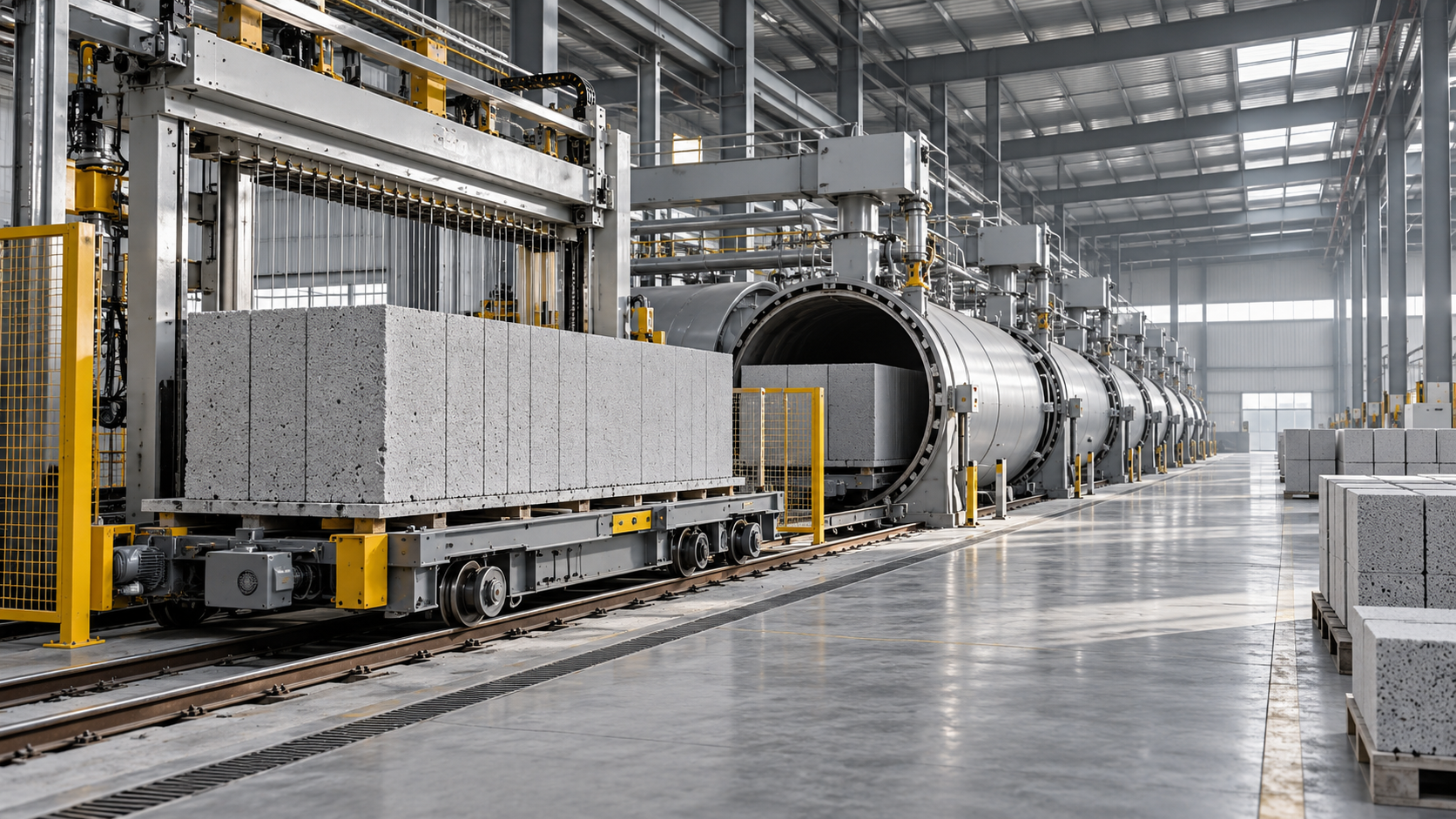
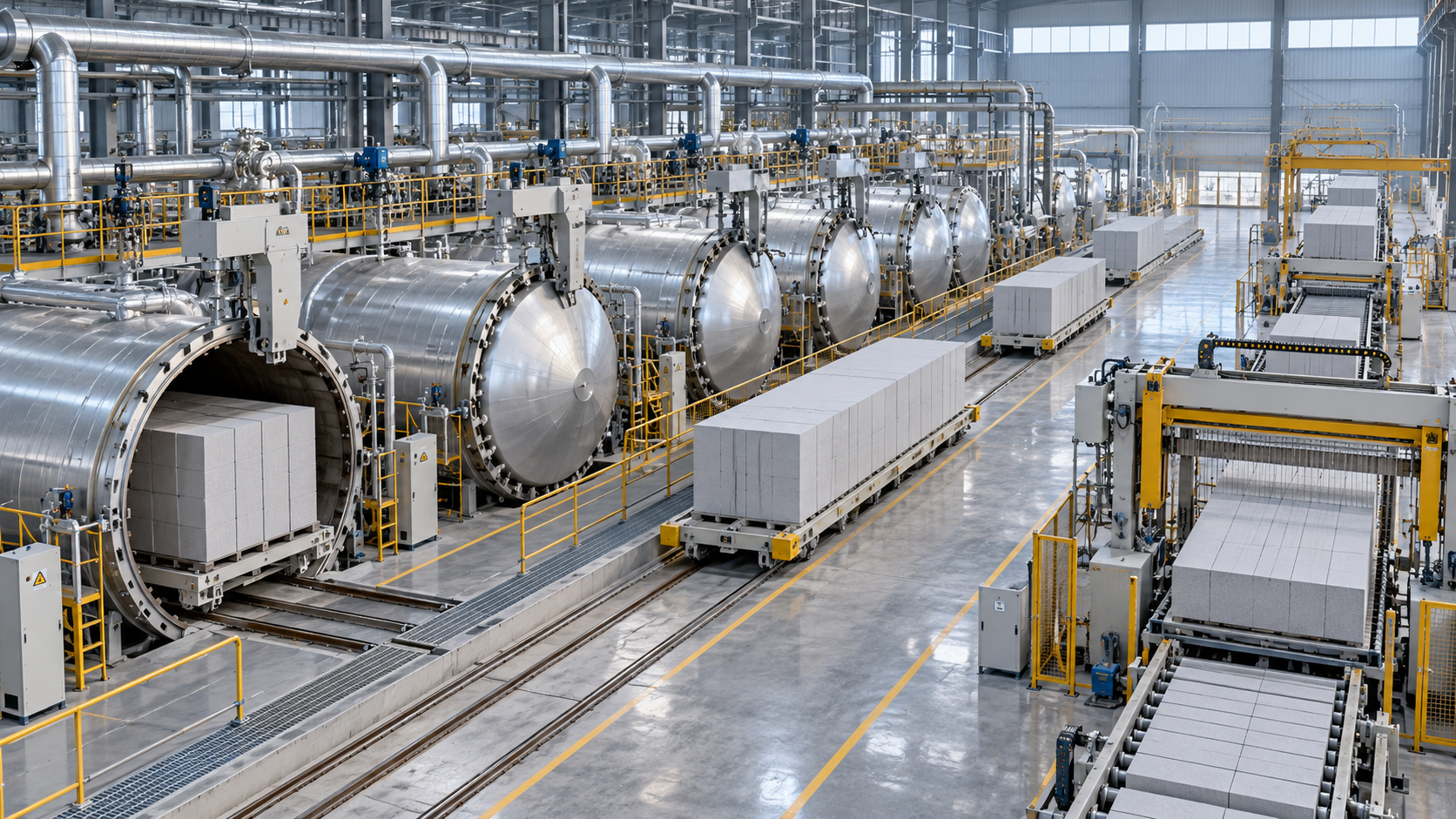
A practical block-production route typically follows raw material preparation, batching and mixing, casting, pre-curing, demolding and cutting, autoclaving, separation, and packaging. Mold return, scrap recovery, and condensate handling run alongside this main flow.
The layout should make these movements visible and straightforward. Avoid unnecessary crossings between fresh cakes, cured products, forklifts, and returning molds. Short travel distances matter, but not at the expense of safe access or adequate process buffers.
Pre-curing capacity deserves particular attention
Freshly cast material must develop enough green strength for demolding and cutting. This holding period depends on formulation, material temperatures, ambient conditions, and the required cutting condition—not merely the desired line speed.
Provide enough molds and pre-curing positions for the validated residence time, with an allowance for normal variation. In cold climates, enclosure, insulation, or controlled heating may be necessary. Simply accelerating mold movement can lead to cakes reaching the cutting station before they are ready.
Match continuous operations to batch curing
Autoclaves operate in batches, while upstream casting and cutting may follow a more continuous rhythm. Their capacity calculation must include loading, heat-up, pressure holding, depressurization, unloading, and operational allowances—not only the steam-holding period.
Check cutting-machine throughput, transfer equipment, curing-car availability, and autoclave schedules together. A time-based production simulation can expose queues that a static equipment list misses. Buffers should absorb normal variation without allowing green cakes to wait beyond an acceptable process window.
Choose the Site and Building Around Real Loads
There is no universal land-area requirement for an AAC factory. Capacity alone is insufficient: storage policy, building configuration, product mix, local setbacks, and expansion strategy all affect the footprint.
A workable site needs reliable road access, drainage, suitable ground conditions, and space for incoming materials and outgoing products. Assess flood exposure and seasonal weather early. Finished AAC must be handled and stored in a way that limits damage and supports orderly dispatch.
Geotechnical investigation should precede foundation design. Silos, mills, autoclaves, cranes, and loaded transfer systems impose different static and dynamic loads. Foundations, rails, pits, and embedded items must follow coordinated equipment drawings rather than approximate footprints.
Building height should accommodate lifting operations, maintenance removal, ducts, and services. Around autoclaves, allow for door operation, loading equipment, inspection, and thermal movement. A compact building is not economical if routine maintenance later requires dismantling adjacent equipment.
Design Steam, Power, and Water as Production Systems
Utilities are often treated as supporting infrastructure. In an AAC factory, they directly influence production stability and operating cost.
For steam, distinguish average consumption from peak demand when several autoclaves require heating close together. Boiler selection, steam headers, pressure regulation, insulation, traps, and condensate return must work as one system. Staggered curing schedules may reduce demand peaks, but scheduling cannot compensate for fundamentally inadequate supply.
Steam transfer and heat recovery may improve energy performance where technically suitable. Their value depends on cycle coordination, pressure levels, water quality, and control arrangements. Evaluate these options through a project-specific heat balance rather than assuming a standard saving.
Separate clean stormwater, process water, sanitary wastewater, and potentially contaminated drainage. Recovered cutting slurry and wash water can often return to production, but their solids content and temperature need control to avoid shifting the formulation.
Build Quality Control into the Line
Consistent AAC quality depends on repeatable conditions before the finished block reaches the laboratory. Critical measurements include dosing accuracy, slurry density and temperature, mixing time, rising behavior, cutting readiness, dimensions, and autoclave temperature-pressure histories.
The control system should connect these records to identifiable batches. If strength or dimensional results drift, operators need to trace the issue back to materials and process conditions instead of relying on memory.
Provide accessible sampling points and a laboratory appropriate to incoming-material checks, process testing, and finished-product verification. Test methods and acceptance criteria should follow the standards applicable to the intended market. Density and compressive strength are important, but dimensional tolerances, shrinkage, and other properties may also be required.
Automation should support this discipline. Recipe management, calibrated weighing, alarms, interlocks, and historical trends are generally more useful than a visually impressive control screen without reliable field measurements.
Resolve Safety and Environmental Controls Before Construction
Autoclaves and boilers require pressure-equipment engineering, inspection, and operating arrangements that comply with local law. Door-locking and pressure-safety systems must prevent unsafe opening; operators should never depend on a procedure alone to establish that a vessel is safe.
Aluminum-based aerating agents also require particular attention. Depending on the supplied form, storage and handling may involve combustible-dust hazards, while the AAC rising reaction releases hydrogen. Ventilation, ignition-source control, electrical suitability, and detection requirements should follow a documented hazard assessment.
Other essential provisions include:
- Guarding and interlocks around cutting, tilting, transfer, and packaging equipment.
- Dust collection at powder unloading, conveying, and dosing points, with controls for respirable silica exposure.
- Safe access platforms, emergency exits, lifting arrangements, and equipment-isolation points.
- Noise management and suitable protection from hot surfaces and steam releases.
- Boiler-emission controls appropriate to the fuel and local permit conditions.
Allow physical space for these systems during layout development. Dust collectors, service platforms, and escape routes are difficult to accommodate properly once every available area has been assigned to production equipment.
Protect Maintenance Access and Future Expansion
Consider an ordinary maintenance shift: a pump needs removal, a cutting wire needs replacement, and an autoclave requires inspection. Can those tasks happen safely without blocking the entire factory?
Provide removal routes, lifting points, workshop space, spare-parts storage, and access to wear components. Check clearances against actual replacement tasks, not just an operator walking past the machine. Drainage and cleaning access are equally important around slurry preparation and recovery areas.
Expansion should be specific. Reserve identified positions for additional autoclaves, storage, or packaging capacity, and assess the implications for steam, power, roads, and dispatch. Leaving spare land is useful, but it does not guarantee expansion if the original material flow cannot accommodate another production stage.
What to Confirm Before Approving the Design
Before equipment procurement and civil construction are released, assemble a coordinated package: a signed design basis, raw material test results, process flow diagram, equipment layout, production-cycle balance, utility balances, foundation loads, safety review, and commissioning acceptance plan. Responsibilities at each supplier interface should be explicit.
Acceptance criteria should address saleable output and product quality under agreed conditions—not simply whether individual machines run. Define the raw materials, operating schedule, utility conditions, and test methods used to demonstrate performance.
For discussions with Shandong Hongfa Scientific Industrial & Trading Co., Ltd., these documents provide a practical starting point. Hongfa’s construction-machinery manufacturing background, dating to 1990, and its AAC production-line offering are relevant to equipment planning; the project still needs site-specific coordination with civil designers, utility specialists, and local compliance professionals.
The strongest AAC factory design is not necessarily the one with the most equipment. It is the one in which material behavior, production timing, infrastructure, and maintenance needs have been reconciled before construction—so the plant can produce consistently without depending on daily workarounds.
Recommend
 Oct 24, 2026
How Do You Choose an AAC Block Machine for a New Plant?
How do I choose an AAC block machine for a new plant? Discover how to match output, raw materials, autoclaves, and costs to select a balanced production line and avoid costly mistakes.
- Oct 24, 2026
What Are the Key Design Requirements for an AAC Factory?
Explore AAC factory design requirements for efficient layouts, reliable utilities, and balanced production. Learn how to avoid bottlenecks and plan a safer, more productive plant.
- Oct 23, 2026
What Should an Annual Hydraulic Brick Machine Maintenance Budget Cover?
Understand hydraulic brick making machine maintenance cost: budget for oil, wear parts, labor, and repairs. Discover how to plan annual spending and reduce costly downtime.