

How Much Can a Hydraulic Roof Tile Machine Produce per Shift?
A hydraulic roof tile machine can produce a useful volume of tiles in one shift, but the answer is rarely the machine’s advertised cycle time multiplied by the number of working hours. That figure assumes continuous feeding, stable material moisture, an available mold, no quality holds, and no interruptions for cleaning or adjustment. A production plan based on that assumption can leave a plant short of finished tiles even when the press itself performs as specified.
For planning purposes, per-shift output should be treated as a range. The upper end represents a stable run of one tile design with prepared material and few stops. The lower end is more realistic when the line changes profiles, operators are still tuning the mix, molds require cleaning, or downstream handling cannot keep pace. The right question is therefore not simply “How many tiles per hour?” but “How many accepted tiles can the complete line produce during our actual shift?”
Start with net productive time, not shift length
A shift may be eight, ten, or twelve hours, but only part of that time is available for repetitive pressing. Material preparation, startup checks, mold changes, hydraulic warm-up, trial pieces, cleaning, planned breaks, and end-of-shift housekeeping all reduce net run time. If a buyer compares machines by multiplying a nominal output rate by a full shift, the comparison can be misleading before installation even begins.
A more reliable working calculation is:
Accepted tiles per shift = net running minutes × completed cycles per minute × tiles per cycle × acceptance rate
Each term needs to be defined for the intended production arrangement.
- Net running minutes are the minutes when the machine is actually making tiles, excluding planned and unplanned stops.
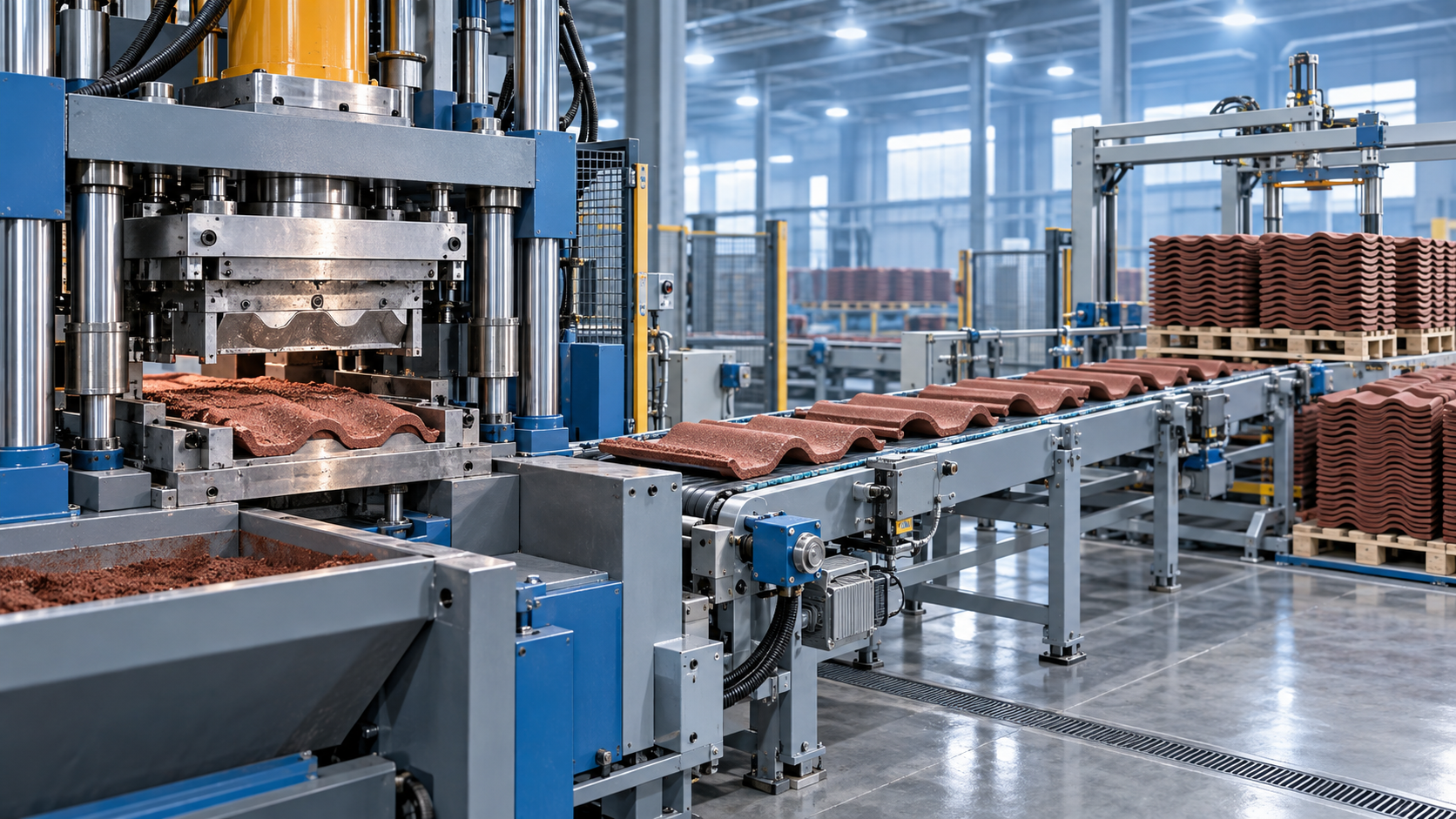
- Completed cycles per minute include feeding, forming, hydraulic pressing, mold release, discharge, and any motion needed to return the station to its next cycle.
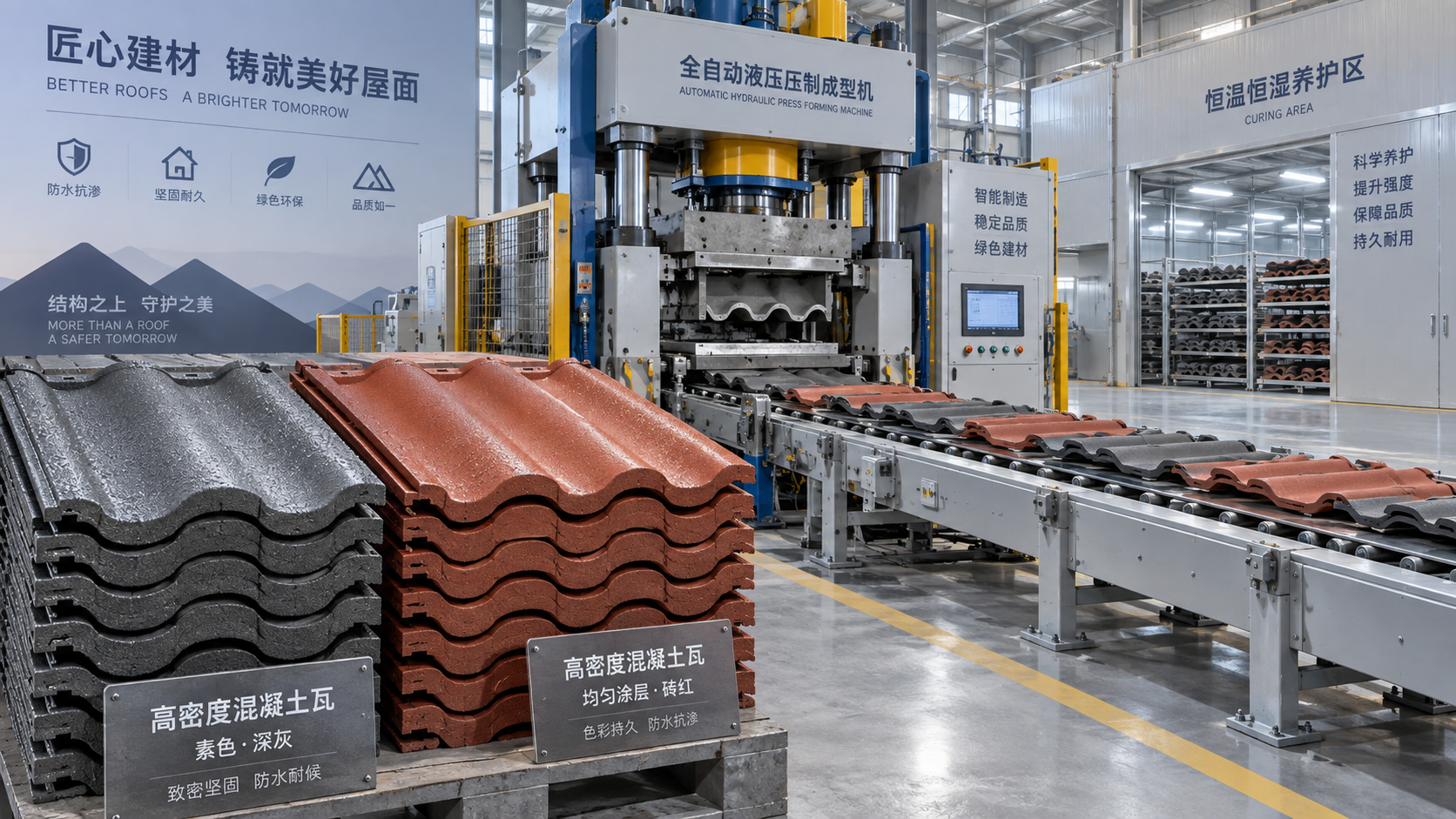
- Tiles per cycle depend on the mold configuration. A machine with multiple cavities may deliver several pieces in one press stroke, provided filling and demolding remain consistent.
- Acceptance rate removes cracked, warped, poorly formed, dimensionally inconsistent, or otherwise rejected tiles from the production total.
This calculation is simple, but it forces the right discussion. A press can have a fast hydraulic movement while the complete cycle remains slow because the material feed is inconsistent or finished tiles cannot be cleared quickly enough. Conversely, a line with a moderate press speed may achieve stronger shift output when its feeding, conveying, and handling systems are well matched.
Why rated output and real output diverge
Manufacturers often state capacity under favorable operating conditions. That rating is useful for identifying the broad size of a machine, but it is not a production guarantee for every roof tile. Tile geometry, surface detail, thickness, mold cavity count, material behavior, and line configuration all change the achievable rhythm.
Roof tiles with deeper profiles, sharper decorative features, edge locks, or more demanding surface requirements may need more controlled filling and release than a simpler flat product. A mold that produces several pieces at once can increase pieces per cycle, but it also creates more opportunities for uneven filling, sticking, or incomplete edge formation. More cavities are valuable only when the feed system distributes material evenly and the mold remains stable throughout the shift.
Hydraulic pressure is another source of misunderstanding. Higher press force does not automatically mean more output. The machine needs enough force, rigidity, and control to compact the selected material and reproduce the required shape. Once that requirement is met, the production limit may move elsewhere: feeder travel, material delivery, mold cleaning, discharge handling, or curing space. Selecting a larger press purely for headline capacity can add cost without solving the constraint that limits actual output.
Cycle time should also be viewed as a sequence rather than a single number. Ask how long the line spends on each of the following operations:
- Metering and feeding the prepared mix into the mold;
- Leveling, spreading, or pre-compacting material where applicable;
- Hydraulic closing and pressing;
- Pressure holding, if the product recipe requires it;
- Opening, stripping, and releasing the formed tile;
- Moving the tile to a pallet, conveyor, or handling station;
- Resetting the mold for the next piece.
A short pressing stage can create a convincing capacity claim, yet it is the total repeated sequence that determines output. Buyers should ask for the full cycle description for their tile profile and mold arrangement, rather than relying on the time assigned to the press stroke alone.
Material flow often decides the shift result
A hydraulic roof tile machine cannot run steadily on material that varies from batch to batch. Whether the product uses a cement-based concrete mix, colored facing material, or another suitable formulation, the feed must arrive at the machine with controlled consistency. Changes in moisture, aggregate grading, pigment distribution, fiber content, or mixing time can affect fill weight, compaction, edge quality, and demolding behavior. The operator then slows the line to correct defects, even though the press remains mechanically capable of running faster.
Production capacity should therefore be assessed as a line balance. The mixer must supply enough prepared material. Storage hoppers and conveyors must prevent the press from waiting. The feed mechanism must deliver repeatable quantities. Pallets or trays must be available at the discharge end. Finished green tiles must have enough handling and curing capacity so that they do not block the machine.
This is especially important for plants moving from manual or semi-automatic work to a more automated roof tile line. The press may be upgraded first because it is the most visible machine, but output will not rise as expected if mixing, feeding, stacking, or curing still depends on a slower manual task. In that situation, the practical improvement may come from stabilizing the transfer between stations rather than increasing press speed.
Material supply should also be judged over the entire shift. A line that runs quickly for the first hour but pauses while a mixer catches up has a lower output than a slower line with continuous feed. When evaluating hydraulic roof tile machine production capacity, ask for the required batch size, mixing frequency, hopper buffer, and material transfer arrangement at the target production rate.
Mold choice changes both output and flexibility
The mold is central to capacity because it determines the number of tiles made in each cycle and the amount of work needed to change products. A dedicated mold for a high-volume tile profile can support repeatable, efficient production. A plant serving several local roof styles, colors, or accessory pieces may need frequent mold changes, which reduces the productive portion of each shift.
It is useful to separate two operating models:
A quoted hourly rate may be achievable in the first model but unsuitable for the second. A buyer whose sales mix requires several designs should ask for changeover time as a separate item, including cleaning, mold installation, alignment, initial adjustment, and the production of acceptable first pieces. Treating all of that time as invisible can materially distort the expected daily output.
Mold condition matters as much as mold quantity. Wear, damage, inadequate lubrication, poor alignment, or buildup from the material mix can cause sticking and dimensional inconsistency. Operators may respond by slowing the machine or stopping repeatedly to clean the cavities. A spare mold strategy and a documented maintenance routine can protect output more effectively than attempting to push a worn mold through a full shift.
Automation improves consistency when the whole line is matched
Automation can raise per-shift production by reducing variation in feeding, pressing, discharge, and transfer. It can also reduce dependence on an operator manually judging every cycle. However, automation is not a universal multiplier. A fully automated press connected to an undersized mixer or limited pallet handling system will simply spend more time waiting.
For a smaller operation, a semi-automatic arrangement may deliver a satisfactory output if one or two trained operators can maintain the pace and the product range is limited. For a larger production target, automated feeding and tile handling may be justified because the main benefit is a more stable cycle over the shift. The choice should be based on expected order volume, tile variety, labor availability, and the ability to maintain the supporting equipment.
Automation also changes the nature of downtime. Manual lines may lose time through uneven feeding or inconsistent handling. Automated lines may lose time when sensors, conveyors, actuators, or control settings are not maintained. During supplier discussions, buyers should look beyond the press itself and clarify which equipment is included in the stated capacity: mixer, batcher, feeder, pallet system, conveyors, stacking equipment, and control system may all affect the result.
Count good tiles, not press strokes
A plant does not sell cycles; it sells tiles that meet its dimensional, appearance, and strength requirements after the relevant curing process. A high cycle count is not useful when defects create sorting work, reprocessing, waste, or customer complaints. Capacity planning must include the quality threshold required by the target market.
Early production after a mold change or recipe adjustment may generate pieces that are unsuitable for sale. Minor defects may be acceptable in one market segment and unacceptable in another. Surface finish, color consistency, water-shedding geometry, edge condition, and dimensional fit can all matter for roof tile buyers. The acceptance rate in the shift calculation should reflect that commercial reality rather than assuming every discharged tile is finished inventory.
There is also a difference between green-tile output and available shipment volume. A press may form tiles rapidly, while curing, storage, inspection, and packing determine when those tiles can be released. A factory planning output against delivery dates should map the production flow through the point at which goods are actually ready for dispatch. Otherwise, the press becomes the visible measure of capacity while finished-goods availability remains constrained elsewhere.
How to evaluate a machine before committing to a capacity target
A useful supplier discussion begins with the buyer’s tile drawing, dimensions, target finish, material recipe, number of daily design changes, shift pattern, and expected quality standard. Without those details, a capacity statement is only a general indication.
Ask the supplier to show the calculation in operational terms: expected total cycle time, mold cavities, planned net running time, staffing assumptions, and the upstream and downstream equipment needed to sustain the rate. It is also reasonable to ask how the line handles startup, mold changes, routine cleaning, and common stoppages. These answers reveal whether the quoted output describes a complete operating system or only the mechanical potential of the press.
For a credible internal plan, build three numbers rather than one: a conservative output for mixed conditions, a normal output for routine production, and a best-case output for long stable runs. Use the normal figure for sales and material planning. Use the conservative figure to judge whether commitments can still be met when the line needs adjustment or maintenance. The best-case figure is useful for understanding the machine’s ceiling, but it should not be the basis for a delivery promise.
The most productive hydraulic roof tile machine is not necessarily the one with the fastest stated cycle. It is the one whose mold, material preparation, automation level, handling arrangement, and maintenance capability fit the factory’s product mix. Once those elements are balanced, per-shift output becomes predictable enough to plan labor, raw materials, curing capacity, and customer deliveries with far less uncertainty.
Recommend
 Sep 30, 2026
When does an automated building material production line pay off?
Automated building material production line ROI explained: assess capacity, quality, labor, waste, and total costs to make a profitable investment.
- Oct 01, 2026
How a green building material production line reduces material waste
Discover how a green building material production line cuts waste through precise batching, controlled forming, stable curing, and smart material recovery.
- Oct 02, 2026
What to confirm before finalizing AAC factory planning
AAC factory planning: confirm product mix, raw materials, capacity, utilities, layout, automation, and supplier scope before investing in a reliable, efficient AAC plant.