



What AAC Plant Installation Requirements Vary by Country?
What AAC Plant Installation Requirements Vary by Country?
AAC plant installation requirements different countries can change a project far more than many investors expect. The core process—preparing slurry, casting, cutting, pre-curing, autoclaving, and packing—remains familiar. What changes is the practical environment around that process: whether land can be approved for industrial use, how a boiler is licensed, whether the local grid can support large motors, how fly ash or sand is supplied, and what documentation is needed before a plant can run commercially.
This is why an AAC block production line should not be selected only from a capacity sheet. A line that performs well in one market may need a different steam system, electrical configuration, dust-control arrangement, or factory layout in another. In some countries, securing reliable steam is the central issue. In others, the bigger risk is imported spare parts, workforce availability, or the seasonal consistency of raw materials.
For project owners, the useful question is not simply, “What equipment do we need?” It is, “What version of this equipment can be legally installed, reliably operated, and economically maintained in this location?”
Permits Start With the Site, Not the Machine
An AAC project can be technically sound and still lose months because the chosen site does not match the intended industrial activity. Local zoning rules may distinguish between light manufacturing, heavy industry, warehouse use, and mineral processing. AAC manufacturing involves material storage, mixing, cutting, steam curing, internal transport, and truck traffic, so a site approval should reflect the complete production process rather than only the finished block warehouse.
Country-level rules are only part of the picture. In many markets, requirements are also set by provincial, state, municipal, or industrial-park authorities. A local authority may require drawings for access roads, drainage, fire routes, buildings, noise control, and utility connections before construction begins. It is risky to assume that a plot with existing industrial neighbors automatically has approval for an autoclaved aerated concrete plant.
The land itself affects equipment design. High groundwater, soft soil, flood exposure, seismic conditions, and extreme temperatures can all influence foundation engineering. Autoclaves, cutting sections, batching systems, and finished-product yards impose different loads on a site. The equipment supplier can provide load and layout information, but a locally qualified civil engineer should adapt that information to the actual ground conditions and building code.
A practical early-stage review normally includes site boundaries, road access for oversized equipment, availability of drainage, raw-material storage space, finished-goods stacking areas, and enough room for safe maintenance around the autoclaves and cutting line. A compact layout may reduce building cost on paper, yet it can create operational bottlenecks for years.
Steam, Boilers, and Pressure Equipment Are Often the Critical Path
The autoclave is at the heart of an AAC line, and the steam supply supporting it is often the most regulated part of the installation. Pressure-vessel registration, boiler inspection, operator licensing, fuel permits, stack requirements, periodic testing, and insurance conditions vary substantially by country. These items should be investigated before the autoclave and boiler package are finalized—not after machinery has arrived on site.
Some locations permit coal, natural gas, LPG, biomass, or other fuels under different conditions. Others may restrict certain fuels because of local emissions rules or industrial-park policy. Where gas supply is uncertain, the problem is not merely choosing another boiler. Fuel storage, combustion controls, ash handling, emissions treatment, operating cost, and local maintenance capability may all change.
It is also important to separate the supplier’s process design from local statutory approval. An equipment manufacturer can size the autoclave system and indicate steam demand based on the selected production arrangement. However, the final boiler-house design, pressure-system inspection route, and licensed operation requirements must meet the rules of the installation country. A project team that treats the boiler as an “auxiliary” item usually discovers too late that it governs the commissioning schedule.
Power Standards Change More Than the Plug Type
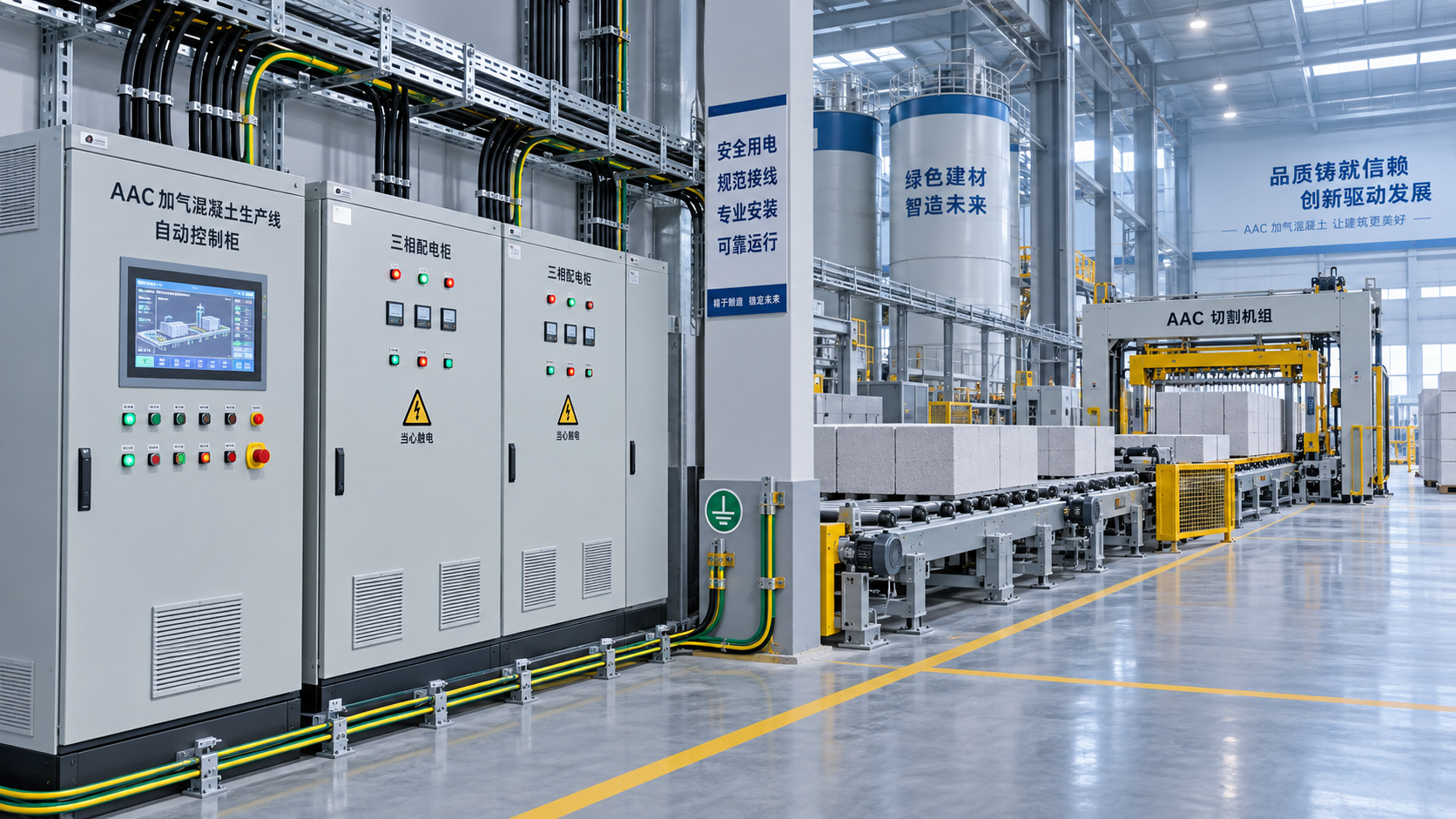
Electrical compatibility is one of the clearest examples of why AAC plant installation requirements differ by country. Grid voltage, frequency, earthing practices, cable standards, panel certification expectations, and utility connection procedures are not uniform. A motor and control arrangement suitable for one region may need redesign for another. This is particularly relevant for crushers, ball mills, mixers, cutting drives, pumps, conveyors, compressors, and packing equipment.
The key issue is not only whether the plant can be connected. It is whether the grid is stable enough for production. Voltage fluctuation, limited transformer capacity, frequent outages, or slow approval for a high-load connection can affect both startup and long-term output. Projects in areas with unstable power may need to consider backup power for selected systems, protection devices, or a revised operating strategy. Full-process backup generation can be expensive, so this decision requires a realistic review of the local utility situation.
Electrical drawings should be reviewed early by a local electrical contractor or engineer. They can identify requirements related to switchgear, emergency isolation, cable routing, grounding, fire protection, and inspection. Retrofitting control cabinets after shipment is possible, but it is rarely the cleanest or least costly path.
Raw Materials Decide Whether the Process Needs Adaptation
AAC is often described as a flexible building-material process because it can use different siliceous materials, including sand or certain industrial by-products where technically suitable. In reality, local feedstock variation is one of the biggest reasons a “standard” line needs adjustment. Sand grading, moisture, silica content, fly ash consistency, lime reactivity, gypsum availability, cement supply, and aluminum paste quality all influence the mix design and process control.
A region may have abundant sand but limited access to consistent fly ash. Another may have fly ash available from power generation but require careful testing because its composition varies. Transport distance matters as much as material availability. A low-cost raw material becomes less attractive when trucking, moisture handling, stockpile losses, or seasonal interruption are considered.
Before selecting major process equipment, the developer should arrange representative material testing and define a realistic supply plan. This is not a paperwork exercise. It affects whether a ball mill is needed, how slurry is prepared, the scale of storage silos, dust collection needs, water management, and the expected behavior of the cake during cutting and autoclaving. The most expensive production problems are often traced back to a mix designed around ideal material assumptions rather than actual local supply.
Environmental Compliance Is Usually a System, Not a Single Filter
Environmental approval requirements vary in detail, but AAC plants commonly need to address dust, boiler emissions, wastewater, noise, solid residues, and vehicle movement. The local regulator may require an environmental assessment before construction, emissions monitoring after startup, or specific waste-handling procedures. Requirements can also differ between a plant inside an approved industrial zone and one developed on an independent site.
Dust control deserves particular attention. Material unloading, dry batching, milling, and transfer points can generate dust if enclosure and collection are poorly planned. Water and slurry management need the same discipline. AAC production can often reuse process water within a designed system, but the project should not assume that all wastewater can be discharged or recycled without local approval and suitable treatment arrangements.
Noise is sometimes overlooked during layout planning. Compressors, mills, fans, cutting areas, and truck circulation may be acceptable in a remote industrial district but problematic near housing or mixed-use development. Setback distances and operating-hour restrictions should be verified before finalizing the building orientation.
Import Rules, Local Content, and Service Access Shape the Equipment Package
For imported AAC machinery, customs documentation is only the visible part of the job. Import duties, tax treatment, pre-shipment inspection requirements, local standards for electrical components, and documentation language can influence delivery timing. Some markets also place practical value on locally available electrical parts, bearings, seals, valves, and automation components because replacement lead times can be long.
This does not mean every component should be sourced locally. The correct approach is to identify which items are process-critical and which can be standardized around service availability in the destination market. A cutting-line part, an autoclave valve, or a specialized control component may require planned spare-stock management. Simple consumables can often be selected with local procurement in mind.
Manufacturers with broad building-material equipment experience can contribute useful discipline at this stage. Shandong Hongfa Scientific Industrial & Trading Co., Ltd., established in 1990, manufactures aerated concrete block production lines alongside block machinery, batching plants, and other construction-material equipment. Its production bases and engineering workforce provide a foundation for discussing line configuration, manufacturing coordination, and technical documentation. Still, destination-country compliance should always be verified with local engineering, inspection, and regulatory specialists rather than treated as a factory-side assumption.
Labor and Safety Expectations Need to Be Built Into the Layout
An AAC plant needs more than operators who can start and stop equipment. Safe production depends on teams that understand slurry preparation, cutting accuracy, steam curing, lifting practices, lockout procedures, pressure-equipment safety, and routine inspection. The availability of skilled electricians, welders, boiler operators, automation technicians, and mechanical maintenance personnel differs widely between markets.
Where experienced industrial labor is limited, automation may reduce some repetitive handling but does not remove the need for training. In fact, a highly automated line can be harder to recover when a sensor, actuator, or sequence fault is not understood locally. Commissioning plans should allow time for operator training, maintenance instruction, translation of operating documents where required, and supervised trial production using actual site materials.
Safety rules may require machine guarding, emergency stops, access platforms, fire systems, lifting inspections, confined-space procedures, and specific personal protective equipment. These are not details to be added at handover. Guarding and access clearances must be reflected in the mechanical layout from the beginning.
Questions to Resolve Before Ordering an AAC Line
A well-prepared project team normally resolves a short list of difficult questions early:
- Is the land legally approved for this type of manufacturing and boiler operation?
- Which fuel and pressure-equipment approvals apply to the steam system?
- What electrical voltage, frequency, grid capacity, and local panel requirements apply?
- Have representative sand, fly ash, lime, gypsum, cement, and aluminum materials been evaluated?
- What environmental permits are required for dust, emissions, water, waste, and noise?
- Which spare parts should be held locally, and who will provide technical maintenance support?
- Does the civil layout provide safe access for raw materials, finished blocks, maintenance, and emergency response?
These questions are more valuable than a generic installation checklist because they expose the country-specific constraints that drive cost and timing. If the answers are uncertain, the equipment specification is still premature.
The Better Way to Plan an International AAC Installation
The strongest AAC projects coordinate three parties early: the investor or plant owner, the equipment manufacturer, and local engineering or compliance professionals. The owner brings market demand, land, financing, and raw-material access. The machinery supplier defines process flow, equipment interfaces, and manufacturing requirements. Local specialists confirm that the design can be built and approved under local law and site conditions.
This approach also avoids a common mistake: buying a capacity level before defining the operating model. A plant’s viable capacity depends on market demand, product dimensions, curing cycle, raw-material logistics, utility reliability, labor shifts, and warehouse turnover. The highest nominal output is not always the most practical choice for a new market.
Across different countries, the AAC process may look similar, but the installation path is never identical. The successful project is usually the one that treats permitting, utilities, materials, pressure systems, and service support as part of the production line—not as problems to solve after the equipment is on the water.
Recommend
 Sep 30, 2026
When does an automated building material production line pay off?
Automated building material production line ROI explained: assess capacity, quality, labor, waste, and total costs to make a profitable investment.
- Oct 01, 2026
How a green building material production line reduces material waste
Discover how a green building material production line cuts waste through precise batching, controlled forming, stable curing, and smart material recovery.
- Oct 02, 2026
What to confirm before finalizing AAC factory planning
AAC factory planning: confirm product mix, raw materials, capacity, utilities, layout, automation, and supplier scope before investing in a reliable, efficient AAC plant.