



What Is the Overseas AAC Plant Commissioning Timeline?
Understanding the AAC plant commissioning timeline for an overseas project is essential for controlling investment risk, coordinating installation teams, and reaching a stable production start without costly surprises. An autoclaved aerated concrete (AAC) plant is not a single machine that can simply be switched on after delivery. It is an integrated production system involving civil works, raw-material handling, batching, mould circulation, cutting, pre-curing, autoclaving, finished-product handling, utilities, automation, and safety procedures.
For overseas investors, the schedule also has another layer: international transport, customs clearance, local construction conditions, labor availability, power and steam connections, and communication between the equipment supplier and the site team. A realistic plan is therefore more valuable than an overly short promise. The goal of commissioning is not merely to produce the first block, but to establish a repeatable process that delivers acceptable product quality, safe operation, and a dependable production rhythm.
A practical view of the overseas AAC plant commissioning timeline
The full timeline for an overseas AAC block production project commonly extends from several months to more than a year, depending on plant capacity, degree of automation, site readiness, local infrastructure, and the scope supplied by the equipment manufacturer. The period after equipment arrives on site is only one part of the journey.
For planning purposes, investors often divide the work into six connected phases:
A smaller or relatively standardized line may move through the on-site installation and commissioning stage in a matter of weeks once foundations, utilities, and labor are fully ready. A larger integrated AAC plant, especially one including extensive material storage, automatic packing, or complex steam infrastructure, needs a longer and more carefully sequenced start-up period. The important point is that “commissioning complete” should be defined before the project begins.
The schedule begins long before installation engineers arrive
Many schedule problems begin during the early planning stage, when the equipment list is discussed but the operating environment is not examined closely enough. AAC production depends on a balanced relationship between raw materials, process equipment, steam supply, and control parameters. If the plant is planned for local sand, fly ash, lime, cement, gypsum, or aluminum paste, those materials should be sampled and assessed as early as possible.
Raw-material variability can affect slurry consistency, expansion behavior, green-cake strength, cutting performance, and final block density. A line can be mechanically installed on time yet still require additional adjustment because the actual local material differs from the initial assumptions. This is why a detailed technical exchange between investor, local engineering team, and supplier is more than paperwork. It protects the commissioning schedule later.
At this stage, the project team should confirm:
- Available electrical voltage, frequency, and transformer capacity;
- Water source, treatment needs, drainage, and recycling arrangements;
- Steam source, boiler selection, fuel availability, and local pressure regulations;
- Local climate conditions that may influence storage, curing, or construction work;
- Access for containers, oversized cargo, cranes, and internal transport;
- Applicable construction, environmental, fire, and pressure-vessel requirements.
These details may seem separate from the AAC plant commissioning timeline overseas project managers are trying to estimate. In practice, they decide whether installation begins smoothly or pauses while the team waits for a missing utility connection, an altered foundation, or a delayed permit.
Civil works: the part that should not be rushed
Heavy equipment can only be installed accurately on properly finished foundations. The autoclave area, cutting section, mould circulation route, batching system, and major conveyors all require correct elevation, embedded parts, and positional tolerances. Where rails or transfer systems are involved, alignment becomes particularly important. A small civil deviation can create recurring mechanical difficulties later.
Good project coordination means releasing civil drawings early enough for local construction teams to work while equipment is being manufactured. However, construction should not proceed using outdated layouts. Changes to plant capacity, product dimensions, autoclave quantity, or material-handling routes can affect foundations and building dimensions.
Before shipment arrives, the site should ideally have the main workshop enclosed or sufficiently protected, foundations cured and checked, lifting paths available, and temporary power arranged. It is expensive to use skilled commissioning engineers as site coordinators while concrete work, drainage, or roof installation is still incomplete.
Shipping and customs are schedule items, not administrative footnotes
International delivery can be straightforward, but it should never be treated as an automatic event. AAC plant equipment includes structural components, motors, control cabinets, pumps, cutting equipment, moulds, pipelines, and sometimes large pressure-related equipment. Packing lists must correspond accurately to customs documentation, and the buyer should understand local import procedures before the cargo leaves port.
Delays may arise from port congestion, incomplete import permits, tariff classification questions, inland transportation restrictions, or insufficient unloading capacity at the plant. For this reason, project managers should prepare a delivery sequence rather than only a shipment date. Equipment needed first for installation should be accessible first. Parts that must be stored should be protected from moisture, dust, impact, and loss.
A clear division of responsibility is equally important. The equipment supplier may provide export packing and shipping documents, while the buyer or appointed logistics company handles destination customs clearance and inland delivery. If nobody is assigned to arrange cranes, forklifts, unloading labor, and storage areas, even an on-time shipment can become an on-site bottleneck.
Installation is a coordinated construction task
Mechanical installation normally follows the production flow: raw-material preparation, batching, pouring, pre-curing, cutting, autoclaving, and finished-product handling. Yet actual site sequencing may vary according to building completion, crane access, and the availability of installation crews.
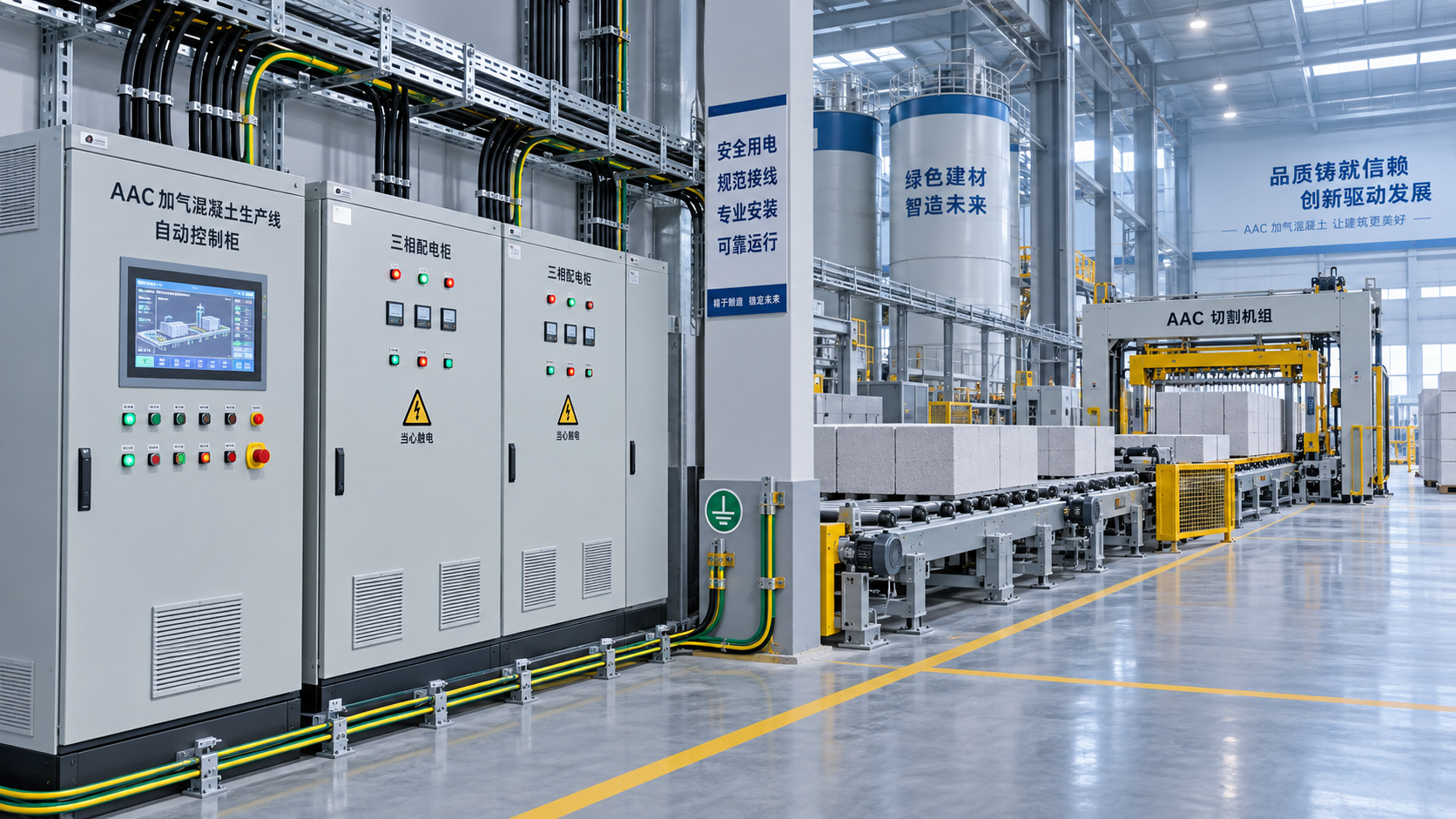
Mechanical assembly alone is not enough. Electrical wiring, control cabinet installation, sensor positioning, pneumatic lines, water pipelines, valves, steam connections, insulation, and safety interlocks must be completed and checked as one system. The more automatic the line, the more important it is to confirm each communication point and operating signal before loading material into the process.
During overseas installation, local teams play a decisive role. Supplier engineers can guide assembly, inspect critical work, adjust equipment, and train personnel, but they need adequate site support. Reliable welders, electricians, riggers, fitters, and interpreters can shorten the path to commissioning far more effectively than trying to solve every issue after the engineers arrive.
What happens during cold commissioning?
Cold commissioning is performed before full production trials. The team verifies that motors rotate in the correct direction, conveyors run smoothly, limit switches respond, pumps operate correctly, mould movement is aligned, and the control system receives accurate signals. Emergency stops, interlocks, alarms, and manual-operation functions should also be tested carefully.
This phase can feel slow because there may be no finished AAC blocks to show for the effort. Nevertheless, it is one of the least expensive moments to identify mistakes. A miswired sensor or a poorly aligned transfer mechanism is easier to correct before a green cake is moving through the cutting line or an autoclave cycle is underway.
Cold checks should also include lubrication points, gearbox oil levels, fastening inspections, compressed-air quality, water supply stability, and the condition of seals and valves. A documented punch list helps the project team track unresolved items instead of relying on verbal handovers between shifts.
Hot commissioning is where process knowledge matters
Hot commissioning begins when the plant starts handling actual production materials and operates through its process cycles. This is the point at which the project moves from equipment installation to manufacturing reality. Slurry mixing time, pouring temperature, aluminum dosage, pre-curing behavior, cutting timing, steam curing conditions, and handling speed must work together.
The first trial batches are not expected to represent final operating performance. The team observes how the mix expands, whether the green cake achieves suitable strength for cutting, whether block edges remain clean, and whether density and appearance meet the intended specification. Adjustments are made gradually. Trying to increase output too quickly before the recipe and operating rhythm are stable may create unnecessary waste and confusion.
Autoclave operation deserves particular attention. Steam pressure, temperature progression, condensate discharge, sealing performance, and safety controls must be managed according to the agreed process and local regulations. Because the autoclave is central to AAC strength development, a weakness in steam supply can affect the entire production schedule. Boiler performance, fuel logistics, water quality, and steam-pipe insulation should therefore be treated as core commissioning items, not peripheral services.
Training should be visible in the timeline
An overseas AAC plant is not truly commissioned when supplier specialists can operate it; it is commissioned when the local operating team can run it safely, recognize process changes, complete routine maintenance, and respond sensibly to alarms. Training is most effective when it happens around live tasks: preparing materials, checking a mould, setting a cutting sequence, reading process data, or reviewing a daily maintenance sheet.
Operators, electricians, mechanical technicians, laboratory personnel, and production supervisors need different levels of instruction. The laboratory team must understand density and material checks. Maintenance personnel need to know inspection intervals and spare-parts priorities. Supervisors need to connect output targets with quality control rather than treating production volume as the only measure of success.
For plants supplied by experienced building-material machinery manufacturers such as Hongfa, commissioning support can draw on established equipment design, process knowledge, and technical documentation. Hongfa’s long-term work in AAC block production lines, concrete equipment, and other building-material machinery provides a useful foundation for coordinating equipment supply with installation guidance. Still, the strongest results come when the owner assigns capable local personnel and treats training as part of the investment rather than an optional final step.
Common reasons an overseas commissioning schedule slips
Not every delay is avoidable, but many can be anticipated. The most frequent causes include incomplete foundations, late utility connections, missing installation tools, unprepared local labor, inconsistent raw materials, delayed customs clearance, and changes made after engineering has been finalized.
Another common mistake is planning the supplier engineer visit too early. If the workshop is not ready, equipment remains unpacked, or electricity and steam are unavailable, valuable commissioning time is lost. Conversely, waiting too long after installation can create problems if equipment has been stored improperly or site teams begin unauthorized modifications.
Investors should also avoid using a single date as the only milestone. A healthier schedule includes measurable gates: civil work accepted, shipment cleared, equipment mechanically complete, power energized, cold test passed, first slurry poured, first autoclave cycle completed, trial production stabilized, and local team accepted for operation.
How to build a more reliable commissioning plan
A realistic plan starts with a shared responsibility matrix. The supplier, purchaser, civil contractor, logistics provider, boiler contractor, and local installation company should all know what they must deliver and when. Weekly progress reviews are especially helpful once shipment and construction activities overlap.
Keep a site-readiness checklist before commissioning engineers travel. Confirm that equipment is on site and inventoried, foundations have been approved, cranes and consumables are available, utilities are connected, key personnel are present, and raw materials have been prepared for trials. If one of these conditions is missing, it is often better to resolve it in advance than to hope it will be solved during start-up.
The most dependable overseas AAC plant commissioning timeline is not the shortest one on paper. It is the one that links engineering, civil work, logistics, installation, process trials, and people into a workable sequence. When each handover is planned carefully, the plant has a better chance of moving from first trial production to stable, commercially useful operation with fewer disruptions and greater confidence from the investment team.
Recommend
 Sep 30, 2026
When does an automated building material production line pay off?
Automated building material production line ROI explained: assess capacity, quality, labor, waste, and total costs to make a profitable investment.
- Oct 01, 2026
How a green building material production line reduces material waste
Discover how a green building material production line cuts waste through precise batching, controlled forming, stable curing, and smart material recovery.
- Oct 02, 2026
What to confirm before finalizing AAC factory planning
AAC factory planning: confirm product mix, raw materials, capacity, utilities, layout, automation, and supplier scope before investing in a reliable, efficient AAC plant.