



How Long Does Technical Training for an AAC Plant Take?
Technical training for an AAC plant commonly runs from the first equipment checks through the early period of stable production, rather than ending after a short classroom session. For a straightforward line with an experienced production crew, core operational instruction can be completed relatively quickly. A new installation, a highly automated line, unfamiliar raw materials, or a team with limited autoclaved aerated concrete experience requires a longer on-site learning period. The meaningful endpoint is not attendance at training; it is the point at which the plant can run safely, produce within the required density and strength range, and respond correctly when process conditions change.
AAC production links raw-material preparation, slurry batching, pouring, pre-curing, cutting, autoclaving, handling, and finished-product inspection. Training duration is shaped by how many of these stages are automated, how much commissioning work remains, and whether the equipment is being introduced into an existing concrete-products operation or a completely new facility. A line can be mechanically installed and still need substantial practical instruction before it is ready for repeatable commercial output.
Training normally has several stages
The first stage begins during installation inspection and pre-commissioning. Technical personnel review equipment layout, electrical connections, piping, lubrication points, interlocks, emergency stops, and the sequence by which major machines start and stop. This work is often overlooked when discussing training time, yet it determines whether later production instruction can proceed without repeated interruptions. A mixer, slurry tank, mold circulation system, cutting machine, or autoclave cannot be taught in isolation when its upstream or downstream connection is not ready.
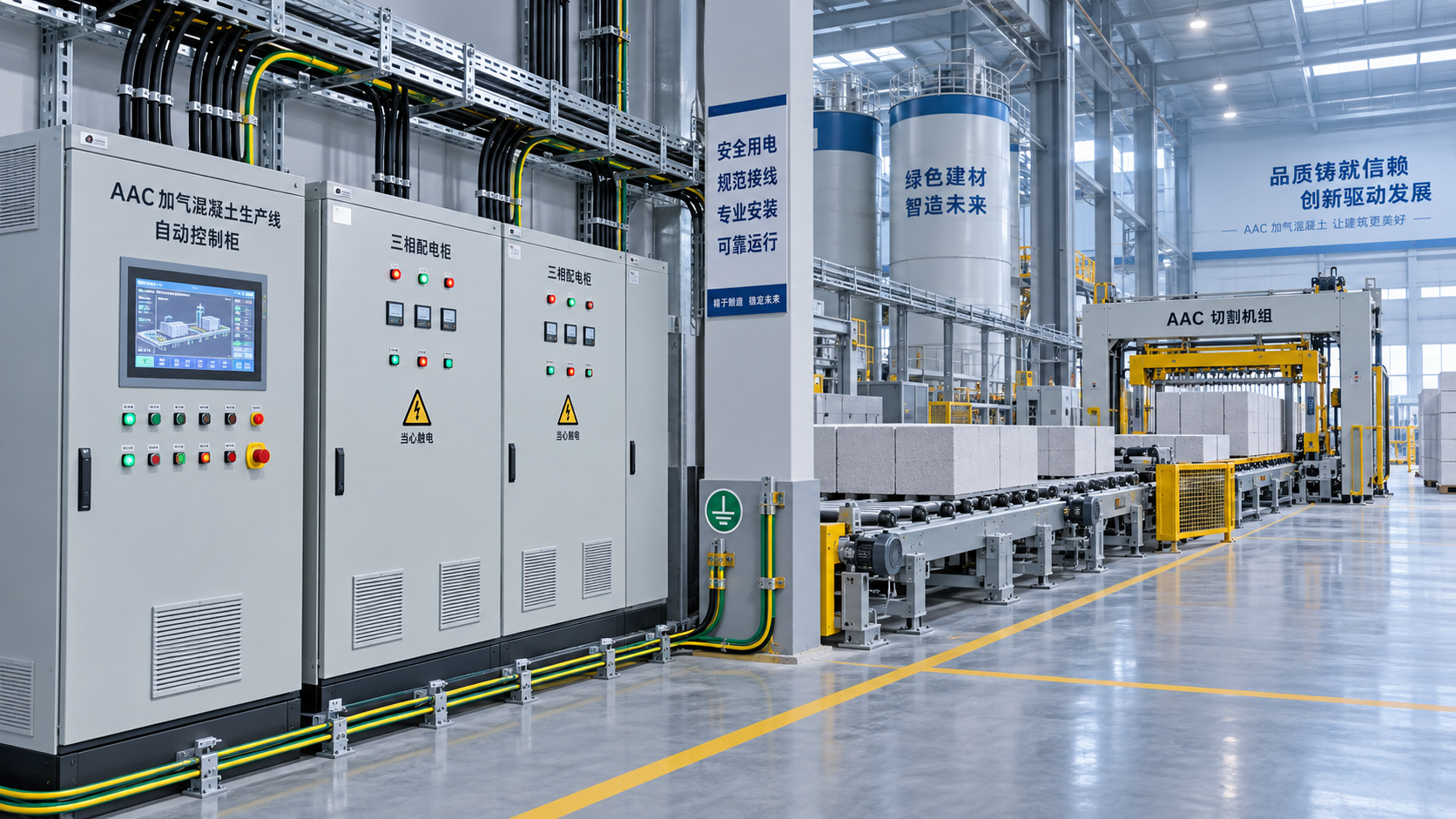
Once individual machines are confirmed, training moves to dry running. Conveyors, mold transfer devices, tilting mechanisms, cutting frames, and control sequences are operated without production slurry or green cake. Dry running gives maintenance personnel and control-room staff a chance to learn normal movement, limit positions, alarm messages, reset procedures, and safe access rules. It also exposes installation issues such as misalignment, loose sensors, incorrect travel limits, or inadequate clearance around service points. Correcting these issues before material is introduced saves time during the more sensitive stages.
The next phase uses actual production materials. This is where the duration becomes less predictable because AAC quality is governed by the interaction of process conditions. Silica sand or other siliceous material must be prepared to a suitable fineness; lime, cement, gypsum where used, water, and aluminum powder or paste must be dosed consistently; and the slurry must reach the mold under controlled temperature and fluidity conditions. The crew needs to see how a small adjustment affects expansion, pre-curing behavior, cutting strength, and final block quality.
Training continues through several production cycles until the line can maintain a reliable rhythm. Early batches are often used to refine parameters rather than to demonstrate maximum output. A green cake that expands unevenly, collapses at the edge, adheres to the mold, or tears during cutting provides practical information that no operating manual can fully convey. The correct response depends on where the deviation began. Increasing cutting speed will not solve weak green-cake structure caused by unstable slurry temperature or an unsuitable rising time.
What changes the total training period?
A common misconception is that a higher level of automation always shortens training. It can shorten routine operation after the process is established, but it does not eliminate the need to understand the process. An automated batching system will repeat a recipe accurately only when the recipe matches the actual moisture content, raw-material characteristics, and desired density. If moisture in sand changes, a nominal water addition may no longer create the same slurry condition. Staff must know whether the deviation comes from weighing, material condition, mixing, temperature, or a control setting before changing the recipe.
Commissioning and training overlap, but they are not the same
Commissioning verifies that the installed equipment performs its intended functions. Training transfers the ability to operate, inspect, adjust, and maintain that equipment under normal and abnormal conditions. The two activities should overlap because the best learning occurs while real settings are being established. Still, they should not be treated as interchangeable.
For example, a cutting machine may complete its travel sequence correctly during commissioning. Training should also cover how to confirm wire tension, identify a damaged or contaminated cutting wire, align the cake before cutting, clean the frame safely, and recognize whether defects are caused by the cutting system or by insufficient pre-curing. A cracked edge on the finished block can appear to be a cutting issue, while the underlying cause may be low green strength, poor mold release, or abrupt handling before the cake is ready.
Autoclave operation requires the same distinction. Starting a steam cycle is not enough. Personnel need to understand loading arrangement, condensate management, door sealing checks, pressure and temperature trends, controlled pressurization and depressurization, and the consequences of opening procedures being performed incorrectly. The process should follow the plant's approved operating instructions and equipment-specific safety requirements. Training must make clear which conditions require stopping the cycle and escalating the issue rather than attempting an improvised correction.
Skills that should be demonstrated before training is considered complete
Completion should be based on demonstrated capability across the production chain. A person may be able to start a mixer yet still be unable to diagnose why the final density drifts or why cutting waste increases. It is more useful to confirm practical tasks than to rely on a fixed calendar alone.
- Prepare and verify raw-material batches, including weighing accuracy, slurry consistency, material temperature, and the condition of aluminum additive handling equipment.
- Run the control system through start-up, routine production, planned shutdown, and recovery after a non-critical alarm without bypassing protective interlocks.
- Judge pre-curing readiness from the actual cake condition, not only from elapsed time, because ambient conditions and slurry behavior can change the required hold period.
- Set up cutting dimensions, inspect wires and guides, control mold and cake transfer, and separate cutting defects from upstream process defects.
- Follow autoclave loading, steam-cycle, unloading, and isolation procedures while recognizing abnormal pressure, condensate, seal, or door conditions.
- Carry out routine lubrication, cleaning, fastening checks, and planned inspections so that wear is found before it causes an unplanned stoppage.
The final point is particularly important for plants transitioning from commissioning into continuous production. The earliest maintenance routines establish the condition baseline for bearings, chains, reducers, hydraulic components, sensors, valves, and moving mechanisms. Without a baseline, gradual deterioration is easily dismissed as normal machine behavior until a transfer fault or alignment problem halts the line.
Why raw materials often lengthen practical instruction
Training schedules are sometimes planned around equipment alone, even though AAC is strongly affected by raw-material variation. Sand fineness, slurry solids content, lime reactivity, water temperature, and the condition of the foaming agent or aluminum additive influence how the material rises and sets. A recipe that performs well with one material supply may need adjustment after a change in moisture, particle distribution, or storage condition.
This does not mean that every change requires redesigning the process. It means the team needs a disciplined method for comparing inputs and results. When density changes, the first response should not be to alter several settings at once. Confirm the actual batch weights, material moisture, mixer time, slurry temperature, additive dosage, mold condition, and pre-curing environment. Changing many variables together may hide the original cause and make the next batch harder to interpret.
Quality training should also connect test results with production observations. Dry density, compressive strength, dimensional accuracy, appearance, and internal pore structure are not isolated quality items. A surface defect may begin with mold preparation; dimensional variation may reflect cutting alignment or green-cake stability; low strength may require examination of material preparation, batching, and autoclave conditions together. The value of early training is that these relationships become visible before the plant settles into a routine that repeats avoidable defects.
Separate instruction by responsibility, while keeping handoffs visible
Control-room staff, wet-process personnel, cutting-area staff, autoclave attendants, laboratory personnel, and maintenance technicians do not need identical instruction. Each role needs sufficient detail for the decisions made at its station. However, handoffs must remain visible. The cutting area needs to report unusual cake behavior in a way that supports root-cause analysis upstream. Maintenance work on a sensor or actuator needs to be communicated before automatic production restarts. Quality results need to reach the people who can adjust the relevant part of the process.
Cross-training is useful for basic awareness, especially for start-up and shutdown procedures, but it should not blur accountability. Complex interventions on electrical panels, pressure equipment, lifting systems, or moving cutting equipment require authorized personnel and the applicable isolation procedure. Training time is better spent building clear escalation paths than encouraging people to work outside their assigned competence.
Signs that more training time is needed
A plant may require additional supervised operation when the same alarm recurs without a documented cause, recipes are changed by trial and error, quality records cannot be linked to batch conditions, or routine cleaning and inspection are deferred to keep output moving. These are not merely administrative gaps. They indicate that the process is not yet understood well enough to remain stable when normal variation occurs.
Another warning sign is a line that appears smooth only while the commissioning technician is present. The test is whether the site team can explain the current production parameters, identify the limits within which they can adjust them, and decide when a problem requires technical review. Stable operation depends on this judgment more than on the ability to press the correct start button.
Technical training for an AAC plant should therefore be scheduled as a staged transfer of operating capability: equipment familiarization, dry running, material trials, parameter confirmation, quality evaluation, and supervised independent shifts. The exact elapsed time varies, but the completion standard remains practical and observable: safe work, controlled production, traceable adjustments, and a team able to maintain the line without treating every process deviation as an emergency.
Recommend
 Sep 30, 2026
When does an automated building material production line pay off?
Automated building material production line ROI explained: assess capacity, quality, labor, waste, and total costs to make a profitable investment.
- Oct 01, 2026
How a green building material production line reduces material waste
Discover how a green building material production line cuts waste through precise batching, controlled forming, stable curing, and smart material recovery.
- Oct 02, 2026
What to confirm before finalizing AAC factory planning
AAC factory planning: confirm product mix, raw materials, capacity, utilities, layout, automation, and supplier scope before investing in a reliable, efficient AAC plant.