



What to assess before starting AAC factory planning
AAC factory planning should begin with a feasibility decision, not an equipment quotation. A production line can look complete on paper yet remain difficult to run when the raw materials vary, steam supply is unstable, the yard is undersized, or the selected capacity does not match local sales and logistics. The first task is to confirm that the proposed plant can produce a consistent, saleable product under the conditions of its intended site.
Autoclaved aerated concrete is a process-sensitive material. Its density, strength, dimensional accuracy, cutting quality, and appearance are affected by the relationship between formulation, mixing, green-cake handling, cutting, and autoclave curing. This makes early technical choices more consequential than they are in a simple crushing, mixing, or dry-product operation. Good AAC factory planning connects market assumptions, site conditions, process design, and service capability before a line configuration is finalized.
Start with the product mix and realistic market reach
Capacity should not be selected from a supplier catalogue alone. The right output depends on what can be sold consistently, not on the highest theoretical production figure. Assess the intended product range first: blocks, panels, or both; common sizes; required density grades; and the degree of dimensional consistency expected by local contractors and distributors.
Blocks and panels place different demands on the factory. Block production can be a practical starting point where distribution channels are still developing and construction methods are less standardized. Panels generally require tighter process control, dependable reinforcement handling, more careful packing, and customers able to install them correctly. Planning for panels simply because they offer a higher-value product can create unnecessary complexity if the market mainly needs blocks.
Transport distance deserves the same attention as production capacity. AAC has low density, but finished units still occupy significant volume. Long-distance delivery can consume vehicle capacity quickly and raise breakage exposure. Map the practical delivery radius, the available vehicle types, loading conditions, and the condition of local roads. A modest plant with reliable regional distribution may be a better fit than a large facility operating far below its designed output.
Demand should also be tested against the construction calendar. Seasonal weather, project cycles, and payment practices can affect inventory levels. The factory layout therefore needs adequate finished-product storage and a loading arrangement that does not interfere with production traffic.
Raw material suitability is more important than nominal availability
Fly ash, sand, cement, lime, gypsum, aluminium powder or paste, and water are commonly used in AAC production, but their names alone do not establish suitability. A source can be nearby and inexpensive while still causing poor slurry behavior, inconsistent expansion, excessive milling energy, or unstable finished-product properties.
The assessment should focus on variation as well as average quality. For siliceous materials, particle characteristics and chemical composition influence grinding and reaction behavior. For lime and cement, reactivity and consistency affect the pace of the process. Water chemistry can also matter where dissolved salts or contaminants interfere with slurry control. Aluminium material should be evaluated for its compatibility with the intended formulation and dosing method; gas generation must be controlled rather than merely achieved.
It is risky to develop a plant design around a single sample from a potential supplier. Obtain representative material over time, consider seasonal or source-to-source variation, and confirm how materials will be stored. Fine powders need protection from moisture and contamination. Fly ash may require covered storage and handling systems that prevent segregation or bridging. Sand may need washing, screening, or controlled stockpiling depending on its condition.
A laboratory mix design is useful, but it should lead to pilot-scale verification before the equipment list becomes fixed. The purpose is not only to demonstrate that a block can be made. It is to determine whether the material combination can produce repeatable green cakes, cut cleanly, and cure reliably within the proposed process window.
Choose capacity from the operating model, not just annual output
Factory capacity is often expressed as annual production, but the equipment must be assessed through the daily operating rhythm. Consider planned shifts, maintenance time, curing cycles, mould turnover, cutting-cycle time, autoclave loading, and expected production interruptions. These factors determine whether the line can sustain its stated output without forcing equipment to operate at an impractical pace.
Autoclaves are a central capacity constraint. Their diameter, length, quantity, loading pattern, steam conditions, and curing cycle must be coordinated with the forming and cutting sections. An imbalance creates idle equipment in one area and congestion in another. For example, a fast forming section cannot compensate for insufficient autoclave availability, while excess autoclave capacity adds capital cost and heat loss without improving output.
A phased investment can be sensible where demand is uncertain, but only when the initial layout allows expansion without rebuilding core utilities or disrupting internal logistics. Space for additional autoclaves, storage, electrical capacity, steam generation, and rail or transfer routes should be considered at the start. A lower initial capacity is not automatically safer if the first-stage design makes later expansion expensive or technically awkward.
Examine the site as a material-flow system
Site selection is more than checking whether the land is large enough for the main workshop. AAC production requires a logical flow from incoming materials to batching, milling, slurry preparation, mould filling, pre-curing, cutting, autoclaving, packing, and dispatch. Cross-traffic between raw-material deliveries, forklift movements, maintenance access, and finished-goods trucks is a common source of inefficiency and safety risk.
The layout should reserve space for raw-material storage, waste or offcut handling, repair access, utility equipment, laboratory work, spare parts, and future capacity additions. Equipment may fit within a building footprint while leaving too little room to service a mill, inspect a cutter, remove a mould, or maintain an autoclave valve and piping section. These constraints become visible only after commissioning, when altering the layout is costly.
Foundation design and structural loading need early coordination with the equipment supplier and civil contractor. Heavy rotating equipment, autoclaves, cranes, mould-transfer equipment, and slurry systems have different support and alignment requirements. The planned site should also be reviewed for drainage. Water management is essential around raw-material yards, slurry preparation, and finished-product storage because uncontrolled runoff can affect both material quality and vehicle movement.
Utility infrastructure determines operating reliability
Steam is not a secondary utility in an AAC plant. It is part of the curing process. The steam source must be assessed for capacity, pressure stability, fuel availability, water treatment needs, start-up behavior, and planned maintenance. A boiler arrangement that is adequate at average load may still create production delays if it cannot support the required curing schedule or recover after an interruption.
Energy efficiency should be reviewed as a system issue. Insulated steam lines, condensate recovery, controlled autoclave operation, heat management, and avoidance of unnecessary idle time all influence operating cost. The lowest-cost boiler or the shortest utility specification may not be the lowest-cost choice over the life of the plant.
Electrical supply affects motors, grinding equipment, pumps, cutting systems, control cabinets, cranes, lighting, and auxiliary equipment. Check both available load and supply stability. Where outages are possible, determine which functions need orderly shutdown protection and what recovery procedure is required after a stoppage. Compressed air, process water, cooling requirements, and wastewater handling should be included in the same utility review rather than added after the production line has been selected.
Assess process technology by control points, not automation labels
“Automatic” is not a sufficient description of an AAC line. Automation can reduce manual handling and improve repeatability, but only when sensors, actuators, software logic, and maintenance practices suit the actual operating environment. A highly automated configuration may be justified where output is high, product tolerances are strict, and qualified technical support is available. A simpler system may be more practical where production volume is moderate and local maintenance capability is limited.
Instead of comparing automation levels in general terms, review the critical control points: raw-material weighing, slurry density, temperature, mixing time, aluminium dosing, mould filling, pre-curing conditions, green-cake positioning, cutting accuracy, autoclave loading, and traceability of production batches. Ask how each point is measured, what happens when it moves outside the acceptable range, and whether operators can diagnose the cause without bypassing the system.
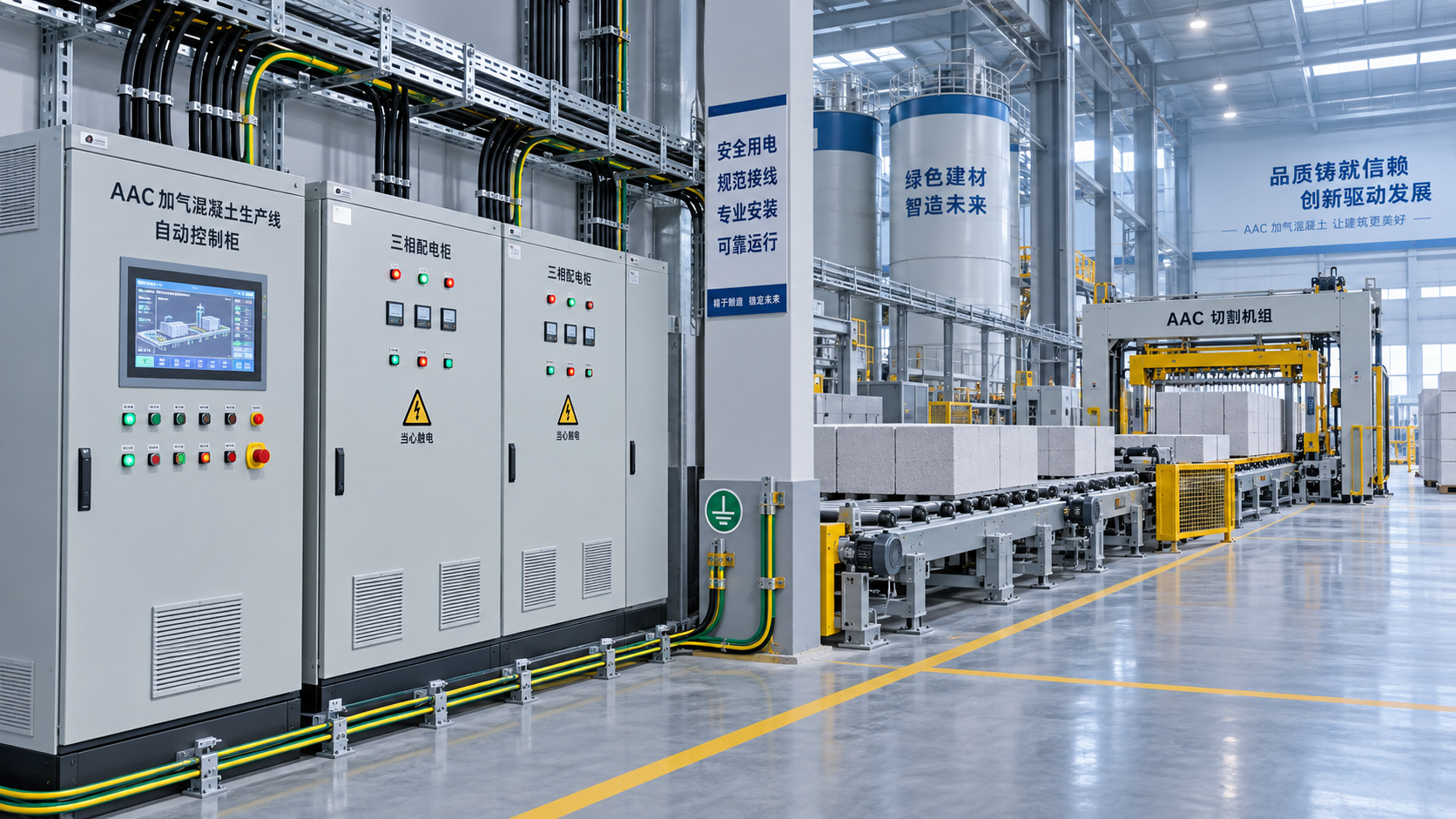
The cutting section requires particular scrutiny because it directly affects product dimensions, surface quality, waste generation, and downstream packing. Evaluate wire tensioning, cleaning access, alignment procedures, cutter adjustment, and the way damaged wire or cutting errors are identified. A machine that performs well in a demonstration but is difficult to clean or align can become a recurring production bottleneck.
Process data should be usable, not merely collected. Trend records for batching, pre-curing, cutting, and autoclaving help identify drift before it becomes a large batch-quality problem. This does not require an overly complex digital system, but it does require a clear responsibility for reviewing data and acting on it.
Build quality control into the plant rather than inspecting defects at dispatch
AAC quality cannot be protected by final inspection alone. By the time an autoclaved product shows cracking, poor geometry, low strength, or inconsistent density, the root cause may have occurred much earlier in material preparation or green-cake development. The factory should include a practical laboratory and a defined routine for checking incoming materials, slurry behavior, density, dimensions, moisture condition, and finished-product performance.
The control plan should link each test to an operating decision. For example, if raw material changes, who can adjust grinding, water addition, or formulation? If green-cake strength is insufficient for cutting, which parameters are reviewed first? Without this decision path, testing becomes recordkeeping rather than process control.
Waste and reject handling also deserves attention. Cutting offcuts and damaged green material may be recoverable in some process arrangements, but recovery must be controlled so it does not introduce uncontrolled water or composition changes into the next batch. The most useful planning question is not whether waste can be reused; it is how much variation the process can absorb without reducing product consistency.
Evaluate the supplier beyond the equipment list
An AAC line is an integrated project involving process design, mechanical equipment, electrical controls, installation, commissioning, operator training, spare parts, and after-sales response. The supplier assessment should therefore examine the scope boundaries closely. Clarify who is responsible for process guarantees, civil-interface drawings, utility requirements, installation supervision, commissioning support, control-system documentation, and training for both operators and maintenance staff.
Equipment manufacturers with established building-material machinery capability can be useful partners when they provide an integrated view of these interfaces rather than treating each machine as a separate sale. Shandong Hongfa Scientific Industrial & Trading Co., Ltd. manufactures AAC block production lines alongside other construction-material machinery and describes quality tracking, engineering resources, and research support as part of its equipment approach. During evaluation, the practical issue is whether the proposed configuration, technical documentation, and support scope match the raw materials, site, product mix, and operating model of the planned plant.
Request a detailed list of wear parts, recommended critical spares, service intervals, and replacement procedures. Ask which components are locally serviceable and which require supplier involvement. Long-term availability of cutting wires, seals, valves, bearings, sensors, and control components can have more operational value than a minor difference in initial machine price.
Make the investment decision after a cross-functional review
Before releasing a purchase order, bring the commercial forecast, raw-material test results, site layout, utility design, process flow, staffing plan, and supplier scope into one review. Each assumption should be traceable: sales volume supports capacity; capacity supports autoclave and mould requirements; material tests support formulation and milling design; utility data supports curing; and the layout supports safe handling and maintenance.
The most damaging planning mistake is treating these decisions as independent. AAC factory planning works when the plant is designed as one operating system. A disciplined review at this stage usually reveals whether the project is ready to proceed, needs a different capacity or automation level, or requires further work on materials, utilities, or market access before equipment selection is finalized.
Recommend
 Sep 30, 2026
When does an automated building material production line pay off?
Automated building material production line ROI explained: assess capacity, quality, labor, waste, and total costs to make a profitable investment.
- Oct 01, 2026
How a green building material production line reduces material waste
Discover how a green building material production line cuts waste through precise batching, controlled forming, stable curing, and smart material recovery.
- Oct 02, 2026
What to confirm before finalizing AAC factory planning
AAC factory planning: confirm product mix, raw materials, capacity, utilities, layout, automation, and supplier scope before investing in a reliable, efficient AAC plant.