Choosing a Paving Block Machine for Paver Thickness, Strength, and Output
Choosing a Paving Block Machine for Paver Thickness, Strength, and Output
Selecting a paving block machine requires more than comparing rated cycle times. The real challenge is matching paver thickness, specified strength, and sustained output without compromising dimensional consistency or production reliability. Mold configuration, vibration control, compaction settings, and concrete mix characteristics all influence whether a machine can meet these requirements under actual operating conditions.
A machine may produce an attractive sample yet struggle to repeat it across a full shift. It may also achieve its advertised cycle time on a thinner, simpler product than the one you intend to sell. A useful evaluation therefore starts with the finished paver and works backward through forming, material preparation, handling, and curing—not with the largest output figure in the quotation.
Define the product envelope before comparing machines
Prepare a product schedule covering dimensions, thickness, shape, surface finish, color requirements, and expected production share. Include the most demanding product, even if it represents only a small part of planned sales. A deep interlocking shape or a textured face can expose filling and demolding limitations that a plain rectangular paver does not.
Thickness alone does not determine suitability for pedestrian, parking, or heavy-traffic applications. Pavement design, bedding, base support, loading, and local requirements also matter. The equipment supplier should demonstrate the ability to manufacture your specified unit; that demonstration does not replace pavement engineering.
Turn the product schedule into a few clear procurement inputs:
- Minimum and maximum finished thickness, with dimensional tolerances.
- Required strength test, acceptance limits, and testing age.
- Surface, edge, absorption, abrasion, or weathering requirements where applicable.
- Saleable output per shift for each principal product.
- Local aggregate characteristics, available utilities, and curing arrangements.
Avoid specifying only “high-strength pavers.” Different markets use different test methods and acceptance criteria. For example, EN 1338 includes tensile splitting strength requirements, while ASTM C936/C936M includes compressive strength requirements. These results are not interchangeable. Confirm the applicable edition and project specification before agreeing on a machine acceptance test.
Check usable thickness capability, not just mold height
A quoted maximum forming height indicates mechanical capacity, not necessarily reliable production at that height. Thicker pavers require more material in each cavity and may need a different filling and vibration sequence. Thin units present their own difficulty: small filling variations can become a meaningful share of the finished thickness.
Ask how the machine controls final height and how it detects uneven filling. Depending on the design, relevant features may include tamper-head position feedback, adjustable feed-box motion, and programmable vibration stages. The important question is not whether these features appear on a specification sheet, but whether operators can use them to maintain consistent products.
During a trial, measure units from different positions across the production board. Center cavities and outer cavities may behave differently because of material distribution, mold condition, or vibration transmission. A batch average can conceal a recurring problem along one edge.
Production boards deserve attention here. Their stiffness, flatness, wear, and compatibility with the machine affect support during vibration and handling. A successful demonstration on new boards does not establish acceptable performance on badly worn boards. Specify the board material and condition used for acceptance testing.
Strength comes from a controlled process, not a pressure claim
Concrete pavers are commonly formed from low-slump mixes using vibration and compaction. Hydraulic pressure is part of that process, but a higher advertised pressure does not independently establish higher finished strength. Aggregate grading, moisture, cementitious materials, filling consistency, compaction, and curing all contribute.
This is where a simple specification comparison often becomes misleading. Two machines can list similar motor power and hydraulic pressure while distributing material and transmitting vibration differently. Compare results made with a documented mix and curing regime rather than treating installed power as a performance ranking.
Moisture control is particularly important. A mix that is too dry may fill poorly or leave vulnerable edges; excessive moisture can cause sticking or deformation after demolding. The workable range depends on the raw materials and product geometry. Request evidence that the batching system can account for aggregate moisture changes, especially when sand is stored outdoors.
For a two-layer paver, evaluate the face-mix feeder separately. Face-layer consistency, material compatibility, and the timing between layers affect appearance and bonding. A clean surface on one sample is not enough: inspect layer uniformity and use the tests required by the product specification.
Do not approve strength from freshly demolded appearance. Green stability matters for handling, but acceptance requires specimens cured and tested under agreed conditions. Record the mix, specimen identification, curing history, test age, and test method so that disappointing results can be investigated rather than argued over.
Convert cycle time into saleable shift output
Theoretical output is straightforward:
Units per board × cycles per hour × scheduled production hours.
Saleable output is lower whenever production stops or units fail inspection. For a transparent comparison, separate planned production time, operating availability, actual running speed, and accepted yield. Ensure the supplier has not already included an allowance before applying another reduction.
As a hypothetical calculation, a mold producing 12 units on a 20-second cycle yields 2,160 units per uninterrupted hour. Across eight scheduled hours, that is 17,280 units. If combined operating losses and rejects reduce that total by 20%, saleable output becomes 13,824 units. These figures illustrate the calculation only; they are not a machine performance claim.
For mixed sizes, compare square meters as well as unit counts. Calculate area from the agreed nominal paving module, accounting consistently for joint spacing and shape. Otherwise, a quotation based on small units may look more productive simply because it reports more pieces.
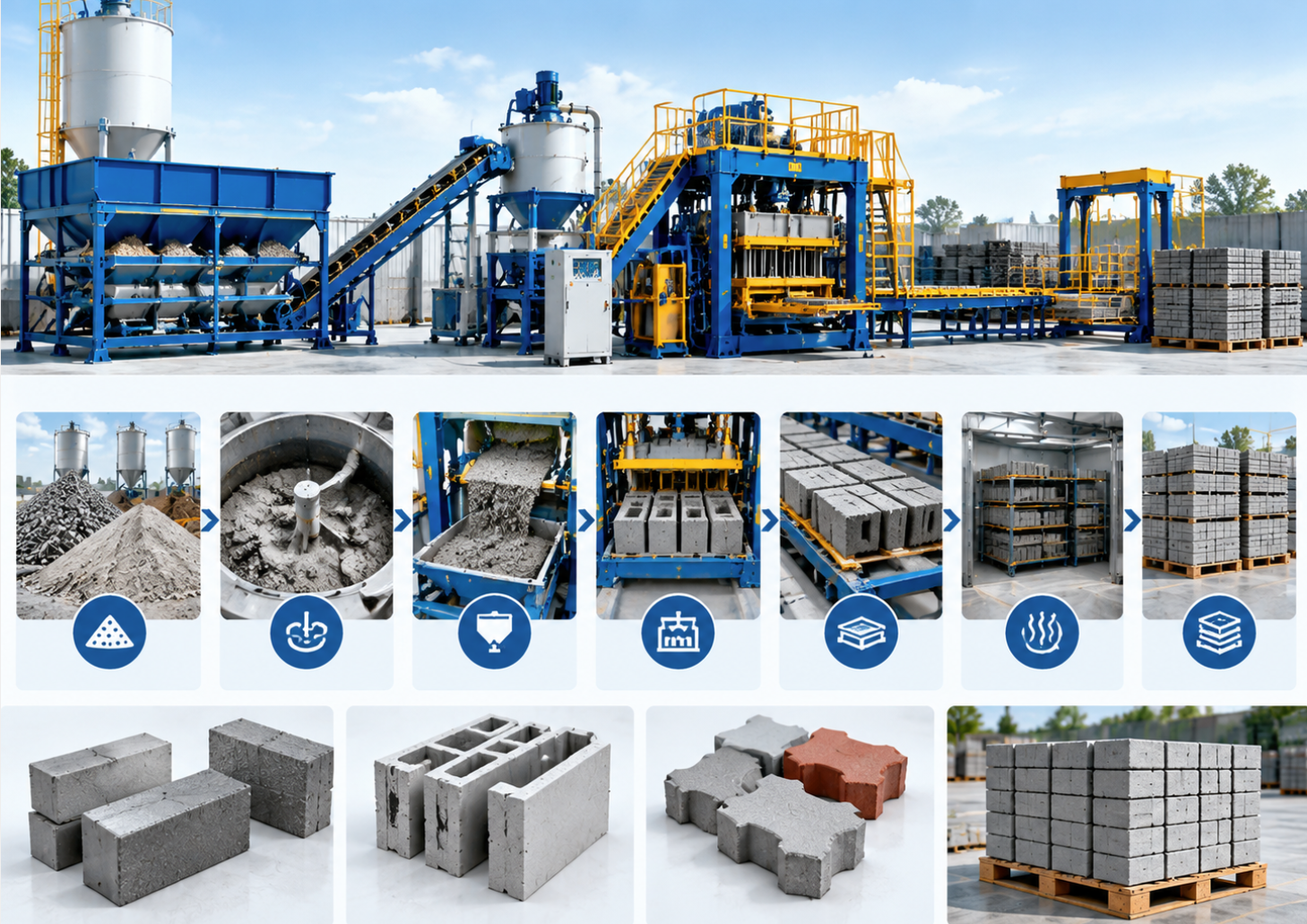
Then follow the material flow. Can the mixer supply each batch on time? Can the elevator and transfer system clear boards without delaying the press? Is there sufficient curing capacity? Can cured products be cubed and dispatched at the same sustained rate? A faster forming machine adds little when downstream storage is already full.
Use the trial to expose limitations
The most useful supplier trial uses your representative raw materials and demanding product geometry. Where shipping aggregate is impractical, document the substitute material and leave final confirmation for site commissioning. A demonstration made with carefully selected materials may not transfer directly to local sand and crushed aggregate.
Agree on the trial protocol before attending. Include startup, a stable production run, sampling across the board, and normal handling. Record all stoppages and adjustments. A short run can verify basic forming capability, but it should not be presented as proof of full-shift availability.
Sample selection matters. Take specimens at agreed intervals rather than allowing only the best-looking units to reach the laboratory. Keep traceability between each sample, production settings, and batch. Inspect chipped corners and handling damage as well as dimensional results; fragile green products can create losses before curing begins.
Also request a witnessed mold change. Check access, lifting requirements, alignment, recipe recall, and first-off inspection. A plant with frequent product changes may gain more from predictable changeovers than from a slightly shorter nominal cycle.
Evaluate the supplier around the complete production route
Shandong Hongfa Scientific Industrial & Trading Co., Ltd., established in 1990, manufactures construction machinery including block production equipment and concrete batching plants. That combination is relevant when evaluating the interface between mix preparation and forming. Still, manufacturing breadth should lead to more specific technical questions, not replace verification of the proposed configuration.
Keep different product technologies separate. A portfolio entry such as Aerated brick concerns a different material system and production route; it is not evidence that the same equipment can manufacture dense concrete pavers. Ask for drawings, process descriptions, and references relevant to the actual paving block machine offered.
Service details deserve equal scrutiny. Identify locally available hydraulic and electrical components, proprietary control parts, mold wear items, and expected spare-part lead times. Establish who provides commissioning, operator training, remote diagnosis, and on-site support. Obtain current certification documents where required rather than relying on historical company descriptions.
Put measurable conditions into the purchase agreement
The final comparison should connect each proposed machine to an agreed product, mix, production rate, and acceptance method. State whether output means molded units, cured units, or accepted saleable units. Define permitted rejects, dimensional sampling, strength testing, utilities, staffing, and the duration of the performance run.
Separate factory acceptance from site acceptance. The factory can verify assembly, controls, safety functions, and forming trials; the installed line must demonstrate operation with local materials and the agreed curing arrangement. Specify what happens if a criterion is missed, including adjustment, retesting, and responsibility for test costs.
Choose the machine whose evidence holds together: repeatable thickness across the board, compliant properties after curing, and sustained output through the complete line. If a quotation cannot connect those three results under defined conditions, request a better trial before committing to the equipment.
Recommend
 Oct 28, 2026
Planning a Wall Panel Production Machine Line for Multiple Panel Sizes
Plan a wall panel production machine line for multiple panel sizes. Explore tooling, capacity, curing, and changeovers to reduce delays and make smarter equipment investments.
 Oct 27, 2026
How a Concrete Brick Machine Works—and Why Curing Still Matters
Learn how a concrete brick machine shapes and compacts bricks, why curing builds lasting strength, and which production checks help you choose equipment for reliable, saleable output.
 Oct 26, 2026
Hollow Block Making Machine: Fixing Cracks During Demolding
Hollow block making machine cracks during demolding? Discover how to check mix moisture, compaction, mold friction, and pallet support to reduce waste and improve block quality.