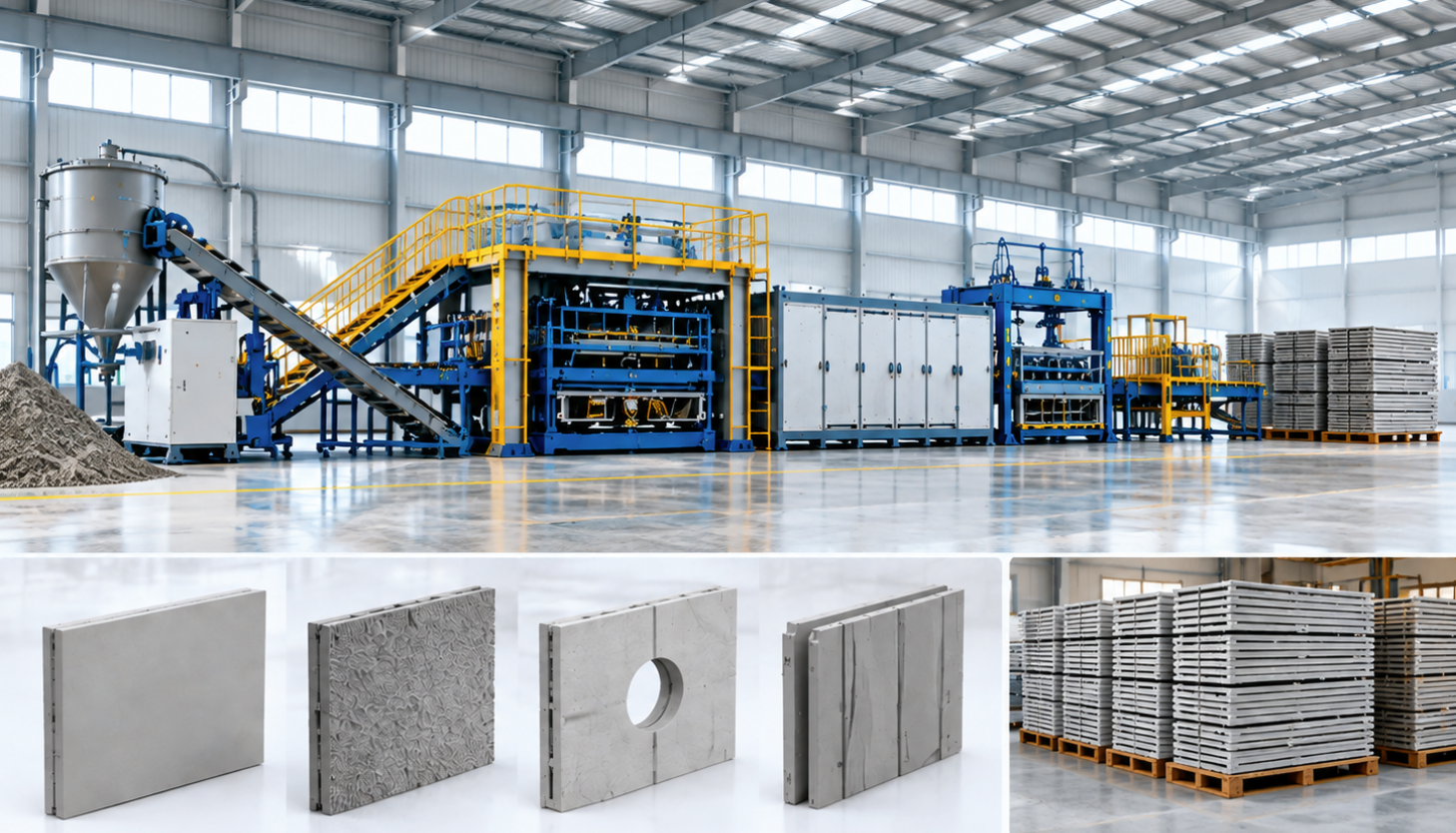
Planning a Wall Panel Production Machine Line for Multiple Panel Sizes
A wall panel production machine can accommodate several panel sizes and still struggle to deliver the required daily output. Adjustable molds solve only part of the problem. Each size must also move through material preparation, filling or forming, curing, demolding, finishing, and storage without creating delays or handling damage.
The practical starting point is to define which dimensions change, how often they change, and how much production each size requires. A line producing long runs of two thicknesses needs a different configuration from one handling frequent orders for several lengths, widths, and edge profiles. Equipment selection should follow that production mix.
Turn the panel schedule into a production specification
A minimum-to-maximum size range is useful, but it does not describe the actual workload. Two factories can require the same dimensional range while needing different mold inventories, handling systems, and scheduling arrangements.
Build a product matrix before requesting a line proposal. Include the following information for each panel family:
- Finished length, width, thickness, and dimensional tolerances.
- Material composition, reinforcement, facing layers, and edge profile.
- Expected order quantity and frequency.
- Estimated panel weight and permitted handling orientation.
- Required openings, embedded components, and surface finish.
- Delivery sequence and acceptable finished stock levels.
Separate recurring products from occasional specials. Standard panels generally justify dedicated tooling and established production settings. Low-volume variants may be better served by interchangeable inserts, a separate mold set, or secondary processing, where the panel construction permits it.
Also distinguish external dimensions from functional details. Two panels with identical length and width may require different tooling because their joints, reinforcement positions, or service openings differ. Grouping them as one size can hide substantial setup work.
Choose the production route before specifying size flexibility
Wall panel machinery covers several manufacturing methods. Mold casting, extrusion, and processes that form a larger element before cutting it into panels do not provide the same kind of dimensional adjustment. The material system and panel structure determine which route is suitable.
For molded cementitious panels, cavity dimensions, partitions, inserts, and end stops may establish the finished geometry. An extrusion process may offer length adjustment through cutting, while thickness or cross-section changes require different forming components. Other systems depend on a defined cutting stage after the material reaches a suitable condition.
Do not assume that every dimension can be changed through the machine controls. A stored recipe may adjust dosing quantities or motion settings, but physical tooling can still determine thickness, joint geometry, and reinforcement clearance.
Cutting also has limits. Trimming a panel to length may be straightforward for an appropriate product, while cutting across reinforcement or removing a factory-formed edge can affect its intended function. Establish which dimensions are formed directly and which can be finished afterward before choosing the line layout.
Match the tooling strategy to the order pattern
There are three common ways to accommodate different panel sizes: adjustable tooling, interchangeable tooling, and dedicated tooling for recurring products. A practical line may combine all three.
When assessing a component such as Hongfa’s Panel Mold Box, use the product matrix to frame the discussion: which sizes require separate tooling, which details need inserts, and how the mold fits the intended filling and demolding sequence. Its suitability depends on the complete process and tooling specification.
Adjustable molds can reduce the number of dedicated sets, but their value depends on reliable resetting. Check how reference positions are established, how partitions are locked, and whether joints remain sealed after repeated changes. A mold that takes extensive measurement and correction after every adjustment may be a poor fit for short production runs.
Calculate capacity for the planned product mix
A headline capacity figure usually reflects a particular product and operating arrangement. Changing panel dimensions can alter material consumption, cavity count, handling time, curing occupancy, and packing speed. A single output figure cannot describe all of those conditions.
Use different units to examine different constraints. Pieces per shift helps with order planning. Square meters per shift helps compare wall coverage. Material volume helps assess batching demand, while panel weight and lifting frequency help assess handling capacity.
These measures can point in different directions. A thicker panel may provide the same wall area while requiring more material and carrying greater weight. A longer panel may reduce the number of pieces per order but require more careful lifting and larger storage positions.
For a mold-based process, estimate available cavity positions, panels per cavity per cycle, and achievable cycles within the schedule. Then allow for cleaning, preparation, changeovers, maintenance, and rejected production. Use the expected product mix rather than applying the fastest product’s cycle to every order.
Curing can set the effective capacity. Where panels occupy molds until they reach demolding strength, mold availability depends on that release time. Faster filling equipment provides limited benefit if every available cavity remains occupied. Where products leave the forming station earlier, curing racks, pallets, or other supports may become the constraint instead.
Follow the largest and most difficult panel through the factory
Check the complete route from material feed to dispatch using the panel most demanding at each stage. The longest panel may control turning space, the heaviest may control lifting equipment, and the thinnest may need the closest support spacing.
Material preparation and filling
Confirm that batching and mixing can supply the largest scheduled production batch within the required working time. For mixes whose flow or setting behavior changes after preparation, interruptions between mixing and filling can affect consistency.
Filling arrangements should also suit the smallest cavities. Equipment that fills a large mold efficiently may be awkward to control in a narrow cavity, particularly around reinforcement, inserts, or facing layers. Distribution and consolidation need to suit the panel geometry without disturbing embedded components.
Curing, release, and lifting
Curing space must accommodate the planned production sequence, including panels waiting for release. Where controlled curing is used, rack loading, spacing, and environmental uniformity should be considered alongside the nominal curing period.
Demolding and lifting require checks for each panel family. A lifting arrangement suitable for a short, thick panel may impose excessive bending on a longer, thinner one. Lifting capacity alone does not establish suitability; support positions, lifting points, release strength, and panel orientation also matter.
Finishing and storage
Check cutting travel, workpiece support, dust or slurry management, and access for edge finishing. Where curing or drying causes dimensional movement, establish the appropriate stage for final sizing and inspection.
Finished storage should accommodate different footprints and dispatch sequences. Panels that are repeatedly moved to reach another order consume handling time and face additional damage risk. Storage positions and loading access belong in the original layout.
Measure changeover until acceptable production resumes
A size change is complete when the line produces acceptable panels at a stable operating rate. The mechanical adjustment is only one part of that interval.
A complete changeover may involve clearing residual material, cleaning molds, moving partitions, changing inserts, updating dosing settings, repositioning supports, checking guards, and inspecting the first panels. Some tasks can happen while the previous batch runs; others require the equipment to stop.
Ask for a changeover sequence between two products from the proposed schedule. Identify which tools and lifting devices are needed, how many operators participate, and what must be checked before production restarts. This gives a more useful comparison than an unexplained “quick change” claim.
Schedule compatible products together where delivery commitments allow. Grouping similar thicknesses, profiles, or material formulations can reduce setup work. However, oversized batches can tie up curing positions and warehouse space. Batch size should balance changeover effort with delivery dates and work in progress.
Control the dimensions that affect installation
Dimensional flexibility increases the opportunities for setup errors. Record approved settings for each recurring product, including tooling arrangement, reference positions, material recipe, reinforcement placement, curing conditions, and inspection points.
Inspection should extend beyond overall length and width. Thickness variation, squareness, bow, edge straightness, and joint alignment can affect installation even when the main dimensions appear acceptable. Tongue-and-groove profiles or connection details need suitable checks because a small mismatch can repeat across an assembled wall.
Use first-piece approval after a tooling change to catch incorrect settings before committing a full batch. Continue checking during production where wear, buildup, movement, or process variation could affect the result.
Track defects by panel family and production stage. If longer panels suffer damage during transfer, the corrective action may involve support spacing or release conditions. If leakage occurs after a thickness change, partition alignment and sealing deserve attention. This makes quality records useful for correcting the process.
Compare investment using the cost of the production schedule
The least expensive forming machine may require more tooling, manual handling, storage, or setup labor. Conversely, extensive automation may be difficult to justify when demand is uncertain or product designs change frequently.
Compare proposals against the same representative schedule. Include the main machine, molds and inserts, material preparation, handling equipment, curing facilities, finishing stations, utilities, installation, training, and replacement wear components. Evaluate the cost per acceptable panel for that schedule, including changeover losses and scrap.
Expansion should follow a likely constraint. Provision for additional mold sets or curing positions can be useful where demand is expected to grow. Extra forming speed has less value if handling or storage already limits output. Any future expansion allowance should have a defined purpose in the layout.
Hongfa’s building materials machinery portfolio provides a relevant basis for discussing equipment coordination. The useful proposal, however, is one that explains the interfaces between mixing, molding, curing, handling, and finishing for the intended panels. Company background cannot replace that process detail.
Use a representative production run for acceptance
Before committing to a wall panel production machine line, turn the product matrix into an acceptance plan. Include a common panel, a product that challenges handling or tooling, and a realistic changeover between them.
Define the outcomes to be assessed: finished dimensions, surface and edge condition, sustained output, setup time, material loss, handling damage, and required staffing. Record the material formulation, curing arrangement, and inspection stage so the results relate to the intended factory process.
The next useful document is a production brief combining that acceptance plan with the panel schedule and factory layout. It gives equipment suppliers a concrete basis for proposing a line—and gives the buyer a way to judge whether dimensional flexibility will remain practical during everyday production.
Next:No more content
Recommend
 Oct 28, 2026
Planning a Wall Panel Production Machine Line for Multiple Panel Sizes
Plan a wall panel production machine line for multiple panel sizes. Explore tooling, capacity, curing, and changeovers to reduce delays and make smarter equipment investments.
 Oct 27, 2026
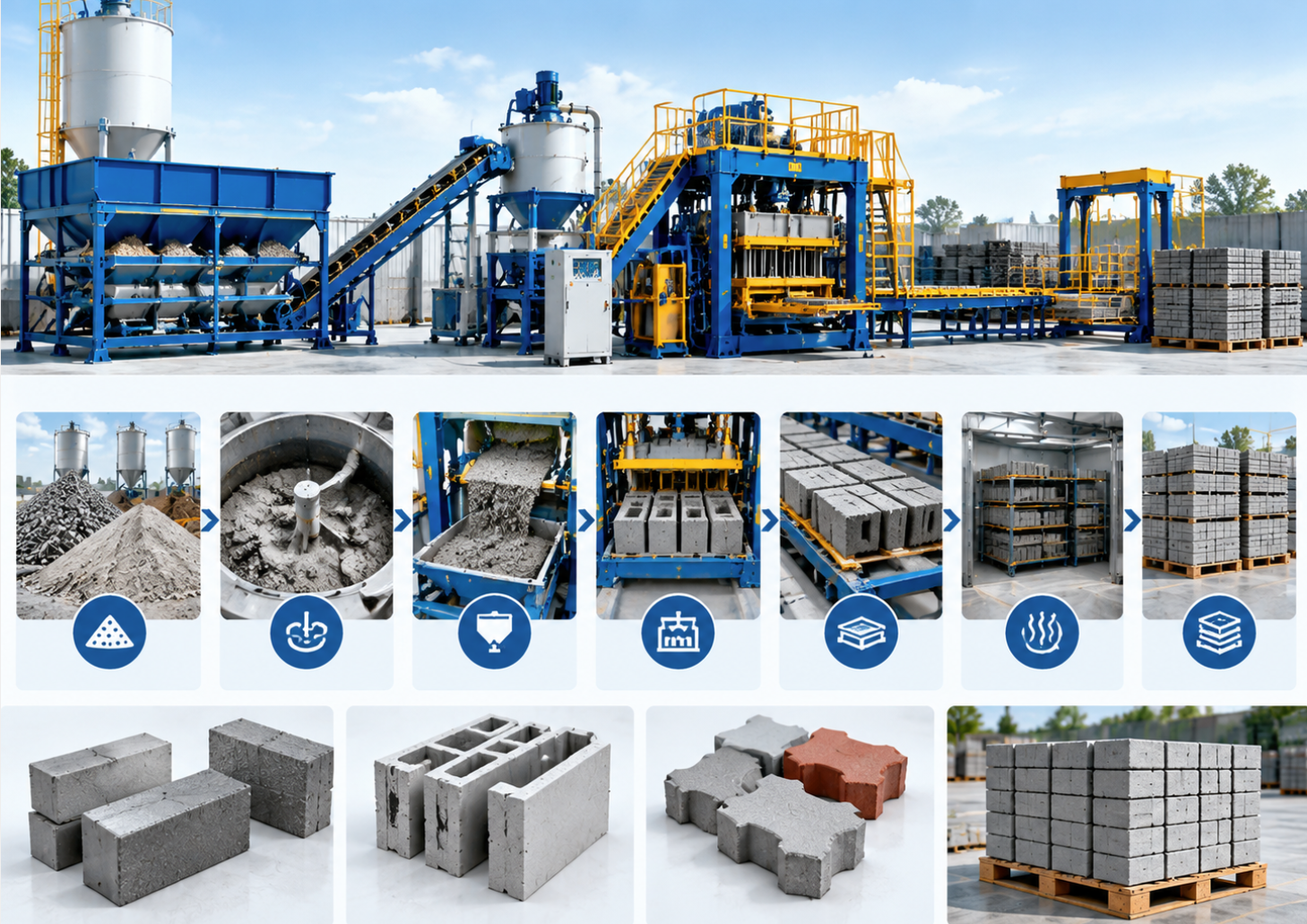
How a Concrete Brick Machine Works—and Why Curing Still Matters
Learn how a concrete brick machine shapes and compacts bricks, why curing builds lasting strength, and which production checks help you choose equipment for reliable, saleable output.
 Oct 26, 2026
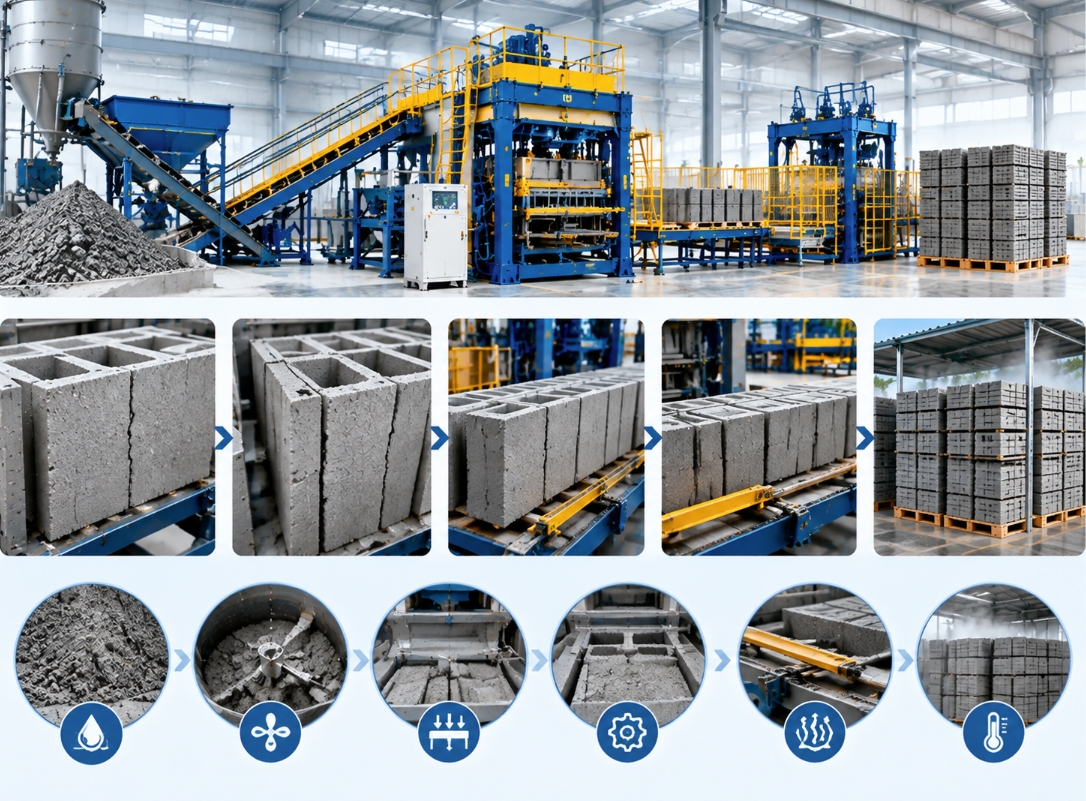
Hollow Block Making Machine: Fixing Cracks During Demolding
Hollow block making machine cracks during demolding? Discover how to check mix moisture, compaction, mold friction, and pallet support to reduce waste and improve block quality.