



How to Evaluate an AAC Production Line Supplier for Green Material Exports
Choosing an AAC production line supplier for export projects is not a matter of comparing a quoted capacity against a quoted price. An autoclaved aerated concrete plant is a connected process system: raw-material preparation, batching, casting, cutting, autoclaving, handling, utilities, automation, and quality control must work together under the conditions of the destination market. A low equipment price can be outweighed by poor raw-material compatibility, excessive steam consumption, unavailable spare parts, or an installation schedule that cannot be supported remotely.
For green building material exports, the supplier evaluation must therefore begin with a practical question: can this supplier deliver a line that produces saleable AAC products consistently, within local energy, safety, logistics, and compliance constraints? The answer depends less on catalogue specifications than on engineering discipline, manufacturing control, export readiness, and the clarity of contractual responsibilities.
Start with the production target, not the nominal line capacity
AAC lines are commonly described by annual output, but annual capacity is not a complete basis for comparison. The useful production target should define the product mix, density range, block or panel dimensions, operating days, shift arrangement, acceptable reject rate, and expected local raw materials. A line intended to produce standard blocks from fly ash may require materially different preparation and process control from one based on sand, especially where grinding behavior, slurry rheology, lime quality, and water chemistry differ.
Before requesting technical proposals, the buyer should establish a project data package covering:
- Available siliceous material, such as sand, fly ash, or another qualified source, including laboratory analysis and supply consistency;
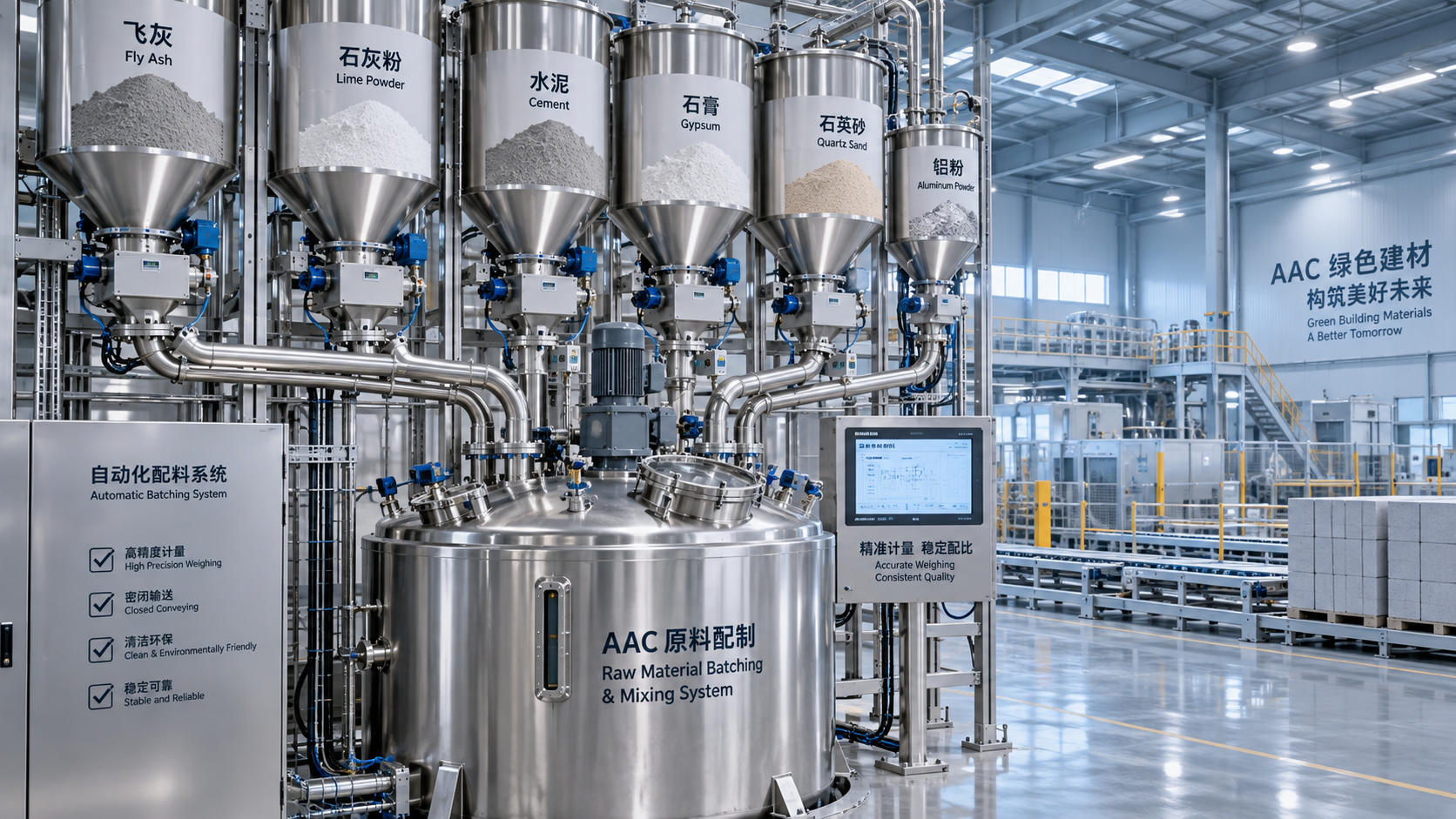
- Specifications and local availability of lime, cement, gypsum, aluminum paste or powder, and additives where used;
- Required product sizes, density classes, compressive-strength expectations, and packaging format;
- Electricity voltage and frequency, water supply conditions, fuel source, steam-generation arrangement, and environmental restrictions;
- Site dimensions, soil information, port access, inland transport limits, and local construction capability;
- Applicable construction-product, machinery-safety, pressure-equipment, emissions, and electrical requirements in the destination country.
Without these inputs, suppliers may quote a generic configuration that appears technically complete but leaves major interfaces unresolved. Capacity claims also need to be translated into a production balance. The batching plant, molds, pre-curing area, cutting machine, autoclaves, boiler or steam source, and finished-product handling system must be sized around the same throughput assumption. A bottleneck in autoclave availability or green-cake handling can reduce output even when the cutting section appears capable of a higher rate.
Assess whether the process design fits the actual raw materials
The central technical risk in an AAC project is not whether the supplier has built machinery; it is whether the proposed process can stabilize the reaction and cutting cycle using the buyer’s materials. AAC performance depends on controlled interactions among fine silica, calcium-bearing materials, water, aluminum, temperature, and time. Variations in particle size, active lime content, fly-ash loss on ignition, aluminum reactivity, or slurry temperature can affect rising behavior, pore structure, green-cake strength, cutting quality, and final density.
A credible supplier should ask detailed questions about material characteristics rather than simply accepting a broad description such as “local sand” or “power-plant fly ash.” Where samples are available, laboratory evaluation and mix-design discussion are more meaningful than a promise that the line can process every feedstock. The buyer should also clarify who is responsible for final recipe development and commissioning optimization after installation.
Particular attention is needed for the raw-material grinding system. Sand-based AAC production may require wet ball milling or another suitable milling arrangement to reach the fineness needed for stable slurry preparation. The supplier should state the design feed size, target fineness, expected mill output, wear-part consumption assumptions, slurry storage arrangement, and method for controlling density and solids concentration. If the proposed mill is undersized, the downstream line may sit idle; if it is oversized without a sensible control strategy, energy use and capital cost rise without improving product quality.
The same scrutiny applies to mold design, cake handling, and cutting technology. Green AAC cake is fragile before autoclaving. Transfer systems must preserve alignment and minimize deformation, while the cutting arrangement must suit the required product dimensions and tolerances. Claims of high precision are less useful than clear information on wire tensioning, wire replacement, cleaning, alignment checks, and the procedure for handling off-specification cakes.
Energy efficiency should be examined as a system balance
AAC is often associated with lower-weight building products and resource-efficient construction, but the factory itself consumes substantial energy, particularly for grinding, steam generation, compressed air, material handling, and autoclave operation. A green building material production line export supplier should be evaluated on the basis of measurable design choices, not broad claims of energy saving.
The largest thermal question is usually steam use. Autoclaves require a stable supply of steam at the specified pressure and temperature profile. The assessment should cover the autoclave loading pattern, cycle duration, insulation design, condensate recovery, steam piping layout, valve quality, pressure control, and the relationship between the autoclave schedule and the boiler plant. A supplier that provides only the autoclaves but leaves the steam balance to others may still be acceptable, but the division of responsibility must be explicit.
Electricity consumption also deserves line-item review. Grinding equipment, pumps, vacuum systems, compressors, cutting units, conveyors, and cranes should be included in a connected load list. Buyers should distinguish installed motor power from expected operating consumption. Variable-frequency drives can be valuable where flow, pumping, or handling demand changes during the cycle, but their benefit depends on appropriate control logic and compatible maintenance capability.
Waste and recovery arrangements reveal whether process efficiency has been considered in practical terms. Cutting waste, rejected green cake, settled slurry, and autoclave condensate can often be managed through recycling loops, provided that recycled material does not destabilize the mix design. The proposed recovery scheme should specify collection points, storage limits, pumping or conveying methods, and the effect on batching calculations. “Zero waste” should not be accepted as a meaningful technical statement without a defined material-flow design.
Separate equipment quality from documentation quality—but require both
Heavy machinery can look substantial during a factory inspection while still being difficult to install, operate, or maintain abroad. Export projects depend on documentation because the destination-site team must assemble systems, connect utilities, perform checks, and troubleshoot equipment across language and distance barriers.
A technically serious proposal should identify the scope of supply in enough detail to show what is included and what remains with the buyer or local contractor. This normally includes general arrangement drawings, foundation loads, utility demand schedules, electrical single-line diagrams where applicable, cable and control boundaries, pneumatic and hydraulic requirements, installation instructions, equipment manuals, spare-parts lists, and commissioning procedures.
Documentation should match the delivered configuration rather than being a generic manual. This matters especially for control cabinets, sensors, valves, motors, and safety interlocks. A line may include components sourced from different manufacturers; the buyer needs model numbers, technical datasheets, and replacement information that can be used after the project team has left the site.
For machinery entering markets with specific conformity requirements, documentation must also support the applicable legal route. Requirements vary by destination and by equipment category. Machinery safety, electrical equipment, pressure systems, and environmental controls may fall under separate rules. The supplier should not make unsupported claims that a complete plant is “fully certified” without defining the standard, jurisdiction, equipment boundary, and supporting documents. Where local certification or third-party review is required, it should be planned as a project workstream rather than treated as a shipping document.
Verify manufacturing capability beyond a factory tour
A supplier’s production bases, engineering staff, patents, and quality-system credentials can indicate organizational capacity, but they do not replace project-specific verification. ISO 9001 certification, for example, demonstrates a quality-management framework; it does not itself prove that a particular AAC line will meet output, energy, or product-quality targets.
More useful evidence includes the supplier’s control of critical fabrication and procurement stages. Ask how steel structures, molds, autoclave-related components, cutting frames, gear assemblies, and electrical panels are produced or sourced; what incoming inspection is performed for bought-out parts; how welding and dimensional checks are recorded; and whether key assemblies can be trial-fitted before shipment.
Autoclaves deserve special attention because they involve pressure service and long-term operating risk. The buyer should understand who manufactures the pressure vessel, which design and manufacturing rules apply, what inspection records are supplied, how doors and sealing systems are maintained, and whether local operating permits will require additional inspection. A supplier of the production line may rely on a specialist pressure-vessel manufacturer, which is not inherently a concern, but the commercial and technical interfaces must be visible.
Factory acceptance testing should focus on what can realistically be verified before shipping. It may include running selected mechanical assemblies, testing automation panels, confirming motor rotation and safety devices, reviewing dimensions, and checking documentation completeness. A complete production test with the buyer’s raw materials is not always feasible at the equipment factory, so site acceptance criteria are equally important.
Automation quality is measured by recoverability, not screen count
Automation can improve batching accuracy, production traceability, and operational consistency, but an elaborate interface does not guarantee a manageable plant. The relevant issue is whether the control system makes abnormal conditions understandable and recoverable.
The proposal should clarify the control architecture, PLC and HMI brands, communication protocols, remote-access method, alarm history, data backup process, user-language options, and cybersecurity permissions. It should also identify which process variables are measured automatically: slurry density, liquid levels, weighing accuracy, mold positions, curing temperatures, steam pressure, autoclave cycle status, and equipment interlocks.
A well-designed system allows operators to identify why a conveyor stopped, why a mold cannot transfer, or why an autoclave sequence is blocked. It should prevent unsafe or damaging actions without making ordinary maintenance impossible. Buyers should request an explanation of manual-operation modes, emergency-stop logic, sensor bypass controls, and the procedure for restoring production after a power interruption.
Remote support is valuable for export projects, but it should not be treated as a substitute for local operating competence. Network availability, time-zone differences, access authorization, and language can limit its usefulness. The supplier’s commissioning and training plan should therefore cover production personnel, maintenance technicians, electricians, and control-system operators with practical responsibilities defined for each group.
Test export execution capability at the level of interfaces
An AAC line is typically shipped as multiple lots: structural steel, process machines, electrical cabinets, motors, pipework, instruments, spare parts, and sometimes components supplied by third parties. Export experience matters because incomplete packing lists, unclear containerization, damaged items, or missing fasteners can delay installation far more than the value of the missing part suggests.
A reliable export plan identifies Incoterms, packing responsibility, shipment sequence, container or break-bulk requirements, preservation methods for sea transport, marking rules, customs-document responsibilities, and insurance allocation. The buyer should verify whether parts are tagged to match installation drawings and whether separate packages can be identified after arrival. Mixed consignments without installation references create avoidable site delays.
Site work should be divided into defined boundaries: civil works, foundations, structural erection, mechanical installation, piping, electrical works, insulation, boiler or steam system, commissioning materials, and product testing. If the supplier offers installation supervision rather than full installation, the required qualifications and number of local workers should be stated. The same applies to cranes, welding equipment, scaffolding, temporary power, and lifting plans.
Delivery dates should be linked to milestones that can be verified: drawing approval, advance payment, fabrication completion, inspection, shipment readiness, dispatch, site readiness, mechanical completion, cold commissioning, hot commissioning, and performance testing. A single promise of “delivery time” is too vague for a project with several external dependencies.
Make after-sales support a contractual operating requirement
AAC plants do not reach stable production solely by completing installation. Initial operation requires tuning of raw-material preparation, batching, rising control, cutting, autoclave cycles, and handling. Support should be assessed according to response capability, available expertise, spare-parts logistics, and the supplier’s willingness to define limits.
The spare-parts package should be separated into commissioning spares, recommended two-year operating spares, and wear parts. Cutting wires, seals, bearings, sensors, valves, contactors, reducers, pump components, and other items should be listed with quantities, part numbers, lead times, and approved substitutes where appropriate. A buyer should avoid both extremes: purchasing an arbitrary large package or relying entirely on urgent international shipments after start-up.
Performance guarantees require precise language. Instead of accepting a general statement of output capability, define the test period, raw-material assumptions, product specification, operating hours, utilities supplied by the buyer, acceptable downtime exclusions, measurement method, and remedies if agreed performance is not achieved. Guarantees that ignore feedstock quality or steam availability are difficult to enforce; guarantees that contain no measurable acceptance condition offer little protection.
Use the supplier comparison to expose assumptions
The strongest proposal is not necessarily the one with the highest quoted capacity, the lowest purchase price, or the longest equipment list. It is the one in which assumptions are visible and the supplier can explain how each subsystem supports the required product, local raw materials, available utilities, and export execution plan.
A disciplined comparison also normalizes quotation scope. One supplier may include automation, electrical distribution, waste recovery, installation supervision, and start-up spares, while another may quote only principal machinery. Comparing total project exposure—not only ex-works equipment price—produces a more realistic decision.
For an AAC export project, supplier selection is ultimately a risk-allocation decision. The supplier must demonstrate not only that it can manufacture equipment, but that it understands the process dependencies that determine whether the plant can produce compliant, commercially usable green building materials over time. When technical assumptions, scope boundaries, acceptance conditions, and support obligations are documented before contract award, the buyer has a far stronger basis for evaluating any green building material production line export supplier.
Recommend
 Sep 30, 2026
When does an automated building material production line pay off?
Automated building material production line ROI explained: assess capacity, quality, labor, waste, and total costs to make a profitable investment.
- Oct 01, 2026
How a green building material production line reduces material waste
Discover how a green building material production line cuts waste through precise batching, controlled forming, stable curing, and smart material recovery.
- Oct 01, 2026
What Raw Materials Does a Fly Ash AAC Plant Need?
What raw materials are needed for a fly ash AAC plant? Explore fly ash, lime, cement, gypsum, aluminum, water, and sand requirements for stable AAC block production.