How Does a Hydraulic Roof Tile Machine Differ from Manual Pressing?
The practical difference between a hydraulic roof tile machine and manual pressing is control. Manual pressing can form usable tiles in small batches, but the result depends heavily on operator technique, material condition, mold handling, and how consistently each cycle is performed. A hydraulic machine applies a defined pressing force through a repeatable sequence, making it easier to produce roof tiles with more stable dimensions, density, surface finish, and output.
That does not make manual pressing automatically unsuitable. For a workshop producing limited quantities, specialty profiles, samples, or short local runs, a manual process may still be workable. But once a producer must supply repeat orders, match tiles across batches, reduce breakage after curing, or control labor exposure, the limits of manual pressing become difficult to ignore.
This matters whether the product is described as a color tile or a concrete roof tile. Color is usually a visible finish or surface layer; the tile's reliability still depends on the quality of compaction, material distribution, curing, and handling. A well-colored tile with uneven density can still create problems in transport, installation, or long-term weather exposure.
What changes when pressure is hydraulic?
Manual pressing relies on human force, mechanical leverage, or a simple hand-operated press. The operator fills the mold, distributes the mix, presses it, releases the formed tile, and repeats the sequence. Even where the same mold is used, the amount of force and the time held under pressure can vary from one tile to the next.
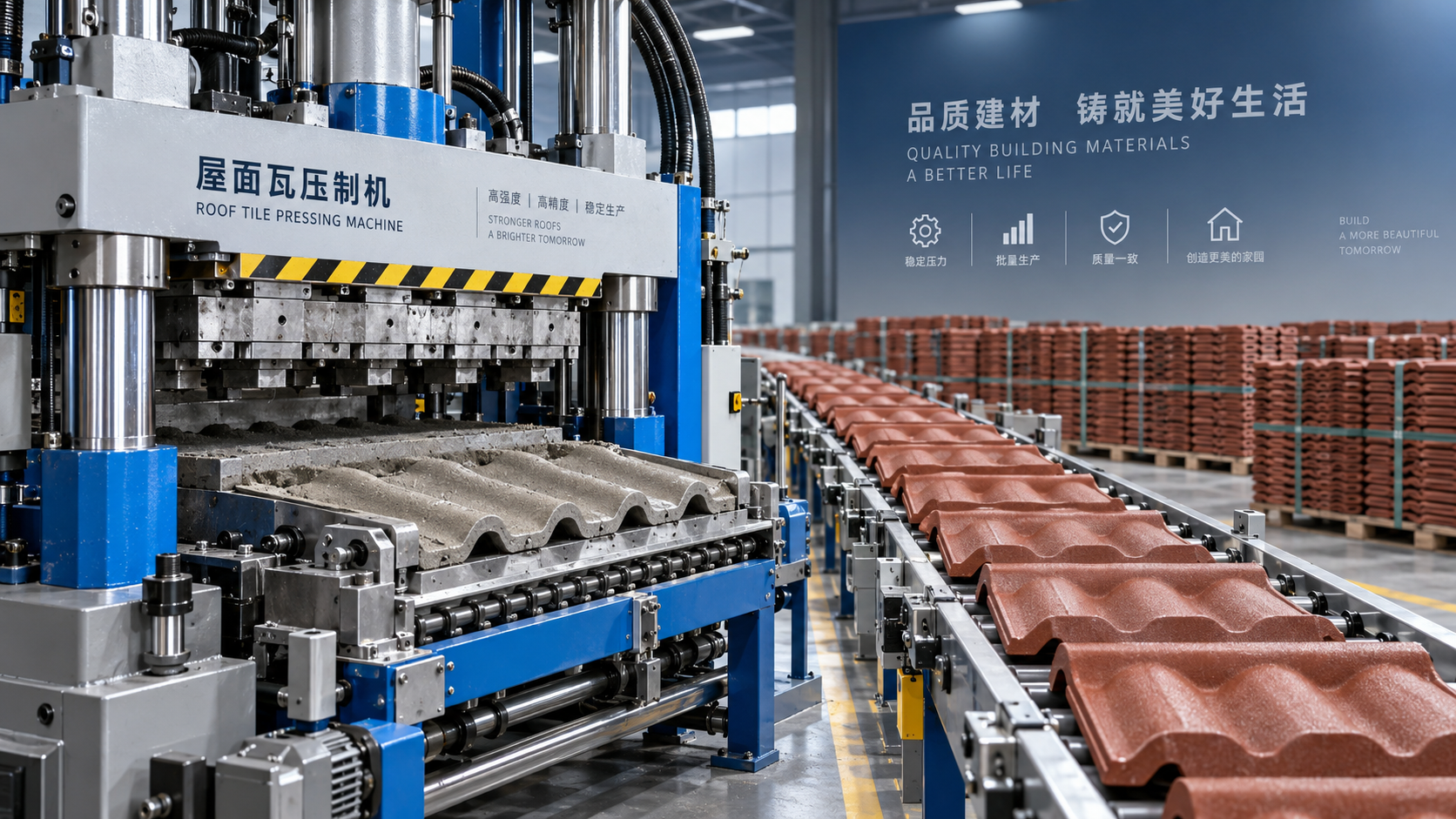
A hydraulic roof tile machine uses a hydraulic system to drive the press mechanism. The machine can be configured to follow a defined forming cycle: feed material, distribute it into the mold, apply pressure, hold or compact as required, release the mold, and transfer the green tile for subsequent handling. The exact arrangement differs by machine design and tile profile, but the central benefit is consistent application of force.
For the buyer, “hydraulic” should not be treated as a simple label meaning high quality. The useful question is whether the machine controls the parts of the forming cycle that affect the finished tile. Those normally include material feed consistency, mold alignment, pressing stability, release behavior, and the condition of the tile during transfer.
If pressure is stable but the mix is fed unevenly, thickness and edge quality may still vary. If the mold is worn, a powerful press will reproduce its wear across every tile. Hydraulic forming improves repeatability; it does not compensate for poor raw materials, unsuitable mix design, weak curing discipline, or neglected tooling.
Consistency is usually the first commercial reason to automate
Roof tiles are highly visible building products. Buyers notice differences in shape, color, edge definition, and surface texture quickly, particularly when tiles from more than one pallet are installed on the same roof. More importantly, variations that are not obvious at the factory can become installation problems later: tiles may not sit correctly, overlap may be inconsistent, or breakage rates may rise during handling.
Manual pressing tends to introduce variation in several ways:
- Material may not be spread evenly across the mold before pressing.
- Different operators may use different fill quantities or pressing habits.
- Pressing force may decline as an operator becomes fatigued.
- Release timing can vary, increasing the risk of corner damage or surface marking.
- Production speed may encourage shortcuts in mold cleaning and inspection.
A hydraulic machine reduces the operator-dependent parts of this work. It can deliver a repeatable press stroke and a controlled cycle, so process discipline is built more directly into the equipment. That is particularly valuable for tiles with interlocking features, pronounced profiles, thin edges, or textured surfaces, where small dimensional changes can affect fit or appearance.
However, consistency should be checked at the finished-tile level, not assumed from the machine type. A producer evaluating a hydraulic line should inspect representative tiles for thickness variation, profile definition, edge damage, surface defects, and stability after curing. It is also sensible to compare tiles made at the beginning and end of a production run. A machine that performs well only under ideal conditions may not solve the daily production problem.
Output is more than tiles per hour
Manual pressing may appear economical because the equipment investment is low and the work sequence is easy to understand. That comparison becomes incomplete when production volume increases. Output is affected by more than the pressing step: materials must be prepared, molds must be filled and cleaned, green tiles must be moved carefully, defective pieces must be separated, and finished stock must remain reasonably uniform.
A hydraulic roof tile machine can shorten the press cycle and make throughput more predictable. Its larger advantage is often that it creates a production rhythm that upstream and downstream tasks can follow. Mix preparation, color-layer application where used, green-tile transfer, curing space, and packing can be planned around a more stable rate of production.
Manual production often has a different bottleneck from the one expected. The press itself may be operated quickly, while tile removal, mold cleanup, rework, and careful stacking consume the available labor. When output rises, the number of people needed to keep the process moving can increase faster than the headline capacity of a hand press suggests.
That said, higher machine capacity only creates value when the rest of the operation can support it. A hydraulic machine is a poor fit if raw material preparation is inconsistent, curing capacity is limited, molds cannot be serviced promptly, or there is no reliable demand for the added output. Equipment selection should begin with the required saleable tile volume, then work backward through curing, storage, labor, and material supply.
Manual pressing still has a place
The choice is not simply “old method versus modern method.” Manual pressing can be appropriate where production is intermittent, product volumes are low, or the business is still testing a roof tile range. It can also suit work that requires frequent changes of profile, color, or small batch formulation, provided the operator has the discipline to control those changes.
Its main strengths are lower initial complexity and easier entry for a small operation. A manual process can allow a producer to learn how its aggregates, cementitious binder, pigments, additives, and curing conditions interact before committing to a more integrated line. It may also be a reasonable backup method for limited orders or temporary production needs.
The limitations become more serious when the business needs repeatability at scale. A contractor, distributor, or project buyer ordering roof tiles expects later deliveries to match the first delivery closely enough to complete the installation. Manual production makes that promise harder to manage because variation is tied to people as well as materials and molds.
For that reason, the transition to hydraulic pressing is often driven less by an ambition to maximize speed and more by the need to reduce uncertainty. Producers move toward controlled pressing when they need a more dependable basis for quality checks, labor planning, delivery schedules, and batch-to-batch matching.
Color finish does not remove the need for good compaction
The question “color tile or concrete roof tile?” can be misleading if it suggests that color tiles and concrete tiles are separate production concerns. Many colored roof tiles use a concrete-based body with pigment, a surface layer, coating, or other treatment that provides the desired appearance. The visible color can influence market positioning, but the pressing process still has to produce a sound structural tile.
Poor compaction can affect the way a surface layer appears and performs. An unevenly formed base may produce inconsistent texture, weak edges, irregular absorption behavior, or differences in how the surface looks after curing. A pressing method that gives stable density and shape makes it easier to maintain a uniform visual result, especially across larger orders.
Hydraulic pressing is therefore useful for color tile production when the color finish must be consistent with the tile profile and surface quality. It should not be presented as a substitute for controlling pigment dispersion, mix moisture, surface-layer feeding, or curing. Those stages remain separate sources of variation.
What should be checked before choosing a hydraulic machine?
Buyers often focus first on rated pressure or stated production capacity. Both are relevant, but neither tells the full story. The machine should be assessed against the intended tile design and the actual constraints of the plant.
- Tile profile and mold design: Confirm that the machine and mold system can form the intended dimensions, interlocking features, edge details, and surface pattern without difficult release or frequent damage.
- Material behavior: The press should be matched to the moisture condition, aggregate grading, binder system, pigment use, and degree of compaction required by the selected formulation.
- Feed and distribution: Ask how material is placed into the mold and how even fill is maintained. Stable press force has limited value if mold filling varies widely.
- Changeover requirements: A producer making several profiles or colors should understand the time, labor, cleaning work, and tooling adjustments required between runs.
- Green-tile handling: Formed tiles can be vulnerable before curing. Inspect the transfer arrangement and ensure it suits the tile's shape and early strength.
- Maintenance access: Hydraulic systems, molds, wear parts, and alignment points need practical access. A machine that is difficult to clean or adjust can lose its consistency advantage over time.
- Production balance: Check whether mixing, curing, storage, inspection, and packing can handle the planned press output without creating a bottleneck elsewhere.
It is also useful to ask for a trial using the intended material mix and tile profile where possible. The purpose is not merely to see a machine cycle. It is to examine whether the formed tiles can be handled, cured, and finished with acceptable consistency. That gives a more useful basis for selection than watching an empty press operate.
Where hydraulic equipment can create new operating risks
Hydraulic equipment introduces maintenance and operating requirements that a manual press may not have. Pressure stability depends on the condition of hydraulic components, fluid cleanliness, seals, connections, and controls. Leaks, unstable motion, overheating, or delayed response can affect both safety and tile quality. A planned maintenance routine is part of the production method, not an optional afterthought.
Operators also need to understand what should remain adjustable and what should be locked down. Frequently changing pressure, cycle timing, or feed settings in response to visual impressions can make production less stable. Process changes should be deliberate and linked to inspection results, material changes, or a defined product requirement.
Another risk is overinvesting in automation before the product specification is settled. If tile dimensions, profile requirements, color range, or demand pattern are still changing rapidly, a highly dedicated configuration can become restrictive. In that situation, flexibility in molds and changeover procedures may matter more than maximum output.
The decision usually comes down to repeatability and commitment
Manual pressing is viable when output is limited, variation can be closely supervised, and the business can tolerate more labor per tile. It is often a starting point or a niche production method. A hydraulic roof tile machine becomes more compelling when a producer must make the same tile repeatedly, control visible quality across larger batches, and organize production around dependable delivery.
The most useful comparison is not whether hydraulic pressing is “better” in the abstract. It is whether the business needs a process that relies less on individual handling and more on controlled, repeatable forming. For many concrete or colored roof tile operations, that is the difference between making tiles and running a production system capable of supplying consistent roofing products.
Recommend
 Oct 19, 2026
How Can Buyers Verify a Green Building Material Line Export Supplier?
Verify a green building material production line export supplier with factory checks, performance evidence, and contract safeguards. Explore this buyer’s guide to reduce risk and invest confidently.
- Oct 19, 2026
What Should an Automated AAC Block Line Cost Estimate Include?
An automated AAC block production line cost estimate should cover more than machinery. Explore equipment, utilities, installation, and startup costs to compare quotes and invest confidently.
- Oct 19, 2026
How Does a Hydraulic Roof Tile Machine Differ from Manual Pressing?
Color tile or concrete roof tile? Discover how hydraulic roof tile machines improve consistency, output, compaction, and quality over manual pressing.